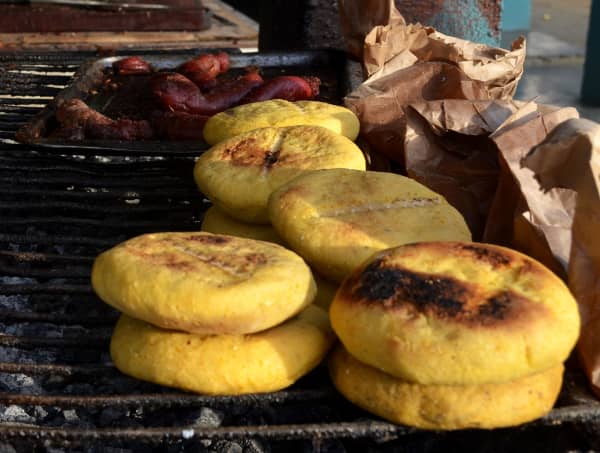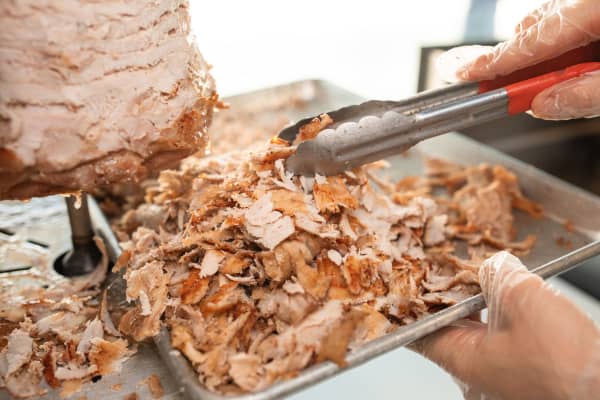

There is a particular kind of Utah Valley evening that ends at a Brazilian steakhouse. A birthday with too many people to order individually. A team dinner. A missionary home from Brazil who wants to show the family what they have been eating for two years. A group of students who have decided that one large bill is better arithmetic than eleven small ones. The Brazilian community's own festival in Orem is in our cultural associations guide.
The format works for all of those, and it works because rodizio is not really a menu. It is a system. Once you understand the system — what the card does, when the good cuts come out, where the money goes — a churrascaria stops being an eating contest and becomes one of the most efficient group meals available in the valley. This guide covers the three in Utah County and how to use them.
The Short Answer
Three churrascarias operate in Utah County. Tucanos Brazilian Grill sits on University Parkway in Orem, in the commercial cluster around University Mall. Rodizio Grill is at The Shops at Riverwoods in north Provo. Braza Grill is on Traverse Parkway in Lehi, at the north end of the county.
All three run the same basic format: a fixed price, a salad and hot bar, and servers circulating with skewers. The card on your table controls everything — green means come to us, red means skip us — and the single most useful habit is to flip it to red early and often rather than treating the meal as a thing that happens to you.
What Rodizio Actually Is
The vocabulary is worth getting straight, because the words are used loosely on this side of the equator.
Churrasco is the cooking: meat grilled over fire, salted heavily, traditionally on long skewers. It belongs to the gaucho culture of southern Brazil, Uruguay and Argentina, and it is a technique rather than a recipe.
Churrascaria is the restaurant — a place that serves churrasco.
Rodizio is the service format. The word carries the sense of rotation, and that is exactly what it describes: a continuous circuit of servers moving through the room with skewers, carving at the table. You are not ordering. You are opting in or out of a parade.
The people carrying the skewers are passadores, and at most restaurants they carry one cut each and work a fixed loop. That detail matters more than it sounds, because it explains the pacing. If the cut you want has just gone past, it will come around again. If you have not seen it at all, it may be on a slower rotation or may not have come out yet.
The Card, and How to Use It
Somewhere on the table there will be a small marker — a card, a disc, a little sign, a cylinder. One side is green. One side is red.
Green tells the passadores to stop at your place and offer what they are carrying. Red tells them to pass you by.
That is the whole mechanism, and it is practical rather than ceremonial. Three things about it are worth knowing.
First, it is per person, not per table. Your card is yours. One person can sit on red for twenty minutes while the rest of the table stays green, and nobody is offended.
Second, red is a pause, not a surrender. New diners often treat flipping to red as declaring themselves finished, then feel stuck. It is the opposite: red is how you get a conversation, a trip to the salad bar, or ten minutes to let a plate settle. Flip it back whenever you want.
Third, green is not a contract. When a passador stops, you can decline what they are carrying. You are not obliged to take a slice of everything simply because your card was green. "No thank you, but I would like the picanha when it comes" is an entirely normal sentence in these rooms and it usually gets results.
The implementation varies. Not every restaurant uses a literal card, and the object on your table may be a two-sided disc or a small standing sign. Look at what is in front of you when you sit down, and if it is not obvious, ask — the staff explain it constantly and expect the question.
The Strategy, Which Is Mostly About Restraint
The single most common way to have a mediocre time at a churrascaria is to eat in the wrong order.
The salad bar is the trap. It is good at all three of the valley's restaurants — produce, composed salads, rice and beans, hot sides, often grilled vegetables and cheeses. It is also where the house margin lives, and it is designed to be appealing at exactly the moment you are hungriest. Take a small plate. Take it as a sampler, not a course.
Flip to green early. The rotation is the thing you paid for. Getting into it within the first few minutes, while you are still hungry, is how the meal pays off.
Take small slices. Passadores will carve as much as you want, and taking a modest portion of many cuts beats a large portion of the first three. You can always ask for more of something.
Wait for the premium cuts. The signature cut is picanha — the top sirloin cap, cooked with the fat cap on, carved in curved slices. It is the reason the format exists and it is usually not the first thing out of the kitchen. Early rotations often skew toward the cheaper proteins: chicken, sausage, bacon-wrapped items. Those are good. They are also not what you came for.
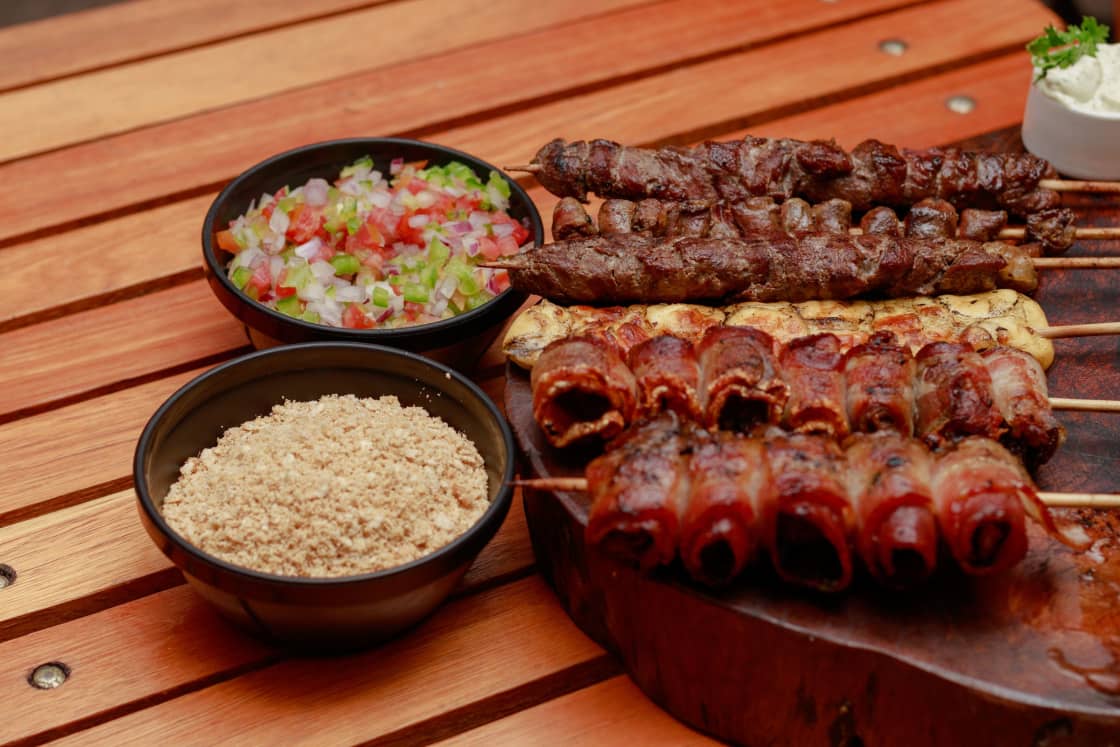
Use the accompaniments properly. Two things on the table are not garnish. Farofa, the sandy-looking toasted cassava flour, is meant to be sprinkled over meat, where it soaks up juice and adds texture. Vinaigrete, the chopped tomato-and-onion relish, cuts the richness. Grilled pineapple, when it appears, does the same job and is the traditional signal that you are near the end.
Pace for ninety minutes. A churrascaria meal is long by design. Trying to compress it into forty-five minutes produces the eating-contest version that gives the format its bad reputation.
The Three in Utah County
Tucanos — Orem
Tucanos Brazilian Grill is on University Parkway in Orem, in the commercial ring around University Mall, and for a great many valley residents it is simply the default. It is the one people mean when they say "let's do Brazilian."
The company grew out of the churrascaria wave that swept American dining around the turn of the century, and it has been a fixture in the valley long enough to be woven into local ritual — team dinners, graduation meals, the free-dinner coupon handed out at the end of a camp.
Practically, it is a large room that handles volume and groups well, with a substantial bar of salads, hot sides and fruit alongside the rotation. It is walking distance from a great deal of Orem retail, which makes it easy to build an evening around.
Rodizio Grill — Provo
Rodizio Grill sits at The Shops at Riverwoods in north Provo and opened there in the second half of the twenty-tens. It is the smaller and quieter of the two big valley rooms, and the Riverwoods setting — an outdoor retail village at the mouth of Provo Canyon — makes it the more atmospheric option on a summer evening.
The chain behind it has a genuine claim to significance: it bills itself as the first Brazilian steakhouse chain established in the United States, and its own site calls it America's first Brazilian steakhouse. Sources differ on exactly when the first location opened, but the broad story holds: this is the company that introduced a lot of America to rodizio.
Two practical notes. Its service windows have historically been narrower than Tucanos', with a dinner-only pattern through the early part of the week and fuller hours at the weekend, and it has historically closed on Sunday. Both are exactly the kind of thing that changes, so confirm before driving up.
Our guide to The Shops at Riverwoods covers what else is there if you want to make an evening of it.
Braza Grill — Lehi
Braza Grill on Traverse Parkway in Lehi is the independent of the three, family-founded by a Brazilian native who came to Utah and initially ran a Brazilian import store before moving into restaurants. There is a second location up in Salt Lake County.
It is the smallest room and the most casual of the three, and it draws heavily on the north-county tech corridor for weekday lunch business — it has historically run a lunch service as well as dinner, which the Provo room has not always done.
For anyone in Lehi, Saratoga Springs, Eagle Mountain or American Fork, it is by some distance the closest option, and worth knowing about precisely because search results tend to push valley residents toward the Orem and Provo rooms by default.
Why the Valley Has Three
A county this size supporting three churrascarias is not obvious, and the explanation is specific to Utah Valley.
Brazil is unusually present here. A large share of the valley's population has spent two years abroad, and Brazil is one of the most common destinations. That produces a steady population of people who speak Portuguese, miss the food, and specifically know what picanha and farofa and pão de queijo are supposed to taste like. It also produces a much larger population who tried churrasco once at twenty-one and want to show it to somebody.
The format fits how the valley eats. Very large families, a strong culture of group celebration, and a dining scene where alcohol is not the center of the evening all favor a restaurant built around one price, a long table and a lot of food. A churrascaria is a good Tuesday-night-with-fourteen-people restaurant in a way that very few formats are.
And the valley has the demographics for the bar. A cheaper salad-bar-only ticket means a table can include a teenager who will eat his weight in picanha and a grandmother who wants soup and salad, at two different prices, without anyone feeling awkward.
A Short Glossary of the Skewers
Passadores announce cuts as they arrive, often in Portuguese, often over a loud room. Knowing roughly eight words turns the rotation from a lottery into a choice.
Picanha — the top sirloin cap, grilled with the fat cap intact and carved in curved slices. The signature cut and the one to hold out for. The outer slices are more done, the inner ones rarer; if you have a preference, say so and they will carve to it.
Alcatra — top sirloin, leaner than picanha and a common early-rotation cut. Good, unremarkable, not worth filling up on.
Fraldinha — bottom sirloin or flank, looser-grained, beefier, and a favorite of people who find picanha too rich. Underrated.
Costela — beef ribs, slow-cooked. When they are good they are the best thing in the room, and they come out less often than the quicker cuts.
Linguiça — Brazilian pork sausage, garlicky and slightly coarse. Reliable, appears constantly, easy to overeat early.
Frango — chicken, usually as thighs or as bacon-wrapped pieces. The bacon-wrapped chicken is the most seductive of the cheap cuts and the most common way a table fills up before the beef arrives.
Coração — chicken hearts, small, firm and heavily salted. A genuine delicacy in Brazil and a reliable dare at an American table. Try one.
Abacaxi — grilled pineapple, rolled in cinnamon and caramelized on the skewer. Traditionally a palate cleanser as much as a dessert, and its appearance is usually a sign the meal is winding toward its end.
Two words worth having for the table rather than the skewer: mal passado for rare, bem passado for well done. Saying either to a passador mid-carve will get you the slice you want rather than the slice on top.
The Rest of Brazilian Food Here
Rodizio is the visible part of a larger presence, and a few things are worth knowing if the churrascaria leaves you curious.
Pão de queijo — small, chewy, hollow cheese breads made with tapioca flour, naturally gluten-free, and the single most beloved Brazilian food among valley residents who spent time there. They turn up on churrascaria bars and occasionally in valley bakeries and freezer cases.
Brigadeiro — dense chocolate-and-condensed-milk truffles rolled in sprinkles, the default Brazilian birthday sweet. They appear at valley parties far more often than any restaurant menu would suggest, because a lot of people here learned to make them abroad.
Açaí bowls have been thoroughly absorbed into American cafe culture and are widely available in the valley, though the version served here bears only a family resemblance to what is eaten in northern Brazil.
Coxinha, pastel and salgados — the savory snack category — are harder to find commercially in the county and tend to circulate through home kitchens, church functions and the occasional pop-up rather than storefronts. If you want them, the community is the supply chain, not a restaurant.
There have been Brazilian import and grocery operations in the county over the years, including the store that preceded one of the restaurants above, and small importers come and go. Because that category turns over, it is worth asking at the restaurants themselves, where the staff generally know what is currently available locally and what has to be ordered in.
Taking Children
Churrascarias are good with children and the reasons are structural rather than about a kids' menu.
Food arrives continuously, which suits a child who will not wait. The salad bar gives an immediate plate before anything else happens. There is no ordering, so there is no negotiation. And the rooms are loud enough that a restless four-year-old is not the loudest thing in them.
The pricing helps too. Children are generally priced by age band with the youngest eating free, which makes a large family meal far less punishing than the headline price implies. Ask at the door rather than assuming.
Two cautions. The skewers are long, sharp and carried at adult-shoulder height through a busy room, so this is not a place to let a small child wander. And the meat arrives salted and rich, which is a lot for young palates — the rice, beans and fruit on the bar usually do more work than the rotation does for anyone under about eight.
Money, Honestly
Prices move and publishing a number would be worse than useless, but the structure is stable and worth planning against.
There are usually tiers. The full rodizio price is the headline. Below it there is generally a salad-bar-only price, often a good deal less, and children are usually priced by age with the youngest free. Asking about the tiers at the door is normal and can change a group's bill substantially.
Lunch is cheaper than dinner where lunch is served, sometimes markedly, with a shorter list of cuts. For anyone who wants the experience without the full outlay, a weekday lunch is the value play.
Drinks are separate and add up fast, as does dessert. The rodizio price covers the rotation and the bar, not the rest of the check.
Tip on the full bill. Rodizio service is labor-heavy — the passadores are working a continuous circuit for your table — and it is easy to under-tip against a format where nobody took a written order.
Practical Notes
Call ahead for a group. Anything over roughly eight benefits from notice, and the restaurants would much rather know.
Verify hours, especially Sunday. Service patterns at all three have shifted, at least one has closed Sundays, and split lunch-and-dinner service means a mid-afternoon arrival can find a closed room.
Ignore aggregator metadata. Listings for these restaurants are unusually bad — we found one national booking site listing a Brazilian steakhouse under Italian cuisine, with a formal dress code, at another restaurant's address. The two big valley rooms sit on University Parkway in Orem and University Avenue in Provo respectively, which is a confusable pair, and the listing sites confuse them. Go to the restaurant's own site or phone.
Tell them about dietary needs at the door. The kitchens are used to it, and the salad bar plus grilled vegetables covers a lot of ground, but the rotation itself is not flexible mid-service.
Do not go starving. Counterintuitive and true. Arriving famished is how people wreck themselves on the salad bar in the first ten minutes.
The Short Version
Utah Valley has three Brazilian steakhouses: Tucanos on University Parkway in Orem, Rodizio Grill at the Riverwoods in north Provo, and Braza Grill on Traverse Parkway in Lehi. They run the same format at different scales, and the valley supports all three because a large share of the population has lived in Brazil, because families here are big, and because a fixed-price format suits a dining culture built around groups rather than drinks.
Use the card. Green brings the skewers, red pauses them, it is yours alone, and red is never a decision you cannot reverse. Go light at the salad bar, get into the rotation early, take small slices of many cuts, and hold out for the picanha. Ask about the tiers, because the salad-bar-only price and the children's pricing can reshape a large bill. And check the hours before you drive, because Sunday is not a given.
Related Guides
- The Best Restaurants in Orem
- The Best Restaurants in Provo
- Date-Night Restaurants in Utah Valley
- Activities for Large Groups in Utah Valley
- The Shops at Riverwoods
Frequently Asked Questions
What is rodizio?
How does the red and green card work?
Where can I get Brazilian rodizio in Utah County?
Do I have to eat meat to go to a Brazilian steakhouse?
What should I eat first at a churrascaria?
Is there a dress code?
Is rodizio good for large groups?
Are the Utah Valley churrascarias open on Sunday?
Sources
The facts in this guide were checked against these sources. Hours, fees and rules change, so confirm anything time-sensitive with the source before you go. How we make Provo.com.
- Rodizio Grill Provo Riverwoods, Rodizio Grill. Checked October 12, 2026.