
Ask for the best Mediterranean restaurant in Utah Valley and you will get four different recommendations from four people who all think they answered the same question.
They did not. Mediterranean is a geography, not a cuisine, and in this valley the word is doing at least four jobs at once. It is on the sign at a Greek gyro counter, at a Levantine kebab house, at a fast-casual bowl concept, and at a full-service restaurant with souvlaki and a wine list it cannot serve wine from. Those are different meals. Some of them are barely related.
This guide sorts them. What the categories are, which restaurants sit in which, and how to order so you get the meal you were picturing.
The four things "Mediterranean" means here
Greek. Gyro meat on a vertical spit, souvlaki on skewers, tzatziki, feta, Greek salad, lemon soup, baklava. Yogurt-based sauces, oregano and lemon dominant. This is the largest category in Utah Valley by a distance.
Levantine. Shawarma, hummus, falafel, tabbouleh, baba ghanoush, garlic sauce and tahini rather than tzatziki. Overlaps with Greek on the vertical spit and on the chickpea, diverges completely on seasoning.
Kebab and grill. Meat on skewers over fire, usually with rice — kofta, koobideh, shish. This is a Turkish, Persian and broadly Middle Eastern tradition and it is a different cooking method from either of the above. Spit meat is shaved; kebab is grilled.
The bowl. A more recent American format that borrows Mediterranean ingredients into a build-your-own protein-grain-vegetable-sauce structure. Fresh, fast, healthy-coded, and good, but a different eating experience from any of the three traditions it draws on.
Almost every complaint you will hear about a Mediterranean restaurant in Utah Valley is really a category error. Someone wanted a Greek gyro and got a Levantine shawarma, or wanted a plate of grilled kebab and got a bowl.
The Greek shortlist
Meráki Greek Grill, at University Place on University Parkway in Orem, is the one with the strongest local following. It is fast-casual but built like something more considered — order at the counter, sit in a real dining room. The reference orders locals cite are the lemon soup, the gyro platter with the seasoned rice, the feta fries and the baklava. Check its current hours, including Sunday.
Worth knowing: there is also a Meráki in St. George, four hours south. If you are searching by name, make sure you are looking at the Orem location.
Greek-n-Go 2.0, on State Street in Orem, is the counter operation, and it is the one people describe with the most affection. The original gyro is a lamb and beef blend; the falafel and pita strips come up constantly in local commentary. Open daily, with reduced Sunday hours.
The Great Greek Mediterranean Grill, in Pleasant Grove, is the north-county full-service option. Souvlaki, rice bowls, gyros, hummus with warm pita, and a substantial baklava program. Open daily. It is a franchise rather than an independent, which some people care about and some do not; it is also consistently well reviewed locally, which is the more useful fact.
The kebab and Levantine side
King Kebab, 1200 Towne Centre Boulevard, Provo, is the most interesting entry on this list because of where it is. It operates in the food court at Provo Towne Centre, and the recurring local verdict is that it is by a distance the best thing in that building — food built to order in front of you rather than held in a bin. Beef and lamb shawarma, gyro, falafel. Closed Sundays.
It also crosses categories deliberately: it is filed as Greek, Mediterranean, Middle Eastern, shawarma and kebab all at once, which is a reasonable description of what it does rather than an identity crisis.
Spitz Mediterranean Street Food, in Spanish Fork, is the south-county option and the one most likely to surprise people who assume the valley's food ends at Springville. Döner-style street food, chicken and lamb, sweet potato fries, outdoor seating. Open daily with later Thursday through Saturday hours.
The bowl category, named honestly
Two Orem restaurants get recommended constantly in Mediterranean conversations and belong in this guide with a clear label, because recommending them to someone who wants a gyro is how you produce a disappointed diner.
Aubergine Kitchen, 530 E University Parkway, Orem, is a health-forward bowl and salad restaurant with strong Mediterranean influence, a large following and a wide range of gluten-free, vegetarian and vegan options. It is not a Greek restaurant. It is very good at what it is. The Orem store opens early, at 7:30 a.m., and its listed hours run to 9 p.m.; the American Fork store is the one that closes on Sunday. The early open makes it one of the more useful breakfast-adjacent options in that corridor.
Konala, 210 West Cougar Boulevard, Provo, is the closest thing to this format inside Provo and sits near BYU campus. Its menu spans Mediterranean and Asian bowl formats rather than committing to one, which is worth knowing before you go expecting souvlaki. Open daily.
If a fresh, fast, vegetable-heavy bowl is what you want, these are better answers than a gyro counter. If you want spit meat and tzatziki, they are not.
Where the density is
An honest map of this cuisine in Utah Valley looks like this: Orem has it, Provo mostly does not, and the south and north ends each have one strong option.
The Orem concentration follows the two commercial spines — State Street and University Parkway — which is the same pattern as most of the valley's restaurant clustering. Our best restaurants in Orem guide covers that corridor generally.
Provo's situation is thinner than its population would suggest. King Kebab in the mall food court is the meaningful in-city option, with Konala serving a different need near campus. That is a real gap rather than an oversight in this guide, and it is worth stating plainly: if you live in Provo and want Greek food, you are probably driving to Orem. The best restaurants in Provo guide covers what the city does have in depth.
North county gets The Great Greek in Pleasant Grove; south county gets Spitz in Spanish Fork. Our city guides for Pleasant Grove and Lindon and Spanish Fork cover the surrounding options.
How to order well
Order the gyro first at a Greek place. It is the benchmark. Meat quality, whether the pita is warmed, whether the tzatziki tastes made rather than bought — one sandwich tells you nearly everything.
Order the plate, not the wrap, at a kebab or shawarma restaurant. A wrap hides the sides. A plate shows you the rice, the salad, the pickles and the sauces, which is where these kitchens do their real work.
Get hummus either way. It is the cheapest possible read on a kitchen's standards and it travels across all four categories.
Ask about the meat. Gyro meat in the United States is usually a beef and lamb blend on a cone; some places do chicken separately; a few grill rather than shave. It changes the dish considerably.
Say something about the sauce. Tzatziki, garlic sauce, tahini and a house spicy sauce are four different things and most counters will give you two if you ask.
Save room for baklava. It is the one dessert almost every restaurant in this category makes or sources well, and several local kitchens treat it as a signature rather than an afterthought.
The menu, decoded
Mediterranean menus assume you already know the vocabulary. Most people order two or three familiar things forever because nobody ever explained the rest. Here is the rest.
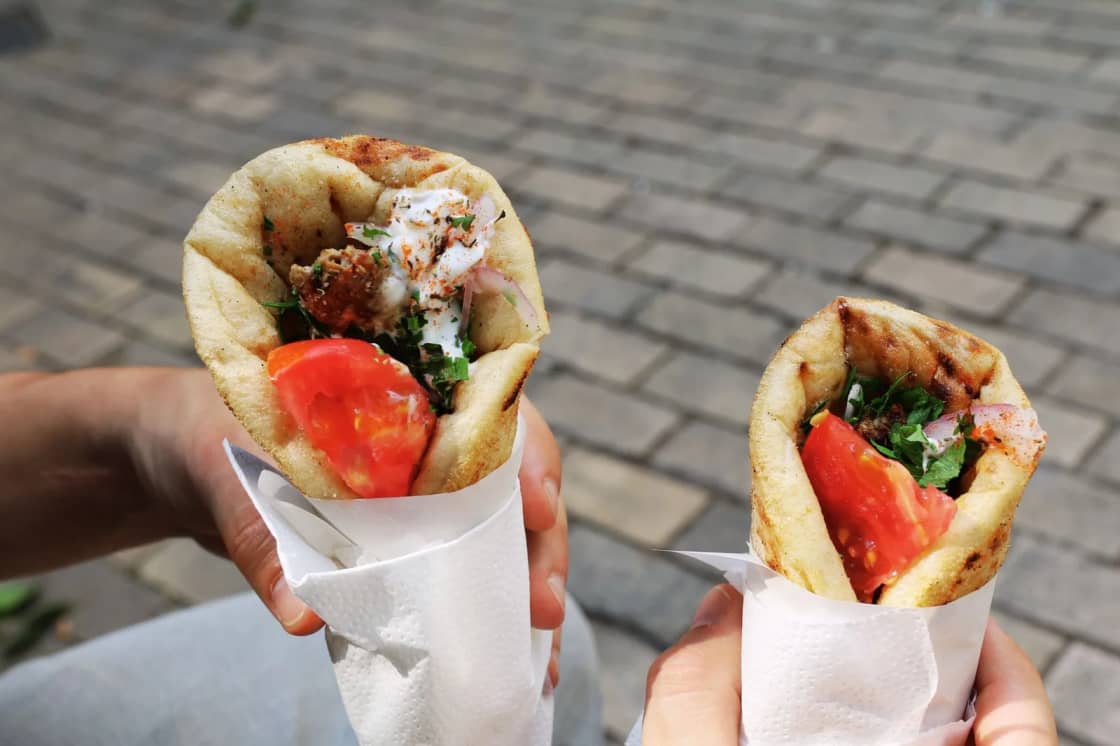
Gyro. Greek. Seasoned meat — in the American version almost always a beef and lamb blend — packed onto a vertical spit, roasted, and shaved off in strips as it cooks. Served in warm pita with tomato, onion and tzatziki. The name refers to the turning.
Souvlaki. Greek. Chunks of meat on a small skewer, grilled. Not shaved, not a blend. Chicken and pork are the common versions. If a menu has both gyro and souvlaki, they are not variations on the same thing.
Shawarma. Levantine. Same vertical-spit method as the gyro, different seasoning — warmer spices, less oregano — and usually served with garlic sauce or tahini rather than yogurt.
Kofta and koobideh. Ground, seasoned meat pressed onto a flat skewer and grilled. Kofta is the broader Middle Eastern term; koobideh is the Persian version. Both are kebabs, both are grilled, neither is spit meat.
Falafel. Fried chickpea or fava croquettes. Should be crisp outside and soft, herby and green inside. A dense gray falafel means the fryer or the mix is tired.
Tzatziki. Strained yogurt, cucumber, garlic, sometimes dill or mint. Greek.
Tahini. Sesame paste, thinned with lemon and water into a sauce. Levantine. Also the backbone of hummus.
Hummus. Chickpeas, tahini, lemon, garlic. Order it warm with pita if the option exists.
Baba ghanoush. The same idea with roasted eggplant instead of chickpeas, and the good version tastes distinctly of smoke.
Dolmas. Grape leaves stuffed with rice and herbs, served cold. Almost always vegetarian.
Tabbouleh. A parsley salad with bulgur, tomato, lemon and mint. It is mostly herb, not mostly grain — if it arrives looking like a grain salad, the kitchen has the ratio backwards.
Spanakopita. Spinach and feta in phyllo. Greek, and a good gauge of whether a kitchen makes its own pastry.
Avgolemono. Greek egg-lemon soup, usually with rice and chicken. Rich and sharp at the same time, and a signature at several valley restaurants.
Baklava. Layered phyllo, nuts, honey or syrup. Ubiquitous and variable in quality, which makes it a good tiebreaker between two places you otherwise like equally.
For groups, and for feeding a lot of people
This is a practical point that matters more in Utah Valley than it would elsewhere, because households here are large and gatherings here are frequent.
Mediterranean food is unusually well suited to feeding a crowd, and the reason is structural. The cuisine is built on platters, dips and shared sides rather than on individually plated entrées. A tray of gyro meat, a bowl of rice, hummus, pita, salad and a few sauces scales cleanly from six people to thirty in a way that, say, a plated steak does not.
It also solves the dietary-spread problem that ruins group catering. In one order you can cover meat eaters, vegetarians, people avoiding gluten and people avoiding dairy, without anyone being handed a sad substitute plate. That is a rarer property than it sounds.
Most of the counters and fast-casual restaurants in this guide handle catering trays, and several list it explicitly. Because packages, minimums and lead times change constantly, get a current quote rather than trusting a published figure — our catering guide covers the valley's options generally and our group restaurants guide covers eating in rather than taking out.
One warning specific to this category: gyro and shawarma meat is at its best straight off the spit and degrades faster than most catered food. If you are ordering for a party, plan to serve within a fairly short window of pickup, or order the kebab and grill items instead, which hold up considerably better.
Vegetarian, vegan and gluten-free, realistically
This is one of the strongest cuisines in the valley for vegetarians, and it happens by accident rather than by accommodation.
Falafel, hummus, baba ghanoush, tabbouleh, dolmas, Greek salad, grilled vegetables, rice and pita constitute a complete and good meal, and none of it is a substitution. A vegetarian ordering a falafel plate is ordering a dish the kitchen makes on purpose, not a modified version of something else.
Vegan is harder because feta and tzatziki are so pervasive. Falafel plus hummus plus a salad without feta is the reliable construction. Ask whether the rice is cooked in stock.
Gluten-free works if you drop the pita and order a plate or bowl over rice. Falafel is frequently but not always gluten-free depending on the fryer and the binder — this is a shared-fryer question rather than a recipe question, and worth asking if you are celiac rather than avoiding gluten by preference. Our gluten-free guide covers which valley kitchens are dedicated and which are shared, and the vegetarian and vegan guide covers the wider picture.
A note on halal, and on what this guide will not claim
Kebab and shawarma restaurants are the most likely category in Utah Valley to serve halal meat, and some do.
This guide does not label any specific restaurant halal, and you should be cautious of any that does. Halal status is a claim about the entire supply chain, it changes when a supplier changes, and it is not something a third party can verify on a restaurant's behalf and then leave in print for two years. Ask the restaurant directly, each time.
For reliable halal grocery and a much wider range of halal restaurants, Salt Lake County has substantially more than Utah County does. Our grocery store guide covers what the valley's international markets stock locally.
The valley context
It is worth saying why this category is thinner here than in a comparable metro. Utah Valley's restaurant scene is shaped by a very large student population, a family-heavy demographic, and a market where the alcohol-driven margins that support full-service ethnic restaurants elsewhere are largely absent — our drinking in Provo guide explains the licensing structure behind that.
The result is a valley that supports counters and fast-casual concepts far better than it supports full-service ones. That is exactly what you see in this category: gyro counters and bowl restaurants thriving, sit-down Greek dining rooms thin on the ground. Our history of how Provo became a food city traces the wider version of that pattern.
It is also a category that has grown recently rather than one with deep local roots, which is why several of the names above are newer arrivals. That growth direction is real and it is worth revisiting this page as it continues.
The short version
Mediterranean in Utah Valley means four different meals: Greek spit meat and tzatziki, Levantine shawarma and tahini, skewered kebab over rice, and the modern Mediterranean bowl. Orem holds most of the density along State Street and University Parkway, with Meráki Greek Grill and Greek-n-Go leading the Greek side; Provo's meaningful option is King Kebab in the Towne Centre food court, which is closed Sundays; Pleasant Grove has The Great Greek and Spanish Fork has Spitz. Aubergine Kitchen and Konala are excellent bowl restaurants and are not gyro restaurants. Order the gyro to judge a Greek kitchen, the plate rather than the wrap to judge a kebab kitchen, and hummus at both. Hours change, several of these close Sundays, and it is always worth a call before driving across the valley.
Mediterranean Food and Delivery: A Natural Fit
This is the cuisine on the site that delivers best, and it is not an accident. A great deal of Mediterranean and Greek cooking was developed around food that is served warm rather than hot, eaten with the hands, wrapped, or perfectly good at room temperature. Those are the same properties that make food survive a drive.
Gyros and shawarma wraps travel excellently — wrapped in paper or foil, dense, structurally sound. Grilled meats over rice hold their heat. Dips and spreads, hummus, baba ganoush, tzatziki and taramasalata, are unaffected by transport because they were never hot. Salads built on cucumber, tomato and herbs survive far better than lettuce-based ones, provided the dressing is separate. Rice, lentils, stuffed grape leaves, roasted vegetables and braised dishes are all fine.
The weak point is bread. Warm pita is one of the pleasures of eating this food in a restaurant, and it is the one element that will not survive twenty minutes in a bag. It goes soft and then leathery. Ask for pita packed separately from anything hot and warm it yourself for a minute at home, and you get most of it back.
The other thing to avoid is anything fried — falafel is the obvious case. It is excellent for about ten minutes and ordinary after that. If falafel is what you want, pick it up.
Our food delivery guide covers the local platforms and how their fees and markup work.
Related Guides
Frequently Asked Questions
Where is the best Greek food in Utah Valley?
Is Mediterranean food the same as Greek food?
What is the difference between a gyro, a shawarma and a kebab?
Is there halal food in Utah County?
Is Greek food a good vegetarian option in Utah Valley?
Where can I get Mediterranean food in Provo itself rather than Orem?
What should I order the first time?
Are these restaurants open on Sunday?
Sources
The facts in this guide were checked against these sources. Hours, fees and rules change, so confirm anything time-sensitive with the source before you go. How we make Provo.com.
- Locations | Aubergine Kitchen, Aubergine Kitchen. Checked October 12, 2026.
- Meráki Greek Grill (home page, locations), Meráki Greek Grill. Checked October 12, 2026.