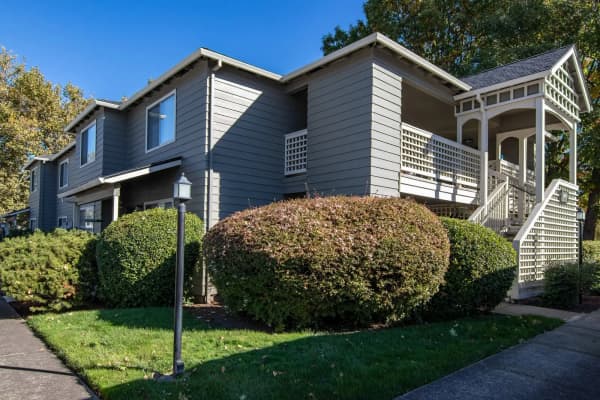
Utah County builds outward. Its housing stock is overwhelmingly low-rise — single-family homes, townhouse rows, three-story garden apartments — spread across a valley floor that has had room to keep spreading.
Midtown 360 is the conspicuous exception. Two eight-story towers on State Street in Orem, roughly 494 units, built around 2016, with a rooftop lounge and a view that most of the county's residents do not have from anywhere they live.
Whether that is appealing depends almost entirely on what you want from an apartment, and the answer splits people more sharply than most properties do.
This page is a profile, not a ranking. We do not rank apartment complexes.
What is unusual about it
The height is the obvious thing, but the more interesting departure is the unit mix.
Most large apartment complexes are built around a narrow band of floor plans — one and two bedrooms, occasionally a studio, because that is what the financing models favor and what the market absorbs predictably. Midtown 360's listings describe a spread running from studios to five-bedroom units, with sizes from roughly 546 square feet to somewhere in the 1,700 to 1,900 square foot range depending on which source you consult.
A five-bedroom apartment is an unusual product. It exists here because the location between two universities creates demand for group housing that a conventional two-bedroom market does not serve, and because a building this size can afford to carry unit types that a smaller property could not.
The practical consequence: this is one of the few buildings in the county where a group of five friends, a family that needs real space, and a single person who wants a studio can all live in the same complex on the same terms.
The location, and what it gets you
State Street through Orem is the county's original commercial spine — the corridor that existed before the freeway and still carries most of the city's retail.
Living on it means walking distance to a great deal of ordinary commerce, proximity to University Place and its surrounding retail, and a position roughly equidistant from both campuses. Freeway access is a few minutes away. The transit connection at the Mt Timpanogos Transit Center is roughly a mile off.
It also means living on a busy arterial road. State Street is not quiet, the building fronts directly onto it, and unit selection within the building matters more than it would on a residential street. A unit facing the corridor is a different experience from one facing away, and this is worth raising specifically when you tour.
For a sense of how this fits the wider city, our guides to living in Orem and Orem neighborhoods cover the corridor's character in more depth.
The ground floor
The building includes commercial space at street level, which the property describes as including restaurants and personal services.
Mixed-use is rare in Utah County and it changes the experience of living somewhere. The upside is obvious — food and errands below your own building, which in a car-dependent county is a genuine amenity rather than a marketing line.
The less obvious consequence is that ground-floor commercial brings its own traffic, its own parking demand and its own hours. A restaurant below your building is convenient at seven in the evening and less so when deliveries arrive at six in the morning. Residents on lower floors experience this differently from residents on the eighth.
Commercial tenancy also turns over. The specific businesses in the building when you tour may not be the businesses there when your lease renews, which is worth remembering if a particular one is part of why you are signing.
The rooftop and the view
This is what the building is selling, and it is not an empty claim.
Eight stories in a low-rise valley produces sightlines that ground-level housing does not have — east to the Wasatch and the Timpanogos massif, west across the valley floor toward Utah Lake. On a clear evening it is the best view available from any residential building in the county, largely because there is so little competition for the title.
The rooftop lounge is the shared version of that. Whether it justifies a premium is personal. Shared amenity spaces at large complexes follow a reliable pattern: heavy use in the first year, declining use as novelty fades, and a small number of residents who use them constantly. If you are the kind of person who will go up there, it is worth real money. If you are not, you are paying for someone else's Saturday.
Unit-level views vary enormously by floor and orientation, and the difference between a high floor facing east and a low floor facing the parking structure is the difference between two entirely different apartments at the same address.
Parking, and the thing you should nail down in writing
Parking is the recurring theme in resident discussion of this property, and it deserves direct treatment rather than a euphemism.
The building has underground parking. What is not uniform is how it is allocated — whether a stall comes with your unit, whether it is assigned or first-come, what a second vehicle costs, and where guests are supposed to go. Reviews of the property include accounts of vehicles being towed, and complaints about signage clarity appear more than once.
We are not in a position to adjudicate individual towing incidents and will not try. What we can say is the actionable version: get the parking arrangement in writing before you sign. Specifically ask which stall or stalls your lease entitles you to, whether it is numbered, who enforces the lot, what the towing policy is, and where a visitor parks at eight on a Friday evening.
This is good advice at any large complex with structured parking and shared commercial tenancy. It is particularly good advice at one where the question comes up as often as it does here. A tow at your own building is expensive and infuriating in roughly equal measure, and the way to avoid it is a specific written answer rather than a reassuring verbal one.
The rest of what to ask
What is the all-in monthly cost? Large complexes commonly quote a base rent and then add mandatory monthly fees for amenities, technology, trash or valet services. Listing sites sometimes disclose these and sometimes fold them in. Ask for the total.
What are the current specials, and what happens after? Move-in concessions — free weeks, a discounted month — reduce first-year cost and do not carry into renewal. The renewal rate is the number that matters if you plan to stay.
Which floor and which orientation? More consequential here than at a three-story property. Ask about noise from State Street, from the ground-floor commercial, and from elevator and mechanical cores.
How is maintenance handled? In an eight-story building, elevators and centralized systems are single points of failure in a way they are not in garden apartments. Ask about response times and about what happens when an elevator is out.
What are the pet terms? Breed and weight restrictions, deposits, and monthly pet rent all vary and none appear in a listing summary.
What does the lease say about deposits? Utah has specific requirements about deposit handling and notice. Our guide to Utah renters' rights covers what the law requires, which is not always what a lease implies.
What living in a tower is like
Utah County residents mostly have no reference point for this, so it is worth describing plainly.
Elevators become part of your day. In a garden apartment you walk to your door. In an eight-story building with 494 units you wait, and the wait is longest at the times everyone else also wants to leave. Residents on the second and third floors often end up taking stairs by choice. Residents on the eighth do not have that option, which is one of the trade-offs against the view.
Moving in and out is a scheduled event. Large buildings typically require reserving a service elevator and a loading window. This is normal and it is also the thing people forget until the truck is downstairs on a Saturday with no reservation.
Sound travels differently. Concrete-and-steel construction usually handles floor-to-floor noise better than wood-frame garden apartments, but shared walls, corridors and mechanical systems produce their own signature. The elevator core and the trash chute are the two locations worth asking about, because units adjacent to either have a distinctly different acoustic experience.
Deliveries and packages are a system rather than a doorstep. Ask how the building handles them. Package theft and package chaos are both common failure modes at this scale, and the buildings that solve it well have deliberately solved it.
The Utah County context
It is worth understanding why there is so little of this housing here, because it explains both the property's appeal and its risks.
Utah County's growth has historically been horizontal, enabled by available land and a planning tradition oriented toward single-family development. Mid-rise and high-rise residential construction arrived late, is concentrated in a handful of corridors, and remains politically contested in several cities.
That has two consequences for a resident. The first is scarcity value: if you want density, your options are few, and they are unlikely to multiply quickly. The second is that the surrounding built environment was not designed around it. Sidewalk networks, transit frequency and neighborhood retail in most of the county assume a car, and a tower dropped into that pattern only partly escapes it.
Midtown 360 mitigates this better than most by sitting on State Street, where the commercial density already existed. A comparable building on a residential arterial would offer the height without the walkability.
Comparing it against the alternatives
The honest comparison set is small.
Against garden apartments elsewhere in Orem: you trade quiet and easy access for height, view and walkable commerce. Rent comparisons between the two are not like-for-like, because the amenity and fee structures differ.
Against a rented house in Orem or Provo: a house generally wins on space, quiet and yard, and loses on maintenance, location and the ability to leave for a semester. Groups considering a five-bedroom unit here are usually also considering a house, and the deciding factor is typically whether they want to handle a lawn and a furnace.
Against student housing: entirely different products. Per-unit leasing here means joint liability among whoever signs, and no furniture. Our guide to finding student housing in Provo explains why the two markets should not be compared on price alone.
Against buying: a separate calculation, covered in rent versus buy in Provo.
Seasonal and weather considerations
Height changes the weather, which sounds like an exaggeration until you have lived it.
Wind. Eight stories in a valley that channels canyon winds means balconies and upper-floor units experience conditions that ground level does not. Patio furniture on a high floor needs to be the kind that stays put.
Inversion. Utah Valley's winter inversions trap cold, polluted air on the valley floor. A high floor is not above the inversion layer — that sits well higher — but the visual experience of looking out across it is a particular feature of winter here, and air quality is a genuine consideration for anyone with respiratory sensitivity regardless of floor. Our Provo weather guide covers the seasonal pattern.
Summer heat and sun exposure. A west-facing upper unit takes direct afternoon sun with no tree cover, which affects both comfort and cooling costs. East-facing units get morning light and the mountain view. This is another reason orientation matters more here than at a shaded three-story property.
Snow and the parking structure. Underground parking is a real winter advantage — no scraping, no shoveling out. It is one of the more valuable amenities the building offers and it goes underappreciated in July.
Who it suits
People who want density in a county that has very little of it. If the appeal of an apartment is being above things and near things rather than in a quiet cul-de-sac, there are few alternatives here.
Groups needing large units. The four and five-bedroom plans serve a real need that most of the market ignores.
Commuters split between Provo and Orem. The mid-corridor location is central in a way that housing at either campus is not.
Anyone who values the view enough to pay for a higher floor. This is the property's actual differentiator.
Who it does not
Anyone sensitive to arterial road noise, unless they secure a unit facing away and verify it on a tour at a realistic hour.
People who want a small, quiet, low-maintenance building. A 494-unit tower is a small neighborhood with the corresponding volume of turnover, shared systems and shared-space friction.
Students looking for by-the-bed leasing. This is a conventional per-unit lease. If you want individual liability, UVU student housing and the BYU-area complexes are the right market.
Touring it properly
Two things make a tour here more informative than at a smaller property, and both require asking.
See a unit on your actual floor and orientation. A model unit on the third floor facing away from State Street tells you almost nothing about the eighth floor facing it, or the reverse. The variation within this building is wider than the variation between many separate properties.
Go when the building is being used. Weekday evening is the honest hour. You learn what the parking structure looks like when residents are home, whether the elevators are adequate at peak, how the ground-floor commercial sounds after dinner service starts, and whether the shared spaces are pleasant when occupied rather than when staged.
Bring the parking question in writing and get the answer in writing. Everything else on the list can be renegotiated or lived with. That one produces the disputes.
The short version
Midtown 360 is the closest thing Utah County has to urban apartment living: eight stories, a wide unit mix including large plans, ground-floor commerce, and a rooftop view that nothing else in the county's housing stock can match. Whether that is worth the trade-offs is a question about what you want from a home rather than a question about the building.
The trade-offs are the ones that come with density — road noise, shared systems, and a parking situation that is worth pinning down in writing rather than trusting to a verbal assurance. Tour a unit at a realistic hour, on the floor and orientation you would take, and get the all-in number before the tour ends.
Living above the fourth floor changes ordinary logistics
Most of what is written about student housing assumes a walk-up or a garden-style complex, and most of it transfers badly to a mid-rise. The differences are not dramatic individually. They compound into a distinctly different daily experience, and they are worth understanding before signing rather than discovering in the first week.
Vertical circulation is a shared resource with a peak. Elevators are sized for average demand, and student housing has spectacularly non-average demand: everybody leaves within the same twenty-minute band before class and returns in another. Ask what the elevator provision is, and ask what happens during a service outage — specifically whether there is a stair route that is genuinely usable and whether the building has a policy for residents who cannot manage stairs. A tower with one lift out of service is a different building for a week.
Move-in and move-out are the stress test. Every resident with furniture and boxes needs the same lift on the same weekend. Buildings that handle this well have a booking system, a protected service lift, or a staggered schedule; buildings that handle it badly have a queue in the lobby. Ask which this is before you sign, because the answer tells you a great deal about how the place is run generally.
Deliveries are structurally different. A parcel cannot be left at your door in the ordinary way, so there is a system — a package room, a locker bank, or a front desk with hours. Each fails differently. Ask what happens to a refrigerated grocery delivery, and what happens to a parcel that arrives while the desk is closed. This is a small thing that becomes a weekly irritation.
Noise transmits vertically, not just horizontally. In a stacked building the neighbor who matters most is often the one above. Ask about floor construction, and if you tour, tour when the building is occupied rather than mid-morning when it is empty.
Wind and weather behave differently with height. Upper floors are more exposed. Balconies that are pleasant at ground level can be unusable higher up on a windy day, and that is worth knowing if a balcony is part of why you are choosing a particular unit.
Everything is more dependent on building systems. In a walk-up, a power interruption is inconvenient. In a tower it can also mean no lift and, depending on the system, reduced water pressure on upper floors. Ask what backup exists and what it covers — this is a fair question and the answer is informative even when it is "not much."
The tour questions specific to a tower
Ask to see the stairwell. Ask what floor the unit is on before you agree to anything sight-unseen. Ask which direction it faces, because in a tower that decides both light and afternoon heat. And ride the lift at a busy hour if you can arrange it — that single data point tells you more about daily life here than the amenity list will.
Related Guides
- Ventana: The Four-Bedroom Student Complex South of UVU
- Wolverine Crossing: The UVU Student Housing Complex Across the Skybridge
- Provo & Orem Apartment Directory — every other complex in Provo and Orem
Frequently Asked Questions
Where is Midtown 360?
How tall is Midtown 360?
Is it student housing?
What floor plans are available?
What are the amenities?
Is parking included?
Is it pet-friendly?
How much does it cost?
What should I ask about before renting in a mid-rise student building?
Sources
The facts in this guide were checked against these sources. Hours, fees and rules change, so confirm anything time-sensitive with the source before you go. How we make Provo.com.
- Utah Code 57-17-3: Deductions from deposit -- Written itemization -- Time for return, Utah State Legislature. Checked October 12, 2026.
- Utah Code 57-22-4: Owner's duties, Utah State Legislature. Checked October 12, 2026.