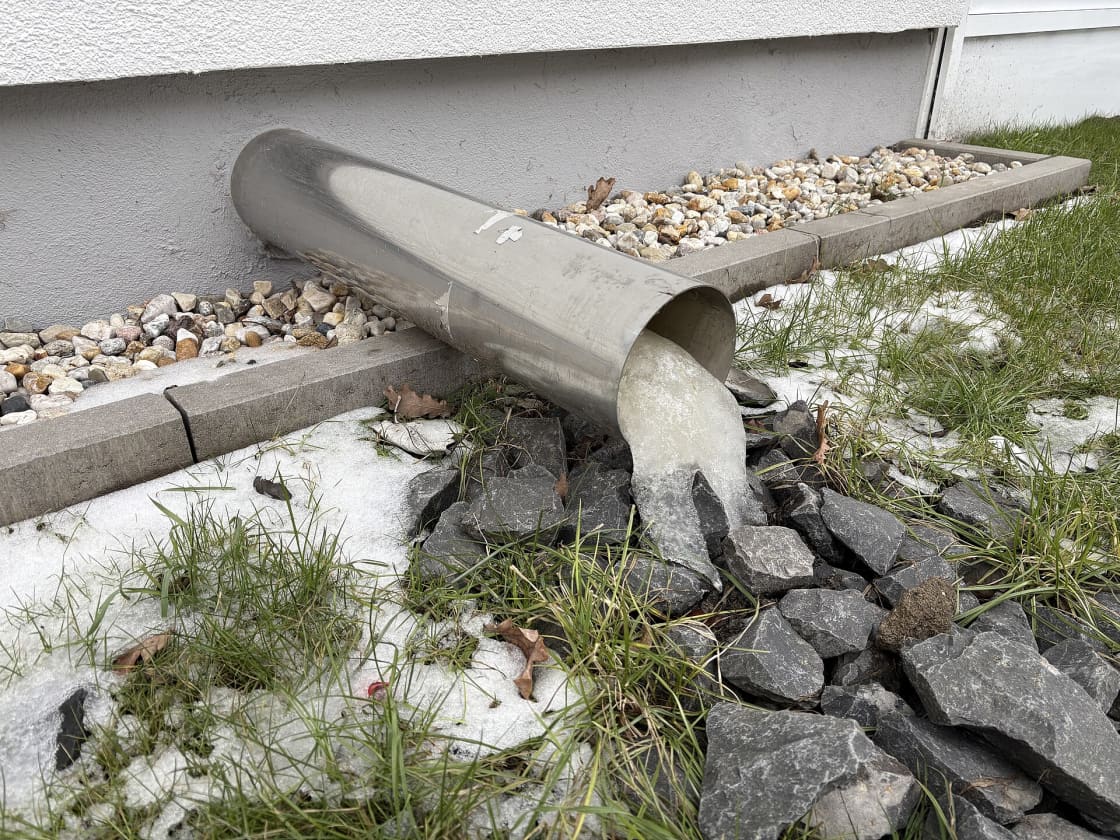

Water is unusual. Almost every substance contracts as it cools and continues contracting as it solidifies. Water contracts down to about four degrees Celsius and then, as it freezes, expands by roughly nine percent.
That expansion is why life exists in lakes that freeze from the top, and it is why plumbing fails in cold climates. Copper and PEX and CPVC are not designed to accommodate a nine percent volume increase in their contents, and when the contents insist, the pipe loses.
Utah Valley gets cold enough for this several times most winters. The good news is that the failures are highly predictable, cluster in four specific places, and are almost entirely preventable by autumn tasks that take an afternoon.
The mechanism, and why it matters practically
There is a widespread misunderstanding worth correcting, because the correction directly changes what you should do.
Most people assume a pipe bursts at the ice, split open by expanding ice pressing outward. That is not usually what happens.
What happens is this. Ice begins forming at the coldest point along the run, typically as a plug that grows until it seals the pipe completely. Water is still in the line on both sides. As freezing continues and the plug lengthens, water is displaced — and on the side where the run terminates at a closed faucet, that displaced water has nowhere to go. Pressure in that trapped segment climbs, and climbs far beyond what the system was designed to hold.
The pipe then fails between the ice plug and the closed tap, which is frequently in a warmer section, sometimes several feet away from any ice at all.
This explains the single most effective emergency measure available: open the faucet. An open tap removes the closed end. Water and pressure have an escape route, the segment cannot pressurize, and even if the pipe freezes solid it very often does not burst. It costs a trickle of water and it is the difference between an inconvenient morning and a ceiling coming down.
The four places it happens here
Interior plumbing in heated space almost never freezes while the heat is running. The failures cluster in four categories, and a walk through the house identifying which apply takes twenty minutes.
Hose bibbs and outdoor spigots. These are the most common single failure point in any cold-climate house, for the obvious reason that they are the part of the plumbing deliberately placed outside. A frost-free sillcock is designed to shut the water off well back inside the heated wall, which solves the problem — but only if the hose is disconnected. A hose left attached traps water in the valve body and defeats the entire design. Disconnecting garden hoses in autumn is the highest-value five-minute task on this list.
Unconditioned space. Garages, crawl spaces, unheated basements and attics all contain plumbing in many Utah Valley houses, and all of them track outdoor temperature far more closely than indoor temperature. An attached garage in particular is a frequent site of failure: it feels like part of the house, is treated like part of the house, and is not heated like part of the house. A water heater, a utility sink or a supply run crossing a garage ceiling are all exposed positions.
Exterior walls. A supply line routed through an outside wall is exposed to whatever the outside is doing, moderated only by the insulation between it and the exterior. This becomes acute when the insulation was installed behind the pipe — between the pipe and the heated room — which places the pipe on the cold side of the thermal barrier. This is a common construction shortcut and it is invisible from inside. North-facing walls, which get no winter sun, are the worst case.
Vacant or under-heated property. Empty houses freeze. So do houses where the thermostat was set very low to save money during a trip, houses where a furnace failed while nobody was home, and houses where a room was closed off for the winter and its supply lines forgotten. This category produces the most severe losses, because a burst pipe in an occupied house is discovered in minutes and one in an empty house runs until somebody arrives.
The autumn checklist
Everything here happens before the first hard freeze, and none of it is difficult.
Disconnect every garden hose and drain it. If the bibb is not frost-free, shut off its interior supply valve and open the outside spigot to drain the run.
Insulate exposed pipes in garages, crawl spaces and unheated basements. Foam pipe sleeve costs very little per foot and installs by hand. Insulation slows heat loss rather than adding heat, so this helps most where the surrounding space is merely cold rather than deeply frozen — but it buys hours, and most cold snaps here are measured in hours.
Find and test your main shutoff. This is the item people skip and the one that determines how bad a failure gets. Locate it, confirm it turns, and make sure everyone in the household knows where it is. A valve that has not moved in fifteen years may be seized, and discovering that with water pouring through a ceiling is the worst possible moment.
Seal the air leaks near vulnerable pipes — the gaps around a dryer vent, a rim joist, a sillcock penetration, a crawl space vent. Cold air moving across a pipe freezes it far faster than still cold air does, and drafts are frequently the actual cause where the ambient temperature alone would not have been enough.
Know your vacancy plan before you need it. If the house will be empty in winter, either maintain heat at a sensible minimum with somebody checking, or shut the water off at the main and drain the system properly. The middle option — heat set very low and nobody looking in — is the one that produces the expensive claims.
Sprinkler winterization is a separate task on a separate system, covered in our sprinkler winterization guide. Blowing out the irrigation lines does nothing for the pressurized domestic supply inside the building, and the two are regularly confused.
During a cold snap
When a genuine cold spell arrives — the kind where the overnight low sits well below freezing for several consecutive nights — a few temporary measures earn their keep.
Open cabinet doors under sinks on exterior walls, so heated room air reaches the pipes behind them. This is trivial and surprisingly effective, because those cabinets are otherwise small unheated boxes attached to a cold wall.
Let vulnerable taps drip. Not every tap in the house — the fixture at the end of the most exposed run. Run both hot and cold slightly, because both supply lines usually follow the same cold path to reach the same fixture. The goal is not primarily to keep water moving, though that helps; it is to eliminate the closed end that allows pressure to build.
Keep the thermostat steady rather than setting it well back overnight. The savings from a deep night setback are modest and the risk during a hard freeze is not.
Keep the garage door closed, particularly where plumbing runs through the garage. This is obvious and routinely forgotten.
Utah Valley's winter has a specific pattern worth knowing: the inversion. When cold air settles into the valley and stays, the valley floor can hold a temperature well below what the surrounding elevations show, sometimes for days without relief. That persistence is what freezes pipes. A single cold night rarely does it; four consecutive days of cold that never lifts will find every weak point in a building. Our Provo weather guide covers the inversion pattern in more depth.
If a pipe is frozen but has not burst
The symptom is usually a tap that produces nothing, or a trickle, while other fixtures in the house work normally. That localization is the diagnostic — it tells you which run is affected.
Open the affected faucet first. Both hot and cold. This gives meltwater somewhere to go and, critically, releases the pressure that causes the burst.
Apply gentle heat, starting at the fixture and working back toward the suspected freeze. Working from the tap end means meltwater can escape as it forms rather than being trapped behind a second plug.
Acceptable heat sources: a hair dryer, a heat gun on a low setting, warm damp towels wrapped around the pipe, an electric space heater warming the room, a heat lamp in a crawl space. All of these are gradual, which is the point.
Never use an open flame. No blowtorch, no propane heater aimed at a pipe. Two reasons, and both are serious. Wall and floor cavities contain framing, insulation and dust that ignite readily, and structure fires from pipe-thawing attempts are a well-documented annual occurrence. Beyond that, intense localized heat can flash trapped water to steam, and steam expansion will rupture a pipe more violently than ice ever would.
If you cannot locate or reach the frozen section — inside a wall, under a slab, in an inaccessible crawl space — that is the point to stop and call a plumber, not the point to start opening drywall.
If it has already burst
The order of operations matters more than anything else, and it is worth memorizing because you will be doing it while adrenaline is high.
One: shut off the water at the main. Before locating the leak. Before calling anyone. Before rescuing anything. Every second the main stays open adds water to the building.
Two: open taps throughout the house to drain the standing water out of the system rather than out of the break.
Three: cut power to affected areas at the panel if water is near outlets, fixtures or the panel itself. If reaching the panel means standing in water, do not — call the utility.
Four: document everything before cleanup begins. Photographs and video of the standing water, the break, and the affected contents. This is the evidence your claim rests on and it cannot be recreated after the fact.
Five: call a plumber and your insurer, in whichever order you can get through. Emergency plumbing capacity in a valley-wide freeze event is limited, and the calls all come at once.
Six: start water removal. Standing water becomes a mold problem quickly, and the window is measured in days rather than weeks. Professional water mitigation exists for exactly this and insurers generally expect prompt action to limit the loss.
Insurance, honestly
Sudden and accidental water damage from a burst pipe is commonly covered under standard homeowners policies. That general statement is true and it is also where most articles stop, which is not good enough, because the qualifications are where claims are decided.
Vacancy and heat provisions. Many policies contain language excluding or limiting coverage where a loss occurred while the property was unoccupied and the insured failed either to maintain heat or to shut off the water and drain the system. The logic is that the loss was preventable by ordinary care. If you travel in winter, this clause is the one to read before you go.
The pipe versus the damage. Policies frequently treat the cost of repairing the failed pipe itself differently from the cost of repairing the resulting damage to the structure and contents. The water damage is typically the larger number and the more clearly covered one.
Gradual versus sudden. A slow leak that caused damage over months is a maintenance issue in most policy language, not a sudden and accidental loss. A burst pipe is the paradigm case of sudden.
Our homeowners insurance guide covers the wider policy structure in this market. But the only authority on your coverage is your own policy document, and the time to read the vacancy language is a quiet evening in October rather than a wet morning in January.
Renters: the responsibility question
In a rental, the general division is that the landlord maintains the plumbing system in working order and the tenant takes reasonable care of the unit. In a cold climate, reasonable care can include keeping the heat on and reporting problems promptly.
Where a specific dispute lands depends on the lease and on the facts — whether a tenant shut the heat off entirely, whether a known problem was reported, whether the landlord responded. Two practical protections for tenants:
Report in writing, immediately. A text or an email creates a timestamp. Verbal reports evaporate.
Photograph conditions when you report them. The question of what the situation looked like on the day is answered far better by a photograph than by a recollection.
Our renters rights guide covers the wider framework of the landlord-tenant relationship in Utah. Renters insurance covers your belongings, which the landlord's policy does not — see our renters insurance guide for how that works.
The short version
Disconnect the hoses in October. Insulate the pipes in the garage and the crawl space. Find your main shutoff and turn it once to prove it works. During a hard freeze, open the cabinets and let the exposed fixture drip. If a tap goes dead, open it and warm the line gently from the tap end. If a pipe breaks, the main comes first and everything else comes second.
The whole failure mode depends on water having nowhere to go. Almost every measure on this list is a way of giving it somewhere.
Heat tape and the things people install
Beyond insulation, there is a category of active solutions, and they are worth understanding because they are frequently installed badly.
Heat tape, or heat cable, is an electrical element run along a pipe that warms it directly. Unlike insulation, it adds heat rather than slowing its loss, which makes it the right answer for exposed runs — a crawl space line, an exposed section in an unheated outbuilding — where insulation alone will not hold.
Two cautions matter. First, product type matters: cable intended for roof and gutter de-icing is not the same product as cable intended for water supply pipes, and using the wrong one is a fire risk. Second, installation instructions on these products are specific about wrapping pattern, overlap, whether insulation may be applied over the top, and whether the cable may cross itself. Deviating causes overheating. Heat tape has a real service life and degrades, so old tape installed by a previous owner deserves inspection rather than trust.
Pipe insulation remains the cheaper and more broadly useful measure. Split foam sleeve installs by hand in minutes, and the joints and elbows people skip are precisely where the cold gets in. Fittings have more surface area relative to volume than straight pipe and freeze first.
Older houses in this valley
Utah Valley's housing stock spans a wide range, and the pre-war and mid-century houses in Provo's older neighborhoods carry a specific set of vulnerabilities.
Uninsulated or under-insulated exterior walls are common in older construction, and any supply line routed through one is exposed. Retrofit insulation blown into a wall cavity may have been installed around a pipe in a way nobody documented.
Crawl spaces rather than full basements are frequent, and crawl space vents that make sense for summer moisture control make no sense in January. Seasonal vent covers are a cheap fix that many owners never learn about.
Additions and remodels create the worst cases, because a bathroom added onto the back of a house often has supply lines routed through a wall or floor that was previously exterior. These runs are frequently the first to freeze in a house that has otherwise been fine for decades.
Vacant rentals between tenancies in the student housing stock are a recurring source of losses in this market, for the obvious seasonal reason that turnover and winter overlap. A unit sitting empty over a semester break with the heat set to minimum is the classic profile. Our renters rights guide covers the tenant side of that relationship.
What a plumber will charge to prevent this
Precise pricing changes and is not worth publishing as a number that will be wrong within a season. What is stable is the relationship between the costs.
Preventive work — insulating exposed runs, replacing a failed frost-free sillcock, adding a shutoff valve where one is missing — sits in the range of a routine service call. Emergency work during a valley-wide freeze event costs substantially more, because it is after hours, because demand spikes for everyone simultaneously, and because the job now includes finding a break inside a structure.
Remediation after water damage is a different order of magnitude entirely, because it involves drying equipment, removing and replacing building materials, and frequently contents. The water damage is almost always larger than the plumbing repair.
The economics are unusually one-sided. An afternoon in October and a few dollars of foam is the cheapest insurance available on a building.
Related Guides
- Sprinkler Repair and Winterization in Utah Valley — the other winterization task, on a different system
- Homeowners Insurance in Utah Valley — what the policy covers
- Renters Insurance in Utah Valley — belongings coverage for tenants
- Renters Rights in Utah — the landlord-tenant framework
- Heating & Cooling in Utah Valley — what this climate does to your system
- Provo Weather by Month — the inversion and the cold that persists
Frequently Asked Questions
Why does a frozen pipe burst, and where does it break?
Which pipes in a Utah Valley house are most at risk?
Should I leave taps dripping overnight?
How do I thaw a frozen pipe safely?
What is the first thing to do if a pipe has already burst?
Does homeowners insurance cover frozen pipe damage?
Whose responsibility is it in a rental?
Do I still need to worry if my sprinklers are already blown out?
Sources
The facts in this guide were checked against these sources. Hours, fees and rules change, so confirm anything time-sensitive with the source before you go. How we make Provo.com.
- Freeze-Thaw Resistance of Concrete With Marginal Air Content, Chapter 2: Background, Federal Highway Administration. Checked October 12, 2026.
- Water and Sewer | Provo, UT, Provo City. Checked October 12, 2026.