Utah's map is a record of who was here first, who came next and whom they wanted to thank. Its 29 counties are named for Native peoples and words, rivers, rocks and trees, three presidents, church leaders and, in one case, a legislator's son. This guide sets out every county name from the Utah State Library's county profiles, then the counties that no longer exist, then a handful of town names, including a few stories that are often told wrong.
For Provo, Orem and the first Utah County towns, see our separate guide, How Utah County Got Its Name.
Quick facts
| Question | Answer | Source |
|---|---|---|
| Counties today | 29 | Utah State Library |
| First counties, 1850 | Great Salt Lake, Weber, Tuilla (Tooele), Utah, San Pete and Little Salt Lake, with Davis later that year | Deseret News, 1989 |
| Newest county | Daggett, 1917 (the profile also lists 1918) | Utah State Library |
| Renamed | Great Salt Lake County became Salt Lake County in 1868 | Deseret News, 1989 |
| Named for presidents | Washington, Millard (for Millard Fillmore), Garfield | Utah State Library |
Every county, and what it is named for
From the Utah State Library's county profiles, checked Nov. 27, 2026. Where a profile gives two explanations, both are listed.
| County | Named for | Created |
|---|---|---|
| Beaver | The Beaver River and the beavers once plentiful there | 1856 |
| Box Elder | The box elder trees growing in the county | 1856 |
| Cache | Trappers' hidden fur stashes (French "cacher," to hide) | 1864 |
| Carbon | The coal found in the county | 1894 |
| Daggett | Ellsworth Daggett, Utah's first surveyor general | 1917 |
| Davis | Capt. Daniel C. Davis of the Mormon Battalion | 1850 |
| Duchesne | The Duchesne River, "possibly" named for a French-Canadian trapper | 1914 |
| Emery | George W. Emery, territorial governor from 1875 to 1880 | 1880 |
| Garfield | President James A. Garfield | 1882 |
| Grand | The Grand River, now called the Colorado | 1890 |
| Iron | Iron deposits in the county | 1850 |
| Juab | The Ute word "yoab," a flat or level plain | 1852 |
| Kane | Col. Thomas L. Kane, a supporter of the Mormon settlers | 1864 |
| Millard | President Millard Fillmore | 1851 |
| Morgan | Church leader Jedediah Morgan Grant | 1862 |
| Piute | The Paiute people | 1865 |
| Rich | Apostle Charles C. Rich, or the fertility of the Bear River Valley; first called Richland | 1864 |
| Salt Lake | The Great Salt Lake | 1850 |
| San Juan | The San Juan River | 1880 |
| Sanpete | A variation of Sanpitch, the name of the local tribe, and of a word for the tule or bulrush | 1850 |
| Sevier | The Sevier River | 1865 |
| Summit | Its high summits, which divide the Weber, Bear and Green River drainages | 1854 |
| Tooele | Uncertain: "tule," a Spanish word of Aztec origin for bulrush, or the Goshute "tu-wada," bear | 1850 |
| Uintah | The Uinta-ats Utes | 1880 |
| Utah | The Ute people (Yuta, the Spanish name for the tribe) | 1850 |
| Wasatch | The Wasatch Range, or a Native word meaning "mountain pass" | 1862 |
| Washington | President George Washington | 1856 |
| Wayne | Wayne Robison, son of legislator Willis E. Robison | 1892 |
| Weber | Trapper John Henry Weber, and the Weber River | 1850 |
Two notes on the dates. The Sanpete profile prints "1830," which cannot be right for a county the settlers reached in 1849; the Deseret News lists San Pete among the original 1850 counties, and the profile's own origin note is labeled 1850. The Washington County profile says its boundaries were set in 1852 and gives 1856 as the founding year.
What the names say
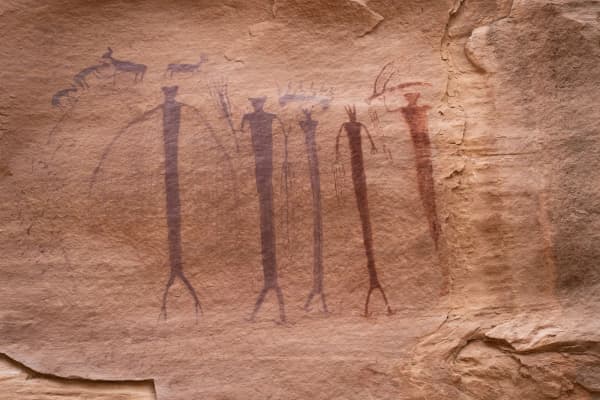
Native peoples and words. Utah itself, and Utah County, take their name from the Utes; Uintah County from the Uinta-ats Utes; Piute from the Paiutes; Juab from a Ute word; Sanpete from the Sanpitch. Tooele and Wasatch may also come from Native words, though the state's own profiles give other possibilities. Our guide to the Ute people of Utah explains where the name Utah comes from.
Rivers. Six counties are named for rivers or partly so: Beaver, Duchesne, Grand, San Juan, Sevier and Weber.
The land. Box Elder for its trees, Carbon for coal, Iron for ore, Salt Lake for the lake, Summit for its peaks and Cache for the trappers' hiding places.
People. Three presidents (Washington, Fillmore and Garfield); two church leaders (Jedediah Morgan Grant and, possibly, Charles C. Rich); two federal officials (Gov. George W. Emery and Surveyor General Ellsworth Daggett); a Mormon Battalion captain (Daniel C. Davis); Thomas L. Kane, a supporter of the Mormon settlers; a trapper (John Henry Weber); and a boy, Wayne Robison.
The counties that disappeared
Utah once had more counties than it does now. Lynn Arave's 1989 Deseret News history traced the lost ones:
- Tuilla, one of the six original counties, was soon respelled Tooele.
- Shambip covered the southern half of present-day Tooele County for about a decade; its name may come from the Goshute word for bulrush.
- Rio Virgin was created in southern Utah in 1869 and absorbed by Washington County about three years later.
- Desert and Green River were among the counties of 1852, and Carson, Humboldt, St. Mary's, Greasewood, Cedar and Malad among those added later in the 1850s. The Deseret News says Carson, Humboldt, St. Mary's, Greasewood and Cedar were all gone by 1879.
- Great Salt Lake County became Salt Lake County in 1868, and the Deseret News says Emery was previously Castle County.
Town names, and the stories people get wrong
Ogden. Named for Peter Skene Ogden, a Hudson's Bay Company trapper who worked the mountains east of town in 1825, Utah's Division of State History says. The settlement was Brown's Fort until 1851, and before that Miles Goodyear's Fort Buenaventura, founded in 1845 on the Weber River.
Logan. Named after an early trapper, Ephraim Logan, the Division of State History says. The town was founded in 1859 and had 100 houses by March 1860.
St. George. Named for apostle George A. Smith, the Salt Lake Tribune reported in 2026: Brigham Young reportedly told apostle Erastus Snow to name the city after Smith, though Smith never lived there. Former church historian Steven Snow told the paper Smith is "considered the father of the southern Utah settlements." The nickname "potato saint," from Smith urging refugees at Winter Quarters to eat potatoes against scurvy, is not the source of the name; historian Amy Tanner Thiriot called that idea a "canard."
Kanab. A Paiute word meaning willow, for the willows along the creek, the Division of State History says, which also notes a second explanation: a word for a willow basket used to carry an infant.
Bicknell and Blanding. Utah's History Encyclopedia tells this one. Thomas Bicknell, an educator from Providence, Rhode Island, offered a library of 1,000 books to any Utah town that would take his name. Thurber, named for settler Albert King Thurber, and Grayson competed for it. The towns split the books: Thurber became Bicknell, and Grayson took the maiden name of Bicknell's wife, Blanding. The encyclopedia's two entries disagree on the date: Robert S. McPherson's Blanding entry puts the offer in 1914, and Kenneth R. Williams' Bicknell entry says Thurber recorded its vote in April 1916.
Book of Mormon and Bible names. Lynn Arave's 2001 Deseret News survey, drawing on John W. Van Cott's "Utah Place Names," lists Bountiful, Nephi, Lehi, Moroni and Manti from the Book of Mormon, and Deseret in Millard County from the Book of Mormon word for honeybee; Moab for the biblical land beyond the Jordan; Eden, named by a surveyor for its setting; Ephraim, renamed to honor the tribes of Israel; and Mount Nebo, for the mountain where Moses died. Iosepa in Tooele County is the Hawaiian form of Joseph, for Joseph Smith.
Church leaders. The same survey lists Brigham City, Benson, Taylorsville, Woodruff, Cannonville, Heber City, Hyrum, St. George and Snowville among the towns named for early church leaders.
Names that sound religious but are not. The Virgin River is likely named for Thomas Virgin, not the Virgin Mary, and Abraham in Millard County is named for church leader Abraham H. Cannon, not the biblical patriarch, the 2001 survey says.
Why so many places are "X City"
The Salt Lake Tribune looked at the grammar in May 2026. Brigham Young proposed "The Great Salt Lake City, of the Great Basin of North America" in 1847, and the 1851 charter used "Great Salt Lake City." Ogden, Provo and Parowan were chartered the same year in the "X City" form, while Manti was chartered as "City of Manti." Moab and St. George still use "City of," and about 70 percent of Utah municipalities use the "X City" form, the Tribune found. It makes no legal difference: "Legally, it doesn't matter," Cameron Diehl of the Utah League of Cities and Towns told the paper.
Related guides
- How Utah County got its name, and the first towns
- Why Utah is the Beehive State
- Provo history
- Ogden from Provo
- Logan and Cache Valley from Provo
- Bluff, Utah
Frequently Asked Questions
How many counties does Utah have?
Which Utah county was created last?
What is Utah County named for?
What does Juab mean?
Why is it called Cache County?
Who is Wayne County named for?
Is St. George named after George A. Smith?
How did Bicknell and Blanding get their names?
Sources
The facts in this guide were checked against these sources. Hours, fees and rules change, so confirm anything time-sensitive with the source before you go. How we make Provo.com.
- Utah's County Profiles (index of all 29 counties), Utah State Library (Utah's County Profiles). Checked November 27, 2026.
- Sanpete County profile, Utah State Library (Utah's County Profiles). Checked November 27, 2026.
- Daggett County profile, Utah State Library (Utah's County Profiles). Checked November 27, 2026.
- Wayne County profile, Utah State Library (Utah's County Profiles). Checked November 27, 2026.
- Tooele County profile, Utah State Library (Utah's County Profiles). Checked November 27, 2026.
- Rich County profile, Utah State Library (Utah's County Profiles). Checked November 27, 2026.
- Juab County profile, Utah State Library (Utah's County Profiles). Checked November 27, 2026.
- Utah Division of State History (History to Go): Ogden, Utah Division of State History (History to Go). Checked November 27, 2026.
- Utah Division of State History (History to Go): Logan, Utah Division of State History (History to Go). Checked November 27, 2026.
- Utah Division of State History (History to Go): Kanab, Utah Division of State History (History to Go). Checked November 27, 2026.
- About Bicknell Town, Bicknell Town. Checked November 27, 2026.
- Bicknell (Kenneth R. Williams), Utah History Encyclopedia (Utah Education Network). Checked November 27, 2026.
- Blanding (Robert S. McPherson), Utah History Encyclopedia (Utah Education Network). Checked November 27, 2026.
- Tuilla, Shambip: Utah counties have colorful history (Lynn Arave, July 27, 1989), Deseret News. Checked November 27, 2026.
- Religious place names are abundant in Utah (Lynn Arave, Jan. 13, 2001), Deseret News. Checked November 27, 2026.
- Who is St. George's namesake? (Mark Eddington, 2026), The Salt Lake Tribune. Checked November 27, 2026.
- Why are Utah cities named the way they are? (Jose Davila IV, May 23, 2026), The Salt Lake Tribune. Checked November 27, 2026.