
Utah Valley residents drive to Salt Lake constantly and to Ogden almost never. It sits at the far end of the Wasatch Front, about ninety minutes north of Provo, and for most Utah County families it exists mainly as a name on a freeway sign.
That is a mistake worth correcting. Ogden is the Wasatch Front city the railroad built, and it feels different because of it — denser, older, grittier in its architecture, and with a downtown street that has a disreputable history nobody has tried very hard to sanitize.
It also sits at the mouth of a canyon that leads to reservoirs, ski terrain and an Olympic downhill course, which means a day trip can be urban, outdoor, or both.
Hours, admission prices and seasonal operations at everything below change. Verify before you drive up.
Why Ogden is not like the rest of Utah
The short version is the transcontinental railroad.
Ogden spent its first two decades as a quiet agricultural settlement. Then the rails arrived. The Golden Spike ceremony took place roughly fifty miles to the north-west in 1869, and Ogden was subsequently established as the junction city where the Union Pacific and Central Pacific lines met.
That changed everything. A town of farmers became a transport hub where thousands of travelers passed through daily, most of them not Utahns, many of them with time to spend between connections. Businesses grew to serve them — hotels, saloons, restaurants, rooming houses — and a demographic mix arrived that the rest of territorial Utah did not have, with Italian, Chinese, Jewish and Japanese business owners establishing themselves along the main commercial street.
The result was a city with a different character from its neighbors, and a reputation that outlasted the trains.
Historic 25th Street, the actual reason to go
The street runs east from Union Station, and in 1889 a new, much larger depot went up at its western end.
What followed made it famous. The three blocks nearest the depot filled with saloons, gambling houses, opium dens, bootlegging operations and brothels, and the street acquired the nickname Two-Bit Street — a play on its number and a reference to the trade that made it money. A parallel red-light lane known as Electric Alley operated for about three decades before civic pressure forced a post-midnight raid that shut it down.
Prohibition made things livelier rather than quieter, and local folklore holds that a tunnel system moved alcohol between Union Station and a downtown hotel. There is also a much-repeated story that Al Capone judged Ogden too rough for his tastes. Treat both as folklore — they are repeated by Ogden's own tourism material with the word "rumor" attached, and neither is documented in the way a fact is.
When passenger rail declined through the 1950s and 1960s, the street declined with it. Recovery came through preservation rather than demolition: property owners and the Junior League organized a historic preservation committee, and the city came to treat the old buildings as the asset.
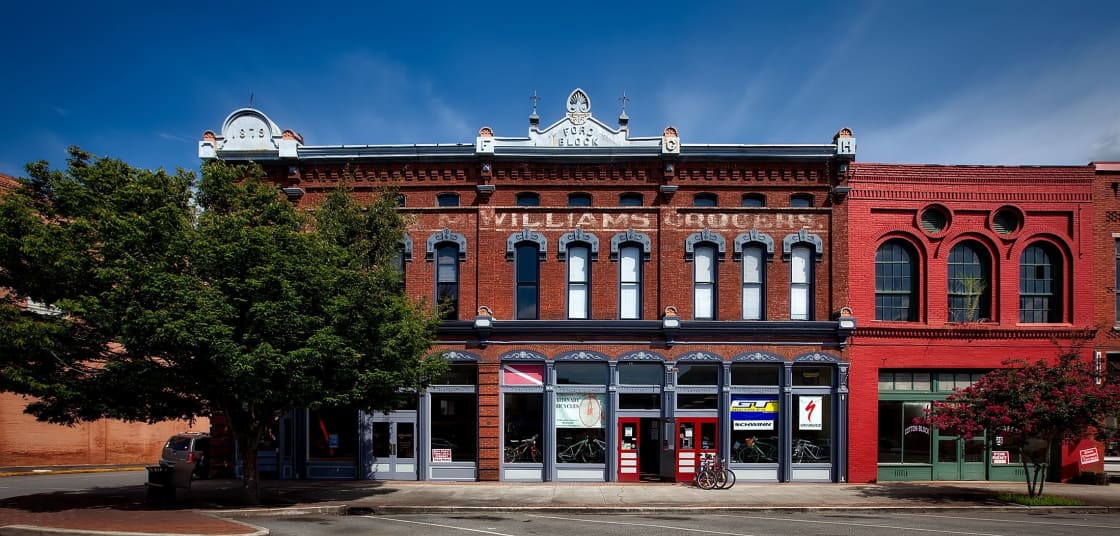
That decision is why the street is worth visiting today. It is a National Historic District holding what is described as the most complete contiguous run of turn-of-the-century commercial architecture in Utah, and it now draws over a million visitors a year to restaurants, bars, galleries and shops in the same brick buildings that once housed the vice trade.
Union Station and its museums
The building at the foot of 25th Street is the third one on the site. The 1889 depot burned in February 1923, and a telegraph operator named Fanny McCarty got everyone out. It was rebuilt in 1924, and that is the Union Station standing today.
Passenger service is long gone, and the building has been repurposed as a museum complex. It has housed the Utah State Railroad Museum, the John M. Browning Arms Museum, the Browning-Kimball Classic Car Museum, a cowboy and western museum and art gallery space.
The Browning connection is the one outsiders underrate. John Moses Browning was an Ogden gunsmith whose designs became the dominant firearms of the twentieth century worldwide, and the museum holds a substantial collection of his work and prototypes. Whatever your relationship with firearms, the industrial-design story is remarkable and specifically local.
The railroad museum is the natural pairing with the building itself, and there is rolling stock outside.
The Dinosaur Park, and why families come north for it
At the east end of the Ogden River Parkway, at the mouth of Ogden Canyon, sits Ogden's George S. Eccles Dinosaur Park.
It is an outdoor sculpture park of full-size dinosaur models. Children walk trails between them.
The indoor half is the Stewart Museum of Paleontology, with fossil exhibits, a gem and mineral museum, and a working paleontology lab visible to visitors — which is the detail that lifts it above a sculpture garden. There are playgrounds and picnic areas on site.
Practicalities worth checking rather than assuming: published hours vary noticeably between sources and seasons, and admission has been modest but is not free. Confirm both directly before driving ninety minutes with excited children in the car.
Most families report two to three hours. Its position at the canyon mouth means it pairs naturally with a drive up Ogden Canyon afterward.
Snowbasin, and the Olympic connection
Thirty to thirty-five minutes from downtown, up Ogden Canyon or over Trappers Loop, sits Snowbasin.
It hosted the downhill, super-G and combined events at the 2002 Winter Olympics, which required building a race course and the access infrastructure to support it. The resort is notably grand for its size — the day lodges were built to a standard that surprises first-time visitors who expected a regional ski hill.
In winter it is a full ski resort. In summer it runs lift-served hiking and mountain biking, and has hosted a free outdoor summer concert series that has been a genuine regional draw.
For Utah Valley families, Snowbasin is further than Sundance and further than the Cottonwoods, so it is not the default. It becomes worth the drive when combined with the rest of an Ogden day, or when the summer concert calendar aligns.
Ogden Canyon, Pineview and the valley behind the mountain
The canyon east of Ogden opens into a mountain valley that most Utah County residents have never seen.
Pineview Reservoir sits in it — a large recreation reservoir with beaches, boating and paddling, and a very different feel from Utah Lake or Deer Creek. It gets busy on summer weekends.
Huntsville is the small town at the valley's south end, and its old tavern is an unusual thing in this state.
Nordic Valley and Powder Mountain are the other two ski areas in the valley, with Powder Mountain notable for its enormous skiable acreage and its unconventional ownership history.
The canyon road itself is narrow, winding and beautiful, running alongside the Ogden River. It is not a road to hurry on, and it can be slow in summer traffic.
Getting there without a car, which works
This is the single best-kept secret of Ogden day trips from Utah Valley.
UTA's FrontRunner commuter rail runs the length of the Wasatch Front, with Provo at the southern end and Ogden at the northern end. The Ogden station sits at the western end of Historic 25th Street — meaning you step off the train directly at the start of the most walkable, most interesting part of the city.
That is an unusually good fit. For a day built around 25th Street, Union Station and downtown, you do not need a car at all, and the ride removes both the driving and the parking problem.
The trade-off is that the Dinosaur Park, Snowbasin and the canyon country all require wheels at the far end. A rail day is a downtown day. Check current FrontRunner schedules and fares, since service patterns differ between weekdays and Saturdays and the line does not run on Sundays.
What Ogden does that Salt Lake does not
Both are north of Provo. They are not substitutes.
Salt Lake has the big institutions — the zoo, the aquarium down south, Temple Square, major venues, the airport, professional sport. It is closer to Utah Valley and easier to reach.
Ogden is smaller, denser and more concentrated. Its appeal is that a single street holds most of what you came for, that the architecture is older and more intact, and that the mountains rise immediately behind the town rather than across a valley.
There is also a cultural difference. Ogden has spent twenty years rebuilding itself around outdoor recreation, and several outdoor-industry companies have based operations there. The city markets itself as a base for climbing, skiing, biking and paddling rather than as a business center, and the downtown reflects that.
If you want a day walking one interesting neighborhood with mountains at the end of the street, Ogden is the better trip. If you want a specific large attraction, Salt Lake usually has it.
The reinvention, and what it looked like
Ogden's recovery from its post-rail decline is one of the more deliberate small-city turnarounds in the Mountain West, and it is worth understanding because it explains the town you visit.
The strategy was to stop competing with Salt Lake as a business center and instead sell proximity to mountains. Ogden sits closer to skiable terrain than almost any city its size in the country — three ski areas within about an hour, canyon trailheads at the edge of downtown, and a river running through the middle of it.
The city leaned into that, courting outdoor-industry employers and building recreation infrastructure downtown rather than at the edges. A downtown facility combining indoor climbing, an indoor surf wave and other recreation anchored the idea physically. Trails were extended along the river. The historic district was protected rather than redeveloped.
The result is a city where the mountain-town identity is genuine rather than marketing. That is the texture Utah Valley visitors notice and struggle to name.
Weber State, and the university effect
Weber State University sits on the bench above the city, and it shapes Ogden in ways a Provo resident will find both familiar and unfamiliar.
Familiar: a substantial student population, campus events open to the public, and a college-town rhythm to parts of the year.
Unfamiliar: Weber State is predominantly a commuter and non-traditional-student institution rather than a residential campus dominating the town the way BYU dominates Provo. Its student body skews older, more part-time and more local, and the university therefore does not set the city's culture the way Utah Valley's schools set theirs.
For a visitor, the practical upshot is that Ogden does not empty out between semesters and does not fill up on a football Saturday to anything like the degree Provo does. The city's calendar is its own.
The Ogden River Parkway and the trail network
The parkway is the connective tissue of an Ogden day and the thing most day-trippers miss entirely.
It is a paved multi-use path running along the Ogden River from near the canyon mouth down through the city, linking parks, the Dinosaur Park, the botanical gardens and downtown. It is flat, shaded in stretches, and stroller-friendly — an easy way to combine two or three stops on foot rather than driving between them.
Above it, the Bonneville Shoreline Trail runs along the bench, and canyon trailheads climb from the edge of town toward waterfalls and ridgelines. Waterfall Canyon is the best-known short hike and starts remarkably close to residential streets.
For a family, the parkway is the useful one. Park once near the Dinosaur Park, walk the path, and let the day be a walk rather than a series of car parks.
Eating, briefly
The food question answers itself: 25th Street. Three blocks hold most of the city's restaurant density, in a range from long-standing diners to newer independent kitchens, plus coffee, bakeries and dessert.
The practical advice is timing rather than choice. Weekend evenings on the street are busy and the better-known places take walk-ins slowly. A late lunch on 25th Street is easy; a 7 p.m. Saturday table is not guaranteed.
Utah's alcohol rules apply as everywhere in the state, though Ogden has more of a bar culture than most Utah cities of its size — a direct inheritance from the railroad era.
If you are driving up the canyon, eat before you go. Options thin out fast beyond the city.
A day that works from Provo
The rail version. Take FrontRunner north in the morning. Walk 25th Street from the station east, stopping at Union Station's museums first while energy is high. Lunch on the street. Browse the galleries and shops in the afternoon. Take the train back. No parking, no canyon driving, and a different day from anything in Utah County.
The car version. Drive up I-15, do the Dinosaur Park first thing while children are fresh, then head into Ogden Canyon for the drive and a look at Pineview. Come back down for a late lunch on 25th Street and finish at Union Station. Home for dinner.
The winter version. Drive to Snowbasin for the day, and stop on 25th Street on the way home. This is the only version where Ogden is the secondary attraction rather than the point.
Timing and seasonality
Summer brings the farmers market to 25th Street, the outdoor concert calendar at Snowbasin, and full operation at Pineview. It is also the busiest and the hottest.
Autumn is arguably the best window. Ogden Canyon's color is excellent, the crowds thin, and downtown is comfortable to walk.
Winter turns the trip into a ski day with an urban add-on, and Ogden Canyon road conditions become a real planning factor.
Spring is the shoulder — canyon country is muddy and reservoirs are cold, but downtown works year-round and the museums are indoor.
Practical notes
Parking downtown is straightforward and cheap by big-city standards, but 25th Street itself fills on weekend evenings.
Ogden's elevation is slightly lower than Provo's, so the weather is broadly similar, but the canyon behind it climbs fast and conditions up there are not the conditions downtown.
Sunday closures apply here as elsewhere in Utah, though 25th Street has more Sunday activity than most Utah commercial districts.
Allow more driving time than the map suggests if your route passes through Salt Lake at rush hour, because the I-15 corridor through Salt Lake County is the slow part of the trip, not the Ogden end.
The short version
Ninety minutes north of Provo is a railroad town with a rough past, a beautifully preserved main street, a dinosaur park at a canyon mouth, an Olympic downhill course half an hour up the hill, and a train that drops you in the middle of it.
Most Utah County residents have never made the trip. It is the most interesting hour and a half you can drive on the Wasatch Front without leaving it.
Related Guides
- FrontRunner from Provo: What to Know Before You Ride
- Logan and Cache Valley from Provo: The Other College Valley
- Best Day Trips from Provo, Utah (2026)
- The Great Salt Lake and the Bonneville Salt Flats From Provo: Two White Landscapes, Two Very Different Days
- Antelope Island from Provo: The Bison, the Causeway Fee Your Pass Does Not Cover, and When the Gnats Win
Frequently Asked Questions
How far is Ogden from Provo?
Can you get to Ogden from Provo by train?
What is Historic 25th Street?
Is Ogden's Dinosaur Park worth the drive?
How far is Snowbasin from Ogden?
Is Ogden safe to walk around?
What is there for kids in Ogden?
Is Ogden a better day trip than Salt Lake from Provo?
Sources
The facts in this guide were checked against these sources. Hours, fees and rules change, so confirm anything time-sensitive with the source before you go. How we make Provo.com.
- Museums at Union Station, Ogden City. Checked October 12, 2026.
- Celebrating 100 Years of Union Station, Ogden City. Checked October 12, 2026.
- Ogden Dinosaur Park, George S. Eccles Dinosaur Park. Checked October 12, 2026.