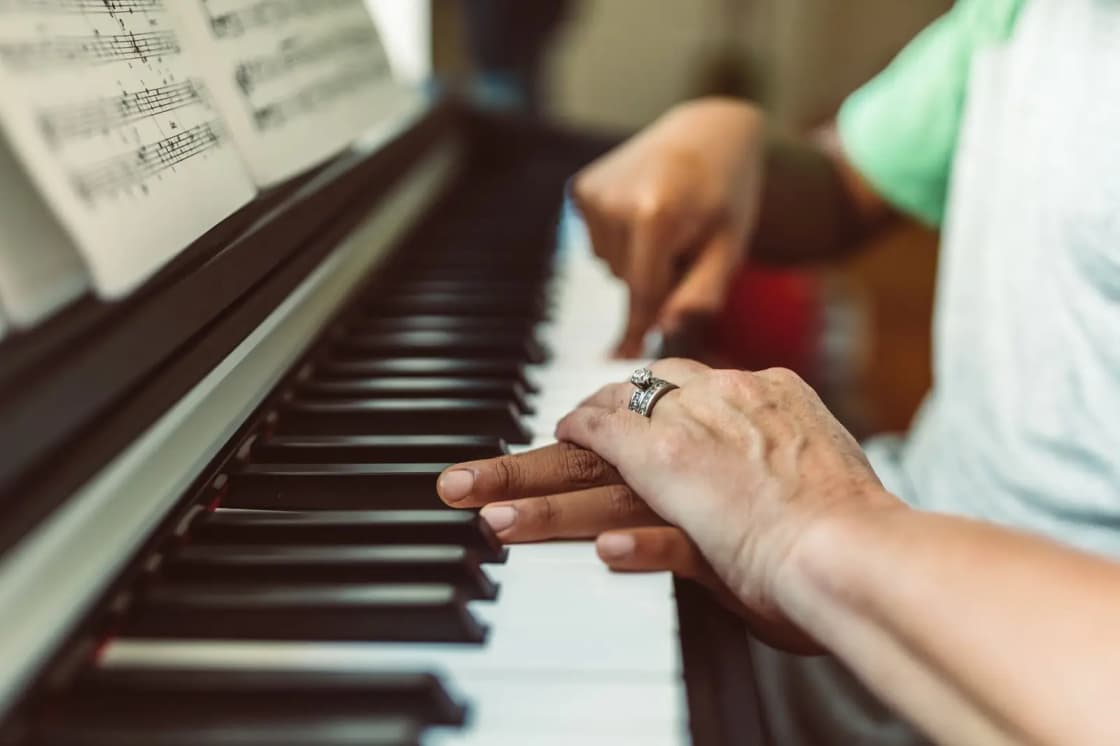

There is a particular sound to a Provo street in the early evening: someone practicing, badly and then slightly less badly, with the window open. It is a small thing, and it is also a fairly accurate reading of the local economy. In this valley an extraordinary number of households contain both a keyboard instrument and somebody willing to teach on it.
That depth is a genuine advantage for families here. It also means the range between the best teacher on your street and the worst is enormous, and the price tells you very little about which is which.
Why the supply here is unusual
Three things stack up.
Two university music schools in one small metropolitan area. Brigham Young University and Utah Valley University both run substantial music programs, and both graduate performers and music educators every year, many of whom stay. A city of this size would not normally support anything like this concentration of trained musicians.
A musical culture with deep roots. The dominant local religious tradition is built around congregational singing, ward choirs and organ playing, which produces steady, unglamorous demand for keyboard competence across generations. A great many adults here learned enough piano to accompany a hymn, and a great many of them now teach.
A large pool of students and young parents wanting flexible income. Teaching four students a week from a home studio is one of the few jobs that fits around a class schedule or a nap schedule.
The result is a market with real depth at every price point — and one where a family can just as easily land on a superb teacher or on someone three chapters ahead of their student.
The tiers, and what actually separates them
Rather than quote figures that go stale, it is more useful to understand the tiers and price within them, because the ordering is stable even when the numbers move.
University students teaching privately. The entry tier, and the best value in the valley when it goes well. Frequently excellent musicians, frequently enthusiastic, and frequently teaching for the first time. The right fit for a beginner whose main need is regular contact with someone who plays well.
Experienced independent teachers with a home studio. The broad middle, and where most long-term students sit. These are people who have taught for years, often hold a music degree, run a recital every spring and have seen a hundred children hit the plateau where beginners quit. You are paying for the plateau experience more than for the playing.
Studio-affiliated and specialist teachers. The upper tier: teachers attached to a named studio or conservatory-style program, teachers who prepare students for competitions and certificate examinations, and teachers who specialize in a specific advanced repertoire. Relevant when a student is genuinely serious. Overkill, and often counterproductive, before that.
Group and early-childhood classes. Priced per term rather than per hour, and a completely different product — social, movement-based, exploratory. For a three- or four-year-old this is usually a better use of money than a private lesson.
In-home teachers who travel to you. A small local segment that charges a premium for the driving. Worth it if the alternative is not doing lessons at all, which for a household juggling several children is a real comparison.
Two cost items sit outside the lesson rate and are routinely forgotten: books and sheet music, which accumulate faster than parents expect, and recital or festival fees. Ask about both up front.
How to read a teacher's training
Music teaching is unregulated. Nobody is checking, and there is no license to lose. So the signals matter.
A degree in music education is different from a degree in performance, and both are different from being a strong player. A performance degree means someone can play. A music education degree means someone has been taught how to teach. Neither guarantees the other, and the best teachers usually have some deliberate pedagogy training regardless of which piece of paper they hold.
Membership in a professional association — a state or national music teachers' organization — is a modest positive signal. It usually means the teacher participates in adjudicated events, keeps up with repertoire, and has peers who would notice if things went badly.
Ask who their students are and where they have gone. Not to collect trophies, but because a teacher who has taken students from beginner to advanced has a proven curriculum. A teacher who only ever has beginners may be losing them at the plateau.
Ask about the plateau explicitly. Every student hits a point, usually somewhere in the second or third year, where progress slows and enthusiasm collapses. The single most useful question you can ask is what the teacher does when that happens. A good answer is specific and slightly rueful. A vague answer about keeping it fun is a warning.
The instruments this valley is good at
Piano is the deepest market by a wide margin, and the easiest to fill at any level or budget.
Strings are well served, with a significant Suzuki presence for violin and cello. Suzuki is an ear-first method with heavy parent participation built into the design; families who can commit an adult to daily practice supervision do very well with it, and families who cannot should say so honestly at the outset rather than discovering it in month four.
Voice is abundant, unsurprisingly given the choral culture and the strength of local musical theater. Note that most reputable teachers will not begin serious classical voice training with a young child, and will suggest choir until the voice settles — a teacher who agrees to start a nine-year-old on heavy technique is telling you something.
Guitar is easy to find and unusually variable in quality, because the barrier to advertising is low. The gap between a working guitarist and a trained guitar teacher is wider here than for piano.
Band instruments are best approached through the school program first, then supplemented. School band directors are the best referral source for a specific instrument, and often maintain a private list.
Organ is a genuine local specialty and almost invisible from outside. There is real demand for congregational organists and a corresponding network of teachers, and it is one of the few instruments where a competent teenager can find themselves genuinely needed.
What lessons cost you that is not money
The honest constraint is not the rate. It is practice.
A weekly lesson without daily practice does not produce a musician; it produces a slow, expensive tour of the first book. Most teachers will tell you that ten focused minutes a day beats an hour on Saturday, and they are right, and every parent discovers this by failing at it first.
For a young student that means an adult in the room, at a consistent time, for the first year or two. Not supervising every note — just being present enough that practice happens. Families who cannot supply that should either wait a year or start with a group class, which asks less at home.
The second cost is transport. A thirty-minute lesson with a fifteen-minute drive each way is an hour and a half of an adult's week, which is why the best teacher in the valley is sometimes the wrong choice and the very good teacher four streets away is the right one.
The policies that cause every argument
Almost all the friction between families and music teachers comes from four items that are never discussed until they matter. Ask about them in the first conversation and you will avoid most of it.
Make-up lessons. Many teachers do not offer them, and this shocks people. The reasoning is sound — the teacher has reserved that half hour and cannot resell it — but it needs saying out loud. Ask what happens when your child is ill, when you are on holiday, and when the teacher cancels. Those three are often governed by three different rules.
Monthly tuition versus per-lesson billing. A teacher charging monthly is charging for a reserved slot across the year, so some months contain five lessons and some contain three. This is normal and it is not a rate change. Families who mentally convert to a per-lesson figure in a three-lesson month invariably feel overcharged.
Summer. Some studios run through June and July, some pause, and some require summer enrollment to hold an autumn slot. That last one is common here and worth knowing before you plan a trip.
Notice to quit. Two to four weeks is typical. A teacher who asks for a term's notice is asking for something unusual; a teacher who asks for none has probably not thought about it.
Get all four in writing, or at least in an email. Most teachers have a written studio policy and will send it if asked. A teacher who has one is a teacher who has been doing this for a while.
What a realistic first year looks like
Managing expectations here saves a lot of families from quitting at exactly the wrong moment.
Months one to three are mechanics — hand position, note reading, very short pieces. Progress is visible weekly and everyone is pleased.
Months four to eight are where the curve flattens. Pieces get longer, the novelty goes, and practice becomes a negotiation. This is the normal shape of learning an instrument and not a sign that the teacher is wrong or the child is unmusical.
The spring recital does more work than anything else in the year. Playing one piece well in front of people converts an abstract activity into something with a point, and children who have performed once are markedly more willing to practice for the second.
By the end of a first year a diligent beginner is typically playing simple two-hand pieces and reading basic notation. Not impressive at a dinner party; a genuine foundation.
The families who succeed are almost never the ones with the most talented child. They are the ones who protected a short practice slot at the same time every day and did not renegotiate it.
Free and low-cost routes worth knowing
School programs. Provo and the surrounding districts run band, orchestra and choir programs that cost a fraction of private lessons and provide the ensemble experience private study cannot. For many children this is enough, and treating it as a lesser option is a mistake.
Congregational music. Ward and community choirs, and the organ-training programs run through local congregations, teach a great many people to read music at no cost. This route is entirely normal here and quietly enormous.
Community ensembles. Utah Valley supports community orchestras, choirs and theater companies that rehearse in the evenings and take capable amateurs. For an adult returning to an instrument after twenty years, an ensemble is often more motivating than a private lesson.
University performances. Both universities present student and faculty recitals, many of them free or close to it. Taking a child who is learning an instrument to hear that instrument played well is unglamorous and disproportionately effective.
The library. The Provo City Library holds sheet music and method books, which takes the edge off the accumulating-books problem, and its programming calendar carries occasional free performances worth checking.
Instrument rental rather than purchase. For band and orchestra instruments in particular, renting for the first year is close to always the right call. Children change their minds, sizes change for strings, and a rented instrument that has been serviced by a shop is more reliable than a bargain purchase that has not been. Several shops in the valley run school-year rental programs, and school music directors will tell you which they deal with.
Finding someone, practically
Directory sites will give you a list. They will not give you a good teacher, because the teachers with the strongest local reputations have full studios and no reason to advertise.
The routes that actually work here, roughly in order:
Ask school music teachers. Elementary and secondary music staff know who teaches well in their attendance area, and will usually tell you plainly. This is the single highest-yield question available to a parent and it is free.
Ask at church. Congregational music directors know every keyboard player within a mile.
Ask other parents at a recital. Spring recitals are open, and a teacher's recital tells you a great deal in forty minutes: what the students sound like, whether they look at ease, whether the teacher is warm with them, whether the repertoire is varied or everyone is playing the same three pieces.
Ask a community ensemble. Youth orchestras and choirs know exactly which private teachers their strongest members study with.
Then, before committing: ask for a trial lesson, expect to pay for it, and watch what happens in it. A good first lesson with a child involves the teacher finding out what the child likes. A poor one involves the teacher explaining their policies.
Timing, and the thing nobody mentions
Studios reset in August. Students graduate, families move, schedules change, and the openings that exist all year exist mostly in a two-week window at the end of summer. A teacher who is full in October may have had space on the first of August. The turn of the calendar year is the second window.
If your first-choice teacher is full, ask to be added to the waiting list and ask when the studio next reshuffles. Lists here move.
And a note for adults, because it comes up constantly and people are embarrassed to ask: most teachers in this valley take adult beginners, many enjoy them more than they expect to, and the adult who practices fifteen minutes a day outpaces the child who does not. Two universities' worth of graduate students teaching evening slots means the supply is there. Nobody is going to be surprised by the question.
If you are assembling a broader picture of what is available for children here, the family guide to Provo and our round-up of dance classes in Provo cover the neighboring corners of the same market.
The background check that exists, and the one that does not
Ask a private music teacher whether they have been background-checked and you will usually get an honest, slightly puzzled yes or no. The more useful thing to understand is that Utah's background-check scheme for people who work with children is built around employers, not around children — and a private studio is not one of the employers it names.
The scheme is Utah Code Title 53G, Chapter 11, Part 4. Utah Code § 53G-11-401 defines who is inside it: an "authorized entity" means a local
education agency, a qualifying private school, or the State Board of
Education. A "contract employee" is somebody employed by a staffing service or
another entity who works at a public or private school under a contract. A
"non-licensed employee" is an employee of an LEA or qualifying private school
without a current Utah educator license.
Utah Code § 53G-11-402 then requires those entities to put non-licensed
employees, contract employees, charter school governing board members, and
volunteers who will be given significant unsupervised access to a student
through a nationwide, fingerprint-based criminal background check with
ongoing monitoring, as a condition of employment or appointment. The
fingerprints run through the Bureau of Criminal Identification inside the
Department of Public Safety, created under Utah Code § 53-10-201, and the
federal authority for the nationwide check is the Adam Walsh Child Protection
and Safety Act of 2006, Pub. L. No. 109-248. Licensed educators are monitored
on an ongoing basis under Utah Code § 53G-11-403, and when criminal history
information arrives the employer must assess the person's employment status
under Utah Code § 53G-11-405.
There is even a small fairness provision inside it: an LEA may not require a non-licensed employee, contract employee or volunteer to pay the fee.
Why none of it reaches a private teacher's living room
A private music studio is not a local education agency. It is not a qualifying private school. A teacher who rents a room above a shop on Center Street and teaches nine students a week is outside Part 4 entirely — not exempted from it, simply never inside it. There is no state list of private music teachers, no fingerprint requirement, no ongoing monitoring, and no agency that would learn about a charge and notify anybody.
That is not an argument against private lessons, which is how nearly all serious music instruction in this valley happens. It is an argument for knowing which questions are yours to ask.
The useful ones are concrete. Has the teacher voluntarily obtained a background check, and will they show it? Many have, particularly those who also work in schools or in a church music program, and the good ones are not offended by the question. Where does the lesson happen, and can a parent be present or nearby — a studio with a window in the door, a lesson in your own front room, a parent in the waiting area for the first month? Does the teacher have a written policy on communicating with a minor student, and does it route through a parent rather than direct to the student's phone?
Music teaching in Utah Valley is heavily concentrated in university-trained performers, many of them students themselves, and the pool turns over quickly. That churn is the practical reason to ask these questions of each new teacher rather than assuming a studio's reputation transfers to whoever is on the schedule this semester.
Related Guides
- Tutoring in Utah Valley: What It Costs, Who's Actually Qualified, and When You Need It
- Homeschooling in Utah Valley: The Affidavit Is Gone, and Most Guides Haven't Caught Up
- Swim Lessons in Provo: Levels, Registration Timing, and the Trick Almost Nobody Uses
- Youth Sports in Utah Valley: City Rec, Club Teams & What It Actually Costs
- Childcare & Daycare Options in Provo (2026)
- Community Choirs, Orchestras and Bands in Utah Valley
Frequently Asked Questions
How much do music lessons cost in Provo?
What age should a child start piano lessons?
Why are there so many piano teachers in Provo?
Are university students good music teachers?
What is the Suzuki method and is it common here?
Do I need to own a piano before starting lessons?
How do I find a music teacher in Provo without using a directory site?
When do music teachers in Provo have openings?