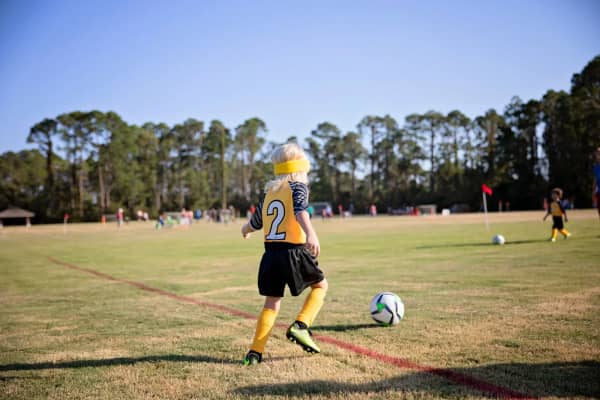
Utah Valley takes youth sports seriously in a way that surprises people who move here. The facilities are better than the population would predict, the participation rate is high, and by the time a child is eight there is a genuine expectation that they are doing something.
What nobody explains on arrival is that there are two entirely separate systems, they cost radically different amounts, and the transition between them is the decision that shapes the next decade of your family's weekends.
The two tracks
City recreation is run by municipal parks and recreation departments. Everyone who registers plays. Seasons are short, practices are local, coaches are usually parents, and registration is a modest fee. The Provo Recreation Center and Orem's recreation programs are the anchors, with every other city in the valley running its own version.
Competitive club is run by private organizations. Rosters are selected by tryout. Training runs most of the year, tournaments involve travel, coaching is paid, and the total annual cost runs into a different order of magnitude.
These are not two intensities of the same thing. They are different commitments for the entire household, and the second one quietly claims Saturdays, holidays and a meaningful share of the family budget.
The useful frame: rec is an activity your child does. Club is something your family does.
Start with the recreation center
The Provo Recreation Center is the obvious first stop and covers a wide range of youth programming, from learn-to-play leagues through swim instruction. Orem, Lehi, American Fork, Springville, Spanish Fork and the north-county cities all run comparable programs, and residency requirements or resident pricing generally apply.
Two things make this track the right default for young children.
The first is cost. A season of city rec soccer or basketball costs a fraction of a month of club tuition, which means a child can try four sports across two years for less than one club season and find out what they like.
The second is proximity. Rec practices are close to home. Club practices are frequently not, and a 30-minute drive four times a week is a commitment nobody counts when they sign up.
For younger children specifically, our guides to toddler activities and family activities in Utah Valley cover the pre-league end, and swim lessons in Provo covers the one skill that is non-optional in a valley full of reservoirs and rivers.
Soccer is the biggest sport, and the most organized
Youth soccer in Utah runs under a statewide structure, with the Utah Youth Soccer Association (US Youth Soccer's Utah state association) acting as the governing body for competitive play. Clubs affiliate through it, which is why registration, rules and discipline feel standardized across organizations that otherwise compete with each other.
Utah County has several established clubs spread across the valley:
- Utah Surf Soccer Club, serving the north-central valley.
- Utah Stars North Utah County Soccer Club, based in Saratoga Springs, serving the fast-growing west side.
- Cracks FC, also in Saratoga Springs, a smaller club.
- Shooters Soccer Club in Benjamin, at the south end of the county,
Ratings across these clubs are worth reading rather than averaging. The positive reviews describe the same things — coaching quality, visible player development, good communication. The negative reviews also describe the same things across different clubs: opaque tryout criteria, limited roster spots for very young age groups, and coaches whose own children are on the team.
That pattern is informative. It suggests the variation is less between clubs than between individual coaches and age groups within them, which is why the single most useful thing you can do is watch a training session for the specific team your child would join.
Gymnastics, tumbling and cheer
Trampoline and tumbling is unusually strong in Utah, and the valley reflects that with several specialized gyms rather than one general one.
High Altitude Tumbling, 2813 South Sierra Vista Way Unit 101 in Provo, runs a broad range: artistic gymnastics (floor, beam, vault and bars), trampoline and tumbling, power tumbling and recreational classes, from very young beginners to competitive athletes. Reviewers describe coaches building confidence in shy and very young children as well as pushing competitive athletes. Phone 801-319-8978; check the posted class schedule for current times.
Utah Valley Trampoline & Tumbling in Orem concentrates on trampoline and tumbling for recreational and competitive T&T teams.
Exceleration Tumbling and Cheer in Orem is the all-star cheer specialist.
The complaints parents raise about gyms anywhere tend to cluster: whether class time is used well in recreational classes, the makeup-class policy, and autopay enrollment and cancellation terms. Those point at exactly the questions every family should ask before enrolling anywhere.
For the full version of that — how to read a gym in the ten minutes you are standing in it, what competitive team costs in money and hours, and where the recreational track is the right answer — see our guide to gymnastics, tumbling and cheer gyms in Utah Valley.
The four questions to ask any gym or club
These come directly from what parents complain about after the fact.
- What is the makeup policy if my child is sick? Policies vary sharply. Some gyms allow a missed class to be made up in another session at no cost; others do not. It costs the gym almost nothing and it matters enormously across a year of childhood illnesses.
- Is billing autopay, and what notice do I need to give to stop? Enrollment that rolls automatically, with a cancellation deadline that falls before a separately charged annual fee, is the mechanism behind most billing disputes.
- What charges exist beyond tuition? Annual program fees, apparel, showcase fees, competition entries and travel are frequently separate line items. Ask for the full-year figure.
- May I watch a complete class first? This is the one that reveals everything. A well-run class uses its time; a poorly run one does not, and no amount of website copy substitutes for watching forty minutes of it.
A gym that answers all four plainly is usually a gym worth joining.
Facilities: better than the market should support
EPIC Sports Park is the valley's large multi-field complex and has hosted national-level youth competition, which is not something most counties this size can say. Our guide to EPIC Sports Park covers the layout and drop-in options.
Two practical consequences follow. Local teams get access to facilities of a standard usually reserved for travel destinations. And on major tournament weekends, traffic, parking and restaurant capacity in the surrounding area are noticeably affected — worth knowing whether or not your child is competing.
Beyond EPIC, the valley's parks carry much of the rec-league load, and the municipal recreation centers handle indoor sports and swimming through the winter.
The cost conversation, honestly
The pattern that catches families is that the jump from rec to club is not a step but a cliff, and it is rarely presented that way at the point of decision.
Tuition is the visible number. The full annual figure adds uniform kit, association registration, tournament entry fees, travel and accommodation for out-of-area tournaments, indoor facility time over winter, and frequently a share of coaching travel. For a family with two children in club sport, the total can rival a significant household expense line.
None of that makes club sport wrong. It makes it a financial decision that deserves the same scrutiny as any other recurring commitment, and one worth revisiting annually rather than renewing by default. Our cost of living guide covers where this tends to sit relative to other household costs in the valley.
Ask specifically what happens if your child is injured mid-season, or if you move. The answer varies, and it is much easier to hear before you have paid.
Specialization, and the pressure to start early
The strongest local pressure is toward starting competitive play young, and it deserves resisting more often than it gets resisted.
Reviews of Utah clubs describe tryouts for seven-year-olds with limited spots. Whatever the intention, selecting rosters at that age sorts children largely by relative maturity rather than by ability, and it produces a cohort effect that is well documented in youth sport generally.
The broader evidence on early specialization is not ambiguous: it does not reliably produce better athletes, and it does raise rates of burnout and overuse injury. Playing several sports through primary-school ages remains the better default, and multi-sport participation is easy to arrange here precisely because the rec system is cheap.
The signal that a child is ready for more is the child asking for more, persistently, across seasons. It is not a coach mentioning that other children are already committed.
The school-sport track, which is cheaper than both
Between city rec and private club sits a third option that gets forgotten because nobody markets it: school sports.
Junior high and high school teams in Utah County cost dramatically less than club programs, practice on site, and require no travel beyond the region's own schedule. For many sports they are also the route that matters competitively at older ages, because school competition is where a great deal of the state's visible athletic achievement happens.
The complication is that in some sports — soccer especially — club and school seasons overlap and clubs discourage divided loyalty. That conflict is worth raising with a club before joining rather than discovering in a child's sophomore year, because the answer differs by organization and is rarely written down.
If school sport is the likely destination, the sensible sequence is rec for the early years, school teams from junior high, and club only if a specific child clearly wants and needs more than school provides.
Registration timing, which catches new arrivals
The calendar is the thing families moving into the valley get wrong in their first year.
Club tryouts for the following season generally happen months before that season starts, and rosters are largely settled before the sport itself is visibly under way. A family that arrives in August and starts researching soccer in September has usually missed the selection window entirely for that year.
City recreation registration is far more forgiving and runs closer to each season, but popular programs and preferred time slots still fill, and swim lessons in particular fill quickly at every recreation center in the valley.
Two habits solve most of this. Register for city rec the week registration opens rather than the week before the season. And if club is a plausible destination, find out the tryout month a full year ahead, because that date governs everything else.
For families new to the area, our moving to Provo guide covers the wider set of things that operate on a calendar newcomers do not yet know.
Officials, and the complaint everyone has
The most consistent negative theme across reviews of youth sports organizations in Utah is refereeing — inexperienced officials, inconsistent calls, and games that get away from them.
The complaint is real and the cause is structural. There is a nationwide shortage of sports officials, which pushes very young and lightly trained referees into competitive matches. The shortage is driven substantially by attrition, and the most-cited reason officials quit is treatment by adults on the sideline.
So it is a loop, and there are only two ways out of it: fewer adults abusing officials, or more adults becoming officials. Both are available to any parent who finds the standard unacceptable. Neither happens from the touchline.
Other sports worth knowing about
Soccer and gymnastics dominate the numbers, but the valley has more than that.
Martial arts in Provo covers a category that suits children who do not thrive in team environments, with progression built into the belt structure. Dance classes are a large scene here in their own right. Swimming runs through the recreation centers and is covered in our swimming guide. And for older students, intramurals and club sports at BYU and UVU are where a lot of Utah Valley athletes end up once school teams finish.
For birthday-party-adjacent one-off activities rather than seasons, kids' birthday parties in Utah Valley covers the gyms and venues that host them, several of which are the same facilities listed above.
What good looks like, from the sideline
A short list of what to watch for once your child is enrolled somewhere, because the enrollment decision is not the last one.
Class or practice time is used. Watch for the ratio of instruction to waiting. Children standing in lines is the most common way a paid hour becomes twenty minutes of activity.
The coach talks to the quiet children. Every group has three children who demand attention and three who do not. How the coach handles the second group tells you what kind of program it is.
Progress is visible over a season, not a week. Skills develop slowly and unevenly, and a program promising fast visible results is usually selecting for children who already had the skill.
Your child talks about it unprompted. This is the single best indicator and it costs nothing to observe. A child who never mentions a sport between sessions is doing it for someone else.
If several of those are missing, changing programs is entirely reasonable and is easier than parents tend to assume. The valley has enough options that no family needs to stay somewhere that is not working out of loyalty.
Who checks a volunteer coach, and who does not
Every fall, several thousand adults in this valley volunteer to coach children they are not related to. Parents reasonably assume somebody has looked into them. Whether anybody has depends entirely on which organization is running the league, and the difference is stark enough to be worth asking about directly before a season starts.
Utah's requirement lives in Utah Code § 53G-11-402, inside Title 53G, Chapter 11, Part 4. It requires a local education agency or a qualifying
private school to put certain people through a nationwide, fingerprint-based
criminal background check with ongoing monitoring as a condition of employment
or appointment — and the category that matters here is explicit: a volunteer
who will be given significant unsupervised access to a student in connection
with the volunteer's assignment. Utah Code § 53G-11-401 supplies the
definitions; the fingerprint check runs through the Bureau of Criminal
Identification under Utah Code § 53-10-201; the federal authority for the
nationwide search is the Adam Walsh Child Protection and Safety Act of 2006,
Pub. L. No. 109-248. Ongoing monitoring for licensed educators sits at
Utah Code § 53G-11-403, and Utah Code § 53G-11-405 requires an employer to
assess employment status when criminal history information comes back. An LEA
may not make the volunteer pay for it.
So a parent volunteering with a junior high team is inside a statutory scheme with fingerprints and continuous monitoring behind it.
A city recreation league is not an LEA. A club team is not an LEA. A church league is not an LEA. None of them is a qualifying private school. Part 4 does not reach them — not as an exemption they were granted, but because the statute was written around school employers and these organizations are not school employers.
What good organizations do anyway
The gap gets filled voluntarily, and unevenly. Some city recreation departments screen every coach. Some club programs run checks through their national governing body. Some leagues screen head coaches and not assistants, which is worth knowing because assistants are frequently the ones running a small group out of sight. Some screen once at sign-up and never again, which is a materially weaker thing than the ongoing monitoring the statute requires of schools.
Four questions get you the real picture, and none of them is confrontational:
- "Are coaches background-checked, and is it a one-time check or ongoing?"
- "Does that include assistant coaches, team parents and anyone who drives?"
- "What is your policy on an adult being alone with a child — at practice, after practice, and in a car?" A written two-adult rule is the single most effective structural protection in youth sports, and it costs nothing.
- "How does a parent raise a concern, and to whom?"
One thing does apply to every adult in every one of these settings regardless of
who runs it. Under Utah Code § 80-2-602, a person who has reason to believe
a child is or has been the subject of abuse or neglect must immediately report it
to the division or to the nearest peace officer or law enforcement agency. Utah
is a universal-reporter state; the duty attaches to knowledge, not to a job
title, and willful failure to report is a class B misdemeanor under
Utah Code § 80-2-609. A league policy that says concerns go to the board first
is describing an internal process, not the law.
Related Guides
- The Provo Recreation Center Guide
- EPIC Sports Park
- Family Activities in Utah Valley
- Swim Lessons in Provo
- Martial Arts in Provo
- Dance Classes in Provo
- Provo for Families
- Homeschooling in Utah Valley: The Affidavit Is Gone, and Most Guides Haven't Caught Up
- Music Lessons in Provo: Inside the Piano-Teacher Economy
- Tutoring in Utah Valley: What It Costs, Who's Actually Qualified, and When You Need It
- Childcare & Daycare Options in Provo (2026)
- High School Football in Utah County: Rivalries and Friday Nights
- Youth Soccer in Utah Valley: Rec, Club, Academy
- Youth Baseball and Softball in Utah Valley
- Summer Camps in Utah Valley
- Youth football in Utah Valley — the two conferences, the weight limits and the flag option
- Swim Teams and Swim Clubs in Utah Valley
Frequently Asked Questions
What is the difference between rec and club sports here?
At what age should a child move from rec to club?
How much does club soccer cost in Utah County?
Which gymnastics gyms are in Utah Valley?
What should I ask a gym before enrolling?
Where do the big tournaments happen?
Are there low-cost options if club is out of reach?
Is the refereeing situation as bad as people say?
Sources
The facts in this guide were checked against these sources. Hours, fees and rules change, so confirm anything time-sensitive with the source before you go. How we make Provo.com.
- Utah Code 53G-11-402: Background checks for non-licensed employees, contract employees, volunteers, Utah State Legislature. Checked October 12, 2026.
- Utah Code 80-2-602: Child abuse and neglect reporting requirements, Utah State Legislature. Checked October 12, 2026.
- Utah Code 80-2-609: Failure to report -- Penalty, Utah State Legislature. Checked October 12, 2026.
- Gymnastics & Tumbling Classes | High Altitude Tumbling | Provo, UT, High Altitude Tumbling. Checked October 12, 2026.
- Homepage - USYS Utah, Utah Youth Soccer Association (US Youth Soccer Utah). Checked October 12, 2026.
- Utah Surf Soccer Club | Competitive Youth Soccer in Utah, Utah Surf Soccer Club. Checked October 12, 2026.