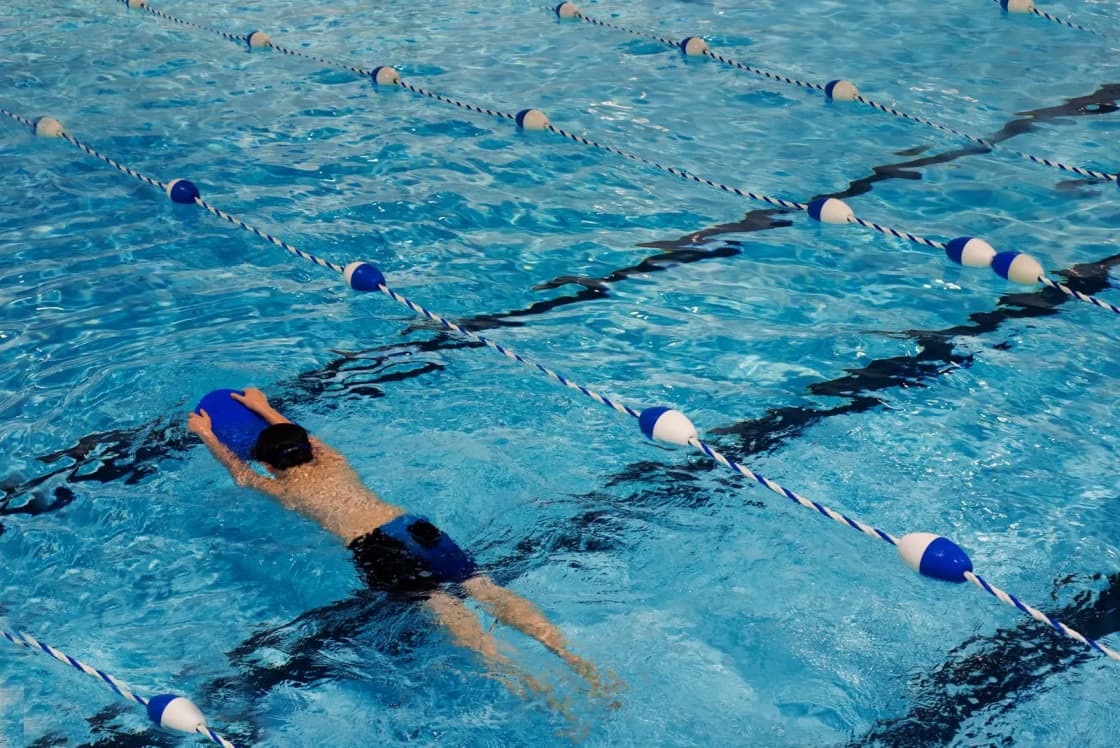

Utah is a landlocked state that spends its summers on the water. Utah Lake is at the bottom of the valley, the reservoirs are half an hour up the canyons, and every neighborhood seems to contain a pool. Which means swimming here is not an enrichment activity. It is closer to a safety requirement with a recreational upside.
The good news is that Provo runs a large, cheap, well-structured municipal swim school. The less good news is that its published information is confusing in a couple of specific ways, and one of the genuinely useful features of the program is buried in a paragraph almost nobody reads.
The main provider, and how it is built
Provo's swim lessons run through Parks and Recreation at the Recreation Center's indoor pool on 500 North. The building itself is covered in our Provo Rec Center guide; this is about the instruction that happens inside it.
The group program is laddered across four bands:
Aqua Tots — the youngest children, with an adult in the water.
Preschool levels one to three — early independent instruction for small children.
Swim School levels one to six — the main progression, from water comfort through the four competitive strokes.
Pre-Swim Team — the bridge for children who have finished the ladder and might go on to a team.
Weekday group classes run thirty minutes, twice a week, across eight classes in a session. Saturday classes run forty minutes across five. Which shape suits you is mostly a scheduling question, though the twice-weekly rhythm generally produces faster progress for a beginner than a single longer weekly class.
Alongside the group ladder sit an adaptive swim school for children with physical or cognitive disabilities, an adult program for ages sixteen and up split into beginner and intermediate or advanced, private lessons from age three, and a set of swim teams — the summer Piranhas, a junior version for younger and less experienced swimmers, an adaptive team, and a year-round Saturday practice group.
There are also certification courses: American Red Cross lifeguard training and a water safety instructor course, both open from the mid-teens, and both a plausible first job for a strong teenage swimmer.
Register for a time, not a level
This is the change that removes the most common barrier and almost nobody has noticed.
You do not need to work out whether your child is a level two or a level three. Provo restructured registration so that you sign up for a time slot only, and an instructor assesses every child on the first day of class and places them in the appropriate group then.
If you have been putting off enrolling because you could not confidently answer a level question on a form, that question is gone. Pick a time that works for your week and let the assessment do the rest.
Two consequences worth expecting. First, the first day is partly administrative — some shuffling happens on the pool deck, and it is normal. Second, in the adaptive program in particular, the city says outright that a child's time slot may change to the other adaptive slot if the instructor judges it a better fit, so build a little flexibility into that first week.
The private-lesson rule that halves the price
Buried in the private-lessons description is a policy that is straightforwardly the best value in the program.
Provo's private swim lessons — thirty minutes, four lessons, from age three — allow you to add one additional participant at no extra charge. You do not register the second person in advance. They are added on the first day.
For two siblings at a broadly similar level, or two friends whose parents split the cost, that turns a private lesson into a semi-private at half price per child. Given that a private session already costs roughly what two group sessions do, a pair of children sharing one lands at close to group pricing with a fraction of the class size.
The obvious caveat is that it only works when both swimmers need roughly the same instruction. Pairing a confident eight-year-old with a nervous four-year-old wastes both halves of the lesson.
This is a genuine, published policy rather than a loophole. It is simply written in a paragraph most people skim.
Read the portal, not the table
A practical warning, and one worth stating precisely because it will save someone a wasted afternoon.
The city's aquatics page carries session tables with dates and weekdays, and those tables are not uniformly current. At the time of writing, the fall listings mix rows that align with this year's calendar with at least one row that does not: a Saturday session is listed as beginning on 13 September, which in 2026 falls on a Sunday. Other rows in the same table line up correctly with 2026.
The explanation is mundane — a page updated section by section across years rather than all at once — and the fix is simple. Treat the online registration portal as authoritative and the printed table as a rough guide. If a date on the page and a date in the registration system disagree, the registration system is the one taking your money.
The same caution applies to fees. The rates published alongside the sessions are real, but they are set by the city and revised, and there is a ten-dollar early-bird discount applied when you register before the posted deadline, which means the number you see may already assume you are early. Check what you are actually charged at checkout.
One more piece of housekeeping: the city changed its recreation software at the end of 2025, and accounts that were not active memberships at that point had to be recreated. If you last registered for something a couple of years ago and your login fails, that is why.
What lessons cost beyond the lesson
Spectators pay. Every person entering the Recreation Center pays admission, and swim lesson spectators are explicitly included — the program description says participants and spectators may not use the facility unless they hold a pass or have paid daily admission. A parent watching from the deck is a paying entrant.
That single rule changes the maths for a family with more than one child in lessons. Across a season of twice-weekly classes, admission at the counter adds up quickly, and a membership frequently comes out ahead. Work it out before the first week rather than after the fourth.
No make-up lessons. The city states plainly that there are no make-ups for missed group classes and none for missed private lessons. A holiday in the middle of a session is a holiday you have paid for.
Resident and non-resident rates. There are two prices for essentially everything, and the gap is consistent. If you live in Provo, make sure your account reflects it.
The kit is minimal, and that is the point. A swimsuit that stays on when a child pushes off a wall, a towel, and goggles if the child wants them — though many instructors prefer beginners to learn without, because a child who will only put their face in the water wearing goggles has learned a conditional skill. Swim caps are not generally required for lessons. Non-swimmers in nappies need a swim nappy, which is a facility rule everywhere and not a Provo peculiarity. Nothing here needs buying in advance beyond what you already own.
Arrive changed. Thirty minutes is short, and a family that arrives five minutes before the hour and changes on site loses a sixth of the lesson to a locker room. Swimsuits under clothes on the way in is the standard local solution, and the reason the changing rooms are quieter than you expect.
What the levels actually teach, and how long they take
Parents consistently expect the ladder to move faster than it does, and then conclude something is wrong. It usually is not.
The earliest band is about water comfort, not swimming. Blowing bubbles, getting the face wet, floating on the back with support, moving along the wall. A child who spends two sessions here has not failed; they have done the part that everything else stands on, and it is the part that cannot be rushed.
The middle of the ladder is where independence appears — unsupported floating, rolling from front to back, and short distances of unassisted swimming. This is the band where most parents relax, and it is also where a child genuinely becomes safer near water rather than just more cheerful about it.
The upper levels are stroke work — refining freestyle and backstroke, then adding breaststroke and butterfly, plus turns, treading water and endurance. Progress here is measured in technique rather than in visible milestones, which is why children who were advancing every session suddenly appear to stall.
Pre-swim-team is the bridge: enough distance and enough strokes to train with a group rather than be taught individually.
A realistic expectation is that a young beginner spends more than one session at most levels, and that repeating a level is the normal case rather than a setback. The children who move fastest are almost always the ones who also swim recreationally between sessions — a family pass and an unstructured hour in the leisure pool does more for a nervous four-year-old than an extra class.
If a child repeats the same level three times, that is the point to change something: a smaller class, a private lesson, or simply a break of a few months. Fear does not respond well to repetition.
The teenage angle: lifeguarding as a first job
Worth flagging separately, because it is one of the better first jobs available in this city and the pathway is not obvious from outside.
Provo runs an American Red Cross lifeguard training course, open to candidates who reach fifteen by the end of the course, covering water rescue, surveillance, first aid, CPR and AED, and producing a two-year certification. Successful candidates are considered for lifeguard and swim-instructor positions with the city.
There is a pre-test, and it is a real one: a continuous 300-yard swim using front crawl or breaststroke, a timed retrieval of a ten-pound object from seven to ten feet of water followed by a twenty-yard swim back holding it with both hands and exiting without a ladder, and two minutes of treading water using legs only. Failing the pre-test disqualifies a candidate from the course, so a teenager should train for it rather than turn up and hope.
A separate water safety instructor course prepares candidates aged sixteen and over to teach swimming and water safety, which is the credential behind the person running your child's class.
For a strong teenage swimmer this is a well-paid, genuinely skilled job that starts earlier than most, and it recycles: a child who came up through Swim School levels one to six is exactly who the city hires back five years later.
Timing, which matters more than anything else here
Swim lessons are the most seasonally competitive children's activity in this city, and the pattern is predictable.
Summer is the crunch. Every family in the valley decides in May that this is the summer the children learn to swim. Sessions fill, and the good time slots go first.
The summer swim team registers in early spring for a season that starts at the beginning of June and runs into late July, with places capped. If your child is aiming at the Piranhas, that is an April decision, not a June one.
Autumn and winter are the quiet windows, and they are the smart ones. The pool is indoors and heated, the sessions are less contested, and a child who learns in October arrives at summer already swimming rather than starting then.
Within any session, the slots that fill first are weekday late afternoons and Saturday mornings — precisely the ones that suit working parents. Register the day the window opens.
And if a session shows full, check again in the last few days before it starts. Cancellations are common.
Where to swim once the lessons are done
Lessons are one part of the picture. Our guide to swimming in Utah Valley covers the pools, splash pads, waterpark and open water across the county, and which suits which swimmer.
When the municipal program is not the right fit
The city program is excellent value and it is not the only option, nor always the correct one.
Private swim schools in Utah Valley run smaller ratios, warmer water and year-round rolling enrollment, at a higher price. For a genuinely fearful child, or one who has stalled at the same level twice, the smaller class is often what unsticks them.
Neighboring municipal programs run on their own calendars, and a family that misses Provo's window can frequently find a place in a nearby city's session. If you are willing to drive fifteen minutes, your effective supply is several times larger.
Private one-to-one instruction — either through the city or independently — is the fastest route for a child with a specific fear or a specific technical problem, and the city's two-for-one rule makes it unusually affordable.
Water safety is not the same as swim lessons. Lessons teach strokes. They do not make a child drown-proof, and no level of instruction substitutes for an adult whose only job is watching. That distinction matters enormously here, because the water this valley actually swims in is not a supervised indoor pool — it is Utah Lake, the Provo River, and the reservoirs up the canyons, all of which are cold, opaque and unlifeguarded in most places people enter them. Cold water disables strong swimmers quickly. A child who can swim twenty-five yards in a warm pool is not equipped for a reservoir in June.
Lessons are the floor, not the ceiling. Life jackets, supervision and a rule about who is watching are what actually keep children safe on the water here.
The short version
Register for a time slot and let the first-day assessment sort the level. Take the early-bird discount. If you have two children close in ability, use the private-lesson rule and put both in one slot. Assume you are paying admission to watch. Book autumn rather than fighting for a June place. And check the registration portal rather than the session table, because at least one row on that table is currently living in a different year.
Related Guides
- Music Lessons in Provo: Inside the Piano-Teacher Economy
- Dance Classes in Provo: The City Studio Nobody Knows About, and How to Read the Rest
- Funeral Homes, Obituaries and Death Records in Utah County: The Practical Guide
- Homeschooling in Utah Valley: The Affidavit Is Gone, and Most Guides Haven't Caught Up
- Childcare & Daycare Options in Provo (2026)
- Tutoring in Utah Valley: What It Costs, Who's Actually Qualified, and When You Need It
- Youth Sports in Utah Valley: City Rec, Club Teams & What It Actually Costs
- Jr. Jazz in Utah Valley: Registration, Fees & the Draft
- Swim Teams and Swim Clubs in Utah Valley
Frequently Asked Questions
Where can my child take swim lessons in Provo?
Do I need to know my child's swim level before registering in Provo?
How much do swim lessons cost at the Provo Recreation Center?
Are swim lesson spectators free at the Provo Recreation Center?
Is there a way to get a private swim lesson cheaper?
When should I register for swim lessons in Provo?
Can adults learn to swim in Provo?
What about children with disabilities?