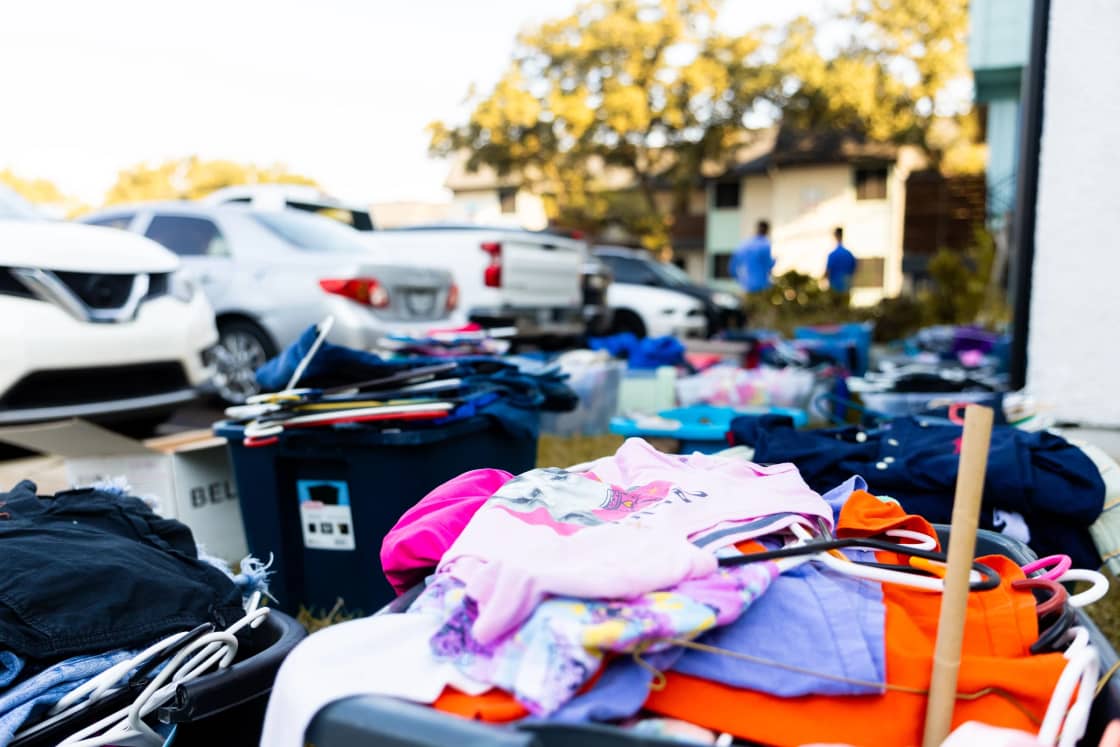

Yard sales in Utah Valley run on a rhythm that has more structure than it looks. There are good weekends and bad ones, predictable neighborhoods, two distinct seasonal peaks, and a set of city rules most people never check until a sign disappears.
This covers both sides — shopping the circuit and running a sale that clears. Permit and sign rules vary by city and change; check your own city's current ordinance before advertising anything.
The season, and its two peaks
The season runs roughly April through October, and it is not evenly distributed.
The spring peak arrives once the weather settles, generally late April into June. This is classic spring-cleaning inventory: garage contents, outgrown children's clothing, furniture being replaced, the accumulated overflow of a winter indoors.
The late-summer peak is the one that distinguishes Utah Valley from most markets. Late July through August, the student housing cycle turns over, and a very large number of people move within a short window. That produces both a flood of goods and a flood of buyers who need to furnish an apartment by the end of the month.
Between and after those, sales continue at lower volume. October sales exist and can be excellent for buyers, because sellers at that point are motivated by not wanting to store things through winter.
Why the student cycle matters so much
In most cities, August is a quiet yard-sale month. Here it is one of the busiest, because tens of thousands of students change addresses inside a couple of weeks.
For buyers, this is the best furniture window of the year. Desks, couches, bookshelves, kitchen equipment and small appliances all come onto the market at once from people who cannot take them and will not store them, and prices fall as the deadline approaches.
For sellers of student-relevant goods, timing a sale into that window is worth more than anything else you can do.
Our guide to furniture shopping in Utah Valley covers this cycle in more depth, including where the market goes when yard sales are not running.
Where the good Saturdays are
Established neighborhoods with older houses generally produce better sales than new subdivisions, for the obvious reason that people accumulate things over time and a five-year-old house has less in it.
Neighborhood-wide and community sales are worth prioritizing over individual ones. Several households in a few blocks means you can park once and walk, and the density improves the odds that something is worth having. These are usually organized through neighborhood associations or community groups and advertised a week or two ahead.
The larger cities produce more volume; the smaller south-county towns produce fewer sales but often less competition among buyers.
Shopping the circuit properly
Go early. The first hour is when the good things sell. If a sale advertises 8 a.m., the serious buyers are there at 7:45.
Carry cash in small bills. Many sellers now take a payment app, but not all, and having exact-ish change makes haggling easier and faster.
Plan a route rather than wandering. Check listings the night before, map the sales, and drive them in geographic order. The difference between a planned circuit and a random drive is several sales in the same morning.
Bring the vehicle you might need. The furniture you find will not fit in the car you brought, every time, unless you thought about it in advance.
Measure first. Know the dimensions of the space you are buying for. The most common yard-sale regret is a piece of furniture that does not fit.
Haggling, calibrated to local norms
Haggling at yard sales is expected here, but the tone matters. Utah Valley sales are neighborhood events as much as commercial ones, and aggressive negotiation reads badly.
Reasonable practice: ask politely, offer a real number rather than a lowball, and buy several things together for a bundled price, which sellers generally prefer because it clears more.
Late in the day, sellers become dramatically more flexible. The last hour of a sale is where the bargains are, at the cost of picking through what is left.
The rules nobody checks
Utah Valley cities set their own rules on garage and yard sales, and they differ. The provisions that commonly exist somewhere in the county include limits on how many sales a household may hold per year, limits on how many consecutive days a sale may run, permit requirements, restrictions on hours, and rules about signage.
Signage is where people get caught. Placing signs in the public right-of-way, on utility poles, on traffic signs or in medians is commonly restricted, and cities do remove them.
None of this is onerous. It just requires ten minutes on your city's website before you advertise. Our overview of what your city can cite you for covers the general shape of municipal enforcement, and the same logic applies across the valley.
Advertising a sale so people come
Local classifieds and community social media groups are the primary channels. Post the night before and again the morning of.
Include the address, the times, and a list of categories — furniture, baby gear, tools, sporting goods. Buyers filter on categories, and a listing that just says "lots of stuff" gets skipped.
Photograph your best items and include the pictures. This is the single biggest improvement most sellers can make, and it costs nothing.
Signs still work, within the rules. Big, simple, readable from a moving car: an arrow and the word SALE. Anything more detailed cannot be read at speed.
Running a sale that clears
Price everything. Unpriced items slow the sale and force you into a hundred separate negotiations. Buyers frequently walk rather than ask.
Price low. The goal is to not own these things anymore. People routinely price yard-sale items at a third of retail, fail to sell them, and store them for another year — which is a worse outcome than selling at a tenth.
Display on tables, not on the ground. Things at waist height sell; things in boxes on the driveway do not get looked at.
Group by category. Kitchen with kitchen, tools with tools, children's clothing by size. Buyers scan for their category and move on if they cannot find it.
Have change ready and a plan for payment apps.
Do not put out anything you are not willing to sell. If you would be annoyed to lose it for five dollars, it belongs inside the house.
What sells here specifically
Utah Valley demand is shaped by its demographics, and the pattern is consistent.
Children's and baby gear sells fast and reliably — strollers, car seats within date, cribs, high chairs, clothing in good condition. Large families and a young population mean constant demand.
Outdoor and camping equipment moves quickly. Tents, coolers, camp chairs, sleeping bags, sports equipment.
Furniture sells, particularly during the student windows.
Tools sell to a reliable and knowledgeable audience.
Adult clothing generally sells poorly, as it does everywhere. Consider donating it rather than pricing it.
Note that safety-recalled items and expired car seats should not be sold at all. Check before putting anything of that kind out.
The alternatives to a yard sale
A yard sale is not always the right vehicle.
Consignment suits higher-value items — quality furniture, brand-name children's gear, sporting goods — where a yard sale would leave money on the table. Kids' consignment events in particular are well established in this valley.
Resale apps and local classifieds suit single valuable items that deserve their own listing and a buyer who came specifically for them.
Thrift donation suits the volume of low-value goods that would not repay the effort of pricing. Our guide to thrift and secondhand shopping in Provo and Orem covers where donations go and where the resale market operates.
Free listings clear bulky items fast when disposal would otherwise cost you money — and our guide to getting rid of the big stuff covers what to do with the things nobody wants at any price.
The neighborhood-sale advantage
If you can get several households on your street to sell on the same morning, do it. The arithmetic strongly favors it.
A single yard sale has to persuade someone to make a special trip. Six sales in three blocks becomes a destination, gets shared more widely, and draws buyers who would not have driven out for one. Everybody's traffic goes up.
Organizing one is not complicated: agree a date, agree a start time, split the cost of advertising, and post it as a single listing with the street name rather than six separate addresses.
Church and community groups organize these regularly in this valley, and joining an existing one is easier than starting your own.
Multi-family sales at one address
The related trick is combining several households' goods at one house. This works particularly well when one household has the better location — a corner lot, a busier street, easier parking.
Agree the money question in advance. The usual approaches are colored stickers or initials on price tags with a tally at the end, or simply splitting the total. Both work; not deciding until the end does not.
It also solves the volume problem. A sale needs enough inventory to look worth stopping for, and one household clearing a closet rarely has it.
Buying for a specific need
The circuit rewards people who know what they are looking for.
If you are furnishing a first apartment, go in August, bring a truck and a friend, and expect to fill it. If you are buying baby gear, go in spring when families are clearing outgrown equipment, and check that anything with an expiry or recall history is current. If you want tools, get there at opening — tools go first and to the same handful of regulars.
If you want camping gear, go early in the season rather than late; people sell it in spring when they realize they did not use it last year.
Pricing, in more detail
The most common seller error is anchoring to what something cost new. Buyers do not care what you paid; they care what it is worth to them on a driveway on a Saturday.
A workable rule for ordinary household goods is somewhere between a tenth and a quarter of current retail, depending on condition and desirability. Furniture and tools support the upper end. Clothing, books and decorative items sit at the bottom.
Round numbers move faster than precise ones. A table of items at one, two and five dollars sells more than a table priced at $1.75 and $3.25, because buyers can add it up in their heads and because it speeds every transaction.
Bundle deals clear volume: fill a bag for five dollars, all books for a dollar each or ten for five. Late in the day, make the bundles more generous rather than dropping individual prices.
Weather, and the reschedule question
Spring in Utah Valley is unreliable. Wind is the more common problem than rain, and a windy Saturday will scatter a clothing table across the neighborhood.
Set a rain date when you advertise rather than deciding on the morning. If you have to cancel, update the listing immediately — people will drive to your address otherwise, and they will be annoyed.
Late summer is the most weather-reliable window of the season, which is another argument for the August peak.
Kids' consignment, which is a separate institution here
Worth understanding as its own thing, because in Utah Valley it is bigger than the yard-sale market for children's goods.
Seasonal consignment sales — where many families bring tagged children's clothing, gear and toys to one large venue for a few days — are well established across the valley. Sellers tag their own items, the event handles the selling, and the seller takes a percentage.
For anyone with a volume of good-condition children's items, this reliably returns more than a yard sale would, because the buyers are there specifically for that category and the event does the marketing.
The trade-off is preparation: tagging is real work, there are condition standards, and drop-off and pick-up windows are fixed. For a bag of mixed clothing it is not worth it. For a garage of good gear it clearly is.
Estate sales are a different animal
You will see estate sales advertised alongside yard sales, and they operate differently.
They are usually run by a company for a percentage, they often include the entire contents of a house, prices are set rather than negotiated on the first day, and there may be numbered entry.
For buyers they are worth attending for furniture, tools and household goods of a quality that rarely appears at a yard sale. Prices are firmer early and drop substantially on the final day.
For sellers, they suit clearing a whole household rather than a garage, and the companies that run them will tell you whether your contents justify it.
What this all costs you in time
An honest accounting, because people underestimate it.
Running a sale is a full day plus most of an evening beforehand: sorting, pricing, hauling tables, making signs, posting listings, then six hours on the driveway and an hour of cleanup.
For a typical household sale, the return is modest. If your goal is purely money, selling a few valuable items individually online will usually beat it for far less effort.
The reason to hold a yard sale anyway is that it clears volume in a single day, which nothing else does, and it does so without you having to transport it anywhere. Judge it on that and it is a good deal. Judge it on hourly return and it is not.
Safety and common sense
Do not leave the cash box unattended, and do not keep large amounts of cash visible.
Keep the sale to the driveway and garage rather than inviting people into the house. If someone asks to use the bathroom or see something inside, it is entirely reasonable to say no.
Have a second person present if you can, particularly at the start and end of the day.
Parking, neighbors and not becoming the problem
A successful sale generates traffic on a residential street, and that is your neighbors' street too.
Keep buyers off driveways that are not yours. Do not let parking block the road so residents cannot get out. If you expect volume, tell the immediate neighbors a few days ahead — most will not mind and some will join in.
Wrap up at the advertised time rather than letting a sale trail into the evening, and clear the signs afterward. Leaving signs up all week is the fastest way to make a city tighten its sign rules.
None of this is complicated. It is the difference between a neighborhood that welcomes yard sales and one that starts complaining to the city about them.
The end-of-day plan
Decide before the sale what happens to the leftovers, and be specific about it.
The default outcome — everything goes back into the garage — is how most yard sales fail at their actual purpose. You did not hold a sale to make forty dollars; you held it to have less stuff.
Book a donation drop-off for the same afternoon, or list the remainder free that evening. Both work. Deciding on Saturday at 2 p.m. does not.
Frequently Asked Questions
When is yard-sale season in Utah Valley?
Do I need a permit to hold a yard sale?
Can I put signs on street corners?
What day is best?
What time should I open?
What sells best here?
Where do I find sales to shop?
What should I do with what does not sell?
Sources
The facts in this guide were checked against these sources. Hours, fees and rules change, so confirm anything time-sensitive with the source before you go. How we make Provo.com.
- Ordinance No. 08-10-42, Chapter 5.32 Yard Sales and Similar Activities, American Fork City. Checked October 12, 2026.