
On December 2, 1984, ABC interrupted its own football coverage to run a phone poll. Viewers were invited to call one number for yes and another for no, at fifty cents a call, to answer a single question: should BYU be ranked number one?
Think about that for a second. A national broadcast network asked the American public to vote, by telephone, on whether a school in Provo, Utah deserved to be at the top of the college football poll. Nothing like that happens to a team that everyone agrees about.
Nineteen days later BYU beat Michigan in the Holiday Bowl to finish 13-0, and a few days after that the final polls made it national champion. Forty-plus years on, it remains the single most argued-about title in the sport, and — for reasons that have nothing to do with Provo — it has become more relevant with time rather than less.
The season, briefly
BYU entered 1984 unranked. It was coached by LaVell Edwards, then in his thirteenth season, with Robbie Bosco at quarterback and an offense that ran a passing scheme far ahead of what most of the country was doing.
The Cougars opened by beating Pittsburgh, then destroyed Baylor 47-13 in week two (Baylor's coach, Grant Teaff, became the first to cast a number one vote for the Cougars) and followed with a 38-15 win over Tulsa. Three weeks in, BYU was already sixth in the AP poll.
Meanwhile the top of college football kept collapsing. Seven different teams held the number one spot during the 1984 season.
BYU kept winning. The rankings record for the season reads like a stock chart: unranked, then 12th, 6th, 4th, back to 8th, 5th for two weeks, 4th, 3rd, 4th again, 3rd, and finally first.
The Cougars reached number one on November 17, after beating Utah 24-14 in Salt Lake City, and only because two other things happened the same day: Nebraska lost to Oklahoma, and Navy upset then-second-ranked South Carolina, which had been unbeaten.
BYU closed the regular season 12-0, finishing with a 38-13 win over Utah State. It was the only undefeated team in Division I-A.
The bowl problem
Here is where the story turns, and it turns on a contract rather than on anything that happened on a field.
As WAC champion, BYU was obligated to play in the Holiday Bowl. The Holiday Bowl was a young game, not one of the top-tier New Year's Day bowls, and it did not have the pull to attract a marquee opponent. Highly ranked teams were reportedly approached about facing the nation's only undefeated team. None accepted.
So BYU got Michigan, and Michigan was the worst of both worlds for a team trying to prove something. The Wolverines came in 6-5 and unranked, having fallen out of the top twenty in early October. Beating them would add nothing to BYU's strength of schedule.
But Michigan was not a bad team so much as a wrecked one. Bo Schembechler's roster had beaten Miami earlier that year and was 6-5 largely because of injuries.
The date compounded it. The game was December 21 — before the New Year's Day bowls, not after. BYU would finish its season and then sit there, done, while the games that could change voters' minds were still to be played.
December 21, 1984
The Holiday Bowl was played at Jack Murphy Stadium in San Diego.
Bosco left in the second quarter with an ankle injury. He came back taped and played much of the rest of the game from the shotgun. BYU scored a late touchdown to win 24-17.
It was not a statement performance, and everyone involved knew it. A 13-0 team had beaten a 6-5 team by seven points. Michigan finished 6-6.
What BYU had, going into the wait, was three things: the only unbeaten record in Division I-A, a two-year winning streak, and a bowl win over a program with a name.
The wait
This is the part of the story people forget, and it is the strangest part.
BYU's season was over on December 21. The title was not decided until the final polls came out after the New Year's Day games. So the players watched.
They watched fourth-ranked Washington beat second-ranked Oklahoma in the Orange Bowl. They watched fifth-ranked Nebraska handle eleventh-ranked LSU in the Sugar Bowl. They watched eighteenth-ranked USC beat sixth-ranked Ohio State in the Rose Bowl. Third-ranked Florida was banned from postseason play over NCAA violations and did not play at all.
Every one of those games was a chance for someone to make a case BYU could not answer, because BYU was finished.
The skepticism had started well before that, from broadcasters and rival coaches who questioned whether a WAC team belonged at the top.
Washington won decisively. It was not enough.
The final vote, and how close it was
In the final AP poll, BYU received 1,160 points with 38 first-place votes. Washington received 1,140 points with 16.
Twenty points. One of the tightest finishes in the poll's history.
BYU was also number one in the coaches poll, and was named champion by the Football Writers Association of America and the National Football Foundation. In 1984 that constellation of votes was the national championship. There was no playoff, no title game, no committee.
Washington finished 11-1 with a win over Oklahoma. Its supporters have never fully let it go, and it is not hard to see why. The counter-argument is equally simple: BYU did not lose.
The case against, stated fairly
An honest page has to make the skeptics' argument properly, because it was a serious one.
Nobody BYU beat finished ranked. Not one of the thirteen.
The combined record of BYU's opponents was 61-85-3. That is a schedule of teams with losing records in aggregate.
Only two BYU opponents made a bowl out of the eighteen games offered that postseason: Air Force and Michigan. And Michigan was there at 6-5.
The conference was suspect to voters. The WAC was playing a pass-heavy style that a lot of the establishment regarded as gimmicky rather than as the future — which, given what college and professional offenses look like now, has aged into one of the funnier parts of the story.
The bowl was not a real test. A seven-point win over a .500 unranked team is not the performance you point to when defending a championship.
Against all of that sits one fact that does not move: BYU played thirteen games and won thirteen games, which is the only thing any team is ever able to do.
The offense the voters held against them was the one everybody copied
This is the part that has aged most spectacularly.
A recurring objection in 1984 was that the WAC played an unconventional, pass-heavy brand of football that inflated numbers and did not translate against real defenses. That was a mainstream view at the time. College football's establishment ran the ball, and a team throwing it forty times a week looked like a team gaming a soft league.
LaVell Edwards had been building that system in Provo since the early 1970s, and the roll call of quarterbacks it produced is the counter-argument by itself: Gifford Nielsen, Marc Wilson, Jim McMahon, Steve Young, Robbie Bosco, and later Ty Detmer, who won the Heisman in 1990. That is not a fluke of one gifted passer. That is a system reproducing a result across two decades and a series of different players.
What Edwards was doing — timing routes, quick reads, using the pass to control the game rather than as a desperation measure — is close to unremarkable now because everyone does a version of it. The offense that made voters suspicious of BYU in 1984 is, in outline, the offense that took over the sport.
Two things follow from that. First, the strength-of-schedule objection to BYU was reasonable and the stylistic objection was not; they got bundled together at the time and they should be separated now. Second, the reason BYU could go undefeated against that schedule is not only that the schedule was soft. It is that BYU was running an offense several years ahead of most of the teams lining up across from it.
The phone poll, and what it says about the moment
Go back to that December 2 broadcast, because it is the best single artifact of how strange the situation was.
ABC was carrying the Iron Bowl and the Florida–Florida State game. Between them, the network put up two 1-900 numbers and asked viewers to phone in on whether BYU should be number one. Fifty cents a call. By the fourth quarter of the second game, enough people had dialed in to declare a result on air.
Set aside who won the phone poll. The revealing thing is that it happened at all. A television network treated the ranking of a specific team as a live national controversy worth polling the audience about, in real time, during unrelated games.
BYU had been number one in the AP poll since November 17 and would stay there through the December 4 poll, the last of the regular season. The school knew it was playing for a championship in the Holiday Bowl. What it did not have was consent — the sense, which normally attaches quietly to a number one team, that everybody agreed it belonged there.
That is the actual texture of BYU's 1984: not a team sneaking up on anyone, but a team that spent six weeks at the top of the poll while the country openly debated whether it should be allowed to stay.
What it meant here
Provo in 1984 was a smaller and considerably less-noticed place than it is now. There was no Silicon Slopes. Utah Valley's national profile was a university, a steel mill and a lake.
A national championship in the most-watched college sport in America did something to that, and people who lived here then will tell you so without prompting. It is the reason BYU football occupies the civic position it does in this town, why fall Saturdays reorganize traffic across two cities, and why a stadium named after a coach is a landmark rather than just a venue.
It also produced a durable local personality trait. Provo's relationship with national attention has a chip in it, and 1984 is where a lot of that chip comes from — the experience of being the best team in the country and being asked, on television, to justify it.
Why the argument got bigger instead of smaller
For decades this was a fun local grievance and a national footnote. Then it became something else.
After 1984, every subsequent national champion for a very long run came from what are now called the power conferences, plus independent Notre Dame — until 2017 UCF, whose claim was self-declared rather than voted, and which is a different kind of case entirely.
That single fact converted BYU 1984 from a disputed title into the reference point in the access argument. Every time someone asks whether a school outside the biggest conferences can win the whole thing, the answer has been the same for four decades: once, in 1984, and people are still mad about it.
The irony is that the strength-of-schedule objection that nearly cost BYU the title in 1984 is the same objection that, structurally, kept teams like BYU out of contention for the next thirty-plus years. A school that cannot schedule top-ten opponents cannot build a top-ten resume, and a school without a top-ten resume does not get the benefit of the doubt. BYU won anyway, in the one year the entire top of the sport fell apart simultaneously.
BYU now plays in the Big 12, which changes that math permanently, and the playoff era changed the mechanism entirely. Neither of those things retroactively settles 1984. They just make it the last artifact of a system that no longer exists.
The Heisman footnote that says a lot
1984 was Doug Flutie's year. Boston College's quarterback threw the most famous pass in college football history against Miami that November and won the Heisman Trophy comfortably.
Robbie Bosco finished third, behind Flutie and Ohio State's Keith Byars.
Read those two facts next to each other and the shape of 1984 comes into focus. The quarterback of the only undefeated team in the country, throwing in the most advanced passing offense in the country, finished third in the individual award voting — while his team finished first in the poll by twenty points over a one-loss team.
Both results came from the same electorate, in the same weeks, using the same information. The voters were willing to hand BYU the biggest prize in the sport and unwilling to hand its quarterback the individual one. That is not a contradiction so much as a portrait of a group deciding something reluctantly, on the strength of a record it could not argue with, about a program it did not quite believe in.
Where to stand in Provo and think about it
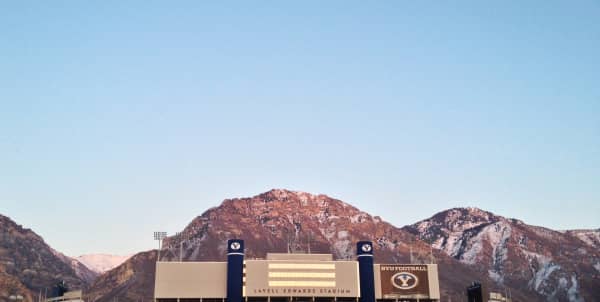
The 1984 team played its home games at Cougar Stadium, which is the building now called LaVell Edwards Stadium. It was renamed for the coach in 2000, while he was still alive.
It is still BYU's home stadium, and it is a good place to visit outside a game — our stadium guide covers access, tours and the bag rule that catches out first-time visitors. If you are coming for an actual game, the game day guide and the parking guide will save you more time than anything else on this site. Our 2026 season preview covers the current schedule.
For visitors who want the wider campus rather than the stadium specifically, the BYU campus visitor guide is the place to start, and the BYU guide to Provo covers the town side of a football weekend.
The short version
BYU went 13-0 in 1984 under LaVell Edwards, reached number one on November 17 after Utah lost and two teams above them stumbled on the same afternoon, and finished the job on December 21 with a 24-17 Holiday Bowl win over an unranked 6-5 Michigan team, Robbie Bosco playing the second half on a taped ankle. Because the WAC champion was locked into a December bowl, BYU then had to wait through the New Year's Day games it had not been invited to. The final AP poll gave it the title over Washington by twenty points, 1,160 to 1,140. The objections were legitimate — no ranked opponents, a 61-85-3 combined schedule — and the answer was equally legitimate: thirteen games, thirteen wins. It remains the last time a team from outside the sport's biggest conferences was voted national champion, which is why an argument about a bowl game in San Diego is still going.
Related Guides
- LaVell Edwards Stadium: The Building and the Name
- BYU Football Game Day Guide
- BYU Football Parking & Game-Day Traffic
- BYU Football 2026: Schedule and Season Preview
- The BYU Guide to Provo
- Visiting BYU Campus
- A Short History of Provo
Frequently Asked Questions
Did BYU win the 1984 national championship?
Who did BYU beat to win the 1984 national championship?
How close was the final 1984 AP poll?
Why was BYU's 1984 schedule considered weak?
Who was BYU's quarterback in 1984?
Was the 1984 Holiday Bowl really the only December national championship game?
Why does BYU's 1984 title still get argued about?
Where did BYU play its home games in 1984?
Sources
The facts in this guide were checked against these sources. Hours, fees and rules change, so confirm anything time-sensitive with the source before you go. How we make Provo.com.
- 1984 National Championship, BYU Athletics. Checked October 12, 2026.
- Football Facilities, BYU Athletics. Checked October 12, 2026.
- BYU's 1984 championship team is still unlike anything we've seen, theScore. Checked October 12, 2026.