
Most college football stadiums are named for a donor, a president, or a place. This one is named for a man who took a mediocre football program in a valley nobody recruited and spent twenty-nine seasons turning it into something the rest of the country had to schedule around.
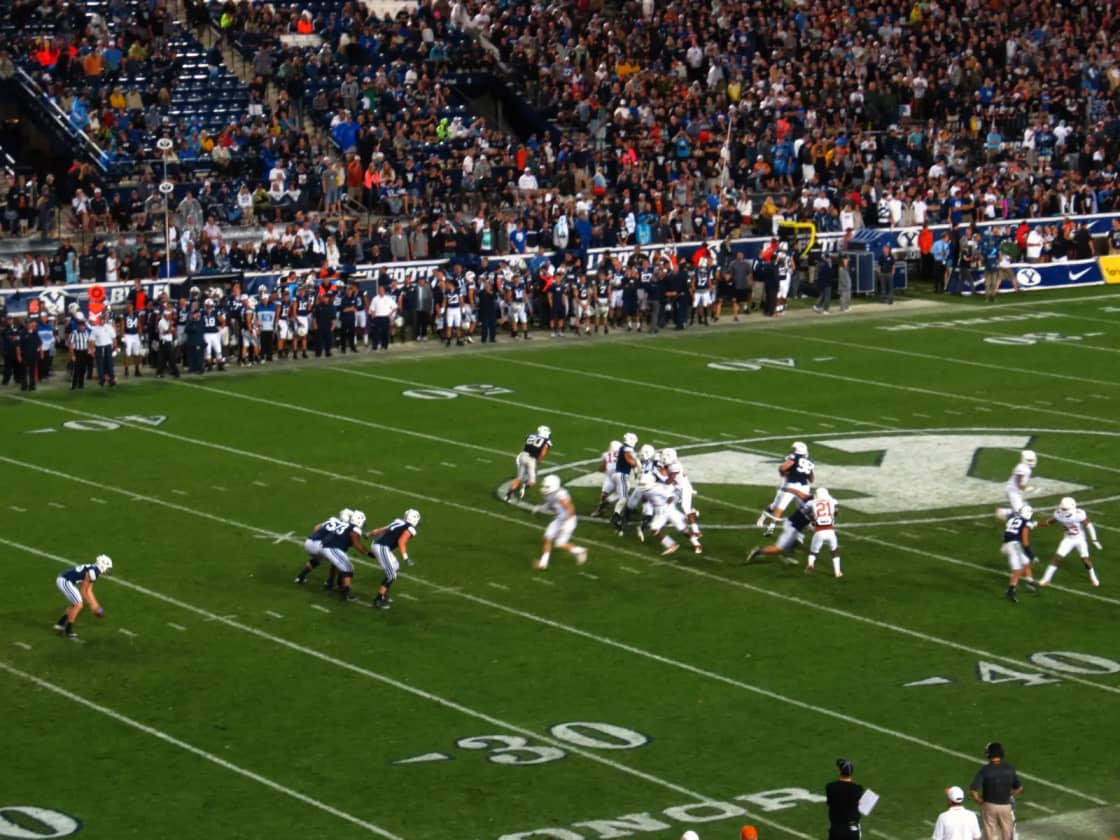
The building itself is unusual too, though not in the way modern stadiums try to be. There is no upper deck. There is no ring of suites stacked into the sky. It is a single-tier bowl dropped into the north end of a university campus, with a mountain behind one end zone and the Wasatch Front filling the view from the other side. On a clear September evening it is one of the genuinely beautiful places to watch a football game in America, and it manages this without a single architectural flourish.
This page covers the building and its story — where it came from, how it grew, and the practical rules that catch visitors out. For getting a car near it, the BYU football parking guide is the detailed version and this page will not duplicate it. For the full experience of a game day from morning to postgame, BYU football game day covers the wider day.
The orchard
Before there was a stadium here there was fruit.
BYU's football teams played at Hillside Stadium, on ground where the Joseph Smith Building now stands, and then at a small facility of about 5,000 seats that also carried the Cougar Stadium name. By the early 1960s the university had outgrown both.
Ground broke in October 1963 on an orchard at the north edge of campus. The architect was Fred L. Markham. The new Cougar Stadium opened in October 1964, and BYU lost the opener to Utah — a detail the record keeps and the marketing does not.
Its original capacity is one of those numbers that depends on who is counting. BYU's own facilities page says 45,000, which includes temporary bleachers thrown up behind each end zone. The permanent bowl was closer to 28,000–30,000. Both figures circulate; neither is wrong, they are just measuring different things.
For its first eighteen years the field was ringed by a running track. The stadium hosted the NCAA Track and Field Championships in 1967 and 1975.
The 1982 expansion, which is the reason it looks like it does
In 1982 BYU did something more drastic than bolting on seats. It lowered the entire playing field by eight feet, tore out the running track, and built permanent concrete stands in both end zones where the temporary bleachers had been.
Dropping the field is why the sightlines work. It is also why the bowl feels tighter than its capacity suggests — you are looking down into it rather than across it.
Capacity went past 65,000. The first game in the expanded stadium, on 25 September 1982, drew 64,253, reported at the time as the largest gathering in Utah history.
Everything since has been subtraction. Club seating in 2003 took it to 64,045. Wheelchair accessibility work in 2010 and 2011 brought it to 63,725 and then 63,470. The 2024 renovation — new natural grass, new LED lighting, remodeled suites, updated club areas — settled it at 62,073.
Which produces one of the better pieces of trivia in the building: the attendance record is 66,247, set against Notre Dame in 1993, and it can never be broken. The stadium is more than four thousand seats smaller than it was that night. Short of another expansion, that number is permanent.
A note on which official number to trust
Here is something worth knowing before you quote a capacity figure for this building.
BYU publishes it in more than one place, and the places disagree. The athletics facilities pages give 62,073. The university relations page has continued to carry 63,470, the pre-2024 figure. Wikipedia and most current fan guides use 62,073; a fair number of travel listings still print 63,470.
This is the same trap that runs through a lot of Utah Valley research: the fact that a source is the official host does not mean that particular page has been updated. BYU's campus map and BYU's driving directions disagree about University Parkway's address number for the same reason. When official sources conflict, the question to ask is which page somebody has a reason to maintain — and for a stadium capacity, that is the athletics department.
Who LaVell Edwards was
The short version is that he was promoted from defensive coach to head coach in 1972, at a program with no particular history, and was widely assumed to be a placeholder. He was also a local: born in Orem, five miles from the campus, and one of the few genuinely homegrown names on our list of famous people from Provo and Utah Valley.
He stayed twenty-nine seasons. He had one losing season in all of them. He took BYU to 22 bowl games, won ten straight conference championships, and in 1984 won a national title with a team playing a schedule the rest of the sport did not take seriously. Along the way the program produced Jim McMahon, Steve Young and Ty Detmer — a passing tradition in a place that, before Edwards, had no offensive identity at all.
The renaming happened in 2000. At the start of Edwards' final home game, Gordon B. Hinckley announced to the crowd that Cougar Stadium would become LaVell Edwards Stadium. It was announced in the building, to the people in it, before the game he was retiring from. That framing is why it registers as a moment rather than an administrative act.
The bag rule, which is the practical reason to read this page
If you take one thing from this guide, take this.
LaVell Edwards Stadium runs a no-bag policy, and it is not a clear-bag policy.
This matters because most of college football has spent a decade training fans in the opposite direction. Clear bags are the norm across the SEC, the Big Ten and much of the Big 12. A visiting fan arrives in Provo holding the regulation clear tote that has worked at every other stadium they have been to, and is turned away at the gate.
What is actually permitted:
- A small clutch, no larger than 5 x 8 x 1 inches, with or without a handle or strap. One per person.
- Medically necessary bags and diaper bags, after inspection at a designated gate.
That is the list. Not backpacks, not purses, not totes, not fanny packs, not clear bags. BYU did use a clear-bag policy starting around 2018 and moved to the stricter rule afterwards, which is part of why the wrong information persists in older guides.
Two aggravating details:
There is no general bag-check. The stadium does not run a storage service for rejected bags. If yours does not fit the rule, the answer is to walk it back to your vehicle, which on a Provo game Saturday may be a long way away.
No outside food or drink. Including sealed, unopened water bottles.
Also on the prohibited list: personal stadium chairs and seat cushions brought from home. Chair-back rentals are available inside on a per-game basis. And professional camera equipment requires a media credential — an enthusiast with a long lens will be turned around.
One important separation: Stadium of Fire uses this same building on the Fourth of July, and it runs its own entry rules under the Freedom Festival rather than BYU Athletics. They have historically been similarly strict, but they are not the same policy and they are not published in the same place. Check the one that matches your event.
Because these rules do get revised between seasons, confirm on byucougars.com before you travel rather than trusting any guide, including this one.
The dry campus rule is real
BYU is a dry campus. There is no alcohol in the stadium, on the concourses, or in the parking lots — and that includes tailgating areas, which is the part visitors most often assume must have an exception. It does not. The policy also covers tobacco, e-cigarettes and vaping.
Fans who have been to Provo generally report that this makes the atmosphere unusual rather than diminished. Visiting supporters routinely come away describing the crowd as almost aggressively friendly — sincere questions about how your team is doing, thanks for making the trip, occasionally your own school's motto quoted back at you. Whether that is a feature depends on what you came for.
The setting, which is the actual argument for coming
Modern stadium design tends to wall the outside world off — deck the sides, ring the top, make the building the entire visual field. LaVell Edwards Stadium does the opposite, mostly by accident of never having been rebuilt.
It is a single tier. The field runs north to south. The press box sits on the west side, and end-zone stands close the north and south ends. From anywhere on the east side you are looking across the field at the Wasatch Front, and Y Mountain stands over the south end with the whitewashed Y on it — a 380-foot letter that predates the stadium by half a century.
The consequence is that this is a stadium where the view out is part of the experience. At a late-afternoon September kickoff, with the light coming down the range, it is as good as college football scenery gets in the United States. It is also why photographs of this stadium are almost always taken from the same side.
The practical version of the same fact: the west side gets shade earlier. For an early-season afternoon game, that is worth more than a better yard line, because Provo in early September is genuinely hot and the bowl holds it.
Weather, at 4,500 feet
Provo sits at roughly 4,500 feet, and the football season runs from late August to late November. That is a wider swing than visitors plan for.
Early season, late August through September. Hot and dry, with strong high-altitude sun. An afternoon kickoff can sit in the eighties or higher, and the sun is doing considerably more work than the temperature suggests. Sunscreen matters more here than the thermometer does. Remember there is no outside water allowed in, so budget for buying it.
October. Generally the best football weather of the year, and pleasant enough that people underdress for the evening. Once the sun goes behind the west stands the temperature drops fast.
November. Cold, and occasionally properly cold. A late-November night game in Provo can sit near or below freezing with wind coming off the mountains. Layers, not one heavy coat — the bowl is exposed and there is nowhere warm to retreat to.
The single most reliable piece of advice across the whole season: the temperature at kickoff is not the temperature at the fourth quarter, and the difference is bigger here than at sea level. Dry mountain air sheds heat quickly once the sun is off it.
Note also that seat cushions from home are not permitted, and the seating is aluminum bench in much of the bowl. Chair-back rentals inside are the sanctioned solution.
The crowd, and the student section
The ROC — BYU's student section — fills the north end and is where the volume comes from. It is a genuinely loud student section in a stadium built as a bowl, which concentrates it.
The wider crowd is the thing visiting fans write home about. The consistent report from opposition supporters is that the atmosphere here is friendly to a degree that is initially disorienting: sincere questions about how your season is going, thanks for making the trip to Provo, occasionally someone quoting your own school's motto back at you. Smack talk is close to absent.
Some of that is the dry-campus rule doing structural work. Most of it is who lives here. Either way, if you are bringing children or older relatives to their first away game, this is an unusually low-friction place to do it.
One tradition worth timing your arrival for: Cougar Walk, where the team walks through the assembled crowd into the stadium before the game. It costs nothing and it is the closest thing to a guaranteed good moment on the schedule.
It is not only a football stadium
The building's biggest single night of the year is frequently not a football game.
Stadium of Fire — the Freedom Festival's Fourth of July concert and fireworks show — fills the stadium every summer and has done since 1980. It is one of the largest Independence Day events in the country, and for a lot of Utah County residents it is the only time they ever set foot in the building.
The crucial practical distinction, and the one that causes real problems: Stadium of Fire is not run by BYU Athletics. It is a Freedom Festival event using BYU's venue. Entry rules, bag rules, what you can bring and what time gates open are published by the festival, not by the athletics department, and they are not identical. People who know the football rules cold have turned up to Stadium of Fire and been caught out, and vice versa. Check the rules for the event you are actually attending.
The stadium was also home to BYU track and field until 1982 and hosted the NCAA Championships twice before the track came out.
The one date where the stadium is not the only plan
Halloween 2026 falls on a Saturday and BYU hosts Arizona State that evening, so the building empties into residential north Provo on the night of the year with the most children walking near the road. If you are attending that game, or live nearby, the Halloween-night breakdown covers which streets carry the load.
What to do with the rest of the day
The stadium sits on the north end of campus, which puts a great deal within walking distance.
Cougar Canyon, directly west of the stadium, opens for pre-game several hours before kickoff. The Backyard at Cougar Canyon sits south of the stadium across University Parkway on Helaman Fields. Both are free-to-enter gathering areas rather than ticketed events.
For food, where to eat before a BYU game is the specific version, and the downtown options along University Avenue are a short drive south. A dedicated gluten-free stand has operated inside the stadium in the southeast corner.
If you are making a weekend of it, the BYU campus visitor guide covers the museums — four of them, free — and the Creamery, and hotels near BYU covers where to stay, with the honest note that very little is genuinely walkable to the stadium.
One small human detail worth knowing: complimentary earplugs are available from ushers at football games, on request. If you are bringing a young child to their first game, that is a better piece of information than most seating advice.
Getting there without a car
The UVX bus rapid transit line has a BYU Stadium station. UVX runs the spine of the valley — downtown Provo, the BYU area, University Place, UVU — and connects to both FrontRunner commuter rail stations, which is what makes the Salt Lake day trip practical.
The fare detail matters and it is wrong in a lot of older writing: UVX has not been free to the general public since August 2024. Current BYU and UVU students still ride at no charge with a school ID. Everyone else pays.
On a game Saturday, transit is frequently the better answer than a car, and the parking guide makes the same case in more detail.
The short version
It started as an orchard, opened in 1964 with a loss to Utah, and became what it is now because BYU dropped the field eight feet in 1982 and tore out a running track.
It carries the name of a coach who was expected to be a placeholder and stayed twenty-nine years, announced to a crowd at his last home game rather than in a press release. It is the largest stadium in the Big 12 at 62,073, a figure BYU's own website does not consistently agree with, and its attendance record was set in 1993 and can no longer be broken.
And if you are coming to a game: leave the clear bag at home. It is not that kind of stadium.
Related Guides
-
BYU Football 2026: The Complete Schedule, Home Games, and Season Preview
-
AJ Dybantsa vs. Darryn Peterson: How the 2026 NBA Draft Left Utah Caught in the Middle
-
The Visiting Fan's Guide to Provo: What Big 12 Fans Should Know (2026)
-
BYU 1984: The National Championship Nobody Wanted to Give Away
Frequently Asked Questions
What is the capacity of LaVell Edwards Stadium?
What is the bag policy at LaVell Edwards Stadium?
Why was it renamed from Cougar Stadium?
Can you buy alcohol at LaVell Edwards Stadium?
What was the largest crowd ever at LaVell Edwards Stadium?
How do you get to LaVell Edwards Stadium without driving?
Is LaVell Edwards Stadium only used for football?
Where should first-time visitors sit?