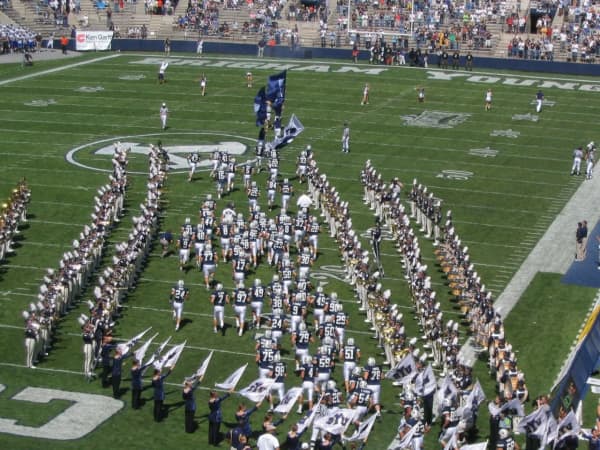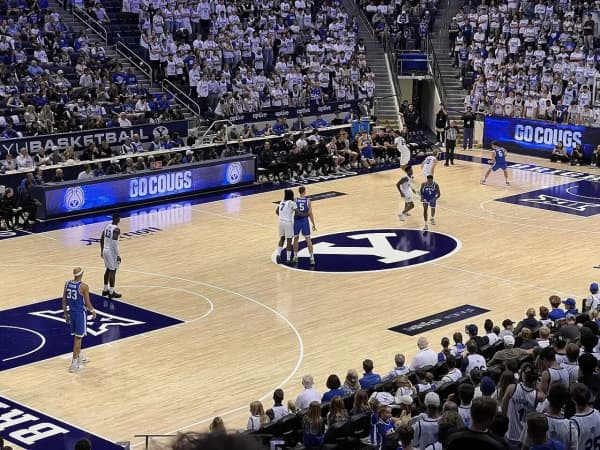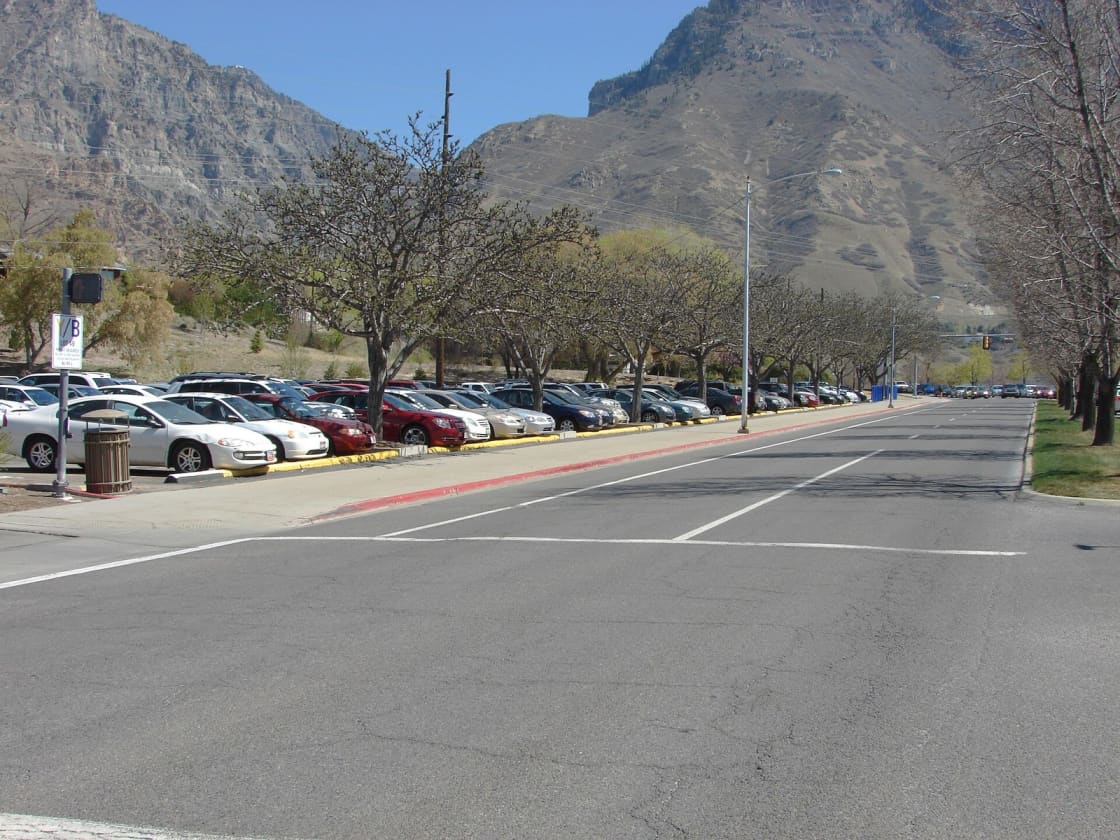

There are two separate problems on a BYU football Saturday, and most guides only solve one of them. The first is where to put your car. The second is how sixty-three thousand people and their cars move through a grid of ordinary city streets that was never designed for them — twice, in opposite directions, a few hours apart. This guide covers both, because knowing about a free lot doesn't help if you arrive to find the streets feeding it gridlocked.
Everything below reflects BYU's published game-day policies and the way traffic behaves around LaVell Edwards Stadium. BYU posts each season's official parking map and prices at les.byucougars.com shortly before the opener; specific dollar figures and lot assignments can shift year to year, so treat that page as the final word on the details and this one as the strategy layer on top of it.
The 2026 home slate — and why the date changes the plan
Seven home games, and they do not create equal parking problems:
- Utah Tech — Saturday, Sept. 5. Season opener. Big crowd energy, but the most forgiving parking day of the year for a non-conference opponent.
- Arizona — Saturday, Sept. 12. Early-season Big 12 game. Normal big-game rules apply.
- Iowa State — Friday, Oct. 9 (played; BYU won 24-10). The odd one out on the 2026 schedule. A Friday night kickoff (8:15 p.m.) stacked game traffic on top of ordinary Friday commuter traffic on I-15 and University Parkway. The drive that takes 20 minutes on a Saturday can take an hour on a Friday at 5:30 p.m., which is the lesson for any future Friday home game: go by transit.
- Notre Dame — Saturday, Oct. 17 (played; BYU won 28-24). Notre Dame had not played in Provo in more than two decades, and it was the most oversubscribed parking day at the stadium in years. Resale parking for this game was trading at several times the price of any other 2026 home date months in advance.
- Arizona State — Saturday, Oct. 31. Halloween. Expect some families to leave early regardless of score, which slightly softens the postgame crush. This is the one game where the egress route and the trick-or-treat route are the same streets; the Halloween-night breakdown works through which ones.
- Baylor — Saturday, Nov. 14. Cold-weather parking: the walk from a distant free spot feels much longer in November than it did in September.
- Cincinnati — Saturday, Nov. 28. The home finale, Thanksgiving weekend. Campus is empty of students, which frees up parking supply — often the easiest big-game parking day of the year.
Your five real options, ranked by hassle
1. Take UVX and skip the whole problem
The Utah Valley Express bus rapid transit line stops at BYU Stadium Station, steps from the gates, and runs in dedicated lanes down the middle of University Parkway — which means it keeps moving when the car lanes around it are parked. Ride in from anywhere along the Orem–Provo corridor, or park free at a station lot and ride the last stretch.
One correction to a claim you will read on other sites: UVX is not free to the general public, and hasn't been since August 2024. It's free with a qualifying BYU or UVU student ID (the UVU pass also covers spouses and dependents); everyone else pays the standard UTA fare. It is still, by a wide margin, the cheapest guaranteed "parking spot" at the stadium.
Coming from Salt Lake, Lehi, or anywhere north: FrontRunner to Provo Central Station, then UVX to the stadium. UTA has historically added extra UVX and FrontRunner service for marquee games — check the UTA site during game week rather than assuming.
2. Free campus lots — the early bird's game
BYU opens a set of campus lots free on game days; they're marked green on the official football parking map. First-come, first-served, no attendant, no fee. The catch is arithmetic: free supply is finite and demand is not, so on conference Saturdays the green lots are effectively done two to three hours before kickoff, and on a marquee date like the Notre Dame game they are done by mid-morning.
Two warnings that save people real money:
- Never park in student housing lots. They're permit-only, residents need them, and they are patrolled on game days precisely because visitors chance it. The ticket-or-tow outcome costs more than a season of paid parking.
- Read the street signs in the neighborhoods. Free street parking exists east and south of the stadium, but several blocks carry residential restrictions, and a 15–20 minute walk is part of the deal.
3. Paid campus and private lots
Paid game-day lots on campus vary in price by lot and opponent, with churches and businesses near the stadium selling spots (sometimes with shuttle service) as well. Resale platforms sell guaranteed spots for much more — useful only for the marquee dates when certainty is worth paying for. BYU publishes current prices with the season's parking map, so check it before you go.
4. Reserved Cougar Club lots
Reserved parking is a Cougar Club benefit. The rules worth knowing even if you're only borrowing a friend's pass: all passes are digital, each pass is valid only for its specified lot, lots open four hours before kickoff, and reserved spaces are held for pass holders until roughly the end of the first quarter — after which an empty reserved spot may be released.
5. Park downtown and walk
If you're eating on Center Street before the game or staying at a downtown hotel, the walk to the stadium runs about 15–20 minutes and neatly sidesteps both the pregame and postgame traffic. This is the quietly superior option for anyone whose game day includes a meal: park once downtown, eat, walk up, and when the game ends you're strolling back to a car that isn't trapped in a lot with three thousand others.
The Tailgate Lot, RVs, and the rules people trip over
BYU's official tailgating home is Lot 18, at 55 E 1230 N (Cougar Blvd), and its rules are specific enough that first-timers regularly get caught out:
- Opens 8 a.m. every home game day, first-come, first-served.
- Cars, vans, trucks, motorcycles, RVs, and camp trailers are all permitted; each vehicle may take up to two stalls.
- Cooking: propane and wood-pellet grills only. No charcoal, no wood fires. This is the rule that surprises out-of-state visitors most.
- No alcohol in the tailgate lot or anywhere on campus — BYU is a dry campus, and game day is no exception. The tailgate scene runs on smoked meat, lawn games, and soda, and it's one of the more family-friendly pregame atmospheres in the Big 12.
- No electrical or water hookups, no fireworks, no tent pegs or spikes, no pets, and nothing attached to BYU fixtures or landscaping.
- No overnight parking — with one exception: for games kicking off at 7 p.m. or later, vehicles may remain until 8 a.m. the following morning.
Late-arriving RVs are directed to a separate designated overflow lot for oversized vehicles, so a late-arriving rig still has somewhere to go — it just won't be in the heart of the tailgate scene.
Disability parking is in the IT Building lot (Lot 58), accessed from Canyon Road or University Parkway, restricted to vehicles displaying a state-issued disability placard or plate.
If you'd rather show up to a party than build one, Cougar Canyon — the official pregame festival directly west of the stadium — opens hours before kickoff with food vendors, live music, and fan activities, and The Backyard at Cougar Canyon runs south of the stadium across University Parkway on Helaman Fields.
Traffic: how the crush works
The stadium sits at 1700 N Canyon Rd, on the east bench, and nearly everyone approaches it from I-15 on the valley floor. That means two funnels:
From the north (Salt Lake, Lehi, American Fork): exit at University Parkway in Orem and ride it east across the valley. This is the main artery and it knows it — the final mile past University Place slows badly in the last 90 minutes before kickoff. A calmer alternative from the north is to exit at Orem 800 North, take it east to State Street or 800 East, and drop south into the campus grid from above, entering via Canyon Road.
From the south (Springville, Spanish Fork, Payson): exit at Provo Center Street or University Avenue and come up through Provo itself, approaching the stadium from the south and west. You'll hit city lights, but you're not sharing the University Parkway funnel with the entire north half of the valley.
The Friday-night exception matters. The Iowa State game on Friday, Oct. 9 put kickoff traffic on top of the normal Friday evening commute, the one day of the 2026 schedule when I-15 through the Point of the Mountain and University Parkway were both heavy before game traffic even started. For any Friday home game, leave dramatically earlier than feels necessary, or take FrontRunner and UVX and read a book while everyone else idles.
Getting out is simpler to explain: don't rush it. The 30–45 minutes after the final whistle are the worst window on every street around the stadium, and no exit strategy beats simply waiting it out. Postgame highlights play in the concourse for a reason. Fans who walk down to Center Street for dessert routinely beat the fans who ran to their cars. If leaving promptly is non-negotiable, park north of the stadium and exit via Canyon Road northbound toward 4800 North rather than fighting south into the University Parkway merge with everyone else.
Before you walk to the gate
A few stadium policies interact with your parking plan, because discovering them at the gate means a long walk back to the car:
- Bag policy: no bags except small clutches (5" × 8" × 1" or smaller) and medically necessary bags after inspection. One per person. Leave the backpack in the trunk.
- No outside food or drink, and no outside stadium chairs. Chair-back rentals can be added when you buy tickets, per game or per season.
- Any ticket works at any gate. Gate 1 in the southwest corner draws the longest lines close to kickoff; the east and north gates are usually quicker.
For everything beyond the parking lot — tickets, tailgating culture, where to eat, and what a BYU Saturday feels like — our full BYU football game day guide picks up where this one ends, and visiting supporters should read our Big 12 fan's guide to Provo before booking the trip.
What the walk is like
Every option above ends in a walk, and the walks are not equivalent. Knowing which one you are signing up for is most of the difference between a good plan and a resented one.
From downtown, the route is a steady, unmistakable climb. The stadium sits on the east bench above the valley floor, so a walk that looks flat on a map is not — you gain elevation the whole way. It is comfortably walkable for most people and pleasant on a cool evening, but budget more time than the distance suggests and rather more if anyone in the group struggles with hills.
From the free lots, the walk is shorter but less obvious. These routes cut through campus rather than following a single street, which is fine on the way in when you are following a crowd and disorienting on the way out in the dark. Drop a pin on the car before you leave it. Every home game produces a scattering of fans walking the wrong parking lot at eleven at night.
From UVX, you are set down close and on level ground, which is the quiet argument for the bus that the ranking above understates. It is the only option with no climb at either end.
Parking with a group
The most common avoidable mistake on a game day is a group arriving in two cars and treating that as one decision.
Two cars are two parking problems, not one. The second car almost never gets a spot near the first, because the lot that had room when the lead car arrived has usually filled by the time the follower reaches it. Consolidating into one vehicle at a hotel or a meeting point before you approach the stadium is worth more than any parking tactic on this page.
Decide the postgame meeting point before kickoff, not after. Mobile coverage around a full stadium is unreliable at exactly the moment everyone tries to use it, and a group that has not agreed where to regroup will spend the worst thirty minutes of the day finding out. Pick a landmark away from the exits.
Split the roles. If the group includes someone who does not mind arriving early, sending one person ahead to secure a spot while the rest come by UVX solves the arrival crush and the departure crush at once — the early arriver has the car, and everyone else has a bus that is not sitting in the post-game merge.
The Neighborhood Streets: What You Are Actually Doing When You Park There
Every option above has a rule you can look up. The one that does not is the informal one — leaving a car on a residential street north or east of campus and walking in. It is what a large share of experienced fans do, it is legal in most places most of the time, and it is also the option most likely to end badly for reasons that have nothing to do with a sign.
Start with the physical reality of these streets. Much of the housing near LaVell Edwards Stadium predates the assumption that every adult owns a car. Driveways are short, garages were built for a narrower vehicle, and on-street parking is not a convenience for those households — it is where a meaningful fraction of them keep their cars every night. Sixty thousand people arriving on a Saturday do not add demand to a system with slack in it. They add demand to a system that is already at capacity by seven in the evening on an ordinary Tuesday.
Then read the actual restrictions rather than assuming. Provo posts and enforces a variety of limits near campus, and they are not uniform street to street: permit-only blocks, time-limited stretches, no-parking zones tied to street sweeping or snow removal, and hydrant and driveway clearances that get enforced far more actively on a game day than on a normal one, because complaints spike. The relevant point is that an absence of a sign in your mirror is not the same as an absence of a sign, and the signage on these blocks tends to sit at the ends rather than mid-block. Walking to the corner and looking costs thirty seconds.
The three failures that generate tickets and tows are worth naming, because they are so consistent. Blocking a driveway even partially — the single most common one, and the one most likely to escalate to a tow rather than a citation, because a resident who cannot get out calls immediately. Parking within the marked or statutory distance of a hydrant, which is not negotiable and does not care that it was only for three hours. And leaving a car in a permit zone on the theory that enforcement takes the weekend off, which is precisely the weekend it does not.
There is a version of this that works well, and it is not subtle. Park farther out than feels necessary — the walk from six blocks is barely longer than the walk from three once you account for the crawl out of a closer spot afterwards. Choose a street where the parked cars are already sparse rather than one where you are wedging into the last gap. Pull fully to the curb, leave real clearance at both ends, and take nothing visible. Then walk. The people who consistently have easy game days are almost never the ones who found the closest spot; they are the ones who accepted an extra four minutes on the way in and saved twenty on the way out.
And a word about being a guest. These streets belong to people who live on them fifty-two weeks a year and get a stadium for six or seven Saturdays. The etiquette that keeps informal parking available for everyone is unglamorous: no tailgating on a residential street, no music from an open trunk, no leaving anything behind, and no treating a front lawn as an extension of the sidewalk. The fastest route to a formal permit district that removes this option entirely is a season of visitors behaving as though nobody lived there.
Related Guides
-
BYU Football 2026: The Complete Schedule, Home Games, and Season Preview
-
LaVell Edwards Stadium: The Building, the Name, and the Bag Rule That Catches Everyone
-
AJ Dybantsa vs. Darryn Peterson: How the 2026 NBA Draft Left Utah Caught in the Middle
Advertisement -
Hotels Near BYU: Walk Times, Game Weekends & Where to Actually Book (2026)
Frequently Asked Questions
Where can I park for free at a BYU football game?
How much does parking cost at LaVell Edwards Stadium?
When do parking lots open on BYU game days?
Where do RVs park at BYU football games?
Is there disability parking at LaVell Edwards Stadium?
Can I take UVX or FrontRunner to a BYU game?
How early should I arrive for a BYU football game?
What's the fastest way out of the stadium after a BYU game?
Sources
The facts in this guide were checked against these sources. Hours, fees and rules change, so confirm anything time-sensitive with the source before you go. How we make Provo.com.
- Utah Valley Express (UVX) Fares, Utah Transit Authority. Checked October 12, 2026.
- UTA School Pass Program: Utah Valley University, Utah Transit Authority. Checked October 12, 2026.
- BYU, Big 12 announce 2026 football schedule, BYU Athletics (byucougars.com). Checked October 12, 2026.
- BYU Security (security.byu.edu): Tailgating, BYU Security (security.byu.edu). Checked October 12, 2026.
- LaVell Edwards Stadium, BYU Ticket Office (tickets.byu.edu). Checked October 12, 2026.
- BYU Football 2026 Schedule and Results, BYU Athletics (byucougars.com). Checked October 20, 2026.