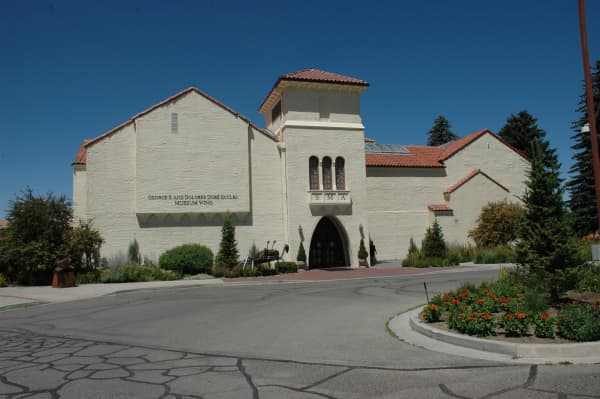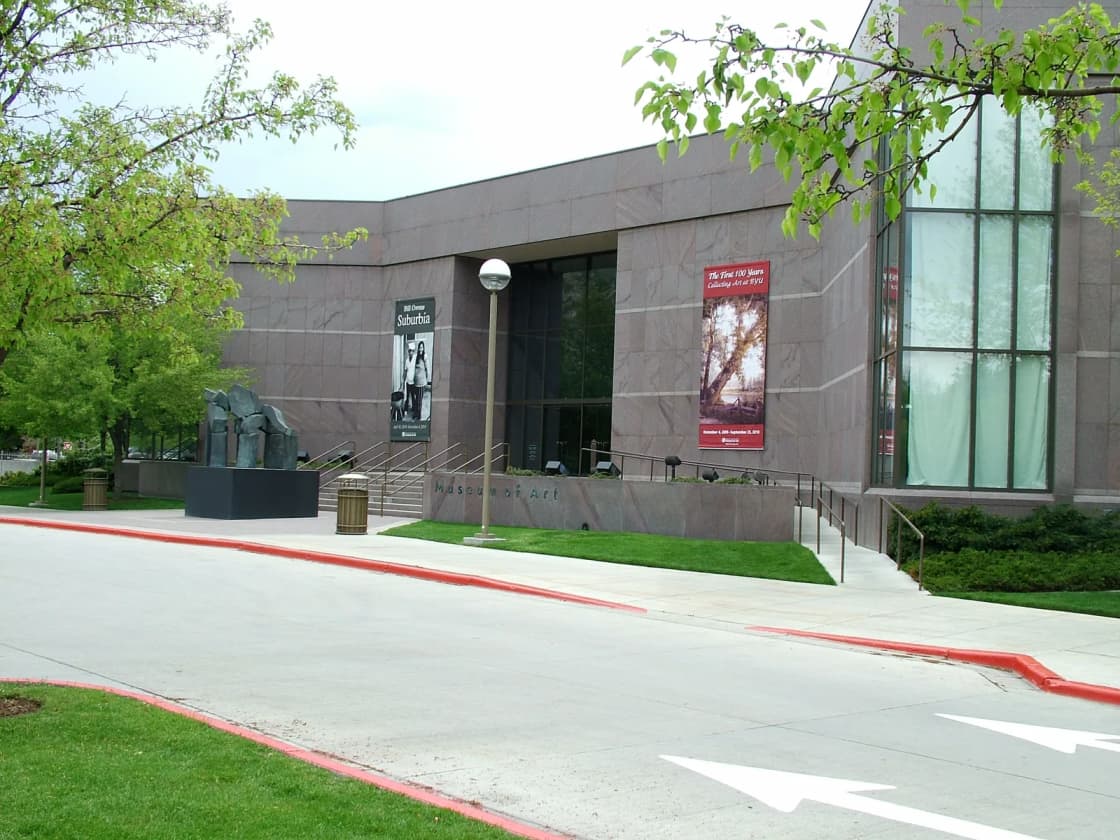

A university in a city of about 115,000 people operates a four-story art museum of more than 102,000 square feet, holding a large collection, and charges nobody anything to walk in.
That sentence is the whole argument for the BYU Museum of Art, and it is the reason the museum describes itself as one of the best-attended art museums in the Mountain West.
What follows is how to use it — including one room most visitors never learn about, and a number about the building that a lot of sources have wrong.
The number that is wrong by a factor of ten
Start here, because it affects what you expect when you arrive.
Widely copied reference sources describe the MOA as having opened in a 10,000-square-foot space. The museum's own About page describes a four-story facility of more than 102,000 square feet. Contemporary reporting from the October 1993 dedication put it at 100,000 square feet.
Those are not close. One of them is wrong by an order of magnitude, and it is not hard to work out which. The museum's own description lists ten exhibition galleries, an auditorium, classrooms, a small theater, a print study room, a gift store, a café, and design, fabrication, imaging, registration and storage areas. None of that fits in 10,000 square feet. A single generous gallery is a meaningful fraction of 10,000 square feet.
The practical point is not pedantry about a typo. It is that people plan a twenty-minute stop and arrive at a building that needs two hours. Plan for the real one.
What it cost, and who paid
The museum was built for $15 million and financed entirely by private donations — roughly 1,400 contributors, according to reporting at the time of the dedication.
Ground was broken in 1991 and the building opened in October 1993, with an inaugural exhibition on the Etruscans. It was designed by Los Angeles architect James Langenheim, and the museum credits former directors of lighting and design at the Metropolitan Museum of Art with shaping its lighting and use of space.
That last detail explains something visitors notice without being able to name it. The galleries are unusually good at the mechanical business of showing objects — the sequencing, the sightlines, the light. It reads as calm. That was bought deliberately, from people who had done it at the Met.
The collection is older than the building by eighty-four years
The museum opened in 1993. The collection it houses started in 1909, when a donor gave the university a painting of a sycamore tree by the Utah impressionist John Hafen.
Everything about the collection's character follows from what happened between those two dates. For most of the twentieth century BYU accumulated art through gifts rather than a purchasing strategy, which means the holdings reflect the tastes and enthusiasms of a long series of individual donors rather than a curator's plan.
That produces a collection with an unusual shape: European portraits and religious works alongside nineteenth and twentieth century American painting, Andy Warhol serigraphs, original comic-strip drawings, and large bodies of Latter-day Saint religious art. It is not the collection a committee would design. It is more interesting than one.
By the time the building opened there was simply nowhere to put any of it — which was, in the end, the argument that got the museum built after more than fifty years of discussion.
What the collection is strong in
A large collection sits behind ten galleries, which means most of it is not on view at any given moment. What you see is a rotating selection.
The names represented across the holdings include Carl Bloch, Maynard Dixon, Rembrandt, Norman Rockwell and Minerva Teichert. American art is the acknowledged strength, and the American galleries are where most visitors find the material that rewards a slow walk.
Teichert deserves her own paragraph. The collection includes her series of murals on Book of Mormon subjects — a substantial body of work by an artist whose reputation has risen considerably. The MOA has loaned Teichert works to major exhibitions elsewhere, including a dedicated Teichert exhibition at the Church History Museum in Salt Lake City in 2023. If you have any interest in her, this is the institution that holds the material.
The room almost nobody asks about
Among the facilities the museum lists is a print study room.
Most visitors will never see it and most will never know it exists, which is a shame, because it addresses a real problem in how museums show art. Works on paper — prints, drawings, photographs, watercolors — degrade under light. They cannot be permanently displayed. A museum with a serious paper collection therefore has a large body of work that is essentially invisible in the galleries.
A print study room is the answer: a controlled space where works on paper can be brought out and examined directly, at reading distance, without glass in between.
For a student writing about printmaking, a teacher building a lesson, or anyone with a specific research interest, this is the most valuable room in the building. Access arrangements are the institution's to set and they change, so the right move is to contact the museum and ask rather than to turn up expecting a service. But it is worth knowing that the question is available to be asked.
Hours, and the Sunday rule
The museum is closed Sunday. So is the rest of campus. This is the single most common way a visit to the MOA fails, particularly for out-of-state visitors for whom Sunday is the obvious museum day.
Published hours have varied by season, and the pattern has generally included extended evening hours on some weekdays — which makes the MOA one of relatively few cultural buildings in Provo available after dinner. Saturday hours have typically been shorter than the extended weekday evenings.
Because the specific hours shift with the season and the academic calendar, this page deliberately does not print a timetable that would be wrong within months. Check the museum's own site. The museum has also historically closed early on Christmas Eve and New Year's Eve.
Free admission, and the honest exception
General admission is free. Parking is free. That has been true since 1993.
The honest qualification is that major ticketed exhibitions have sometimes required paid tickets — the Sacred Gifts exhibition is a documented case where admission to the museum remained free but that specific show required a ticket. Academic symposia can also be ticketed.
So the reliable statement is: walking in and seeing the galleries costs nothing. A headline traveling show may need a ticket, and popular ones can require booking ahead. Check before you drive if a specific exhibition is the reason for the trip.
Why a campus museum outdraws city museums
The MOA's attendance is the statistic that surprises people who have not been. In a survey conducted in 2004 the museum ranked first in attendance among university campus art museums, with 334,774 visitors, and placed 31st out of 157 member art museums surveyed across the United States, Canada and Mexico.
That is not a Utah Valley number. That is a number that puts a campus museum in Provo among the busier art museums on the continent.
Several things produce it, and they compound. Free admission removes the decision — nobody weighs whether the show justifies the ticket, so casual visits happen at a rate paid museums never see. The campus supplies a permanent audience of tens of thousands of students, staff and their visiting families. The exhibition program brings in shows that would not otherwise come here, which converts curiosity into repeat attendance. And Utah Valley has no competing art museum of comparable scale, so the MOA is not sharing its audience with anyone.
The museum's own stated philosophy of reaching outward to students and to the surrounding community, rather than functioning as a teaching collection with a door, has been credited as a substantial part of the explanation.
How the exhibition program works
Understanding the rhythm of the place is what turns a single visit into a habit.
The MOA runs on two tracks simultaneously. Rotating selections from the permanent collection occupy some galleries and change gradually — the American galleries in particular reward returning, because what hangs there is a fraction of what exists and the fraction changes.
Traveling and specially organized exhibitions occupy others, and these are the reason to pay attention to the schedule. A university with institutional connections can borrow at a level a regional museum cannot, and over the years the MOA has hosted material spanning Egyptian antiquities, Rockwell, Escher, Tiffany glass, Chinese archaeological material and contemporary photography and video.
These exhibitions run for months rather than weeks, which is generous, and they close on published dates, which is unforgiving. The practical habit is to check the current exhibitions page at the start of a semester rather than when you happen to think of it — an exhibition you learn about in its final week is one you will probably miss.
What to look at in ninety minutes
If you have one visit and no particular agenda, there is a shape that works.
Start with whatever is temporary. It has a deadline and the permanent collection does not. Give it forty-five minutes.
Then find the American galleries. This is the collection's strength, and it is where the density of good objects is highest. Thirty minutes.
Then stop. Museum fatigue is real and it is not a character flaw. The building holds ten galleries and no first-time visitor absorbs ten galleries. Because admission is free, the cost of coming back is a drive rather than a ticket, which makes the MOA one of the few museums where "I'll see the rest another time" is a rational plan rather than a polite fiction.
The café overlooks a sculpture garden and reflection pool, and it is a legitimate part of the visit rather than an afterthought — it is one of the more pleasant places to sit on campus.
Accessibility and visiting with children
The building is modern, purpose-built and vertically organized across four floors, which means it was designed with elevators and circulation in mind rather than having them retrofitted. Visitors with mobility needs generally find it straightforward compared with older museums.
Children are a different question, and the honest answer is that the MOA is a good art museum for children and the Bean is a better museum for children. An art museum asks a child to look quietly at objects behind a rope; the Bean asks them to look at a liger. If the group includes young children and you are choosing one, choose based on what the child will do.
That said, the MOA runs education programming and its galleries are generously spaced, which matters more than it sounds when somebody in the group is five and moving unpredictably. And a free museum you leave after twenty minutes has cost you nothing.
Getting there and parking
The museum sits on North Campus Drive on the BYU campus, with parking adjacent to the building. Among campus destinations it is one of the easier ones to drive to, and visitors reliably remark on that.
The qualification is the one that applies to all BYU parking: campus lots carry designations, the designations change, and enforcement is real. Read the signage at the lot you park in. A general assurance that parking is easy is not a defense against a citation.
Home football Saturdays and major campus events change the calculation completely. On those days, park further out and walk, or come another day.
Building an afternoon around it
The MOA is the anchor of what is probably the best free afternoon in Utah Valley, because BYU's museums are all free and all within walking distance of one another.
The natural pairing is the Monte L. Bean Life Science Museum, which we cover in a full guide — it is the best of the campus museums for children and the one with unusual evening hours. Add the Museum of Paleontology for thirty to forty-five minutes of fossils and a working preparation lab you can watch through a window, and the Museum of Peoples and Cultures for archaeology in a set of galleries that is frequently almost empty.
Our guide to museums in Provo covers the full set including the off-campus institutions, and our free things to do in Provo page puts the campus museums in the context of everything else that costs nothing here.
Who this museum is for
Three groups get disproportionate value from it.
Parents visiting students get an hour of shared activity that is free, indoors, weather-proof and not a restaurant. Our parents' guide to visiting Provo leans on it for exactly this reason.
Students get an art museum inside walking distance of their classes, open some evenings, with rotating exhibitions — which is a resource most undergraduates in the country simply do not have and most BYU undergraduates never use.
Anyone on a date with no budget gets the most reliable option in the city. It is free, it is quiet, it generates conversation, and it has a café. Our cheap date ideas in Provo guide makes the same case at greater length.
The MOA is not the only art in the valley
Worth saying, because visitors often assume a campus museum is the whole picture here and it is not.
Springville has a museum of art that predates the MOA by decades and holds a serious collection of Utah art — it is the older institution and a different experience, covered in our Springville guide. Provo's downtown carries working galleries. BYU itself shows student and faculty work in campus exhibition spaces outside the museum, which is where you see what is being made now rather than what has been collected.
The MOA is the anchor rather than the entirety, and the valley's art scene reads very differently once you have seen the other pieces of it.
The short version
Free to enter, free to park, closed Sunday, one to two hours minimum, and considerably larger than the most-copied figure about it suggests. Check the hours and the current exhibition before you go, because both change and one of them may need a ticket. Ask about the print study room if you have a reason to. And if the weather is bad and you have an afternoon, the campus museums together are the best free thing in Utah Valley.
The broader point is worth stating plainly for anyone who has lived here a while and never gone. A city this size has no business having a museum of this scale, and the only reason it does is that a university spent a century accepting donated art with nowhere to hang it, and then 1,400 people paid for somewhere to hang it. Most residents of Utah Valley have driven past it hundreds of times. It costs nothing to stop.
Related Guides
- Museums in Provo
- Bean Life Science Museum
- BYU Campus Visitor Guide
- Free Things to Do in Provo
- Cheap Date Ideas in Provo
- Indoor Activities in Provo
Frequently Asked Questions
Is the BYU Museum of Art free?
How long should I plan for a visit to the MOA?
Is the BYU Museum of Art open on Sunday?
What is in the MOA's permanent collection?
What is the print study room at the BYU Museum of Art?
Where do I park for the BYU Museum of Art?
How big is the BYU Museum of Art building?
Is the MOA worth visiting if I am not an art person?
Sources
The facts in this guide were checked against these sources. Hours, fees and rules change, so confirm anything time-sensitive with the source before you go. How we make Provo.com.
- About the Museum, BYU Museum of Art. Checked October 12, 2026.