
Provo has a free natural history museum, open six days a week until nine at night for most of the week, holding a Guinness World Record and roughly three and a half million specimens. A surprising number of people who live here have never been inside it.
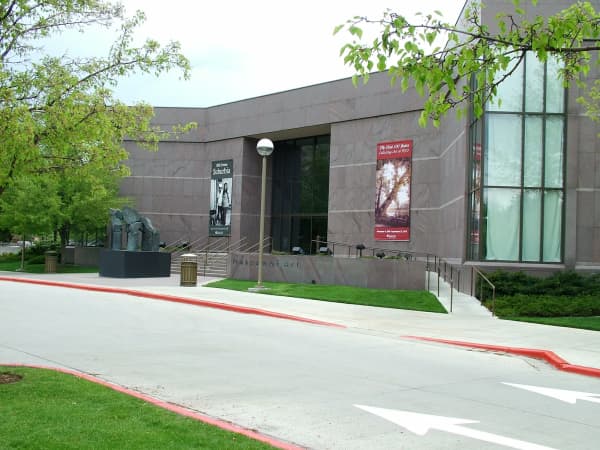
The Monte L. Bean Life Science Museum sits on the southeast side of BYU campus at 645 E 1430 N. Admission is free. Not discounted, not free-on-Tuesdays — free, permanently, with no ticket to book. That fact alone puts it in a very small category of Utah Valley attractions, and it is the reason it holds up as a plan B when the weather ruins a plan A.
This guide covers what is actually in the building, the practical business of getting in and parking, one genuinely unresolved question about its programming, and how to fit it around the rest of a day.
Start with the parking permit, because nobody warns you
Here is the single most useful thing to know before you arrive, and it appears on almost no listing for the museum: you will need a parking permit, you get it inside at the welcome desk, and you will be asked for your vehicle's license plate number.
Visitors describe the same routine consistently — park in the lot by the museum, walk in, give your plate number at the desk, and display what they hand you. BYU enforces campus parking properly during the working week, and "I was only inside for forty minutes" is not a defense anyone has successfully run. Photograph your plate before you leave home if you are the sort of person who cannot recall it under mild pressure, which is most people.
The approach most locals use is Phillips Lane, the road immediately south of the Marriott Center, followed to the end and then left. The museum is southeast of the arena. If you are aiming at it from University Avenue you are coming at it from the wrong side of campus and will spend ten minutes learning about BYU's one-way loops.
Two further practicalities. The museum is closed Sundays, which in Provo needs no explanation but catches visitors out constantly. And BYU's academic calendar drives everything around it — during Education Week in August, home football weekends in autumn, and the start of each semester, campus parking becomes a different and worse problem, and the museum's own lot fills accordingly.
Shasta: the world-record animal in a Provo display case
The Bean holds a genuine world record, and most people walk past it.
Shasta was a liger — the hybrid offspring of a male lion and a female tiger — born at Salt Lake City's Hogle Zoo on 6 May 1948. She was the first liger born in America and she became a Utah celebrity: the zoo threw her an annual birthday party, thousands of children came, and the attention and the ticket money helped lift Hogle Zoo out of a lean period. Her father was a lion named Huey; her mother a tigress named Daisy. The two had been raised together, which is the usual explanation for why they mated at all, since lions and tigers in captivity generally want nothing to do with each other and their ranges barely overlap in the wild.
She died on 19 July 1972, aged 24 years and 74 days. Guinness World Records still lists that as the longest lifespan of any liger, anywhere.
The rest of the story is the interesting part. After her death the zoo had her taxidermied, and her mount drew visitors on its own for decades. Then the ground shifted underneath her. Deliberate hybridization of big cats fell out of favor in the zoo world — a liger has no conservation value, no wild population to support, and a set of health problems attached to its size — and Shasta was taken off display at Hogle Zoo in the late 1990s. She arrived at BYU shortly after. Published accounts put her removal from the zoo at 1997 and her arrival at the Bean at 1999, which fits: she was pulled first and rehomed second.
Today BYU uses her to teach exactly the thing that got her retired. Guides talk about hybridization and the ethics of it. An animal that was originally bred as a novelty attraction is now the object lesson in why that was a bad idea, which is a considerably better second act than most taxidermy gets.
Her name, incidentally, came from zoo staff joking that "she hasta have this and she hasta have that."
What's actually in the building
The Bean opened in 1978 and then shut in July 2012 for a rebuild that turned out to be the making of it. Construction added roughly 32,400 square feet, and the museum reopened to the public on 7 June 2014 after two years dark. Donor funding for the expansion also carried a second purpose: honoring Boyd K. Packer, the LDS apostle and amateur wildlife artist, with a wing in his name.
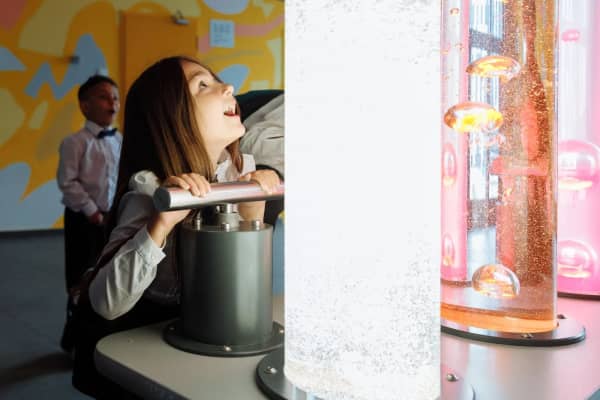
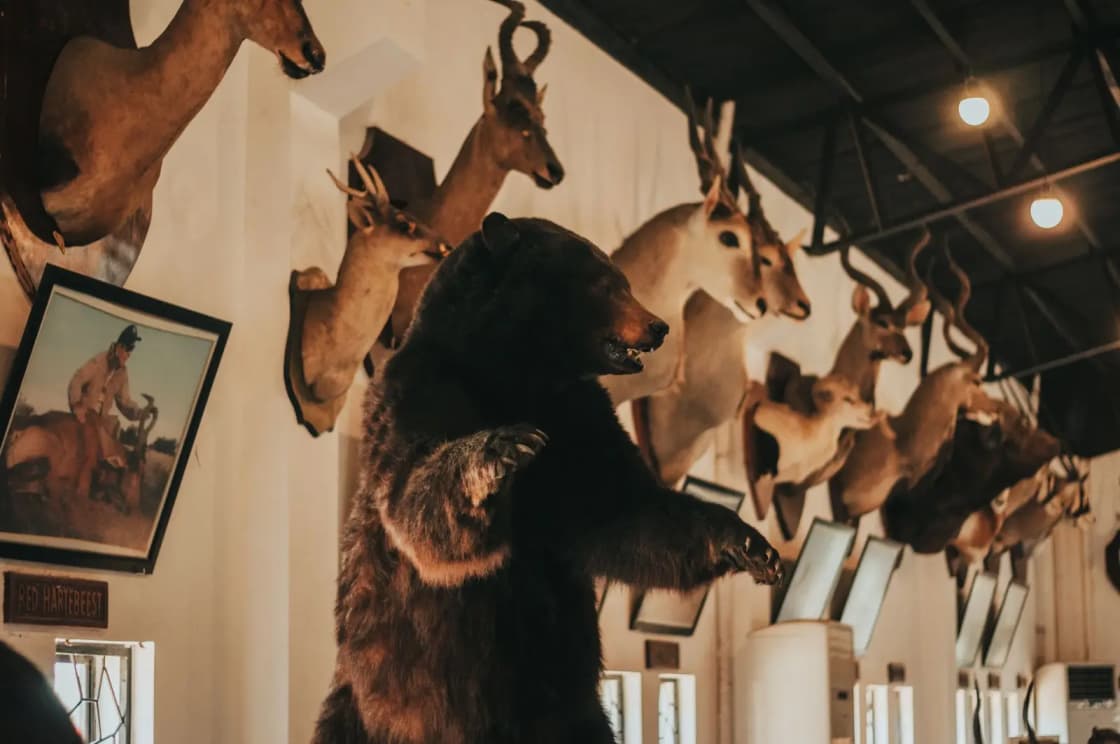
The exhibits installed for that reopening set the shape of the museum you walk into now — a globe several feet across mapped with satellite imagery, a hall of apex predators arranged as they might stand in the wild, a bird gallery running to well over a hundred species, and a play area built specifically for toddlers with a talking owl, a bear cave and a slide out of a tree nest. Big African mounts greet you near the entrance: giraffe, elephant, the cats.
Two things are worth knowing that regular visitors take for granted.
The basement is the Utah floor, and most people skip it. Downstairs is quieter and less theatrical — two long corridors of cases, mostly birds, with the mammals you might actually meet on a trail above Provo. If you have spent any time on the hiking trails around Provo, it is a much better experience than it sounds: you go looking for the things you have seen and the things you hope to see. It is where a Utah Valley family gets more out of the museum than a tourist does.
Grab a scavenger hunt at the front desk. They come in several difficulty tiers — picture-based for pre-readers, harder for older children. It converts a twenty-minute walk-through into an hour, and it is free.
There is also a gift shop immediately inside, which parents should factor into their exit strategy.
The collections you are not allowed to see
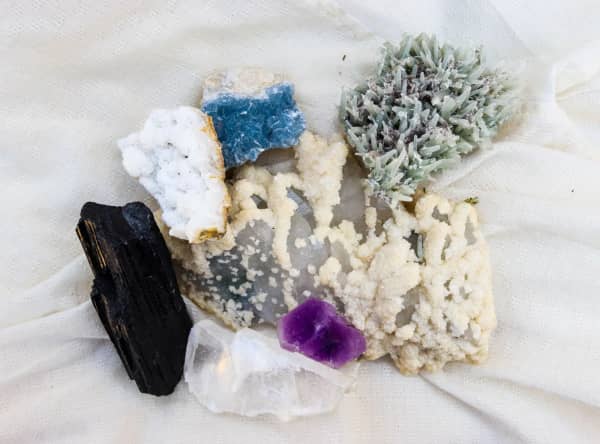
The public galleries are the small part. Behind them the Bean is a working research institution, and the numbers involved are startling for a building most of Provo drives past.
At the time of the 2012 rebuild, then-director Larry St. Clair described nine research collections holding over 3.5 million specimens, insured at roughly $46 million. The renovation gave the entire third floor over to restricted-access research space, including a dedicated cryogenics facility. St. Clair described BYU's frozen tissue holdings as one of the largest such collections in the world.
Those figures are more than a decade old now and the collections have not shrunk, so treat them as a floor rather than a current count. The point stands either way: the display cases downstairs are the shop window for a serious biological archive, and the museum's public programming is funded by and staffed from a department doing actual science.
The live animal question — and why we're not printing a schedule
This is the part of the Bean's story that every other guide gets wrong, and we would rather be honest about it than confident.
For years the museum ran live animal presentations — free, frequent, and the single most-cited reason to visit. Search now and you will find them everywhere: the county tourism board lists Live Animal Shows as a headline program, national and regional guides describe a free weekly live-animal show, and family blogs name it as their favorite part of the visit.
But the museum's own website carries a page titled "Goodbye to the live animals at the Bean Museum."
We could not resolve it. That page exists on BYU's own domain for the museum. Against it, BYU's student newspaper ran a piece in April 2026 about a trivia night at the Bean in which a staff member referred to the variety of exhibits and live animals available year-round. Those two things cannot both be the current state of affairs, and we could not read the farewell page directly to find out which came first.
So: do not drive to the Bean specifically for a live animal show without phoning first. The number is 801-422-5050. Everything else in this guide holds regardless.
There is a broader lesson buried in this one, and Utah Valley readers will recognize it from other attractions. The most widely repeated fact about a place is usually its oldest fact. It has had the longest to propagate, it has been copied the most times, and it is the slowest thing to correct when it stops being true. A listing site has no incentive to notice a program quietly ending. Neither does a blog post from 2018 that still ranks.
Programs worth planning around
Beyond the galleries, the Bean runs a genuine calendar. The recurring pieces:
- Saturday Safari — a long-running discovery class for primary-age children, run on Saturday mornings in themed sessions across a term. It carries a fee per child and requires registration in advance, typically about a week out. Prices and session lists change term to term, so get them from the museum rather than from a directory.
- Family Home Evening programs — free, and pitched at exactly the Monday-night slot Utah Valley families already keep clear.
- Trivia Night — BYU has run these across the Bean, the Museum of Paleontology and the Museum of Art. The Bean's tend to mix biology with gospel-themed rounds, which is a very Provo combination and works better than it sounds.
- Summer camps and Discovery Reading — school-holiday programming aimed at younger children.
- School programs built against the Utah State Science Core Curriculum, delivered in-house, as outreach, and by webcast.
If you are visiting with children in the school holidays, check the events calendar first. The difference between a good Bean visit and a great one is usually whether something was happening while you were there.
Fitting it into a day
The Bean is a strong ninety minutes, not a full day, and it slots naturally into several longer plans.
With the rest of campus. BYU's Museum of Paleontology is a separate building — this is a genuine source of confusion, since visitors routinely arrive at the Bean expecting dinosaurs. The Museum of Art is a third. Doing two of the three in a morning is comfortable. Our BYU campus visitor guide covers the geography and the parking properly.
With ice cream. The BYU Creamery is a short walk, and the Creamery's own story took a turn recently that most people have not caught up with — the BYU Creamery guide has the detail.
As bad-weather insurance. This is the Bean's real role in Utah Valley. It is indoors, free, and open until nine on weekdays, which makes it one of the few places you can redirect to at four in the afternoon when a canyon plan has collapsed. Our guide to indoor activities in Provo has the rest of the fallback list.
As part of a museums run. The museums of Provo and Utah Valley guide covers the wider set, including the ones in Springville and Lehi.
The Bean as a free evening in Provo
There is a category of Provo activity that barely exists elsewhere: things that are free, indoors, open late, and not a film. The Bean is one of maybe three.
It is open until nine o'clock, Monday through Friday, which puts it at the top of our Monday-night list for Provo. That is a genuinely unusual closing time for a museum of any size, and it is the single most underused fact about the place. Most people picture it as a mid-morning outing for small children, which it also is, but the weekday evenings are quiet, the galleries are close to empty, and it costs nothing.
For BYU and UVU students this makes it one of the better free dates in the city — a walkable, warm, low-pressure hour with plenty to talk about and no bill at the end. Our guide to cheap date ideas in Provo covers the rest of that list, and the Bean sits near the top of it for the simple reason that most people have never been.
For families it works as the thing you do after dinner rather than instead of it, which is a slot almost nothing else in Provo fills. And for anyone visiting a student — parents in town for a weekend, grandparents down for a day — it is an easy, free, air-conditioned ninety minutes that does not require anybody to have booked anything.
Practical notes
Address: 645 E 1430 N, Provo, UT 84602 (BYU campus) Phone: 801-422-5050 Admission: Free Hours: BYU lists Monday–Friday 10 a.m.–9 p.m., Saturday 10 a.m.–5 p.m., closed Sunday. Holiday closures are posted on the museum's own hours page — check it in late December and around Pioneer Day in particular.
A note on that address: at least one well-known regional magazine has published it as 1420 North with weekday hours ending at 5 p.m. Both are wrong against BYU's current pages. It is the same pattern as the live animal shows — a snapshot that was accurate once and has been copied since.
Accessibility. The building is modern, post-2014, and lifts serve the public floors. The basement is reached by lift as well as stairs.
Best time to go. Weekday mornings in term time are quiet. Saturday mornings are the busiest hours of the week, particularly in winter. The long weekday evenings — open until nine, Monday through Friday — are the Bean's underused window and the reason it works as an after-dinner outing in a way almost nothing else in Provo does.
With a pushchair. Fine throughout, and there is space to park one.
The honest verdict
The Bean is not the Natural History Museum of Utah in Salt Lake, and it does not try to be. It is a mid-sized university teaching museum with an unusually good collection behind it and an unusually generous admission policy in front of it.
What it is genuinely excellent at: a free, warm, indoor hour with young children; a rainy-Tuesday redirect; and one world-record animal with a real moral attached to her. What it is not: a full-day destination, or a dinosaur museum.
Go on a weekday evening, take the scavenger hunt, go downstairs, and find Shasta.
Related Guides
- Haunted Places in Utah Valley: The Stories, and the History Underneath Them
- Hines Mansion: Provo's Victorian Landmark, and the B&B That Says It Isn't One
- The Soap Factory in Provo: What It Is and Whether It Is Worth It
- Museum of Natural Curiosity: A Complete Guide to Thanksgiving Point's Play Museum
- EPIC Sports Park Opens for Free Drop-In Play Through Mid-October
- All-Together Playground: The Park 4,100 Volunteers Built in Six Days
- Free Things to Do in Provo (2026)
- Provo Beach: The Indoor Surf Park at Riverwoods, and How to Do It Without Overspending
- Butterfly Biosphere: Utah's Only Butterfly Conservatory
- Loveland Living Planet Aquarium from Provo: The Drive, the Tickets, the Exhibits, and a Plan for the Day
- Hogle Zoo and Tracy Aviary from Provo — when the free option is not enough
Frequently Asked Questions
Is the Bean Museum free?
What are the Bean Museum's hours?
Where do you park at the Bean Museum?
What is Shasta the liger?
Does the Bean Museum still have live animal shows?
Is the Bean Museum good for toddlers?
How long does a visit take?
Is the Bean Museum the same as the BYU dinosaur museum?