Upcoming dates

More on Spanish Fork: every guide we have published there, in one place.
Search interest in Cornbelly's is one of the largest seasonal spikes in Utah County — tens of thousands of searches a month at peak. Almost all of that traffic lands on pages that assume one thing which is wrong.
Cornbelly's is two places, not one. There is the Lehi festival at Thanksgiving Point that everybody has heard of, and there is a second, cheaper, quieter, more rural Cornbelly's in Spanish Fork that opens more than two weeks earlier and that a surprising number of lifelong valley residents do not know exists.
Which one you should go to depends entirely on what you want out of the afternoon, and the honest answer for a lot of families is not the famous one.
2026 dates, both sites
| Lehi | Spanish Fork | |
|---|---|---|
| 2026 season | 21 September – 31 October | 4 September – 31 October |
| Address | 3003 North Thanksgiving Way, Lehi | 3687 W 5600 S, Spanish Fork |
| Setting | Thanksgiving Point grounds | Open countryside |
| Advertised attractions | 65+ | 30+ |
| General admission | $19.99 | $12.99 |
| Haunted trail | Frightbelly's, $37.99 | — |
Admission closes one hour before the listed closing time at both sites. Daily hours vary by day of the week rather than running to a fixed schedule, so the operator's own calendar page is the thing to check for the specific day you plan to go — not a third-party listing, which will be showing last year's grid.
Cornbelly's has been cutting mazes since its first one in 1996.
The prices above were the operator's listed sale prices in August 2026. Seasonal pricing moves — weekday and weekend rates differ, and pre-season sale pricing is not what you will pay in the last week of October. Take these as the shape of the cost, not a quotation.
The case for Spanish Fork
This is the part of the guide that is useful, so it goes first.
Spanish Fork costs $12.99 against Lehi's $19.99, which is a meaningful difference for a family of five before anyone has bought a single funnel cake. It advertises 30-plus attractions rather than 65-plus, which sounds like the worse deal until you consider that no family of small children gets through 65 attractions in one visit anyway.
What Spanish Fork has that Lehi does not:
- A sunflower festival, with the fields planted in rotation so that cut flowers are available through September and into October rather than for one narrow week.
- A locomotive train around the property.
- A u-pick pumpkin patch — you walk the field and cut your own, rather than choosing from a pallet.
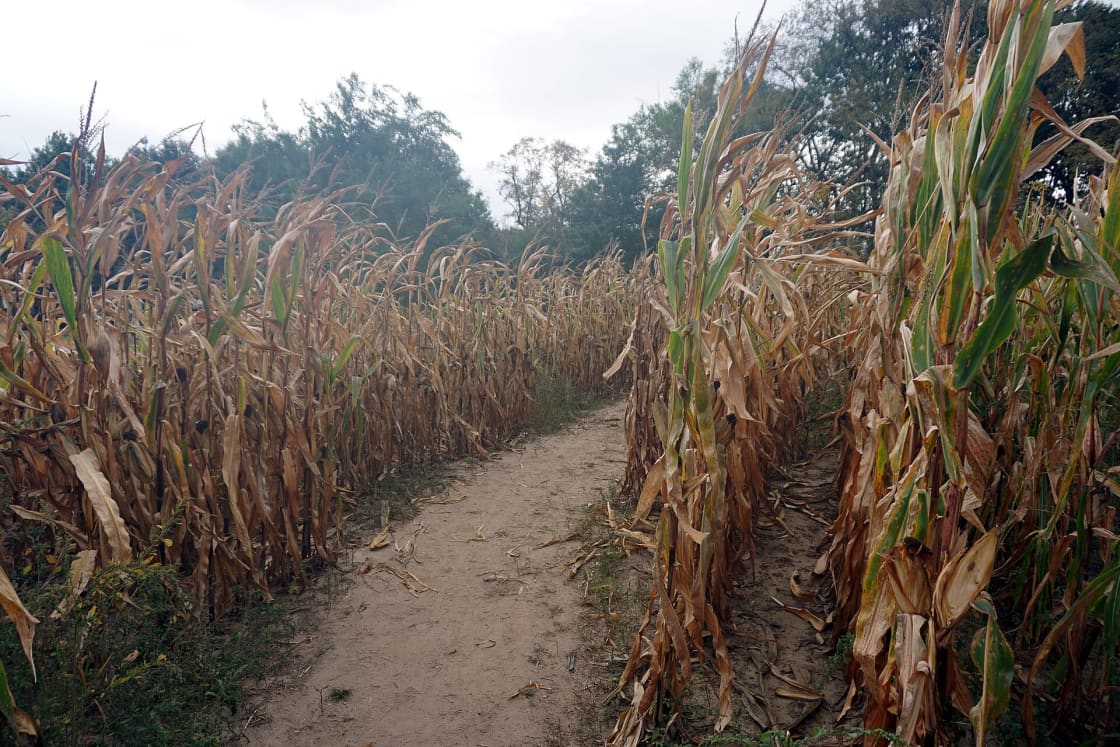
- Open countryside, which is the operator's own framing and an accurate one. This is a farm in the south valley, not an attraction bolted onto a museum campus.
And crucially, it opens on 4 September, seventeen days before Lehi. The first three weeks of September at Spanish Fork are the least crowded fall-festival experience available in Utah County, at the moment when the weather is still pleasant.
The case against Spanish Fork is straightforward: no Frightbelly's, no fireworks, fewer of the large mechanical attractions, and it is a thirty-to-forty-minute drive from north Provo rather than a twenty-minute one from Lehi's freeway exit.
The case for Lehi
Lehi is the original, it is the spectacle, and if you want the version of Cornbelly's that shows up in photographs, this is it. More than 65 attractions, fireworks and scheduled events, and the corn maze that started the whole thing in 1996.
It is also on the Thanksgiving Point grounds, which means the surrounding infrastructure is real: proper indoor restrooms at the Village Shops, parking built for museum crowds, and the option to combine a Cornbelly's evening with something else on the property. Both locations have portable restrooms on site; only Lehi has the indoor alternative nearby.
If you are coming from out of the county, Lehi is also simply easier to reach.
The ticketing trap: Thanksgiving Point membership does not admit you
This is worth its own heading because people arrive at the gate having got it wrong.
Cornbelly's is operated separately from Thanksgiving Point and ticketed separately. A Thanksgiving Point admission, and a Thanksgiving Point All-Access Pass, do not get you into Cornbelly's. The two organizations share a zip code, not a till.
What membership gets you is a 25% discount on regular-priced Cornbelly's tickets and season passes, at both locations, claimed at the ticket booth on presentation of your membership card. The number of discounts available depends on the type of pass you hold, and the discount cannot be combined with other offers — so it does not stack on top of a bundle or a sale price.
That 25% is not nothing. On two adult Lehi admissions it is roughly the price of dinner. But it is a discount, not an entry.
Ticket types, and which one is worth it
General admission, single location. $19.99 Lehi, $12.99 Spanish Fork. The default, and correct for a one-off visit.
Two-location bundle — $33.00, against a $43.98 regular price. One general-admission visit to each site. On purchase you receive two separate digital tickets, one per location, and you must present the right one at the right gate. The Lehi portion can be upgraded to include Frightbelly's at the ticket window on arrival. This is the sweet spot for anyone curious about both sites, and it is a genuine saving rather than a bundling gimmick.
Frightbelly's — $37.99. Includes Cornbelly's Lehi general admission, so the real premium over a Lehi ticket is around eighteen dollars for the haunted trail, hayrides and campfires.
Season pass — $99.99. Covers both locations for one person, with ages 2 and under free. Check the pass terms on the operator's site before buying, including what extras are bundled and whether it can be shared.
The season pass math is simple: it pays for itself at roughly five Lehi visits, or three visits plus the haunt. For a family that treats the fall festival as a weekly October ritual — and plenty here do — it is the right purchase. For everyone else it is not close.
The rules that catch people out
Cornbelly's posts its own rules, and three of them regularly surprise visitors:
- No full-faced masks. At a Halloween-season attraction. This is a crowd-safety and staff-identification rule, and it means a molded costume mask will not get through the gate. Face paint is the standard workaround.
- Chaperones required in the corn maze after 6:30 p.m. Chaperones are encouraged for children under 15 at all times, but after six thirty in the maze itself they are required.
- No pets other than service animals. Service animals as defined under Titles II and III of the ADA are permitted on the farm, on a lead and under control — but not at Frightbelly's.
Also prohibited: alcohol, smoking and vaping, and weapons.
Two rules run the other way and are worth knowing because they save money:
- You may bring your own food. There is a large grassy area and picnic tables available first-come, first-served. Private tent areas can be reserved for groups.
- In-and-out privileges apply for the day or evening as long as you keep your wristband on.
Weather, and the raincheck nobody asks for
There are no refunds if you leave because of rain. There is, however, a raincheck — and the operative detail is that you must ask at the ticket booth before you leave. Walk out of the parking lot without asking and you have simply bought a wet evening.
If Cornbelly's itself closes for extreme weather, guests on site can request a raincheck to return another day. Closure announcements are recorded on the operator's 801-794-FARM hotline and posted on its website. In late October, when a squall can come over the Wasatch in twenty minutes, checking the hotline before a forty-minute drive is a reasonable habit.
Where you stand legally, and why the sign at the gate matters
Most guides to attractions like this say nothing about liability, which is a shame, because the position at a seasonal farm festival is more interesting than at an ordinary theme park.
Utah has a statute covering amusement rides: Utah Code § 78B-4-507. It sets out what an amusement park owes riders — informing them in writing where appropriate of the nature of each ride and the rules of conduct, posting notices about reporting injuries — and what riders owe in return, including not boarding or dismounting outside designated areas, not disabling restraints, and not boarding while intoxicated. Under subsection (8), a rider's violation of those duties may be weighed by a court in allocating fault.
But read the definition at § 78B-4-507(1)(a). An "amusement park" means a permanent indoor or outdoor facility or park where amusement rides are available to the public — and it expressly does not include a ski resort, a traveling show, carnival, or fair. A seasonal festival that stands up on a farm for eight weeks a year is not obviously a permanent facility, and it is not obviously a carnival either. The statute does not settle it.
Running alongside that is Utah Code § 78B-4-512, the agritourism statute, which is the one most farm attractions in this state rely on. It limits an operator's liability for injury resulting from the inherent risks of an agritourism activity — but only if the operator posts a specific sign, in black letters at least one inch high on a white background, at each entrance, carrying the statutory warning text. No sign, no protection. And the protection has hard limits: it does not reach gross negligence, a known dangerous condition, a known dangerous animal propensity, or intentional injury.
The practical takeaway is not that you should worry. It is that the sign at the entrance is informative. If an operator has posted the § 78B-4-512 warning, it is telling you it considers itself an agritourism operation and that you are assuming the inherent risks of a working farm — uneven ground, animals, farm equipment. That is a reasonable thing to be told, and it is a reasonable thing to read on the way in. Our pumpkin patches and fall farms guide works through what that sign covers and, more usefully, what it does not.
This is general information about Utah statutes, not legal advice about any particular incident.
When to go
The single best window is the first three weeks of September at Spanish Fork. Warm, uncrowded, sunflowers up, and Lehi has not even opened.
Weekday evenings in early October are the best Lehi option. The last ten days before Halloween are the busiest of the entire season at both sites, and a Saturday in that window is a dense crowd.
Avoid Saturday 31 October at Lehi specifically. BYU hosts Arizona State that afternoon, kickoff time still to be announced, and the I-15 corridor between Provo and Lehi carries that traffic. Our Halloween in Utah Valley guide sets out how that day is likely to run.
The short version
Two locations, different seasons: Spanish Fork 4 September to 31 October at $12.99, Lehi 21 September to 31 October at $19.99. Spanish Fork is cheaper, quieter, rural, and opens first, with a sunflower festival and a u-pick patch. Lehi is the spectacle and has the haunt. A Thanksgiving Point membership gets you 25% off at the booth, not entry. Bring your own food, keep your wristband, ask for the raincheck before you leave, and leave the full-faced mask at home.
Getting there, and parking
Lehi sits on the Thanksgiving Point grounds at 3003 North Thanksgiving Way, immediately off the I-15 corridor at the north end of Utah County. From central Provo it is roughly twenty to twenty-five minutes without traffic. The practical warning is that "without traffic" does a lot of work in that sentence: the northbound I-15 stretch between Provo and Lehi carries commuter load until well into the evening, and on a Friday it can add half an hour. Parking is on the Thanksgiving Point property and is built for museum-scale crowds, which is one of the genuine advantages of the Lehi site over a working farm.
Spanish Fork is at 3687 W 5600 S, out in the fields west of the town. From central Provo it is a thirty-to-forty-minute drive south, and the last part of it is rural road rather than arterial. Parking is on the farm. The road in is not lit in the way a commercial frontage is, so allow for the fact that leaving at nine in the evening is a dark drive.
Neither site is realistically reachable without a car. There is no public transport routing that lands you at either gate at a useful hour, and the walk from the nearest stop is not one to attempt with children and a pumpkin.
Food, and the rule that saves you money
Both locations sell food on site, and the range is what you would expect from a fall festival — the sweet, hot, seasonal end of the spectrum, priced at attraction rates.
The rule worth knowing is that you may bring your own. Cornbelly's permits outside food, and both sites have a large grassy area with picnic tables available first-come, first-served. Private tent areas can be reserved in advance for groups and parties, which is the mechanism most large family gatherings and birthday parties here use.
For a family of five, packing a meal and buying one thing on site is the difference between a moderate evening and an expensive one. The picnic tables fill up on October weekends, so a blanket is a reasonable backup.
Nutrition information for the on-site food is published by the operator, which is unusual for a seasonal festival and useful for anyone managing an allergy.
Restrooms, accessibility and the practical details
Both locations have portable restrooms on site. Lehi additionally has indoor restrooms at Thanksgiving Point's Village Shops, which is a meaningful difference on a cold October evening and with young children, and it is one of the strongest practical arguments for the Lehi site.
Ground conditions at both are farm ground. After rain, expect mud — this is a working field with attractions on it, not a paved midway. Closed shoes are the sensible choice at either site, and a stroller with small wheels will struggle.
Service animals as defined under Titles II and III of the ADA are permitted on the farm, on a lead, properly identified and under control, and the operator asks that they not come into contact with other guests. They are not permitted at Frightbelly's. No other pets are allowed at either location.
Timing your visit within the day
Admission closes one hour before the listed closing time, which is the single most common way people waste a drive. Arriving forty minutes before closing at Lehi means being turned away at the booth.
Daily hours are not uniform across the week. Weekday evenings are shorter, weekend days are long, and the operator's calendar page is the only place the actual grid for a given date lives.
The corn maze rule about chaperones after 6:30 p.m. is a useful proxy for when the site changes character. Before six thirty it is a family afternoon; after it, the lighting drops, the haunt opens, and the crowd shifts older.
Related Guides
- Halloween in Utah Valley: the October circuit
- Pumpkin patches and fall farms in Utah Valley
- Haunted attractions in Utah Valley
- Every haunted attraction on the Wasatch Front, ranked by scare level
- Thanksgiving Point: the complete visitor guide
- The Pumpkin Regatta, WitchFest and the Salt Lake County October
- Fall in Provo: the complete autumn guide
- U-pick orchards in Santaquin and Payson
- Family activities in Utah Valley
- Every Fall Farm Festival in Utah Valley
Frequently Asked Questions
When is Cornbelly's open in 2026?
What is the difference between the Lehi and Spanish Fork locations?
How much does Cornbelly's cost?
Do Thanksgiving Point members get into Cornbelly's free?
Can I wear a Halloween costume mask to Cornbelly's?
What happens if it rains?
How scary is Frightbelly's, and what age is it for?
Is there a law covering injuries on the rides and attractions?
Sources
The facts in this guide were checked against these sources. Hours, fees and rules change, so confirm anything time-sensitive with the source before you go. How we make Provo.com.
- Utah Code 78B-4-507: Amusement park rides -- Park responsibilities -- Rider responsibilities, Utah State Legislature. Checked October 12, 2026.
- Utah Code 78B-4-512: Agritourism -- Limitations on civil liability -- Signage requirement, Utah State Legislature. Checked October 12, 2026.
- Cornbelly's. Checked October 12, 2026.
- Cornbelly's: FAQ, Cornbelly's. Checked October 12, 2026.
- Cornbelly's Spanish Fork Admission Tickets, Cornbelly's. Checked October 12, 2026.