
Sledding is the cheapest winter activity in Utah Valley and the one most likely to end in an emergency room visit. Those two facts are connected, and not in the way most people assume.
The connection is not that free things are dangerous. It is that sledding is the only common snow sport with no infrastructure between the participant and the consequences. Skiing has patrol, boundaries, groomed runs and a lift that meters how many people are on a slope. Commercial tubing has walled lanes and staff. Sledding on a public hill has a hill, and whatever happens to be at the bottom of it.
This guide is about that bottom.
The runout is the whole problem
Ask most people what makes a sledding hill good and they will describe the slope. Ask an emergency physician what makes one dangerous and they will describe the twenty yards after the slope ends.
The reason is mechanical. A sled has no brakes. It has, at best, marginal steering, achieved by dragging a limb or shifting weight, and both of those authorities collapse as speed rises. A rider on a fast hill is a passenger. Whatever the hill accelerates them into, they arrive at.
So the useful question is never "how steep is this?" It is "where does this end, and what is there?"
A hill of modest pitch with two hundred feet of flat open ground at the bottom is a safe hill. A steeper hill that flattens for thirty feet and then meets a curb, a road, a chain-link fence, a frozen irrigation ditch or a stand of mature trees is not a safe hill, and no amount of care on the way down changes that. The runout sets the ceiling on how bad the worst outcome can be. Everything else is detail.
Walk the bottom first. This is the single practice that separates people who sled for decades without incident from people who do not. Before anyone rides, walk the runout from where the slope flattens to where a sled would stop, and look for the four things that cause the serious injuries: roads, fixed vertical objects, water, and drop-offs.
Reading a hill in Utah Valley specifically
Two features of this valley shape where sledding works and where it does not.
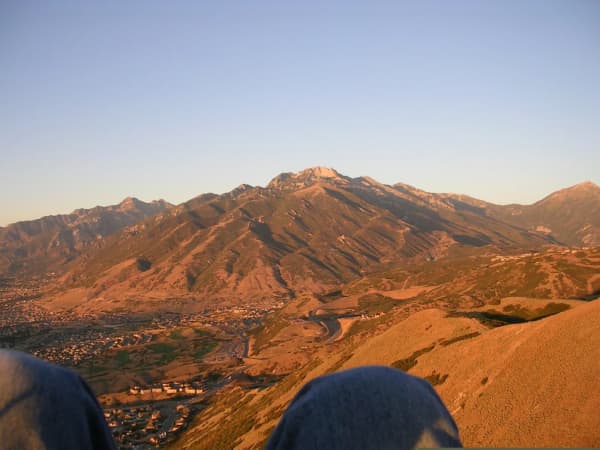
The first is that the valley floor is flat and the mountains are abrupt. There is very little intermediate terrain. The Wasatch rises out of Provo and Orem with unusual steepness, which means the slopes closest to town are frequently steeper than a sledding hill should be, while the parks on the valley floor are frequently flatter than one needs to be. The good sledding terrain is the transitional ground — park edges, benches, drainage swales, the low foothill margins — and there is less of it than the visual impression of a mountain town suggests.
The second is that a great deal of the shaped terrain near housing is shaped for water rather than for recreation. Detention and retention basins, drainage swales and canal banks look like purpose-built sledding hills because they are smooth, grassed and consistently pitched. They are also engineered to move or hold water, they often contain concrete inlet and outlet structures at exactly the point a sled would reach speed, and access to some of them is restricted. A basin is the most common example of a slope that reads perfect from the top and contains a hard structure at the bottom.
Our Provo parks guide covers the park inventory itself. What it will not tell you — what no guide can tell you reliably — is which slope within a given park is in good condition on a given weekend, because that changes with every storm and every thaw.
Snow cover, and why the valley floor disappoints
Utah Valley sits at roughly 4,500 feet on the valley floor, with the mountains immediately east climbing past 11,000. That gradient produces a snow situation that surprises people who move here expecting a uniformly white winter.
The valley floor gets snow, but it does not reliably hold it. A storm can leave several inches overnight and a sunny afternoon with the temperature a few degrees above freezing can take most of it back. The canyons and the benches hold cover far longer at the same latitude, simply because they are higher and, on north-facing aspects, shaded.
The practical consequence for sledding is that valley-floor hills have short windows and mountain-adjacent terrain has long ones. If a household is planning a specific outing rather than seizing an opportunistic morning, elevation is the variable to optimize for. Our Provo weather guide covers the seasonal pattern in more detail, including how much the valley and mountain snowfall figures diverge.
Thin cover is a wait signal, not a go-slow signal. When grass shows through, the sled is intermittently contacting frozen ground. That does three bad things at once: it slows and then abruptly catches the sled, it transmits impact directly to the rider's spine and tailbone, and it exposes the rider to whatever hard objects the turf conceals — sprinkler heads, irrigation boxes, rocks, edging. A hill that is marginal is not a hill to ride carefully. It is a hill to leave.
Surface condition changes through the day
The same slope is several different hills over the course of one day, and understanding the progression is most of what local knowledge amounts to.
Fresh snow is slow, deep and forgiving. Sleds sink slightly, speeds stay low, and falls are cushioned. This is the safest condition and, for small children, by some distance the best.
Packed snow, after a few hours of traffic, is the ideal recreational condition — fast enough to be fun, still soft enough to absorb a fall, and with a defined track that keeps riders predictable.
Polished or icy snow is what packed snow becomes after heavy use, or after a partial thaw and refreeze. Speeds rise sharply, the ability to stop by dragging a foot largely disappears, and the surface no longer absorbs anything. This is when runouts that were adequate become inadequate, because the sled now arrives at the bottom carrying far more speed than it did that morning.
The refreeze case deserves particular attention in this valley because the sun is strong at this elevation even in cold weather. A south-facing slope can soften visibly at midday under an air temperature well below freezing and then set hard as the sun drops. A hill that was pleasant at one in the afternoon can be hazardous at four.
Traffic, and the failure mode nobody plans for
Most sledding injuries that involve another person are collisions, and most collisions happen because of the walk back up.
The geometry is unavoidable. Riders descend the fall line, which is the fastest, most attractive line. Walkers climb the same line, because it is the shortest route back. Add a dozen people to a hill and the descending traffic and the climbing traffic occupy the same corridor, with the descending traffic unable to steer and the climbing traffic facing uphill with their backs to it.
The fix is trivially simple and almost never organized: climb the edges, ride the middle. On a busy hill, one adult stating this out loud once, at the top, changes the traffic pattern for everyone present for the rest of the afternoon. It costs nothing and prevents the most common multi-person injury on any sledding hill anywhere.
The second traffic rule that matters: clear the runout immediately. A rider who stops at the bottom and remains there is a fixed object for the next person down, and unlike a tree they are unmarked and moving unpredictably. Land, stand, move sideways, then look uphill.
Equipment, assessed
Sledding equipment divides on one axis: how much control the rider retains.
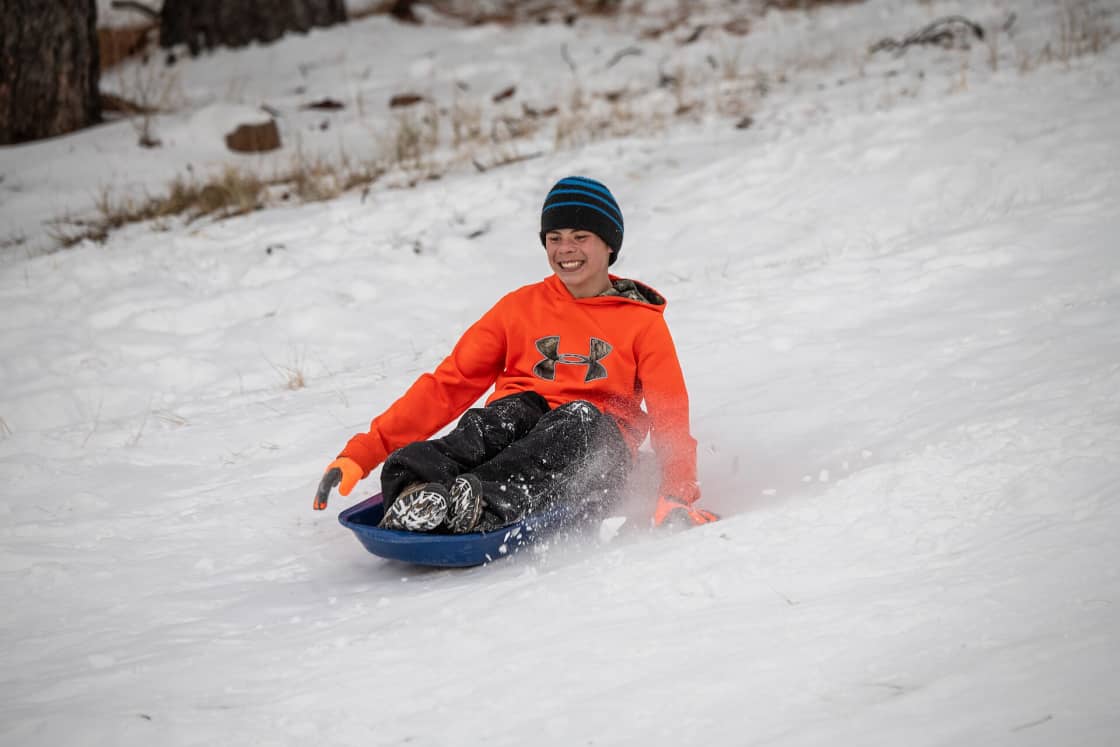
Flat saucers are the least controllable common device. They spin freely, and a spinning rider loses orientation, which means losing the ability to see what they are about to hit and the ability to present feet rather than head to it. They are cheap, popular and fine on gentle terrain with a generous runout. They are the wrong tool on anything fast.
Runner sleds and toboggans track straighter, hold a line, and permit modest steering through weight shift. They are the most controllable option and the traditional one.
Inflatable tubes are the fastest common device on packed snow, because the contact patch is smooth and the pressure distribution is even. They are also close to unsteerable. Commercial venues use them precisely because they can supply the walls and the lane that the tube itself cannot supply. On an open hill, a tube is the device most likely to end up somewhere nobody planned.
Improvised sleds — pool floats, cardboard, plastic lids, garbage bags, and every other household object that has ever been pressed into service — behave unpredictably, often fail structurally mid-ride, and have no defined front. They are part of the tradition and they are also the category with the highest surprise rate.
On protective equipment: a helmet is the highest-value item by a wide margin. Ski, bike and skate helmets are all substantially better than bare heads. Gloves prevent the abrasion injuries that come from the instinctive attempt to brake by hand. Eye protection matters more than people expect on fast, cold, bright days when snow is being thrown up.
Who should be on which hill
The temptation with children is to treat sledding as a single activity with a single venue. It is more useful to think in three tiers.
Very young children need almost no pitch at all. A gentle rise, a short slow ride and a flat stop is the entire experience for a three-year-old, and a hill that an adult would describe as barely a slope is exactly right. Riding tandem with an adult on a fast hill is a common practice and a poor one: adult mass increases speed substantially and the child is positioned in front, which puts them between the adult and whatever is struck.
School-age children can handle a real hill with a real runout, and this is where the traffic rules and the helmet matter most, because this is the age group that generates the most speed relative to its ability to react.
Teenagers and adults are the group that seeks out the marginal terrain — the steeper pitch, the jump built halfway down, the hill that ends closer to the road than it should. This is worth naming plainly because the injury data across sledding as an activity skews toward exactly the terrain people choose when they have outgrown the safe hill.
Built jumps: a specific warning
Somebody on every busy hill eventually builds a jump. It is a fixed feature that the builder understands and every subsequent rider does not.
The problem is the landing. A jump built into a slope launches a rider who then lands on hard packed snow, often flat rather than on a downslope, and often having lost control of orientation in the air. Spinal compression injuries in sledding cluster around exactly this mechanism. A jump on a groomed terrain park has a shaped, angled landing built for the purpose. A jump built out of shoveled snow halfway down a public hill has whatever is there.
If a jump exists on a hill, treat it as a hazard to route around rather than a feature to use, and be aware that it is invisible to a rider approaching at speed from above who has not walked the hill.
Rules, permission and where sledding is not allowed
This section is deliberately non-specific, and the reason is worth stating rather than hiding.
Utah Valley cities generally permit informal winter use of public park land, but the picture is neither uniform across cities nor stable over time. Individual parks contain restricted features. Cemeteries, golf courses, school grounds, canal corridors and water-district land are all separately controlled and several of them contain the most attractive-looking slopes in any given neighborhood. Signage is posted where a city has decided to post it, which is not everywhere it applies.
Any guide that publishes a definitive list of permitted sledding hills is either publishing a snapshot that will age badly or asserting a permission it has not confirmed. What is stable enough to be useful:
- Posted signage at the site governs, and it supersedes anything written here or anywhere else.
- Absence of a sign is absence of information, not permission.
- Water infrastructure is not recreational infrastructure, however well shaped it looks.
- Private land looks exactly like public land under snow. Property lines vanish under cover, and the foothill margins where the good transitional terrain sits are precisely where public and private land interleave most confusingly.
The city parks departments are the authority for their own land, and a phone call before an outing is a great deal cheaper than the alternative.
Where sledding fits in a Utah Valley winter
Sledding earns its place in this valley for a reason worth stating: it is free, it works for a wide age range simultaneously, and it requires no skill acquisition, no lessons and no lift ticket. In a region where the marquee winter activities carry meaningful cost, that matters.
Our winter activities guide covers the wider seasonal picture, including the commercial tubing venues where the lane, the lift and the supervision are supplied for you. Our free things to do guide covers the other no-cost options across the year.
The trade for that freedom is that every safety function is delegated to the people present. Nobody grooms the hill, nobody closes it when it turns to ice, nobody marks the hazard at the bottom, and nobody meters how many people are on it. Supplying those functions deliberately — walking the runout, setting the traffic pattern, calling it when the surface turns — is not excessive caution. It is the price of the free version.
The short version
Walk the bottom before anyone rides the top. Wait for cover rather than riding thin snow. Climb the edges and ride the middle. Put helmets on the children and, if there is one spare, on yourself. Leave when the surface goes from packed to polished, which will happen sooner than the enthusiasm does.
Everything else about sledding is preference. That list is the part that keeps the day ending the way it started.
What to bring beyond the sled
A sledding outing is short and close to home, which is exactly why people arrive underequipped for it in a way they never would for a hike.
Dry spare gloves for every child, without exception. Wet gloves are certain rather than likely, and cold hands end sledding afternoons faster than any other single factor.
Waterproof outer layers, because sledding involves sitting and lying directly in snow rather than walking above it. Snow trousers matter more here than a good coat does.
Boots with grip, since most of the effort of a sledding session is climbing a slippery hill on foot.
Something warm to drink and something to eat, because the activity burns energy fast in cold air and small children go from delighted to inconsolable with very little warning.
A change of clothes in the car for the drive home, which converts a wet miserable journey into a non-event.
Parking, and the hazard people underrate
The most consistently underrated risk in a sledding outing is not on the hill. It is the moment of arrival and departure.
Popular hills fill their nearby parking on a good Saturday, which pushes cars onto residential streets that are themselves snow-narrowed. Snowbanks at the curb reduce sightlines for everyone. Children in bulky clothing move unpredictably between parked cars, drivers are looking for a space rather than for pedestrians, and the whole thing happens in low winter light.
Two habits help. Park further away than you want to and walk, which removes you from the congested zone entirely. And hold small children's hands from the car door to the snow and back again, every time, without negotiating it.
The related point is that a hill whose runout ends near where people park is doubly bad — the runout hazard and the traffic hazard are the same hazard.
When to just go somewhere else
There is a version of this that ends the afternoon well and it is worth naming, because the default is to persist.
Leave when the surface turns from packed to polished. Leave when the hill gets crowded enough that the traffic pattern breaks down. Leave when somebody has built a jump you did not agree to. Leave when the light goes flat and the hazards at the bottom stop being visible, which in midwinter happens well before it is properly dark.
None of these require a bad outcome first. The whole appeal of sledding is that it costs nothing, which means abandoning an afternoon costs nothing either. There is no ticket to justify and no drive to redeem.
Related Guides
- Things to Do in Provo in the Snow: The In-City List — the in-city plan for the morning after a storm
- Winter Activities in Provo & Utah Valley — the full seasonal picture including tubing venues
- Best Parks in Provo — the park inventory itself
- Provo Weather by Month — snowfall patterns and why the valley and mountain figures differ
- Free Things to Do in Provo — the wider no-cost list
- Winter Tires & Canyon Driving in Utah — if the hill you want requires a canyon drive
Frequently Asked Questions
What makes a sledding hill safe or unsafe?
Is sledding allowed in Provo city parks?
Do helmets matter for sledding?
What time of day gives the best snow?
Are plastic sleds, tubes and toboggans meaningfully different?
What is the difference between sledding and commercial snow tubing?
How much snow does a hill need?
Is sledding on a golf course or school field a reasonable idea?
Sources
The facts in this guide were checked against these sources. Hours, fees and rules change, so confirm anything time-sensitive with the source before you go. How we make Provo.com.
- Alpine Loop Leaf Peeping Guide, Utah Department of Transportation (Timpanogos Area). Checked October 12, 2026.
- Pediatric and adolescent sledding-related injuries treated in US emergency departments in 1997-2007 (Pediatrics 126(3):517-24, doi:10.1542/peds.2009-1499), American Academy of Pediatrics (via PubMed). Checked October 12, 2026.
- Sledding-Related Injuries Among Children and Adults Treated in US Emergency Departments From 2008 to 2017 (Clin J Sport Med 31(6):e460-e466, doi:10.1097/JSM.0000000000000864), Clinical Journal of Sport Medicine (via PubMed). Checked October 12, 2026.