Provo has a lot of live music, and much of it is free or cheap. A night with the Utah Symphony at Abravanel Hall is a different kind of outing: a professional orchestra, a hall built for the purpose, and a trip of about an hour each way from Utah Valley. This guide covers the practical side from Provo's point of view: how to get there, where to leave the car, what a student or a family can expect to pay, how to dress, and what to confirm before you head north.
A note on method. We checked the Utah Symphony and Utah Opera's own pages (the organization's site now redirects to usuo.org) and the Salt Lake County Arts venue page on November 9, 2026. Where a price or policy could change, we say so and point you to the official page rather than print a number that may go stale. Where sources disagree, we say that too.
Quick facts
| Item | What we found | Where to confirm |
|---|---|---|
| Venue | Maurice Abravanel Hall, 123 West South Temple, Salt Lake City | Salt Lake County Arts |
| Seats | 2,766 in the auditorium | Salt Lake County Arts |
| Typical start | Most concerts at 7:30 PM | Utah Symphony FAQ |
| Typical length | 1.5 to 2 hours, including intermission | Utah Symphony FAQ |
| Dress | "Whatever you feel comfortable in" | Utah Symphony FAQ |
| Student rate | Up to 50 percent off on many concerts, full-time students and under 30 | Student ticket page |
| Youngest listeners | No children under 5 except specified performances | Utah Symphony FAQ |
| Photos and recording | Prohibited during performances | Utah Symphony FAQ |
| Ticket office phone | 801-533-NOTE (6683) | Student ticket page |
| Transit | Temple Square TRAX station, hall is across the street to the south of it | Parking and directions page |
Who this guide is for
This is written for people who live in Provo, Orem or elsewhere in Utah Valley and are weighing a first concert in Salt Lake City. That covers a few groups.
Students at BYU and UVU are the most obvious. The symphony has a dedicated student pricing structure, and a student ID already covers most of the transit side (more on that below). Families with school-age children will want to know about the age rules and the Family series. Couples planning a date night and visitors staying in Provo for a weekend get the clearest benefit from a short, well-timed evening trip. Longtime concertgoers who have been going for decades will find little new here, apart from a few notes on transit and parking that change from season to season.
If you want local live performance without leaving the valley, start with our guide to live theater in Utah Valley and our overview of community choirs, orchestras and bands in Utah Valley. The Utah Symphony is the professional benchmark that many of those groups point to, and it is a reasonable weeknight or weekend destination in its own right.
What the hall is
Abravanel Hall opened on September 14, 1979, according to the Utah Symphony's own history of the building. It was first called Symphony Hall and was renamed in 1993 for Maurice Abravanel, who conducted the Utah Symphony for more than 30 years. The orchestra performed in the Tabernacle on Temple Square before moving here.
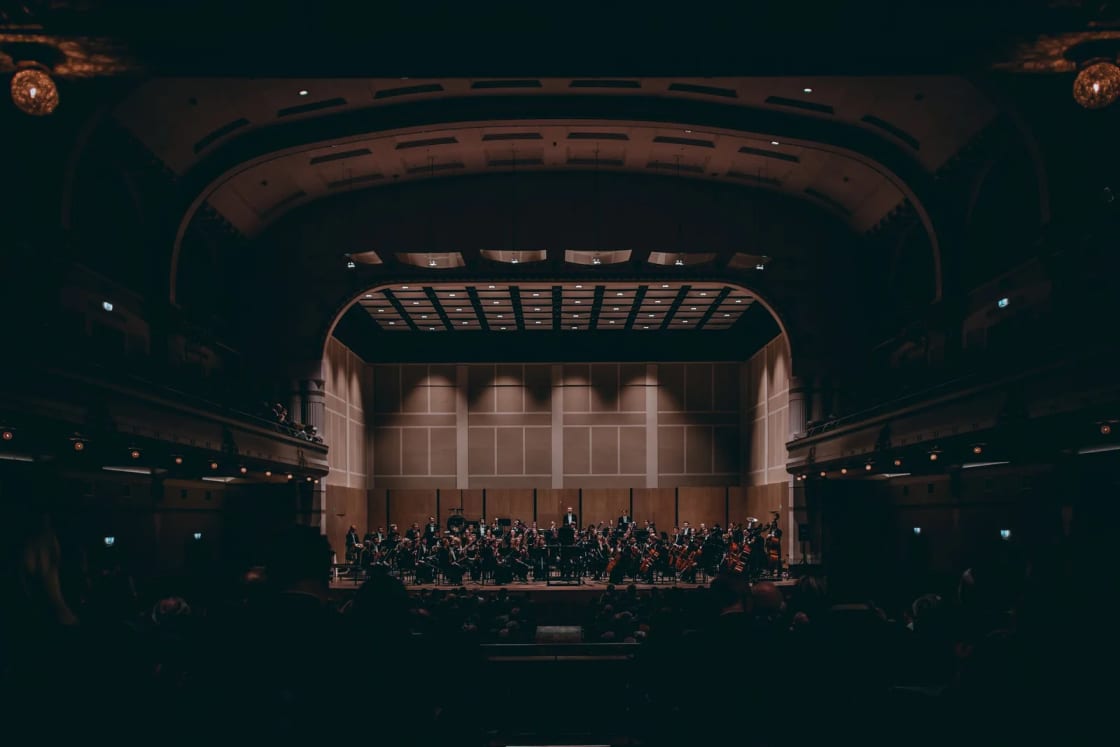
Per that same retrospective, the hall was designed for symphonic performance. It has no proscenium and no orchestra pit, and its surfaces avoid parallel walls and 90-degree angles to help the acoustics. The lobby has a four-story glass wall on the east side that honors Temple Square and the Tabernacle, and a 30-foot Dale Chihuly glass sculpture called Olympic Tower. The page also says there are six chandeliers, each with 3,000 hand-cut crystals, that are serviced each August. The orchestra's own history claims that acoustically there is no bad seat in the house. That is the organization's claim about its own building, so treat it as a description of the design intent rather than a guarantee for every seat. If sound quality matters to you, ask the ticket office about the section you are considering.
Season basics
The Utah Symphony's season runs through the school year, with concerts in several series. The student All-Access Pass page names Masterworks, Pops, Family and Finishing Touches among the series it covers at Abravanel Hall, and it also covers Utah Opera performances at its downtown venue. The student page excludes other venues, naming Deer Valley among them. We did not pull a dated season calendar for this guide, so we cannot give you specific concert dates or programs. Check the symphony's calendar and use these as a rough way to sort what you find:
- Masterworks concerts are the core classical programming. These are the ones to choose if you want the full orchestra experience.
- Pops concerts are lighter and often built around popular music, film scores or guest performers. They are a gentler entry point.
- Family concerts are the series to look at first for younger children.
- Finishing Touches appears in the pass listing, and we did not pull its details. Check the series description on the official page.
The student page also notes that the Design-A-Series, a build-your-own package, requires choosing four or more performances from the season. That page carried an outdated season label while listing 2026-27 performances, which is one more reason to confirm details with the ticket office instead of relying on a cached page.
Weekend concerts and holiday programs tend to draw bigger crowds. We did not find official attendance figures, so we cannot say which dates fill first. Plan on buying earlier for a date that matters to you.
Getting there from Provo
Abravanel Hall is in downtown Salt Lake City, about an hour's trip each way from Provo by the usual routes. You have two sensible choices: drive, or ride FrontRunner and TRAX.
Driving
The Utah Symphony's parking and directions page gives two exact I-15 routes. Coming from the south, which is the Provo direction, it says to take exit 309 for 600 North, turn right onto 300 West, then turn left onto South Temple. Abravanel Hall is on the right. (From the north, it lists exit 306 for 600 South, a left on 300 West, then a right on South Temple.)
Late-afternoon I-15 northbound traffic is the variable. Leave more time than the map shows for a 7:30 PM start, and remember that your drive south after the concert is at night. If you are bringing children, a long drive after a late evening is part of the plan.
FrontRunner and TRAX
Our guide to FrontRunner from Provo covers the station, schedules and fares in detail. For a symphony trip, the shape is this: ride FrontRunner north to Salt Lake Central, then transfer to TRAX and ride to Temple Square Station. The symphony's parking page says to ride to the Temple Square Station and that Abravanel Hall is "across the street to the south" of it. The county's venue page says you can reach Temple Square Station on the Green or Blue lines.
Three details deserve attention.
- FrontRunner does not run on Sundays. Our own FrontRunner guide says so plainly, and it says midday service is hourly, with trains every thirty minutes at weekday peak. A Sunday matinee from Provo by rail is not possible.
- The return trip decides the evening. A concert that ends at about 9:30 PM and a last southbound train that leaves earlier than that is an expensive lesson. Look up the last southbound FrontRunner from Salt Lake Central for your date and work backward from it. Do not rely on our article for the time, because schedules change.
- Fares. BYU and UVU students can ride the UTA system, FrontRunner included, with a current student ID, according to our FrontRunner guide. See also our note on the UVU student ID and UTA pass. Everyone else pays a distance-based fare that we do not print here. Use UTA's current fare table.
The county's page adds one more point: it says an ArtTix ticket doubles as a full-fare UTA transit pass on the day of the show. That statement is made about ArtTix tickets, and it is not clear whether it applies to a ticket bought through the Utah Symphony's own ticket office. Ask when you buy. A UTA rule that rides inside downtown Salt Lake City's free fare zone cost nothing also turned up in our research, but we did not confirm it on UTA's own page, so check it before you plan around it.
For a longer look at the city beyond the concert hall, our Salt Lake City day-trip guide covers the stops, and our guide to the Eccles Theater covers a similar downtown performance venue, with its own parking and TRAX notes.
Where to park
This is where official sources do not fully agree, so read carefully.
Salt Lake County Arts' venue page states that parking is not available at Abravanel Hall, and that metered street parking and paid lots are nearby. The Utah Symphony's parking and directions page lists recommended garages and lots with prices. We found these on that page on November 9, 2026:
| Lot or garage | Address | Price listed |
|---|---|---|
| 400 West Surface Lot | 24 North 400 West | $10 per day |
| City Creek Center | 50 South Main Street | First 2 hours free; 2 to 5 hours $2 per hour; $3 each additional hour |
| Regent Street Garage | 119 South Regent Street | $2 per hour |
| Eagle Gate Terrace | 154 East Social Hall Ave. | $2 per hour |
| 500 South Surface Lot | 50 West 500 South | $12 per day |
| North Temple Surface Lot | 120 North 400 West | $8 per day |
| West Temple Surface Lot | 134 West North Temple | $9 per day |
Those are the figures as listed, and they can change without notice. Event pricing at any downtown lot can differ from a posted daily rate, so confirm on the day. The lots on North Temple and 400 West are the closest of the surface options, and City Creek Center and Regent Street are the garage choices. We have not measured walking times, so we do not give them.
Two practical points. First, a concert that starts at 7:30 PM means you are parking in the evening, and some downtown garages and lots have different rules after dark and on weekends. Read the sign. Second, a free-for-two-hours deal at City Creek will not cover a concert and a dinner, so work out the real cost before assuming it is the cheap option. At the listed rate, a 2-to-5-hour stay costs $2 per hour after the free period, per the symphony's page.
Accessible parking has its own listing. The symphony's page says there is an on-street accessible space on South Temple, and that additional lots and metered parking are near the theater. Another page we saw described the location of accessible parking differently, so call the access services contact or the ticket office and ask exactly where to go before you arrive.
Costs and student and youth ticket options
We do not print general ticket prices in this guide because they vary by concert, section and season and they change. Check the symphony's listing for your date. What we can report is how the student and under-30 structure works, from the Utah Symphony and Utah Opera student ticket page.
- Single-performance student tickets. Available to students ages 5 and older for many Utah Symphony performances, with savings of up to 50 percent. Eligible students include K-12, undergraduate and graduate students, and full-time enrollment is required. A valid student ID is needed to purchase. The page says these are not available for all concerts in advance, and that no discounts apply to Signature performances. There is a limit of one ticket per student per concert. Blackout dates may apply, though tickets often become available on the day of the performance, according to the page.
- Under 30. The page says the student rate is also extended to patrons under 30.
- All-Access Pass. Listed at $69 for unlimited performances for students and anyone under 30, and the Duet Pass, for two people, at $109. The pass page limits it to certain series and venues, as described above.
- Student Design-A-Series. Choose four or more performances from the season and save up to 50 percent. Bring your ID to the ticket office when you pick up your package.
To buy, use the View Tickets links for each performance on the symphony's site, or call 801-533-NOTE (6683).
Prices on older pages and third-party sites can be out of date, so confirm with the ticket office before relying on any of these figures. If you are a student on a tight budget, our student discounts guide lists other ways to stretch a semester's entertainment money.
A rough way to think about total cost for a Provo student: the ticket, a parking charge if you drive, or a FrontRunner fare if you ride and are not covered by an ID, and something to eat before the concert since food is not allowed in the hall. We do not guess at the total, because each piece depends on your choices and the date.
Timing the evening
The symphony's FAQ says most concerts start at 7:30 PM and run an hour and a half to two hours, including intermission. It says most of the audience likes to be in their seat about ten minutes before the performance.
For a Provo-based trip, that suggests working backward in this order:
- Pick the concert and check the listed start time.
- Choose your route. If you ride, look up the last southbound FrontRunner that night.
- Plan to reach downtown comfortably early, with time to find parking or walk from Temple Square Station, collect tickets and check a coat.
- Account for the drive or ride home, and the school or work day that follows.
If you arrive late, the FAQ says most performances have late seating after the first piece or movement, and that latecomers wait in the lobby where monitors and speakers carry the performance. That is a safety net, not a plan. You will miss the opening music, and the opening is often a good reason to be there.
Intermission is included in the concert length. Refreshments are sold at the lobby booth, and the symphony says the gift shop, coat check and refreshment booth are on the south side of the lobby. Eating inside the concert hall is not allowed.
What to wear
The Utah Symphony's FAQ answers this directly: the simple answer is whatever you feel comfortable in. It says business casual is common but that you will see everything from tuxedos to jeans. Salt Lake County Arts' page did not include a dress code. A third-party summary of county material mentioned casual business attire as a safe choice, but we could not confirm that on the county's own page, so we rely on the symphony's statement.
Here is what that means in practice for a Utah Valley audience, as a suggestion and not an official rule.
- Students. Clean, comfortable clothes are fine. If you are coming from campus, you do not need to change into anything formal.
- Date nights. Many people dress a step up from everyday wear to make an occasion of it. That is a choice, not a requirement.
- Families. Dress children so they can sit still comfortably for up to two hours. Shoes that are quiet on hard floors help.
- Layers. Downtown Salt Lake City in winter is cold between the car or station and the door, and indoor temperatures vary by hall. A jacket you can check or fold under your seat is useful. The coat check is on the south side of the lobby.
- Scents and noise. Avoid anything that rustles, jingles or beeps during quiet passages. Silence your phone fully.
Rules in the hall
Several policies from the symphony's FAQ are worth knowing before you go.
- No photography or recording of any kind during performances.
- No eating inside the concert hall.
- Age limits. The general terms say no children under 5 except at specified performances. Student tickets begin at age 5.
- Late seating happens after the first piece or movement at most performances.
Applause etiquette is a common worry for first-timers. The symphony's FAQ excerpt we reviewed did not address it, so we will not state a rule. Watching the audience and the musicians is the usual guide. When in doubt, wait until others begin.
Accessibility
The Salt Lake County Arts page lists elevators to all levels, an escalator from the ticket office to the main lobby, wheelchair seating, curbside assistance and assisted listening devices. It lists ADA restrooms on every level. For ASL interpreting, captioning or other accommodations, it points to ArtTix at 801-355-ARTS (2787) or info@arttix.org. The Utah Symphony also publishes its own accessibility page for the hall. Contact the relevant office well before the concert, since interpreting and captioning generally need advance notice. We did not confirm the notice period, so ask when you call.
Who should skip it
This is not the right outing for every group or every evening. Consider skipping, or choosing a different concert, in these cases:
- You need to get home early. A 7:30 PM concert plus an hour south does not suit a school night with very young children, or a work shift at dawn.
- You are traveling on a Sunday by rail. FrontRunner does not run, so a Sunday trip means driving or a TRAX park-and-ride in Salt Lake County, as our FrontRunner guide notes.
- Your child is under 5. Unless the performance is specifically listed as open to younger children, the general terms exclude them.
- You want to take photos or eat a meal in your seat. Neither is allowed.
- You expect to decide on the day. Student tickets may not be available in advance for every concert, and popular programs can sell out. Spontaneity is risky for a 2,766-seat hall that may still sell through on a major night.
- You are on a very tight budget and would pay full price. Check the student or under-30 rate first, or consider free local music instead. Our live music in Provo guide is a starting point.
What to check before you go
A short list, since details change.
- The concert page. Confirm the date, start time, program and any age notes.
- Your ticket type. If you use a student or under-30 rate, bring a valid student ID or proof of age as the ticket office requires, and confirm whether the concert is eligible. The page says no discounts apply to Signature performances.
- The last train. Look up the last southbound FrontRunner from Salt Lake Central for your date if you plan to ride. Remember there is no Sunday service.
- Parking. Choose a lot or garage from the symphony's list, check the current price and decide on a fallback.
- Accessibility. If you need accommodations, contact the access services office or ArtTix ahead of time.
- Weather and traffic. Winter storms can slow I-15 and the walk from the station or lot.
- Policies. Silence your phone, leave the camera in your pocket and finish your snack outside.
What we could not confirm
We did not pull a dated 2026-27 concert calendar, current single-ticket prices or hours for the box office, so we do not give them. We did not confirm UTA's free fare zone rule or whether a symphony ticket doubles as a transit pass the way the county says an ArtTix ticket does. Parking information differs across sources: the county says parking is not available at the hall, while the symphony lists nearby lots and garages with prices. Accessible parking is described as being on South Temple, but the side of the street is not consistent across pages we saw. For all of these, the official pages and the ticket office at 801-533-NOTE (6683) are the final word.
The bottom line
For a Provo household, the Utah Symphony is a manageable evening trip: an hour north, a short walk or a TRAX stop from the hall, and a flexible dress standard. The savings are real for students and anyone under 30, and the rules are simple enough to learn in one read. The main risks are timing the ride home and relying on stale price information. Plan around those two and the rest of the evening takes care of itself.
Related guides
- Live Theater in Utah Valley: Where to See a Show
- FrontRunner From Provo: Schedule, Station, Fares & Speed
- The Eccles Theater: parking, TRAX and rules
- Student Discounts in Provo
- Salt Lake City Day Trip from Provo
Frequently Asked Questions
Where is Abravanel Hall?
How do I get there from Provo without driving?
Is there a dress code at the Utah Symphony?
Are there student discounts for Utah Symphony concerts?
What time do concerts start, and how long do they last?
Can I bring my children?
What if I arrive late?
Can I take photos or eat in the hall?
Sources
The facts in this guide were checked against these sources. Hours, fees and rules change, so confirm anything time-sensitive with the source before you go. How we make Provo.com.
- Abravanel Hall, Salt Lake County Arts & Culture. Checked November 9, 2026.
- Abravanel Hall: A Retrospective, Utah Symphony | Utah Opera. Checked November 9, 2026.
- Frequently Asked Questions, Utah Symphony | Utah Opera. Checked November 9, 2026.
- Parking & Directions, Utah Symphony | Utah Opera. Checked November 9, 2026.
- Student Ticket Discounts, Utah Symphony | Utah Opera. Checked November 9, 2026.