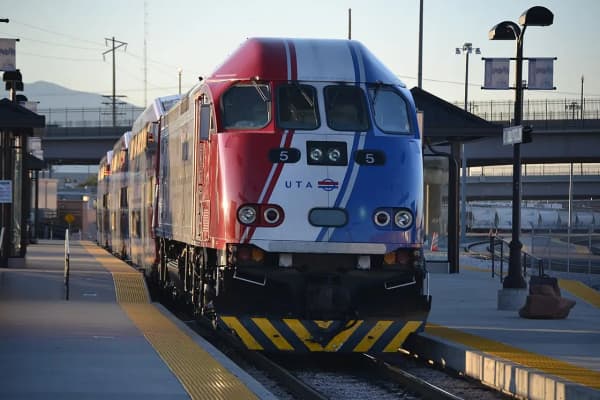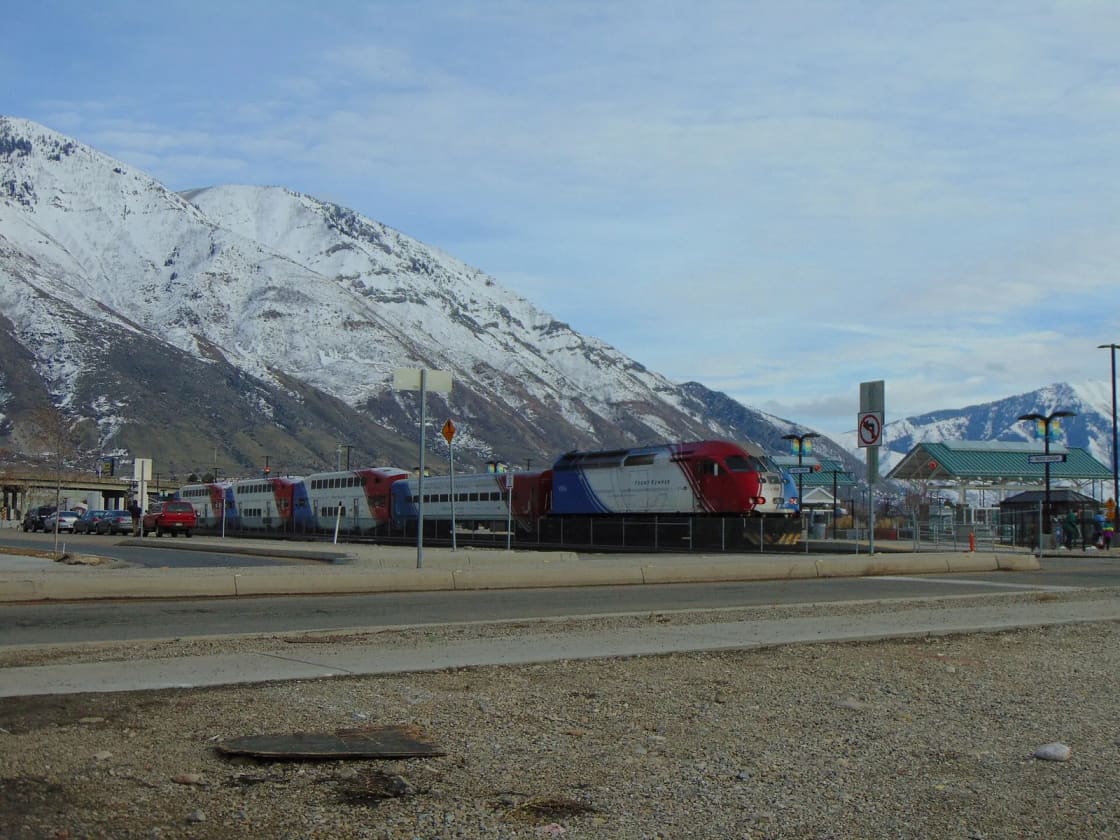

There is a commuter rail line that runs from Provo to Ogden along the length of the Wasatch Front, and a surprising number of people who live in Utah Valley have never been on it.
Some of that is habit. Most of it is that FrontRunner is excellent for a specific set of trips and mediocre for everything else, and if your trips are not in the first category the line is essentially invisible to you.
This is a guide to working out which category you are in.
The basics
FrontRunner is UTA's commuter rail service. It opened in 2008 between Salt Lake City and Weber County and was extended south to Provo in 2012. It runs roughly eighty miles north to south with sixteen stations, on dedicated track rather than shared freight track, at speeds up to seventy-nine miles per hour.
Provo Central Station is the southern end of the line. It sits at 701 South Freedom Boulevard, south of downtown Provo, with a large park-and-ride lot and bike storage including lockers. A pedestrian bridge completed a couple of years ago lets passengers cross the UTA and Union Pacific tracks without a level crossing.
Going north from Provo, the line calls at Orem Central, then works up through Utah and Salt Lake counties to Salt Lake Central, and on to Ogden.
Travel time from Provo to Salt Lake Central is about an hour and five minutes.
The schedule, honestly
- Weekdays: every thirty minutes at peak, hourly in the middle of the day
- Saturdays: hourly, all day
- Sundays: nothing
The hourly midday figure is the one that should govern your planning. Thirty-minute peak service is forgiving; hourly service is not. Miss an hourly train and the cost of that mistake is an hour standing on a platform, and there is no way to shorten it.
The Sunday problem, and why it exists
This deserves its own section because it strands people, repeatedly, and because the reason is more interesting than "they decided not to."
About three-quarters of the FrontRunner corridor is single-tracked. Trains going in opposite directions have to meet at passing sidings and at stations where the line briefly doubles. That constrains the schedule — it is a large part of why midday service is hourly rather than every thirty minutes — and it constrains maintenance, because there is no parallel track to shift trains onto while crews work.
So UTA concentrates track maintenance into Sundays. It is the only full day the agency can take the line out of service without disrupting a workday or a Saturday. The agency has publicly tied the prospect of regular Sunday service to getting a substantially larger share of the corridor double-tracked, which is a capital project measured in years and hundreds of millions of dollars rather than a scheduling decision.
The practical upshot is unchanged regardless of the reason: there is no train on Sunday, from Provo or anywhere else on the line.
This interacts badly with two things people commonly want to do on a Sunday in this valley. The first is attend something in Salt Lake City. The workable version of that trip is to drive to a TRAX park-and-ride in Salt Lake County and take light rail in from there — TRAX does run on Sundays — rather than driving to Provo Central Station and expecting a train. The second is fly somewhere, which we cover below.
When the train genuinely beats driving
Be specific about this, because the answer is not "always" and pretending otherwise makes the case worse.
Rush hour into Salt Lake County. This is the strongest case and it is not close. I-15 northbound in the morning and southbound in the evening is the reason this line exists. An hour on a train where you can work beats an hour and a bit in traffic where you cannot, and the gap widens on a bad day.
Anything involving downtown Salt Lake parking. A Jazz game, a concert, a conference, a day at the state capitol. Downtown parking costs real money and takes real time, and the train drops you at Salt Lake Central with a TRAX connection into the core.
General Conference weekends. Twice a year, downtown Salt Lake City fills up in a way that makes driving genuinely unpleasant. On the Saturday, the train is the smart route from Provo — north to Salt Lake Central, then TRAX to Temple Square. Our Salt Lake City day-trip guide covers the stops. On the Sunday, it does not exist, which catches people out every single time.
Any trip where you would rather work than drive. Wifi and a table are the argument. Two hours of usable time a day is a different proposition from two hours of commuting.
When it does not
Midday, off-peak, one-way. Hourly service plus the walk at both ends usually loses to a car on an empty freeway.
Trips that start or end far from a station. The train solves the middle of the journey. It does not solve the first and last miles, and in this valley those miles are often the hard part.
Anything on a Sunday. Yes, again.
Trips with a lot of luggage and a tight connection. Doable, but the transfer at Salt Lake Central is a real transfer.
Getting to and from the station
This is the part people underestimate, and it is where the trip is won or lost.
Park and ride. Provo Central Station has several hundred spaces and Orem Central has a few hundred more. For most Utah Valley riders this is the default and it works. Arrive earlier than you think on a weekday morning.
Take the UVX. Both FrontRunner stations in Utah County are UVX terminals, which makes the bus the natural feeder. If you live or work along the University Parkway and University Avenue corridor, you can do the whole trip without a car — and if you are a BYU or UVU student, without paying anything either. We have written the bus half of this in our UVX guide.
Bike. Provo Central has short-term and long-term bike parking including lockers, and the trains carry bikes. For a rider within a couple of miles of the station this is often the fastest option available.
Get dropped off. Unglamorous and frequently correct.
Fares
FrontRunner is a premium service. A regular one-way UTA fare — the one that covers local buses, UVX and TRAX for a two-hour window — does not cover it. You pay more, and the amount varies with how far you go, which is unusual in a system that is otherwise mostly flat-fare.
BYU and UVU students ride free, as with the rest of the UTA system, on a current student ID. This is worth restating because students routinely use their ID for the campus bus and never discover it also covers the train to Salt Lake City.
Everyone else should look at the current fare table rather than a number in an article. Fares move, and a figure printed here would eventually become the kind of confidently wrong detail we try hard not to publish. Buy through the app or at a station machine; tap in and tap out, because distance-based fares depend on the system knowing where you got off.
The airport question
This comes up constantly, so here it is plainly.
You cannot ride FrontRunner to the Salt Lake City airport. You ride FrontRunner to Salt Lake Central and transfer to the TRAX Green Line, which does serve the airport.
That works, and plenty of people do it. The things to weigh:
- Total time. Budget the train, the transfer and the light rail, then add the buffer you would want before a flight. It is not a short trip.
- Luggage. Two vehicles and a transfer with bags is a different experience from one car.
- Sunday. There is no train. A Sunday departure from SLC cannot start with FrontRunner from Provo.
- The alternative. Provo has its own commercial airport, which for a growing list of destinations removes the problem entirely.
We compare those two airports directly in PVU or SLC: which airport should you fly?, and cover the ground route in detail in our guide to getting from SLC airport to Provo.
The scale of the thing
Numbers help calibrate expectations, so here are the ones that matter.
FrontRunner carried around 4.1 million passengers in 2025, running at roughly 14,300 boardings on a typical weekday as of late that year. Sixteen stations. Around eighty miles of route from Provo to Ogden — it was eighty-eight before the Pleasant View station at the northern end was closed. Top speed seventy-nine miles per hour, on UTA-owned track that runs parallel to Union Pacific's rather than sharing it.
Those figures describe a real regional railway rather than a demonstration project, and they also explain the constraints. Fourteen thousand weekday boardings across eighty miles is respectable commuter-rail performance and nothing like the density that would justify turn-up-and-go frequency. Hourly midday service is a rational response to the demand, not a failure of ambition.
The first train of the day leaves Provo Central in the small hours — early enough for a shift start in Salt Lake County — and the last one back is early enough that an evening in the city needs checking against the timetable rather than assuming.
Holidays behave differently
This is the kind of detail that ruins a plan and is almost never written down anywhere findable.
UTA runs regular service on several holidays that other systems treat as Sundays — Juneteenth, Columbus Day and Veterans Day among them. So a holiday does not automatically mean no train.
Pioneer Day is the notable Utah case. On July 24, FrontRunner runs an enhanced Saturday schedule rather than shutting down or running a skeleton service — a sensible response to a state holiday that moves a lot of people toward parades and fireworks.
The rule to internalize: check the specific date rather than assuming a holiday follows the Sunday pattern. UTA publishes holiday service arrangements, and the digital schedules and the Transit app carry them.
The station itself
Provo Central Station is more than a platform, and a few things about it are worth knowing before your first trip.
The pedestrian bridge, completed a couple of years ago, lets passengers cross the UTA and Union Pacific tracks without a level crossing. Before it, getting between sides of the station involved a wait that could be genuinely long behind a freight train.
Amtrak stops in Provo too. The California Zephyr — Chicago to the Bay Area — calls at the Provo Amtrak station daily, running west past the FrontRunner station. It is a different service on a different schedule at a different building, and it is not a commuting tool by any stretch. But it means Provo has a daily long-distance train, which is unusual for a city this size and genuinely pleasant if you have the time to spend.
Salt Lake Express and other intercity bus operators also use the station area, which makes it the closest thing Utah Valley has to a single intermodal hub.
Bike facilities include both short-term racks and long-term lockers, which is the detail that makes a bike-plus-train commute realistic rather than theoretical.
Riding it well
A few habits separate people who like this line from people who tried it once.
Tap in and tap out. FrontRunner fares vary by distance, which is unusual in a system that is otherwise mostly flat. The system needs to know where you left.
Sit upstairs if you want to work. The cars are double-deck and the upper level is quieter.
Use the wifi, and do not depend on it. It is a real amenity and it is a train.
Know your last train. This is the single most common way an otherwise good evening in Salt Lake City ends badly. Hourly service is forgiving in the middle of the day and unforgiving at the end of it.
Bring the bike. Bikes are carried, and having one at the far end converts a station-to-destination problem into a pleasant ten minutes.
What is coming
Two things are worth watching, neither of which should change a decision you make this year.
Double-tracking. More double track means more frequent service and is the stated precondition for Sunday operation. This is the project that would most change what FrontRunner is.
The southern extension. UTA has done planning work and held public meetings on extending the line south from Provo through Springville and Spanish Fork to Payson. South county currently has no rail at all, and an extension would be a significant change for those cities.
Both are long-horizon. Plan around the line as it is.
A note on reliability
Reported on-time performance for FrontRunner sits in a respectable band relative to the rest of the UTA network, which is what you would expect from a service on dedicated track. The delays that do occur tend to come from level crossings and from the single-track meets described above, and they propagate — an hourly service that loses ten minutes cannot make it up before the next scheduled meet.
Build a buffer into anything with a hard deadline at the far end, and check alerts before leaving rather than at the platform.
The honest summary
FrontRunner is a good commuter railway with two real constraints: it runs hourly outside peak, and it does not run on Sunday. Both trace back to the same physical fact about the corridor being mostly single-tracked.
If you commute north on weekdays, it is very likely better than driving and you should try it for a week before deciding. If you go to Salt Lake City occasionally for events, it is often better than driving and always better than parking downtown. If your travel is midday, local, or Sunday, it is not for you and no amount of enthusiasm changes that.
The strongest version of using it in this valley is the combination: UVX to the station, train to the north, TRAX at the far end. Six days a week, that chain works. On the seventh, you need a car.
Related Guides
- Things to Do in Bountiful and South Davis County, Utah, From Provo
- Things to Do in Murray and Midvale, Utah, From Provo
- Things to Do in Provo Without a Car: The UVX and FrontRunner List
- Buses From Provo to Vegas, St. George & Beyond: The Intercity Guide
- Car Ownership in Utah Valley 101: Registration, Emissions & Winter Reality
- Living in Provo Without a Car: An Honest Assessment
- Parking in Downtown Provo Without Getting a Ticket
- Driving Schools in Provo: Driver Ed, Road Tests & the Third-Party Shortcut
- Scooters & Bike Share in Provo: What's Actually on the Street (2026)
- Towed in Provo: The Sign at the Entrance Decides Whether They Were Allowed To
- Winter Tires & Canyon Driving in Utah: What You Actually Need
- Getting Around Provo: FrontRunner, UTA & Commuting Guide (2026)
- The Orem Line: The Interurban That Came First
- Game Night at the Delta Center from Utah Valley
- Getting to Sundance and the Resorts Without a Car
- Temple Square in December from Provo
- Loveland Living Planet Aquarium from Provo: The Drive, the Tickets, the Exhibits, and a Plan for the Day
- Where to Live in Utah County If You Work in Salt Lake: The Commute Math, City by City
- UTA Fares and Passes Explained for Utah County
- Things to Do in Provo on a Sunday
- Ogden From Provo: 25th Street, the Dinosaur Park and the Mountain Behind It All
- The Wasatch Front's Big Annual Events From Provo: The Calendar Utah Valley Keeps Missing
- Salt Lake City from Provo: The FrontRunner Day Trip
- Amtrak from Provo: Riding the California Zephyr- The Utah Asian Festival: the state's big pan-Asian day at the Fairpark
Frequently Asked Questions
Does FrontRunner run on Sunday?
How long does it take from Provo to Salt Lake City?
How often do trains run?
Where is the Provo FrontRunner station and can I park there?
Is FrontRunner covered by a regular bus fare?
Can I get to the Salt Lake City airport on FrontRunner?
Does the train go south of Provo?
Is there wifi and a bathroom on the train?