Upcoming dates

Every November, a walled garden on the west edge of Lehi becomes the most-visited place in Utah County for eight weeks. Fifty acres of Ashton Gardens are strung with about 10 million lights, set to music, dotted with fire pits and hot-chocolate stands and glowing set pieces the size of houses, and opened to timed groups of families who walk a loop in the cold and call it the best night of December. In summer, the gardens host Imaginaria, Thanksgiving Point's play festival for families.
That is Luminaria at Thanksgiving Point, and it has become the valley's biggest Christmas tradition in less than a decade. It is also the one with the most moving parts for a family to plan around: a presale, two ticket tiers, timed entry, a sellout calendar, an optional add-on, and a December that fills up. This is the explanation — what it is, when it runs, what it costs, how the tickets work, how long it takes, and how to do it on the night the crowds are smallest.
Dates and hours below are from Thanksgiving Point's Luminaria page for the 2026-27 season; prices are the published 2025 figures, which 2026 pricing will replace when the presale opens October 1. Confirm on the event page before you buy.
What Luminaria Is
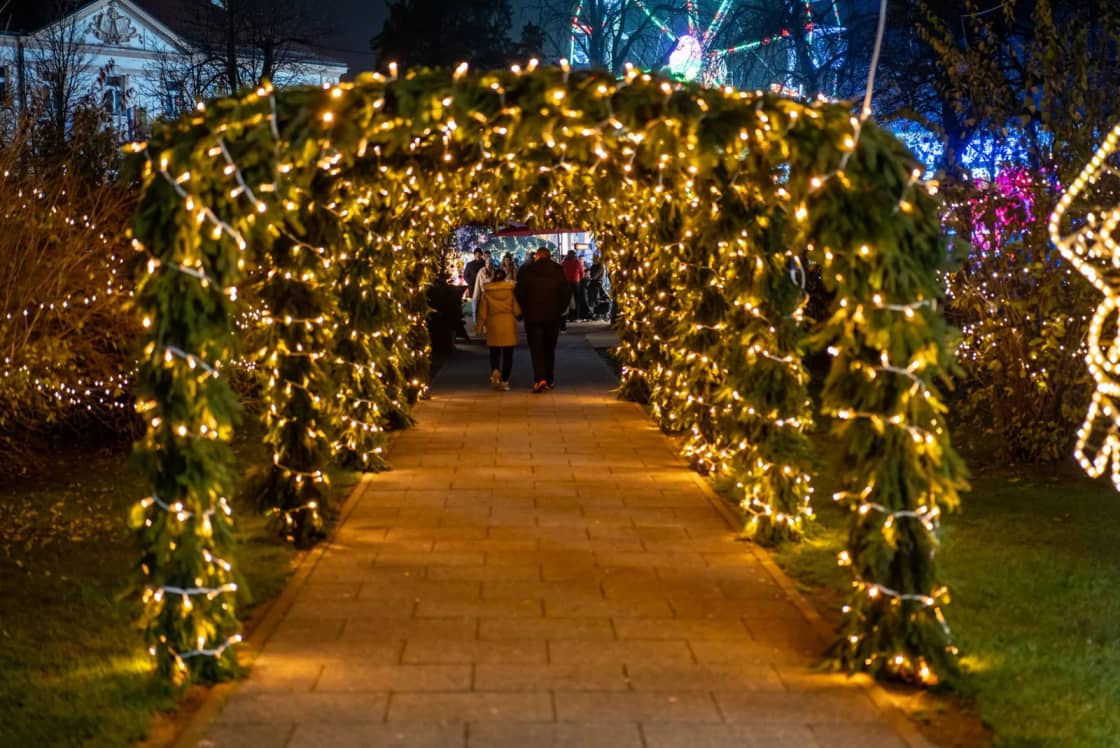
Luminaria is held at Ashton Gardens, the 50-acre formal garden at Thanksgiving Point. The concept is a walk-through light installation rather than a drive-through: the garden's paths, trees, ponds, and structures are lit and animated, with music synchronized to a lit hill that changes color and set pieces — oversized ornaments, snowmen, a nativity, illuminated tunnels — placed along a loop. A village at the midpoint has fire pits (some reservable, with igloos for a fee), food and hot drinks for sale, and gift boutiques. The whole thing is designed to be walked in about ninety minutes at a family's pace.
It has grown each year, with new exhibits announced each fall, and in the 2024-25 season it added the Tree of Life, a sculpture garden interpreting the biblical tree in light, sold as an add-on. Thanksgiving Point bills it as Utah's largest Christmas light display, and by any measure it is the largest walk-through one.
If you have never been to the gardens in daylight, our Ashton Gardens guide covers them; the Thanksgiving Point guide covers the rest of the campus, which matters because a Luminaria night pairs with dinner at the campus restaurants or a museum afternoon.
The 2026-27 Dates and Hours
Thanksgiving Point's event page lists the season by entry windows, and the 2026-27 calendar reads:
- November 12-24, November 30, December 1-3, 14-16 and 29, January 1-2: time slots 4 to 9 p.m., last entrance 9:15.
- November 26 (Thanksgiving Day): 5 to 9:30 p.m.
- November 25, November 27-28, December 4-5, 11-12 and 17-28: 4 to 9:30 p.m., last entrance 9:45.
- January 4-9: 5 to 8:30 p.m.
The season closes on Sundays, Christmas Eve, and Christmas Day, so check the event page for the exact open dates. It runs through Saturday, January 9, 2027, with the heaviest hours in December.
The season is long enough that the decision is less "whether" than "which night," and the ticket tiers exist to steer you.
Regular Nights, Premium Nights, and the Presale
Luminaria's tickets are sold for a specific date and a specific entry window, and they come in two tiers.
Regular nights are the lower-demand dates: the first two weeks in mid-November, a handful of early-December weeknights, and the January tail. Premium nights are the ones expected to sell out: Thanksgiving weekend's Friday and Saturday, and essentially every night from the first weekend of December through New Year's Eve. The lights are identical on both; the crowd is not.
Prices are set by date, and premium nights cost more than regular ones. Check the event page for the price of the night you want.
- Exchangeable tickets cost a little more, and they are the only ticket that can be exchanged the day of, for a sick kid, a storm, or a change of plans.
- Presale (October 1-31) is the cheapest time to buy.
Tickets purchased in advance are non-refundable unless they are the exchangeable kind. Members are limited to 30 discounted presale tickets and get more than 10 percent off regular-season prices.
The presale is the whole game. It runs October 1 through 31, it is the lowest price of the year, and it is when the premium Saturdays go. Thanksgiving Point says tickets sell out every year, and the sellouts are the premium nights in the second and third weeks of December. A family that decides in early December to go on December 19 will find that night gone or nearly so. Buy in October.
A Thanksgiving Point membership pays for itself on Luminaria alone for a family of five going once on a premium night, and the membership's Luminaria discount has been generous enough that neighbors go together on one member's tickets.
The Crowd Math
Here is how to pick the night.
The quietest nights are the regular-tier weeknights in mid-November — the first two weeks — when the lights are all up, the weather is often mild, and the paths are nearly empty. The trade is that it is not December yet, and for some families that matters. The next quietest are the early-December Tuesday through Thursday regular nights and the January week after New Year's, when the entry windows shorten to 5 to 8:30 (January 4-9).
The busiest nights are Thanksgiving Friday and Saturday and every Friday and Saturday in December, peaking the two Saturdays before Christmas. On those nights the paths are shoulder-to-shoulder in the narrow sections, the village fire pits are claimed, and the last entry window is 9:45 because the demand runs that late.
Within any night, the earliest entry window — 4 p.m., when it is barely dark — is the least crowded, and it lets a family with small children finish by 6 and be home for dinner. The 7 and 8 p.m. windows are the peak. The last windows, 9 to 9:15 or 9:45, are quieter again, and the lights are at their best in full dark, but a child who is awake at 10:30 in Lehi on a school night is a parent's problem.
So: a mid-November or early-December weeknight at 4 or 5 p.m. for small children; a December Friday at 8 for a date; the last window on a January weeknight for the adults who want the place to themselves.
How the Night Goes
Arrival. Ashton Gardens is at 3900 North Garden Drive, at the west end of the Thanksgiving Point campus off I-15 exit 284. Parking is free and on site, and it fills on premium nights. Arrive 15 to 20 minutes before your window on a busy night, less on a quiet one. Your ticket is scanned at the gate for the window it was bought for; arriving late for your window has been accommodated on quiet nights and not guaranteed on busy ones.
The loop. The route is a single path through the gardens, roughly a mile and a half, with the set pieces, lit tunnels, and the music-synchronized hill along the way. It is a loop; you do not double back. The paths are paved, strollers and wheelchairs manage them, and wagons are the local family's choice. Expect some grades and slick spots when it is cold; the staff clears snow.
The village. At the midpoint is Luminaria Village: fire pits you can stand around free or reserve (with igloos) for a fee, hot chocolate and treats for sale, and gift boutiques. This is where the family regroups, warms up, and decides whether to add the Tree of Life. On a busy night the reservable pits are the only guaranteed seat.
The Tree of Life. Off the main loop, an optional add-on ticket, 30 to 45 minutes more. Contemplative, adult-friendly, and the best-reviewed section for anyone over about ten. With a tired four-year-old, skip it.
Departure. Once in, you stay as long as you want; the entry window governs entry, not exit. The last visitors leave around 10:30 on the late nights. The drive back to Provo is 25 minutes.
Plan on an hour and a half for the loop, two hours with small children, and two and a half with the Tree of Life and a fire pit stop.
What to Wear, What to Bring
It is a winter walk in a garden after dark, and the people who have a bad time are the ones who dressed for the car.
Real coats, hats, gloves, and warm socks for everyone, including the child who will refuse the hat until the second tunnel. Boots or shoes with tread; the paths get slick. Hand warmers are a small kindness. A wagon or a stroller with real wheels for the under-fives. Cash or a card for the hot chocolate, because the village is where the cold catches up with children. A phone with a charged battery, because you will take a lot of photos and the cold drains it. Leave the tripod; the paths are too crowded.
Dinner before or after is a real question. The Thanksgiving Point campus has restaurants, Lehi's food corridor along Thanksgiving Point Way and State Street is five minutes away, and on a premium night the restaurants near the campus are as full as the gardens. Our Lehi restaurant guide is the list.
Going Without Children, and Going as a Group
Luminaria reads as a family event, and most nights it is, but two other ways of doing it are worth naming.
As a date or a couple. The late window on a December Friday — 9 p.m. entry, full dark, the paths thinning as families leave — is the version that works for two adults. Add the Tree of Life, reserve a fire pit or an igloo in the village, and it becomes the best two-hour winter date in the county. Our date night activities guide lists it alongside the alternatives, and the drive back through Lehi at 11 p.m. is empty.
As a group. Ward activities, extended families, office parties, and youth groups book Luminaria in blocks, and Thanksgiving Point has offered group pricing for larger parties on request. The reservable fire pits and igloos in the village are the group's base; without one, a party of twenty spreads out along the loop and regroups at the village. Groups should pick a regular night and an early window; a premium Saturday with twenty people is a night of counting heads. Book in October like everyone else.
With grandparents. The loop is manageable for most older adults at a slow pace, the paths are paved, and the village is a rest. Two hours in the cold is the constraint, not the distance. A weeknight at 4 p.m., when the temperature is highest and the crowd smallest, is the right window, and a wheelchair from the gardens' entrance is the right tool if walking a mile and a half in the cold is a stretch.
Weather, and the Ticket That Handles It
Utah's December weather is the one thing the ticket calendar cannot control. A snowy night at Luminaria is, by every account, the best version — the lights on fresh snow, the paths hushed — and Thanksgiving Point says so on its own page. A night of 12 degrees and wind is not, and a night of rain is worse.
The exchangeable ticket, at $2 above the regular price, is the only Luminaria ticket that can be moved the day of, for weather, illness, or a change of plans. For a family with small children or a long drive it is cheap insurance, and it is the ticket to buy if the plan is a specific December Saturday that could turn. Standard advance tickets are non-refundable. Check the forecast the morning of; if it is the exchangeable kind, move it; if it is not, dress warmer and go, because the lights in a storm are the ones people remember.
The inverse also holds. Mid-November nights are often 40 degrees and dry, which is the most comfortable Luminaria of the season and the cheapest, and the trade for going before December is that your photos will not have snow in them.
Luminaria Versus the Rest
Utah County has a full menu of holiday lights, and Luminaria is the premium ticket on it. Spanish Fork's Festival of Lights at Canyon View Park is a drive-through with a per-vehicle fee, thirty minutes, warm, and good for babies and grandparents. The Christmas in Provo guide covers the Provo light displays and the free neighborhood routes. Temple Square in Salt Lake is the other walk-through, free and forty-five minutes north. And the neighborhood displays in every city in the valley are free and endless.
Luminaria costs more and asks more — a ticket bought in October, a cold two hours, a crowd on the good nights — and gives more: a designed environment on a scale nothing else in the county attempts. Families with children over four who can manage the cold tend to make it the tradition. Families with infants or mobility limits often do the drive-through instead, and many do both. If you do it once, do it on a quiet weeknight in early December at 5 p.m., with the wagon and the hand warmers, and see.
How It Grew
Luminaria began as a more modest light walk. Each year since has added acreage, set pieces, and production: the music-synchronized hill, the tunnels, the village with fire pits and igloos, the premium-night tier, the presale, and in 2024 the Tree of Life. Attendance has grown with it, which is why the sellout calendar and the two-tier pricing exist at all. A family that went in its early years and remembers an easy walk-up night will find a different, larger, and more scheduled event — and the same lights on the same gardens, multiplied.
The Checklist
- Watch Thanksgiving Point's event page for the October 1 presale; buy then.
- Pick a regular-tier weeknight and an early window for small children; a premium Friday at 8 for a date.
- Buy the exchangeable ticket if a sick child or a storm would wreck the plan.
- Decide on the Tree of Life at the village, not in advance.
- Arrive 15 to 20 minutes early on a busy night; parking is free.
- Dress for a two-hour walk outdoors in December.
- Eat before or after; the campus and Lehi's corridor fill on premium nights.
- Pair it with Thanksgiving Point's Breakfast with Santa on a Saturday if the dates line up — our Santa guide has the breakfast details.
Related Guides
-
Santa in Utah Valley: Breakfasts, Photos, Runs and Parades
Advertisement -
Christmas Boutiques & Craft Fairs in Utah Valley: The Circuit
Frequently Asked Questions
When is Luminaria 2026?
How much do Luminaria tickets cost?
What is the difference between regular and premium nights?
How long does Luminaria take?
What is the Tree of Life?
Is Luminaria walkable with a stroller or wheelchair?
How does Luminaria compare to the drive-through lights?
Where do I park, and is it free?
Sources
The facts in this guide were checked against these sources. Hours, fees and rules change, so confirm anything time-sensitive with the source before you go. How we make Provo.com.
- Thanksgiving Point: Luminaria, Thanksgiving Point. Checked October 12, 2026.