
More on American Fork and Pleasant Grove: every guide we have published there, in one place.
American Fork and Pleasant Grove share a border, a bench, a pioneer founding decade, and until recently a school district. They are frequently treated as interchangeable by people shopping north Utah County.
That was always a little unfair. As of 1 July 2027 it stops being true in a way that shows up on paper, because the two cities land in different school districts on the same morning.
This covers what that change means, and everything else that separates them — size, housing, canyons, freeway access, city character and the practical texture of living in each. Boundary decisions, rates and city programs are all still moving; confirm current specifics with each city and district before you commit.
The short version
American Fork is the larger, better-connected city with its own freeway interchange and one of the best canyons in the state at its back door. Pleasant Grove is smaller, quieter, set back from the freeway, and cheaper to reach the mountains from on foot.
After June 2027 they are also in different school districts, which for a family with children is likely to be the deciding factor regardless of anything else on this page.
The school district split is the headline
Alpine School District stops existing on 30 June 2027. Utah County voters approved the breakup in November 2024, and three new districts take over the following morning.
American Fork joins the Aspen Peaks School District, alongside Lehi, Highland, Alpine, Cedar Hills and the Utah County portion of Draper. Pleasant Grove joins the Timpanogos School District, alongside Orem, Lindon and Vineyard.
Two cities that share a municipal border will be administered by different school districts, with different boards, different superintendents, different budgets and eventually different policies.
Both districts have been staffing up. Aspen Peaks appointed Joel K. Perkins as its first superintendent in January 2026; Timpanogos appointed Joe Jensen in the same window. The three districts signed an agreement in mid-2026 covering how Alpine's assets and liabilities get divided.
What the split does and does not change
It changes administration. Which board sets policy for your child's school, which district negotiates with teachers, which district runs the calendar, and which district's tax rate applies.
It does not automatically change which building your child attends. School boundaries are a separate process, run by each new district, and those studies were still underway as this was written. Aspen Peaks launched a boundary study during 2026.
So the honest answer to "will my kid switch schools" is that nobody could tell you with certainty at the time of writing, and anyone who says otherwise is guessing. Ask the district about your specific address. That is not a dodge — it is the only reliable method while boundary work is live.
Why this matters more than it sounds
New school districts make their own decisions. Over five or ten years, two districts starting from the same inheritance will diverge — on calendars, on programs, on bond measures, on how they handle growth.
If you are choosing between these two cities and you have young children, you are not choosing between two similar districts. You are choosing between two institutions that do not exist yet and whose character will be set by boards elected in the next few cycles.
That is difficult to evaluate. The practical move is to look at who was elected to each board, read their public meeting minutes, and form a view. The information is public and almost nobody reads it.
How the split happened, and why Pleasant Grove did not vote
This is worth understanding, because it explains some of the local feeling around the change.
In November 2024, two propositions went to voters in northern Utah County. Proposition 11 created the district covering Alpine, American Fork, Cedar Hills, Highland, Lehi and part of Draper. Proposition 14 created the west-side district covering Cedar Fort, Eagle Mountain, Fairfield and Saratoga Springs. Both passed with roughly 60 percent support.
Pleasant Grove residents did not vote on either one. Neither did Orem, Lindon or Vineyard. Those four cities were not included in the propositions, and when the other two districts separated, the remaining cities became a third district by default.
So American Fork actively voted itself into a new district, and Pleasant Grove was placed in one by the arithmetic of everyone else leaving. Orem had previously tried to leave Alpine on its own in 2022 and been refused by its own voters by a wide margin.
None of this changes the practical situation. It does explain why the conversation sounds different on each side of the border, and it is useful context if you are moving into either city and want to understand the politics you are joining.
The property tax question
A frequent argument for splitting the district was property tax relief, and a frequent argument against it was that three administrations cost more than one.
Both claims are contestable and the outcome was not settled at the time of writing. What is knowable is that each new district sets its own rate, which means American Fork and Pleasant Grove will have different school tax rates set by different boards from 2027 onward, having had the same rate for a century.
Whether that difference favors one city or the other is not something anyone can responsibly predict today. If it matters to your budget, watch the first budget cycle each new district runs. That is when the answer becomes real rather than rhetorical.
Size, and the growth neither city is having
Census estimates for July 2025 put American Fork near 41,000 and Pleasant Grove near 37,800. Closer than most people guess.
More striking is that neither is growing quickly. In the county's recent growth accounting, the explosive numbers all belong to the west side — Lehi, Saratoga Springs, Eagle Mountain — while several of the established north-county and central cities have posted flat or slightly negative year-over-year changes.
Both of these cities are largely built out. Growth now comes from infill, redevelopment and going up rather than out, and both have had the resulting arguments about density and building height.
For a buyer this is mostly good news. You are not moving into a construction zone. The trade-off is that the housing stock is what it is, and inventory is tighter than in a city still opening subdivisions.
Housing, and where they differ
Both cities have a historic core, a mid-century ring, and newer development on the edges and up the bench. The proportions differ.
American Fork has more variety, including more multifamily and more redevelopment near its freeway interchange and along the main corridors. Its northern and eastern edges climb toward the mountains with newer and generally more expensive housing.
Pleasant Grove is more uniformly single-family and more consistently residential in feel. Its bench neighborhoods below Battle Creek and Grove Creek are among the more desirable in the north county, and priced accordingly.
If you want a condo or townhouse, American Fork has more of them. If you want a house on a street where every other building is also a house, Pleasant Grove delivers that more consistently. The American Fork and Pleasant Grove guides go street by street.
The canyons are not comparable
This is the largest lifestyle difference, and it is lopsided.
American Fork Canyon is a major recreation corridor. The Alpine Loop runs up it, Timpanogos Cave National Monument is in it, Tibble Fork and Silver Lake Flat reservoirs sit up the American Fork drainage, and the whole thing connects through to Sundance and Provo Canyon. It is a fee area under Forest Service management and it is busy, but it is a genuine asset to have at the end of your street.
Pleasant Grove's canyons are different in kind rather than degree. Battle Creek Falls and the Grove Creek trail are short, steep, close-in hikes you can do before work. They are excellent for exactly that and they are not a weekend destination.
So: American Fork if your recreation involves driving up a canyon with gear. Pleasant Grove if it involves walking uphill from your house for an hour.
Freeway access, which is a daily tax
Both cities have I-15 access — Pleasant Grove's is the Pleasant Grove Boulevard interchange at its western edge, a busy commercial hub UDOT has been studying for a rebuild — but much of Pleasant Grove's housing sits farther east of the freeway than American Fork's does.
Over a year of commuting, that is real. It is a few minutes each way, every day, plus the difference in how badly you are affected when the interchange backs up.
Neither city has a FrontRunner station of its own; the American Fork station serves the area and is more convenient from American Fork than from most of Pleasant Grove. If you commute to Salt Lake by train, that tilts the comparison further.
Character, and the nicknames
Pleasant Grove has called itself Kissing City for generations, from a local story attached to a rock formation. It appears on city signage. Residents treat it with the affection reserved for things that are slightly embarrassing and entirely theirs. The city's summer anchor is Strawberry Days, one of the older continuously running celebrations in the state.
American Fork's identity is less singular and more practical — a working city with a hospital, a commercial corridor, a big high school with deep athletic tradition, and the canyon. Its steel days are gone but the town's self-image still has some of that in it.
The two high schools are a real part of local identity, and the rivalry map is worth understanding before you pick a side of the line. Our guide to high school football in Utah County covers how that landscape works.
Services, medical and daily errands
American Fork has more inside its borders — including a hospital, which matters more as households age. It carries more retail and more restaurants simply as a function of the freeway corridor.
Pleasant Grove residents do a meaningful share of their shopping in American Fork, Lindon or Orem. That is not a hardship; the distances are short. But it does mean the city is more residential and less self-contained, which is precisely what many people move there for.
For a fuller picture of which hospital network runs what in the valley, our guide to Utah Valley's hospital networks lays out who owns which building.
The bench and the flats, in both cities
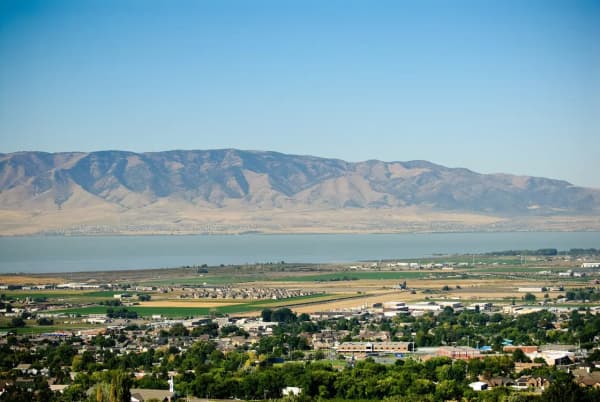
Both cities run from lake-side flats up to mountain bench, and in both, that vertical axis matters more than the city line.
Bench property is generally newer, more expensive, better views, steeper streets and more snow-shoveling. Flat property near the older core is generally cheaper, closer to schools and services, on a grid, and gets less weather.
The practical consequence is that a bench house in Pleasant Grove has more in common with a bench house in American Fork than it does with a house near its own city center. When people say the two cities are similar, this is largely what they are noticing — the bands run horizontally across both.
Anyone comparing these cities should therefore compare like with like: bench to bench, core to core. Comparing one city's bench to the other's flats produces a difference that is about elevation, not about the city.
What each city's history left behind
American Fork was settled in the early 1850s and grew as an agricultural and later industrial town, and for a long stretch it was one of the more commercially significant places in the north county. Its main street still carries that: a real downtown grid with buildings that were built to be businesses rather than converted into them.
Pleasant Grove was settled in the same decade and stayed more agricultural for longer. Its strawberry-growing past is where Strawberry Days comes from, and the celebration has been running long enough to be one of the older continuous civic events in Utah. It is a genuine community week rather than a marketing exercise, with a rodeo, a parade and the strawberries and cream that give it its name.
Both histories left a similar physical inheritance — a compact old core, a grid, large lots subdivided over time — but the civic personalities that came out of them are distinguishable. American Fork behaves like a small city. Pleasant Grove behaves like a large town.
If you are renting rather than buying
The comparison shifts if you are renting. American Fork has considerably more rental inventory, including newer apartment product near the freeway corridor. Pleasant Grove has less, and more of what exists is basement apartments and accessory units in single-family neighborhoods.
That means American Fork is the easier city to move to quickly, and the easier one to try before committing. It also means a renter in Pleasant Grove is more likely to be living in someone's house, with the different relationship that implies.
For families renting with school-age children, the district split matters just as much as it does for buyers, and possibly more — because a lease is easier to change than a mortgage, and knowing which district you are in before you sign is worth the phone call.
Where each is stronger
American Fork is stronger for freeway and rail access, canyon recreation, in-city medical care, housing variety, and having more of daily life available without leaving town.
Pleasant Grove is stronger for a quieter residential feel, walk-from-the-door hiking, a more consistent single-family character, and a smaller city government you can get the attention of.
The mistakes people make comparing these two
The first is treating the district split as a reason to panic. It is a reason to research, not to rule a city out. Neither new district is known to be better, because neither has operated yet.
The second is assuming Pleasant Grove is cheaper because it is smaller and quieter. Its bench neighborhoods are among the more expensive in the north county, and the city-level averages hide that completely.
The third is comparing published median sale prices at all. Utah does not disclose sale prices publicly, so those figures are estimates built from partial data. They are directionally useful and precisely wrong, and they should never be the deciding input.
The fourth is touring on a Saturday and never seeing the commute. This is the most common and most expensive mistake anyone makes buying in Utah Valley, in any city.
How to decide
Start with schools if you have children, because that is the axis where these two cities diverge from 2027. Find out which district your specific address lands in, read the board minutes for that district, and go from there.
Then drive the commute. The freeway-access difference is small on a map and noticeable in practice, and it is the sort of thing that stops being tolerable in year three.
Then walk the neighborhood on a Saturday morning. Both cities have streets that are much better than their city-level averages and streets that are worse, and no comparison written at the city level will tell you which is which.
Finally, if you are torn, remember that these two cities are four miles apart. Whichever you choose, you can use the other one freely. The school district is the one thing you cannot opt into from the wrong side of the line.
Frequently Asked Questions
Are American Fork and Pleasant Grove in the same school district?
Which city is bigger?
When does the school district change take effect?
Will my child change schools because of the split?
Which one has better canyon access?
Is one cheaper than the other?
Which has better freeway access?
Does Pleasant Grove really call itself Kissing City?
Sources
The facts in this guide were checked against these sources. Hours, fees and rules change, so confirm anything time-sensitive with the source before you go. How we make Provo.com.
- UDOT to begin construction to improve mobility at Pleasant Grove and North County Boulevard, Utah Department of Transportation. Checked October 12, 2026.
- I-15; Pleasant Grove Interchange, Federal Permitting Dashboard (USDOT). Checked October 12, 2026.
- Timpanogos School District Board Meeting (August 26, 2026) - Utah Public Notice, Utah Public Notice Website (State of Utah). Checked October 12, 2026.
- City and Town Population Totals 2020-2025 (sub-est2025_49), U.S. Census Bureau. Checked October 12, 2026.