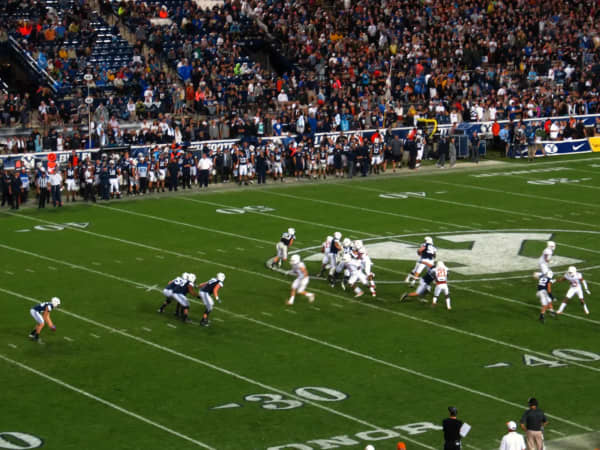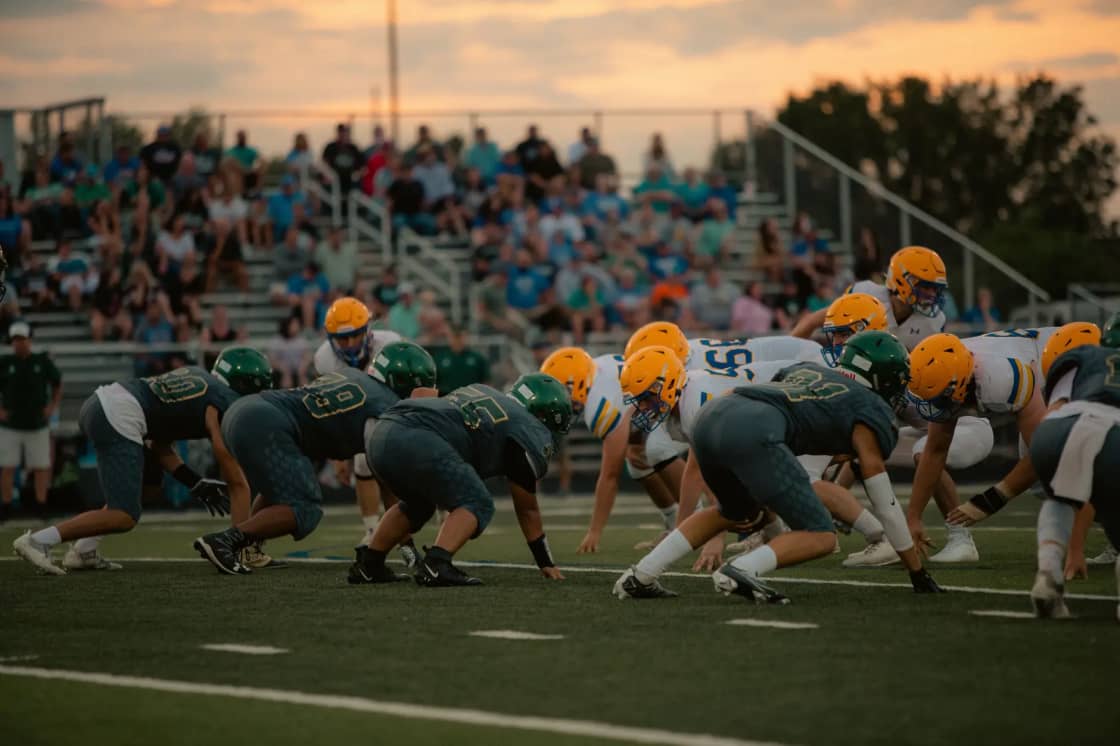

There are two football seasons in Utah County. The one everyone knows about plays on Saturdays at LaVell Edwards Stadium, sells out, and is covered on this site in detail. The other one plays on Friday nights in a dozen stadiums from Highland to Payson, draws more total spectators over a season than most people would guess, produces a startling share of the state's Division I recruits, and has decided the Utah 6A championship — the state's top classification — with a Utah County team in the final every year since 2018. If you have moved here with a school-age kid, or you just like football, the Friday season is the one that will put you in the middle of the community faster than anything else.
This guide is for the person who did not grow up here and does not know which school is which. It maps the county's high schools onto the state's classification system under the alignment that runs through the 2026 season, names the rivalries that actually fill a stadium, explains the state-title pedigree that makes the county the center of Utah football, and covers the practical Friday-night questions — tickets, times, parking, what to bring, whether to bring a toddler — that the schools' own pages assume you already know. For the Saturday season, start with our BYU game-day guide.
The Map: Who Plays in What
The Utah High School Activities Association sorts schools by enrollment into classifications, 6A (largest) down to 1A, and groups them into regions, re-drawn every two years. The current alignment covers the 2025–26 and 2026–27 school years; the next one takes effect for the 2027 season. Football regions differ from the regions for other sports, which is why a school can be "4A" in the hallway and "5A" on Friday night.
6A, Region 3 — the north-county heavyweights. American Fork, Lehi, Lone Peak and Skyridge, joined by Corner Canyon of Draper, which returned to the region in this cycle. This is the best region in the state by any measure — recruits, titles, crowds — and it is why a 6A Region 3 game on a Friday in October looks and sounds like a small college game.
6A, Region 2 — the west side, playing north. Westlake in Saratoga Springs and Cedar Valley in Eagle Mountain were placed with the Salt Lake Valley's southwest schools — Bingham, Copper Hills, Herriman, Mountain Ridge and Riverton — which means their region road games are across the Point of the Mountain. Their county rivalry with each other is the west side's biggest night.
5A, Region 7 — the all-Utah-County region. Maple Mountain (Spanish Fork), Orem, Payson, Pleasant Grove, Spanish Fork, Springville and Timpview (Provo). Every region game is a county game, every road trip is under 40 minutes, and the region has produced the 5A champion in most recent years. Pleasant Grove dropped from 6A into this region in the current cycle; Payson and Spanish Fork moved up from 4A. Orem is a 5A school for football only — it is 4A for every other sport — which is a concession to how good its football program is relative to its enrollment.
4A, Region 8 — the Provo and Orem schools, and the neighbors. Mountain View and Timpanogos (both Orem), Provo, and Salem Hills (4A for football only), with Park City, Uintah of Vernal, Wasatch of Heber and Deer Creek, the Heber Valley's second high school. The region road trips are the long ones — Vernal is three hours — which is part of the 4A experience.
2A. American Leadership Academy, the charter school in Spanish Fork, plays 2A North.
Our Orem high schools explainer and Lone Peak vs. American Fork page cover the boundary questions that decide which of these is yours; the school boundaries guide covers the rest of the county.
The Rivalries
A rivalry game in Utah County is identifiable from the parking situation: if the church lots three blocks from the stadium are full at 6:15, it is one of these.
Lone Peak vs. American Fork. The north county's main event. The two schools share the Alpine District (until its split in 2027), share a boundary through Highland and Cedar Hills, and have traded region titles and state-playoff eliminations for two decades. Lone Peak's program was built into a national name in the 2010s; American Fork's is the county's oldest tradition. When both are ranked — which is most years — the game is the county's biggest regular-season crowd.
Skyridge vs. Lehi. One city, two schools, one night. Skyridge opened in 2016 on Lehi's north side and inside a decade had a 6A title; Lehi, the older school, won three 5A championships before moving up. The city divides by neighborhood for this game, and the stands on both sides are full of people who went to the other school.
Timpview vs. Provo. The Provo City School District's two schools, in different classifications since Provo's enrollment dropped it to 4A, but scheduled most years as a non-region game in August or September. Timpview is the program with the state-title pedigree — championships in three classes, including a run of 5A titles in the last decade — and Provo is the program that has won 4A recently and plays the game as the one that matters. It is the closest thing the county has to a city derby.
Orem vs. Timpview, and Orem vs. Mountain View. Orem's rivalry comes in two flavors. The 5A one is Timpview, the program Orem beat in back-to-back championship games in 2019 and 2020 and has met in the playoffs repeatedly since. The city one is Mountain View, the school Orem shares a city with; they are now in different classes for football, so it is a non-region game when scheduled, but Orem itself divides for it.
Spanish Fork vs. Salem Hills, and Spanish Fork vs. Springville. The south county's two rivalries. Salem Hills and Spanish Fork share the Nebo District's northern half and have been region rivals in every alignment until this one split them; Springville and Spanish Fork are the two old towns of the south valley, and their game is the one the grandparents attend.
Westlake vs. Cedar Valley. The west side's game, between the two big 6A schools of Saratoga Springs and Eagle Mountain, now region rivals in the Salt Lake-flavored Region 2. The stands have sunset views across Utah Lake; the traffic afterward on Redwood Road is the worst in the county.
Pleasant Grove vs. American Fork. The oldest pairing in the county — the two towns have been neighbors and rivals since the nineteenth century — now in different classifications, and played when the schedules allow. Older residents will tell you this was the game before Lone Peak existed.
Maple Mountain vs. Springville, Payson vs. Salem Hills. The younger rivalries of the south, between schools that were built to relieve each other and split the same towns.
The region games are set by the UHSAA cycle and appear on every schedule; the cross-class rivalries are scheduled by the schools and land in the non-region weeks of August and early September. The full statewide schedule is published in August by the UHSAA and the local news sites.
Why This County Is the Center of Utah Football
The numbers are not subtle. Since the 6A classification was created in 2017, only four schools have won it: Corner Canyon (Draper, but a Region 3 member) most often, Lone Peak twice, and Bingham and Skyridge once each — and a Utah County team has played in every 6A final since 2018. Orem has won five state titles since 2017 across two classifications, including the 2025 5A championship in a 42–7 final over Springville, which was itself a Utah County team. Lehi won three 5A titles in 2017, 2021 and 2022 before moving up. Timpview won three straight in a previous era and has sent a steady stream of players to BYU and the Pac-12 and Big 12. Provo and Spanish Fork have both won 4A in the last few seasons.
The reasons are the ones you would guess and one you might not. The county is young and large, so the schools are big. The local college is a football school, and the BYU program's presence — its camps, its coaches' kids, its alumni coaching at every level — raises the floor. The Latter-day Saint mission cycle means a share of the county's best players return to college football at 21 rather than 18, which does not change the high school game but does mean recruiters watch it closely. And the club and youth infrastructure — the Ute Conference tackle leagues, the flag leagues, the 7-on-7 summer circuit, the private quarterback coaches — is as developed here as anywhere in the Mountain West. Our youth sports guide covers the on-ramp.
The practical consequence for a spectator: a 6A Region 3 game or an Orem home game is a chance to watch several future Division I players, and the state playoffs in November are the best amateur football in the state.
The Season, and When to Go
August. Utah kicks off in mid-August, among the earliest in the country, with non-region games; the cross-class county rivalries — Timpview–Provo, Orem–Mountain View when scheduled — tend to land here. The evenings are warm and the crowds are moderate. Best first game for a newcomer.
September. Region play begins. Homecoming weeks (most schools' are in September) bring the biggest regular-season crowds, the parade of floats in the afternoon, the royalty at halftime. Nights cool fast after the equinox.
October. The regular season ends mid-month; the region titles are decided in the last two weeks; the state playoffs begin at the end of the month, with the higher seed hosting. The Halloween-week games, covered in our Halloween-night football guide, are the cold ones.
November. Quarterfinals and semifinals at the higher seed's home stadium (semifinals sometimes move to a neutral site), then the championship games at Rice-Eccles Stadium in Salt Lake City in the third week — all classifications over two or three days, a doubleheader or tripleheader each day. A Utah County team has been in the 6A final every year since 2018, and often the 5A and 4A finals too; the drive north for a title game is a county tradition.
Games are Friday at 7 p.m. as the rule. Because officials, stadiums and buses are shared, some region games move to Thursday, and a few early-season games are Saturday afternoon. Check the home school's athletics page for the exact time the week of.
Tickets
Almost everything is digital now. The UHSAA and the county's districts sell regular-season and playoff tickets through a mobile ticketing platform — GoFan has been the standard — bought on a phone, scanned from the screen at the gate, with a service fee on top of the face price. Regular-season adult admission has run in the single digits, with student and child prices lower and senior discounts common; most schools sell a season pass or a family pass for home games that pays for itself in three or four Fridays. Playoff and championship prices are set by the UHSAA and are higher, and the championship games at Rice-Eccles are sold as a day ticket covering every game that day.
Cash gates still exist at some schools, especially the smaller ones, but do not count on one at a 6A game. The student section usually requires the school's own activity card and has its own gate. The link is on the home school's athletics page the week of the game; the visiting school links the same one.
Parking and Logistics
The stadiums were built when their schools were half the size they are now, and the lots show it. At a rivalry game the school lot is full an hour before kickoff and the overflow spills into the nearest church lots — which the wards generally tolerate on Friday nights — and onto neighborhood streets, where the no-parking signs are enforced and the cities do ticket. Arrive 45 minutes early for a big game, 20 for an ordinary one, and expect a ten-minute walk.
Bring a stadium seat or a blanket (aluminum bleachers), a jacket for the second half regardless of the month, cash for the boosters' concessions (some now take cards, many do not), and your ticket already loaded on your phone, because cell service in a full stand is poor. Most schools ban outside food and drink, large bags, and re-entry, and several ban backpacks outright; the rules are on the athletics page. Late-October and November games are cold enough for ski gear; the county's stadiums are open to the wind and the evening lows are in the 30s by then.
Getting there without a car is possible for the Orem and Provo schools — UTA's local routes serve State Street and University Parkway, and Timpview and Orem are a walk from bus stops — but it is a car county on Friday nights. Our UTA On Demand guide covers the microtransit option for the west side.
What a Friday Night Is Actually Like
A Utah County high school game is a community event first and a football game second, which is the thing newcomers notice. The crowd is families — grandparents, church youth groups in matching shirts, elementary-school kids in the team jersey playing catch behind the end zone, alumni back for homecoming. The marching band and the drill team perform at halftime and are taken seriously. The student section is loud, themed by week (whiteout, blackout, Hawaiian, neon), and mostly good-natured; the schools police it. The concessions are run by parent boosters and sell hot chocolate by October. The public-address announcer knows everyone's name.
It is appropriate for young children, with the two cautions of cold and crowds; a September non-rivalry region game is the ideal introduction, and a Skyridge–Lehi or Lone Peak–American Fork game is not the night for a two-year-old. Our family activities guide has the other Friday-night options if the weather turns.
The Stadiums
Timpview, Provo. On the east bench below Y Mountain, with the sunset over Utah Lake behind the visitors' stand. The most scenic venue in the county and the one with the deepest state-title history in the Provo District.
Lone Peak, Highland. Under the Alpine ridgeline, with a modern grandstand and the county's most nationally known program of the 2010s.
American Fork. The county's old-money stadium, mid-city, with the longest tradition and the loudest alumni section.
Skyridge, Lehi. The newest of the big ones, in north Lehi near the Traverse Mountain developments; big, modern, and the home of a 6A champion.
Lehi. The older Lehi stadium, tucked into the old town; smaller, and intense on Skyridge night.
Orem. On the city's east side, with more state-championship banners than anywhere else in the county and a program that fills it.
Provo High. The new west-side campus by the lake, opened in 2018, with the best sightlines of the smaller stadiums and the sunset directly behind the press box.
Mountain View and Timpanogos, Orem. The two Orem 4A schools; modest stadiums, neighborhood crowds, and a crosstown game between them that Orem takes seriously.
Pleasant Grove. Mid-city, old, loud; the Viking crowd travels.
Westlake, Saratoga Springs, and Cedar Valley, Eagle Mountain. The west-side newcomers with large modern stands and views across the lake; both fill for each other.
Spanish Fork, Maple Mountain, Springville, Salem Hills, Payson. The south-county stadiums, each in the middle of its town, each with a rivalry that fills it once a year.
The Short Version
Utah County's high school football is the best in the state and the most communal thing that happens here on a Friday. The 6A Region 3 games (Lone Peak, American Fork, Skyridge, Lehi, Corner Canyon) and Orem's home games are the ones with the Division I talent; the rivalry nights — Lone Peak–American Fork, Skyridge–Lehi, Timpview–Provo, Orem–Timpview, Westlake–Cedar Valley — are the ones that fill the church lots. Tickets are digital and cheap; games are Friday at 7 with Thursday exceptions; arrive early, dress warm, bring a seat and cash. The season runs mid-August to the championships at Rice-Eccles in November. Confirm times and ticket links on the home school's athletics page the week of the game, and check the alignment again in 2027, when the map redraws.
Related Guides
- BYU Football Game Day: The Complete Guide
- Halloween-Night Football in Provo
- Youth Sports in Utah Valley
- Orem's High Schools, Explained
- Lone Peak vs. American Fork High
- School Boundaries in Utah Valley
- Where to Watch Sports in Provo
- Family Activities in Utah Valley
- Youth football in Utah Valley — the feeder system beneath the Friday-night map
Frequently Asked Questions
Which Utah County high schools play in which classification?
What are the big rivalry games?
How good is Utah County football, really?
How do tickets work?
When are the games?
Where do you park, and what should you bring?
Are the games appropriate for young kids?
Which stadiums are worth a visit on their own?