Before Utah had settlers, it had trappers. For about 15 years, from the early 1820s to about 1840, fur-company men worked the rivers of the northern Wasatch, met each summer to trade their pelts, and left names on the map that people still use: Provo, Ogden, Weber, Bridger. This is that era, from Utah's History To Go and Wyoming State Parks, through the life of its best-known figure, Jim Bridger, and the fort he built. For the trapper Provo is named for, see our Provo history guide.
Quick facts
| Year | Event | Source |
|---|---|---|
| 1822 | William Ashley advertises for "enterprising young men" to go up the Missouri | Utah's History To Go |
| 1824-25 | Jim Bridger reaches the Great Salt Lake | Utah's History To Go |
| 1825 | First rendezvous, at Henry's Fork of the Green River | Utah's History To Go |
| 1827 | A rendezvous on the south shore of Bear Lake | Utah's History To Go |
| 1840 | The rendezvous end | Utah's History To Go |
| 1843 | Bridger and Louis Vasquez open Fort Bridger | Wyoming State Parks |
| 1847 | Bridger meets Brigham Young near the Little Sandy | Utah's History To Go |
| 1855 | Mormons take possession of the fort | Utah's History To Go; Wyoming State Parks |
| 1857 | Mormons burn the fort ahead of the federal army | Wyoming State Parks |
| 1858-1890 | U.S. Army post | Wyoming State Parks |
The rendezvous
In 1822, William H. Ashley and his partner Andrew Henry ran an advertisement inviting "Enterprising Young Men" to go up the Missouri River and trap beaver, Utah's History To Go says. Beaver hats "became the latest fashion rage," and prime pelts were worth the trip.
Ashley arranged for his men to meet each year in the mountains to trade their furs and resupply. The first rendezvous, in 1825, was at "Henry's Fork of the Green River." The next three were in Utah: one in Cache Valley and two at the south end of Bear Lake. Bear Lake's south shore is now home to the state park's Rendezvous Beach; our Bear Lake guide covers it today. After that, the meetings moved mostly to southwest Wyoming and eastern Idaho, with one more in Cache Valley in 1831.
The business didn't last. Pelts brought $4 to $6 a pound at the peak, between 1830 and 1832, Utah's History To Go says, but by 1840 prices had fallen to $1 or $2, beaver were nearly gone, and the Hudson's Bay Company had outcompeted the Americans. The rendezvous were discontinued in 1840.
The trappers' names
Several of the men left their names on northern Utah. Étienne Provost, "the most famous Taos trapper," is the source of Provo's name, Utah's History To Go says. Ogden is named for Peter Skene Ogden, a Hudson's Bay Company trapper who worked the mountains east of town in 1825, and Weber County for trapper John Henry Weber and the Weber River, by the state's accounts. Our guide to how Utah's counties and towns got their names has more.
Jim Bridger
Bridger answered Ashley's 1822 call and went up the Missouri under Andrew Henry, Utah's History To Go says. In the winter of 1824-25 he was sent to settle a dispute about where the Bear River went, and followed it to the Great Salt Lake, which he took for an arm of the Pacific. The same source notes that the discovery of the "Inland Sea" is now more often credited to Provost.
Bridger went to the 1825 rendezvous, to the one in Cache Valley, and to the two on Bear Lake's south shore. In 1830, he and four partners formed the Rocky Mountain Fur Company, which they dissolved in 1834 as the trade wound down.
Fort Bridger
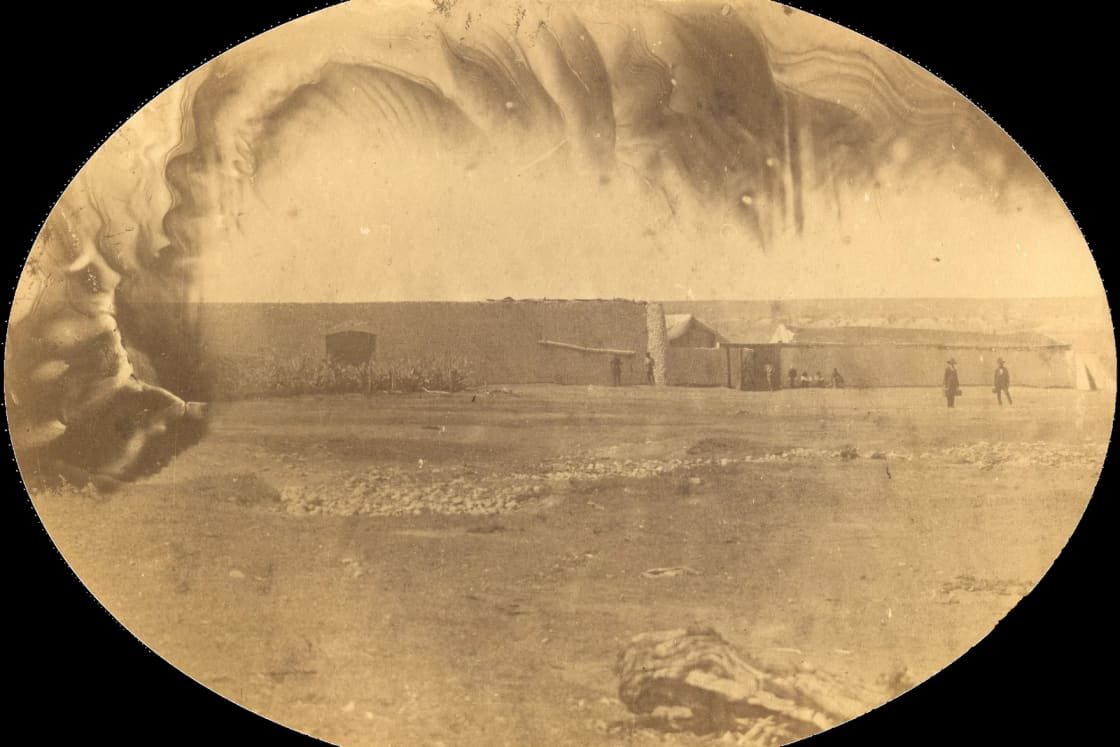
As the beaver trade ended, the emigrant trade began. In 1843, Bridger and Louis Vasquez opened a trading post on the emigrant road, on Black's Fork of the Green River in what is now southwest Wyoming. Bridger wrote that he had "established a small fort, with a blacksmith shop," Wyoming State Parks says. Oregon- and California-bound wagons stopped there, and so did the Latter-day Saints: in June 1847, Bridger met Brigham Young near the mouth of the Little Sandy River, and the Church History Library says he described the Salt Lake Valley to Young. Our day-by-day account of July 1847 picks up the story after Fort Bridger.
Bridger and the Mormons
Relations soured. In the summer of 1853, Mormon leaders revoked Bridger's trading license and issued a warrant for his arrest, and he fled before the posse arrived, Utah's History To Go says. "The Mormons took possession of Fort Bridger in 1855"; by Mormon records it was a purchase for $8,000, with $4,000 paid in gold that August, though Bridger claimed he had fled in 1853 to avoid arrest, Wyoming State Parks says. In 1857, with federal troops approaching in the Utah War, Mormon leaders chose a "scorch and burn" policy, "leaving both Fort Bridger and Fort Supply in ashes," Wyoming State Parks says. Bridger was guiding the army. Vasquez collected the remaining $4,000 in Salt Lake City in 1858. Our Utah War and Camp Floyd guide covers the conflict.
The Army made Fort Bridger a post in 1858 and kept it until 1890, Wyoming State Parks says. Bridger died in July 1881.
Visiting Fort Bridger
Fort Bridger State Historic Site, in Fort Bridger, Wyo., has a museum in the old Army barracks, restored buildings, the site of Bridger's trading post and the ruins of the "Mormon Wall," Wyoming State Parks says. Its interpretation covers the Oregon, California, Mormon Pioneer and Pony Express trails and the Lincoln Highway.
- Museum and historic buildings: daily, 9 a.m. to 5 p.m., May 1 to Sept. 30. From Oct. 1 to April 30 the museum is closed, though it can be opened by appointment with advance notice.
- Grounds: open year-round, sunrise to sunset.
- Rendezvous: the Fort Bridger Rendezvous Association holds a mountain man rendezvous there "every Labor Day weekend."
- Fees: listed on Wyoming State Parks' permits and fees page.
The fort is about 132 miles and 2 hours 30 minutes from downtown Provo by an OpenStreetMap (OSRM) routing estimate without traffic, by way of I-80 east through Evanston.
Related reading
- Provo history: from Étienne Provost to Fort Utah
- July 1847, day by day
- The Utah War and Camp Floyd
- Bear Lake from Provo
Frequently Asked Questions
What was a mountain man rendezvous?
Did Jim Bridger discover the Great Salt Lake?
When was Fort Bridger built?
Why did the Mormons burn Fort Bridger?
Can you visit Fort Bridger?
Sources
The facts in this guide were checked against these sources. Hours, fees and rules change, so confirm anything time-sensitive with the source before you go. How we make Provo.com.
- Utah Division of State History, Utah's History To Go: James Bridger, Utah Division of State History, Utah's History To Go. Checked November 27, 2026.
- Traders, Trappers, and Mountain Men, Utah Division of State History, Utah's History To Go. Checked November 27, 2026.
- About Fort Bridger, Wyoming State Parks, Historic Sites and Trails. Checked November 27, 2026.
- Who were the first Latter-day Saint pioneers to enter the Salt Lake Valley?, Church History Library. Checked November 27, 2026.