
Bear Lake is the trip Utah Valley residents describe wrong. Ask around Provo and you'll hear it filed under "a couple hours north" with the confidence of people who have not driven it lately, as though it were somewhere past Ogden. It is not. Bear Lake sits in Utah's opposite corner, half of it in Idaho, about 160 road miles from Provo, and planning for that is the difference between a great weekend and a bad day trip.
What you get for the distance: the most improbably colored water in the intermountain West, a raspberry culture with a real harvest behind it, the best scenic-canyon approach of any drive in this series, and, in late January when no one is looking, one of the strangest fishing traditions in the state. This guide covers all of it, activity by activity, including what it costs to get on the sand in 2026 and how a low-water year changes the beaches.
The drive: Logan Canyon is the point, not the obstacle
From Provo, the route is I-15 north past Salt Lake City to Brigham City, then US-89/91 over Sardine Canyon into Cache Valley and Logan, and finally about 40 miles up Logan Canyon on US-89, a National Scenic Byway that follows the Logan River through limestone walls and aspen slopes to the summit above the lake. Then comes the moment the whole drive is built around: the road crests, and the entire lake appears below at once, twenty miles of turquoise framed by dry hills, with the Bear Lake Overlook pullout positioned exactly where every passenger says "pull over."
How long it takes: OSRM routing estimates about 163 road miles and 3 hours 15 minutes from central Provo to Garden City by this route, with no traffic. The canyon alone, Logan to Garden City, is about 39 road miles and an hour by the same estimate. Add time for Salt Lake traffic on the way out and a Saturday summer crawl through the canyon.
The canyon deserves stops of its own (Tony Grove Lake up its high side road is a wildflower amphitheater in July, and the Wind Caves trail climbs to a triple limestone arch above the river), but those belong to a Logan trip as much as a Bear Lake one, and our Logan and Cache Valley guide covers them properly. The efficient version: pick one canyon stop each direction and save the rest.
There is an alternative: I-80 east past Park City to Evanston, Wyoming, then north on back roads to the lake's south end at Laketown. OSRM puts Provo to Laketown that way at about 154 miles and 3 hours, so if Rendezvous Beach or the East Side is your goal, it is about as quick as the canyon, and it turns the trip into a loop with the Logan Canyon return. In shoulder seasons when canyon weather is ugly, its freeway share is the calmer drive. The same road north continues through Star Valley toward Jackson; see Jackson Hole and Grand Teton from Provo. Kemmerer's fossil quarries are also within reach; see Kemmerer and Fossil Butte. For a winter crossing of either route, our guide to winter tires and canyon driving covers Utah's traction rules.
Why the water is that color
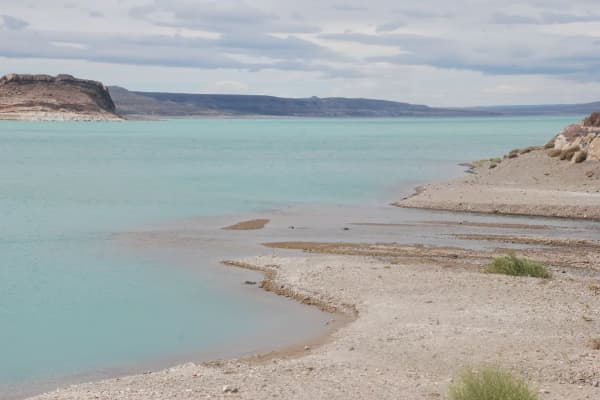
The turquoise is chemistry. Utah State Parks credits minerals, calcium carbonate, suspended in the water and reflecting sunlight. The springs and streams feeding Bear Lake pass through limestone, carrying in fine white mineral particles that hang in the water column and scatter the blue wavelengths back at you. The same chemistry strips nutrients out of the water, which keeps it exceptionally clear, which intensifies the effect. It is the Caribbean mechanism running at about 5,900 feet in a valley between two mountain ranges, on a lake 20 miles long, 8 miles wide and just over 200 feet deep at full pool.
The color performs on the sun's schedule: brilliant on clear middays, moodier under cloud, and best seen the first time from the summit overlook rather than the shoreline. That is the real argument for the Logan Canyon route: no other approach gives you the reveal.
What it costs to get on the sand
Developed lake access on the Utah side runs through Bear Lake State Park, which charges per vehicle and charges Utah households less than visitors from out of state. These are the day-use rates on the park's fee page in October 2026:
| Area and season | Utah resident | Utah senior (65+) | Non-resident |
|---|---|---|---|
| Marina and Rendezvous Beach, summer | $25 | $15 | $30 |
| Marina and Rendezvous Beach, regular | $15 | $10 | $20 |
| East Side beaches, summer | $20 | $15 | $25 |
| East Side beaches, regular | $10 | $10 | $15 |
The park defines summer day use as the Saturday of Memorial Day weekend through September 30, and regular as October 1 through the Friday of Memorial Day weekend. The East Side rate covers First Point, South Eden, Cisco Beach, Rainbow Cove and North Eden. You can buy the day pass online through the state's pass site, which saves time at the gate on a July morning. Our statewide summer list has the other resident-rate parks.
Camping carries the same resident and non-resident split. At Rendezvous Beach, a full hook-up site in summer was listed at $55 for residents and $60 for non-residents, and a tent-only site at $45 and $50. The park recommends reserving campsites through Labor Day weekend. Cisco Beach's 58 primitive sites are first come, first served.
Idaho's half is separate. Bear Lake State Park in Idaho, headquartered in St. Charles, sells its own motor vehicle entrance permits, and Utah's day pass does not cover it. At North Beach, Idaho offers a parking day pass you can reserve up to nine months ahead, which it says is not the same as the Idaho Parks Passport, because the lot often reaches capacity in warm months.
The beaches, ranked
Rendezvous Beach, at the south end about two miles northwest of Laketown on State Road 30, is the family answer: a long arc of sand, shallow gradual entry, cottonwood shade at the campgrounds behind it, and the most forgiving swimming on the lake. It is named for the mountain-man rendezvous held on this shore in 1827 and 1828, when the fur trade briefly made this valley a commercial center of the Rockies. It is seasonal: the park lists it open from about May 1 through the third weekend of October, and in 2026 it scheduled the closing and winterizing of Rendezvous Beach's facilities for the morning of October 20. Its four campgrounds (Birch, Big Creek, Cottonwood and Willow) sit behind the sand.
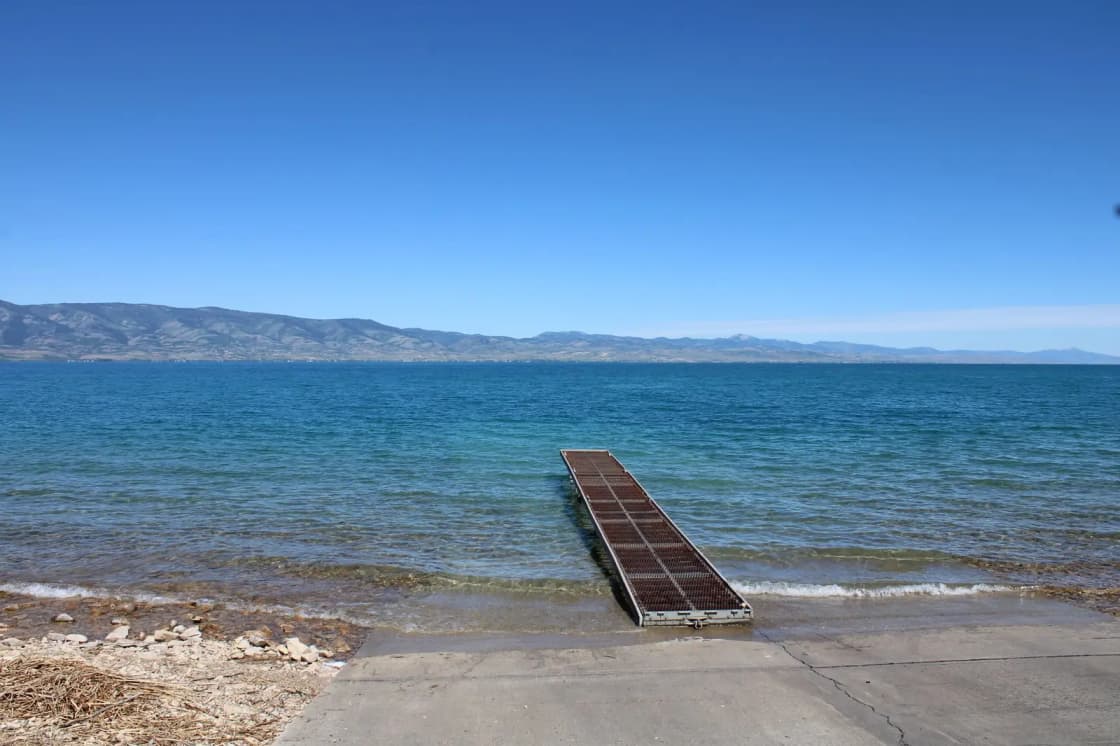
The Marina, on the north end of Garden City, is the operations hub and the park office: a seven-lane launch ramp, 361 long-term boat slips rented May through October, 21 slips rented by the night, and a small beach on its north side. It is open year-round. A marina expansion is under construction; the park's conditions page says crews are working to minimize disruption to the existing marina, so expect some fencing and detours. The long-term slip waiting list is closed while State Parks decides whether to change how slips are assigned.
The East Side units, Cisco Beach among them, are the quieter shore: rockier, reached by Cisco Road north from Laketown, with water that gets deep fast. That drop-off makes Cisco Beach a favorite of shore anglers and scuba divers, and, in winter, the stage for the cisco run below. In low water the park recommends a four-wheel-drive vehicle for the Cisco Beach launch ramp.
North across the state line, Idaho's North Beach is over a mile of sand at the top of the lake, with two boat ramps, a life jacket loaner station, picnic tables and restrooms. Idaho's park page describes a gradual slope to the lake bottom that makes "an enormous swimming area" in summer. No dogs are allowed on North Beach, and there are no fires on the sand (propane fire rings and charcoal grills are allowed). Circling the whole lake is about 50 miles and turns beach-hopping into a tour.
A word about the water itself, because "Caribbean" oversells one particular: the temperature. At this elevation, fed by cold springs, the lake warms late. Early-summer swimming is bracing, the comfortable window runs roughly mid-July into early September, and even in August the first thirty seconds are a negotiation. Families with small children will appreciate Rendezvous Beach's shallow shelf for exactly this reason: the skim of water over sand warms far faster than the open lake.
Sand bars, shallows and a low-water year
Bear Lake's beaches change size from year to year because the lake is managed as a reservoir and its level follows the snowpack. 2026 was a low year. In May, KSL reported that the lake had already peaked for the season about 7 feet below normal after a nearly snowless winter, and the park manager expected it to fall another 4 to 5 feet by October. The park's conditions page, updated October 12, listed the lake at 5,911.5 feet against a full elevation of 5,923.65.
What that means on the ground:
- Wider beaches and longer walks. At the shallow south and north ends, a lower lake exposes broad flats of sand and leaves shallow water stretching far from the old shoreline. Small children can wade a long way out, and you will carry the cooler farther.
- Launching is harder at the shallow ends. In October 2026 the park advised against launching boats at Rendezvous Beach because of the low elevation, and recommended four-wheel drive at Rendezvous and Cisco Beach for anyone who tried. The Marina and First Point ramps were open.
- Watch for shallows from the water. Boaters and paddlers should expect sand and rock closer to the surface than in a full year, especially near the south end.
In a high-water year, the opposite happens: beaches shrink, and the walk from towel to waterline is a stroll. Check the park's current conditions page before you go; it lists lake elevation and which ramps are open.
Rentals: boats, boards and side-by-sides
You do not need to tow anything to get on Bear Lake. Garden City has a rental economy built for people who drove up with a car full of beach towels. A few operators, with addresses from Google's listings in October 2026:
- Bear Lake Funtime, the state park's concessionaire, which State Parks says rents Sea-Doos, ski and wakeboard boats, jet skis, fishing boats, a wake and surf boat, paddleboards, kayaks, canoes and water trampolines from four on-site locations, plus OHVs and five "camper cabins" at Rendezvous Beach's Big Creek campground. Its office is at 255 300 West, Garden City, (435) 946-3200.
- Bear Lake Rentals, 2126 South Bear Lake Boulevard, Garden City, (435) 946-8611.
- Ideal Beach Watercraft Rental, 2176 South Bear Lake Boulevard, at Ideal Beach, (435) 946-2297.
- Bear Lake Adventure Center, 584 West Logan Road, listed by Google as an off-road outfitter, (435) 946-3742.
- Bear Lake Boating, a boat-outing operator listed at the State Park Marina's address, 940 North Bear Lake Boulevard, (435) 227-5251.
Three practical notes. Reserve ahead for the Fourth of July week and Raspberry Days weekend, which book first. Ask whether the rental price includes fuel, life jackets and the state park entry, since launching from inside the park means a day-use fee. And if you plan to put your own boat, kayak or paddleboard in on the Idaho side, Idaho's park visitor center sells the invasive species permit the state requires for motorized and non-motorized vessels.
On the east shore, the state park also rents small solar-powered cabins it calls casitas at First Point, North Eden, Cisco Beach and Rainbow Cove. Each sleeps four to five, has heat and air conditioning, an 8-by-8 deck and a fire pit with a grill, and, per the park, each reservation includes park entrance. They are the cheapest way to make Bear Lake an overnight without a tent.
Raspberry season, and what the shakes are
Bear Lake's raspberry identity is agricultural fact before it is marketing. The valley's climate (cold nights, short intense summer) suits raspberries, and the harvest typically begins in late July, which puts peak berries around the end of July and early August. The valley celebrates accordingly: Raspberry Days, Garden City's signature festival, ran August 6 to 8 in 2026, with a parade on Thursday evening, the Laketown Rodeo on Friday and Saturday nights at the Laketown Arena, a 5K fun run from Laketown Park on Saturday morning, a craft fair, and a Saturday-night boat light parade run by the Bear Lake Yacht Club between the Marina and Ideal Beach. The city listed the 2026 fireworks as canceled. If your trip can hit that window, it is the valley at full personality; if crowds are what you drive to escape, it is the window to avoid.
The 2026 crop was a bad one. On the eve of the festival, KSL reported that a winter with little snow followed by intense summer heat had left some growers with little or no harvest. Silvia Earley, who has grown raspberries in Round Valley near Laketown since 2000, called it her worst season; the report named Chad's Raspberry Kitchen as the area's only other remaining commercial grower, using its smaller yield for jams, salsa and shakes. The point for a visitor: local fresh berries are a small, weather-dependent crop. If picking or buying fresh berries is your reason for the trip, call ahead in late July.
The raspberry shake is the year-round ambassador. Garden City's stands and drive-ins have made it the mandatory transaction of any visit. LaBeau's Drive-In wears the "famous" label and draws lines to match, the Chocolate Bear is the other name locals volunteer, and the standard across town is high enough that arguing about the best one is a local sport with no losers. Expect summer lines, expect a "small" to defeat most adults, and expect to conclude the drive was worth it somewhere around the second inch.
Evenings in Garden City
One Garden City institution deserves promotion out of the "besides the beach" footnotes: Pickleville Playhouse, the log theater founded in 1977 by LaGrande and Betty Larsen and their seven children. It stages melodramas, original musicals and a Broadway production in summer, plus a Christmas show, and its mustached outlaw character, Juanito Bandito, has become a multi-generational Utah tradition in his own right. For Utah Valley visitors it solves the specific problem of what a beach town does after sunset. Summer nights sell out, so book ahead rather than walking up.
Off the sand, a paved shoreline path runs along the Garden City stretch of the west side.
Summer operational truth: this is one of Utah's most loved warm-water destinations and July weekends behave like it. Arrive before mid-morning or embrace the overflow.
Winter: the cisco run
Here is the fact that separates this guide from every summer listicle. Bear Lake holds four endemic fish species, found on earth only here, survivors of ancient Lake Bonneville's ecosystem: the Bear Lake sculpin, two whitefish, and the star, the Bonneville cisco.
Each winter, Utah State Parks says, the cisco spawn for up to two weeks in late January into early February, crowding into the rocky shallows along Cisco Beach. The fish are small, six to eight inches, and the method is unlike any other fishing in Utah: no casting and no bait, just a long-handled dip net, swung by anglers wading waist-deep in icy water or working through holes in the ice when the lake freezes. You need a Utah fishing license and should know the daily limit before you go; our fishing and hunting license guide covers who needs one. Locals freeze the catch for cutthroat bait; the bold fry them. In past years the Bear Lake Valley's Monster Winterfest has built a weekend around the run, with a cisco dip-netting contest, a chili cook-off, a cardboard boat regatta and a plunge, mostly at the State Park Marina; check the Bear Lake Valley visitors bureau for the coming year's dates. Cisco Beach and its primitive campground stay open year-round. If you want the version of Bear Lake with no lines at anything, this is it. For more cold-weather trips, see things to do in Utah in winter and our guide to ice fishing in Utah Valley.
The monster, the cave, and the Idaho half
Every deep cold lake earns a monster eventually; Bear Lake's arrived in 1868, when Joseph C. Rich's dispatches to the Deseret News reported a serpent-like creature witnessed by respectable settlers, accounts Rich himself later cheerfully undercut. The legend outlived the retraction by 150 years and counting: the Bear Lake Monster is now the valley's mascot, name-dropped in businesses, boat tours and the winter festival, and best understood as the community being in on its own joke.
The Idaho half of the lake is not filler. Minnetonka Cave, up St. Charles Canyon from the town of St. Charles, is one of the region's premier show caves. Recreation.gov describes the tour as three-quarters of a mile, 888 stairs and about 80 minutes, at a constant 40 degrees, which feels miraculous in August. It opens Memorial Day weekend and closes on Labor Day, depending on snow, with tours from 10 a.m. to a last start at 5:30 p.m., tickets through recreation.gov, and it is not ADA accessible. Nearby, the Paris Ice Cave is its free-range cousin: unguided, unlit, bring-your-own-flashlight, with ice that lingers deep into summer. And the towns of the Idaho shore (St. Charles, Paris with its 1880s tabernacle of hand-cut stone, Montpelier on the Oregon Trail) give the loop drive its history stops. North Beach and Idaho's Mountain Fawn campground on the east shore complete the Idaho side; the campground takes reservations year-round.
One planning note that applies to the whole valley, both states: Sunday remains quiet here. Many businesses close or shorten hours, exactly as a Provo resident would guess. Stock the cooler accordingly.
When to go, what it costs, and the verdict
Summer is the headline season and behaves like it: book Garden City lodging well ahead for July and August, expect the state park fee, the shake line and the traffic, and get on the water early when it's glass. Late September trades swimming for gold canyons and empty beaches, still at summer park rates through September 30. October brings the lower regular rate but closes Rendezvous Beach around the third weekend. Late January into early February offers the cisco run and skiing at Beaver Mountain at the canyon summit, a family-run hill of long standing and short lift lines. Shoulder months are the gamble: the lake is always there, but the businesses around it operate seasonally, and a May or October trip should verify hours rather than assume them.
The verdict on the day-trip question: possible, punishing, not recommended. Bear Lake rewards the overnight, or the split trip with Logan taking one of the days. Either way, take the canyon at least one direction, stop at the summit, and let the lake introduce itself properly. That first full view of the turquoise is the thing the drive was for.
The moose problem on the way home
Logan Canyon is the best part of this drive and the part that asks the most of you after dark, for a reason specific to this canyon rather than Utah roads generally: moose.
Utah's moose population is small (state estimates put it in the range of roughly 2,500 to 3,000 animals), and the Bear River Range that Logan Canyon climbs through is among the places you are most likely to meet one. Their scarcity is exactly what makes them dangerous to drivers. A collision with a mule deer is a bad night. A collision with a moose is a different category of event, because the mass sits high: the body rides over the hood rather than under it, which is why moose strikes produce a share of serious injuries far out of proportion to how rarely they happen.
The cost estimates give a sense of the gap, though they should be read as ranges rather than figures. Work by the Center for Large Landscape Conservation put the average deer-vehicle collision at roughly nine thousand dollars in 2021 terms and the average moose collision at something over forty thousand; published figures elsewhere for moose run both lower and considerably higher depending on what the analysis counts. An analysis published by the Pew Charitable Trusts frames the question as avoided cost per prevented collision and puts it at more than nineteen thousand dollars for a deer, around seventy-three thousand for an elk, and about a hundred and ten thousand for a moose. Those figures are several times the Center's, because they count different things, and the two cannot be reconciled. What none of them disagree about is the ordering: both put a moose at roughly five times a deer, which is the ratio that should shape how you drive this canyon at night.
Practically, Logan Canyon after sunset asks for the same discipline as any Utah canyon and one addition. Moose are dark, they lack the bright eyeshine that gives deer away at distance, and they are often standing still in the road rather than crossing it. High beams and scanning the shoulders help less here than they do with deer, so the working adjustment is speed. The canyon's forty-odd miles are a National Scenic Byway rather than a commute, and treating the descent as part of the trip rather than the end of it is both safer and, on a summer evening, better.
If you are making Bear Lake a full day, the cleanest fix is scheduling. Leaving the lake with light still in the sky puts you down the canyon before the animals move, and it is the one decision on this trip that costs nothing.
Related Guides
- The Heber Creeper: A Complete Guide to the Heber Valley Railroad
- The Lavender Farm in Mona: What to Know Before You Drive Down
- Zion and St. George from Provo: The Southern Utah Weekend
- Camping Near Provo: Best Campgrounds & Tips (2026)
- Moab from Provo: Planning the Drive, Arches and Canyonlands
- Capitol Reef from Provo: The Closest National Park Nobody Plans For
- Dispersed Camping Near Provo: The Rules, The Roads & What Most Guides Get Wrong (2026)
- Heber Valley & Midway from Provo: The Day Trip Through the Canyon
- Hot Springs Near Provo & Utah Valley (2026)
- Park City from Provo: The Year-Round Day Trip Guide
- Best Day Trips from Provo, Utah (2026)
- Rockhounding from Utah Valley: Topaz, Geodes, Trilobites and the 25-Pound Rule
- Antelope Island from Provo: The Bison, the Causeway Fee Your Pass Does Not Cover, and When the Gnats Win
- Lava Hot Springs From Provo
- Preston, Idaho and the Napoleon Dynamite Day from Provo
Frequently Asked Questions
How far is Bear Lake from Provo?
Why is Bear Lake so blue?
How much does Bear Lake State Park cost for Utah residents?
When is raspberry season at Bear Lake?
Where are the best beaches, and do they cost money?
Is Bear Lake a day trip or an overnight from Provo?
What is the Bonneville cisco, and why do people stand in a frozen lake in winter?
Is anything open in winter?
Sources
The facts in this guide were checked against these sources. Hours, fees and rules change, so confirm anything time-sensitive with the source before you go. How we make Provo.com.
- Bear Lake Raspberry Days, Garden City, Utah. Checked October 12, 2026.
- Bear Lake | Idaho Fishing Planner, Idaho Department of Fish and Game. Checked October 12, 2026.
- Bear Lake Water Quality, U.S. Geological Survey. Checked October 12, 2026.
- Bear Lake State Park: Discover, Utah State Parks. Checked October 12, 2026.
- Minnetonka Cave, USDA Forest Service (Caribou-Targhee National Forest). Checked October 12, 2026.
- How to avoid conflicts with moose in Utah this summer, Utah Division of Wildlife Resources. Checked October 12, 2026.
- Logan Canyon Scenic Byway, Federal Highway Administration (America's Byways). Checked October 12, 2026.
- Bear Lake State Park: park fees, Utah State Parks. Checked October 20, 2026.
- Bear Lake State Park: current conditions (updated Oct. 12, 2026), Utah State Parks. Checked October 20, 2026.
- Bear Lake State Park: marina and boat slips, Utah State Parks. Checked October 20, 2026.
- Bear Lake State Park: beaches and camping, Utah State Parks. Checked October 20, 2026.
- Bear Lake State Park: rentals and lodging, Utah State Parks. Checked October 20, 2026.
- Bear Lake State Park (Utah) overview, Utah State Parks. Checked October 20, 2026.
- Bear Lake State Park (Idaho), Idaho Department of Parks and Recreation. Checked October 20, 2026.
- Minnetonka Cave tickets, Recreation.gov (Caribou-Targhee National Forest). Checked October 20, 2026.
- TJ Davis finds his happy place (Pickleville Playhouse history), Utah State Magazine, Utah State University. Checked October 20, 2026.
- Bear Lake Monster Winterfest, Bear Lake Valley Convention & Visitors Bureau. Checked October 20, 2026.
- Water levels peak early at Bear Lake, KSL. Checked October 20, 2026.
- Intense summer heat takes toll on Bear Lake raspberry crop ahead of Raspberry Days, KSL. Checked October 20, 2026.
- OSRM routing engine (drive distance and time estimates, no traffic), Project OSRM. Checked October 20, 2026.