
Utah County has no county-wide library system. That single fact explains almost everything confusing about borrowing books here, and almost no local guide states it plainly.
There is no county card. There is no shared budget. There is no central catalog that covers every city. What exists is sixteen library locations, each funded by the city it sits in, each setting its own nonresident fee, plus two separate reciprocal agreements that do not overlap, plus one statewide digital layer that quietly ties the whole thing together.
If you have just moved here and you assumed a library card works the way it did in whatever county you came from, this page is the correction.
The structural fact everyone skips
Most American metropolitan areas run libraries at county level. You pay county property tax, you get a county card, and the card works at every branch.
Utah County does not work that way, and the libraries themselves are unusually direct about it. Pleasant Grove's library states the reason on its own card page: because Utah County does not have a county-wide library system, each city provides library access for its own residents. Pleasant Grove City supports its library through property taxes that each Pleasant Grove household pays. A nonresident therefore pays a fee set to approximate what a resident household already contributes.
That is not a quirk of one city. It is the operating logic of the entire county. Every free card in Utah County is free because somebody's property tax paid for it, and every fee exists to replicate that contribution from someone whose taxes went somewhere else.
Once you understand that, the fee structure stops looking arbitrary and starts looking like exactly what it is: eighteen-odd separate municipal budgets, each defending its own.
The Provo–Orem arrangement, which is the big exception
The two largest cities in the county have a mutual agreement, and it is generous.
Provo City Library states that all Provo and Orem City residents are entitled to a Provo City Library Card. The Orem Public Library states the mirror image: cards are free of charge for Orem or Provo residents.
So if you live in either city, you have free access to both. That covers a very large share of the county's population and it is the single most valuable thing to know if you live in Provo or Orem — the Orem Public Library and the Provo City Library have quite different collections, different programming, and different buildings, and a resident of either city can simply use both.
Card expiry differs slightly by category. Provo's cards expire every two years for resident borrowers, and annually for resident students — worth noting if you are a student who set up a card in freshman year and has not thought about it since.
The north county cooperative, which is a different thing entirely
Further north, a separate agreement operates among five cities: American Fork, Pleasant Grove, Lehi, Highland and Eagle Mountain.
American Fork calls it the North Utah County Library Cooperative. Pleasant Grove describes it as a reciprocal borrowing system allowing cardholders to check out materials from all five libraries. Both are describing the same arrangement.
Two limits matter, and both are stated by the libraries themselves.
First, Pleasant Grove's page is emphatic that this is not a county library system. Each library continues to function independently in terms of policies, budget, administration and nonresident fees. The agreement covers borrowing and nothing else about how the libraries are run.
Second — and this is the part people miss — the reciprocal card is mainly about borrowing items. American Fork lets co-op members join its programs too, but the other libraries generally do not. So an Eagle Mountain cardholder can check out a book at the Highland library, but should not assume they can sign their child up for Highland's summer reading program on the same card; ask the library first.
American Fork adds a practical condition: your card must be current and you must be in good standing at your home library, with no blocks such as lost books or unpaid fines. A neglected account at your home library quietly disables you at the other four.
Both libraries also make the same polite request — search your home library's catalog first, before searching the others. The cooperative is designed as an overflow, not as a way to shop five collections for the shortest hold queue.
Note what these two agreements do not do
Here is the thing worth sitting with. The Provo–Orem arrangement and the north county cooperative do not connect to each other.
Provo and Orem are not in the North Utah County Library Cooperative. American Fork, Pleasant Grove, Lehi, Highland and Eagle Mountain are not in the Provo–Orem arrangement. They are two unrelated agreements that happen to exist in the same county.
And a large part of the county sits in neither. Springville, Spanish Fork, Payson, Salem, Santaquin, Saratoga Springs and Vineyard all appear in the state library directory with their own libraries, and none of them is inside either reciprocal group as described on those two pages. Vineyard is a special case and is explained below — it is in the directory, and its residents are still offered a refund on a card bought somewhere else.
So the honest summary is: there are two islands of reciprocity and a lot of open water.
What a nonresident card costs
The fees differ by city, and the differences are not trivial.
- Provo City Library — $62.50 for six months, or $125 for one year
- Orem Public Library — $70 for six months, or $125 for one year
- Pleasant Grove Library — $90 for one year
Notice the shape of that. Provo and Orem land on the same annual figure but different six-month figures, which means the six-month option is better value in Provo and the annual option is a wash. Pleasant Grove's annual fee is materially lower than either.
These are the figures those libraries published at the time of writing, and library fees are exactly the kind of number that changes at budget time without any announcement reaching the wider internet. Confirm the current amount with the library before you hand over a card number. Treat any figure you find on a general Utah blog — including the ones above, a year from now — as a starting point rather than a quote.
The refund nobody tells you about
This is the most useful paragraph on this page for anyone in a small city.
If your city has no library, your city may refund part of the nonresident fee you pay elsewhere.
Orem's library page names four cities that will reimburse a portion of the Orem nonresident fee for their residents: Lindon, Vineyard, Alpine and Cedar Hills. Pleasant Grove's page makes the more general statement that some cities without a library offer a partial refund, and directs residents to contact their city hall.
Vineyard is on that list and also has its own library, which sounds like a contradiction and is not. The Vineyard Children's Library is exactly what its name says: it opened in 2021, now sits inside the Vineyard City offices on Main Street, and holds a collection of a few thousand books aimed at readers from infancy through eighteen. It is a real public library — it is in the Utah State Library's directory and it belongs to the statewide consortium that gets its cardholders the shared digital collection. What it is not is a general-purpose adult library. So a Vineyard family can walk to story time and borrow picture books on a free city card, and the adults in that same household still have reason to buy a nonresident card in Orem — which is precisely why the city offers to refund part of it. If you live in Vineyard, you are entitled to both, and most residents use only the first.
Two things follow. First, the refund is a city hall function, not a library function — the person at the circulation desk is not going to volunteer it, because it is not their program and not their budget. Second, ask before you pay, because the process for claiming may depend on producing a receipt.
If you live in a city with no library, this is a phone call to your own city offices that could be worth most of a hundred dollars. Very few people make it.
The Provo Canyon trap
A mailing address is not residency, and Provo City Library spells out the consequence.
Homeowners in Provo Canyon — including Spring Dell, Sundance, and properties on South Fork Road — are not located within Provo City limits. They do not pay the property taxes that support the library. They are not eligible for a free resident library card, despite having a Provo mailing address.
They can purchase a nonresident card at the standard rate, and that is the only route available.
This is the same category of confusion that catches people out on school boundaries, city utilities and voting precincts up the canyon, and it is worth internalizing as a general rule for this valley: your postal address tells you where the mail goes, not which municipality you live in. The two diverge more often here than newcomers expect. Our guide to Provo's ZIP codes covers the wider version of the same problem.
The digital layer, which behaves like a real system
For all the fragmentation above, there is one place where Utah County libraries do act as a single thing: ebooks and audiobooks.
Utah County's city libraries participate in the Beehive Library Consortium, the shared digital collection that most Utah public libraries use. In practice you reach it through the Libby app, and a card from essentially any participating library opens the door.
The list of participating libraries is long and includes the Utah County names you would expect — Orem, Payson, Pleasant Grove, Provo, Salem, Santaquin, Saratoga Springs, Spanish Fork, Springville, Vineyard — alongside the Utah County Bookmobile.
This matters more than it sounds. It means the practical answer to "which card should I get" is often "whichever one you can get free," because for digital borrowing the card you hold matters far less than the fact that you hold one. The physical collections are where the cities differ. The digital collection is largely shared.
American Fork's own FAQ points patrons at Utah's Online Public Library and then Libby, which is the same route by a different name.
The bookmobile, for cities with nothing
The Utah County Bookmobile Service appears in the state library directory as its own entry, and it is the answer for parts of the county that have no library building at all.
For a family in a small unincorporated area or a city that has never funded a library, the bookmobile is not a consolation prize — it is a functioning library service with a schedule, and it participates in the same digital consortium as everyone else. If you are weighing a nonresident fee against your options, find the bookmobile schedule before you decide.
Where the libraries are
The Utah State Library directory lists sixteen locations in Utah County. A few worth having in hand:
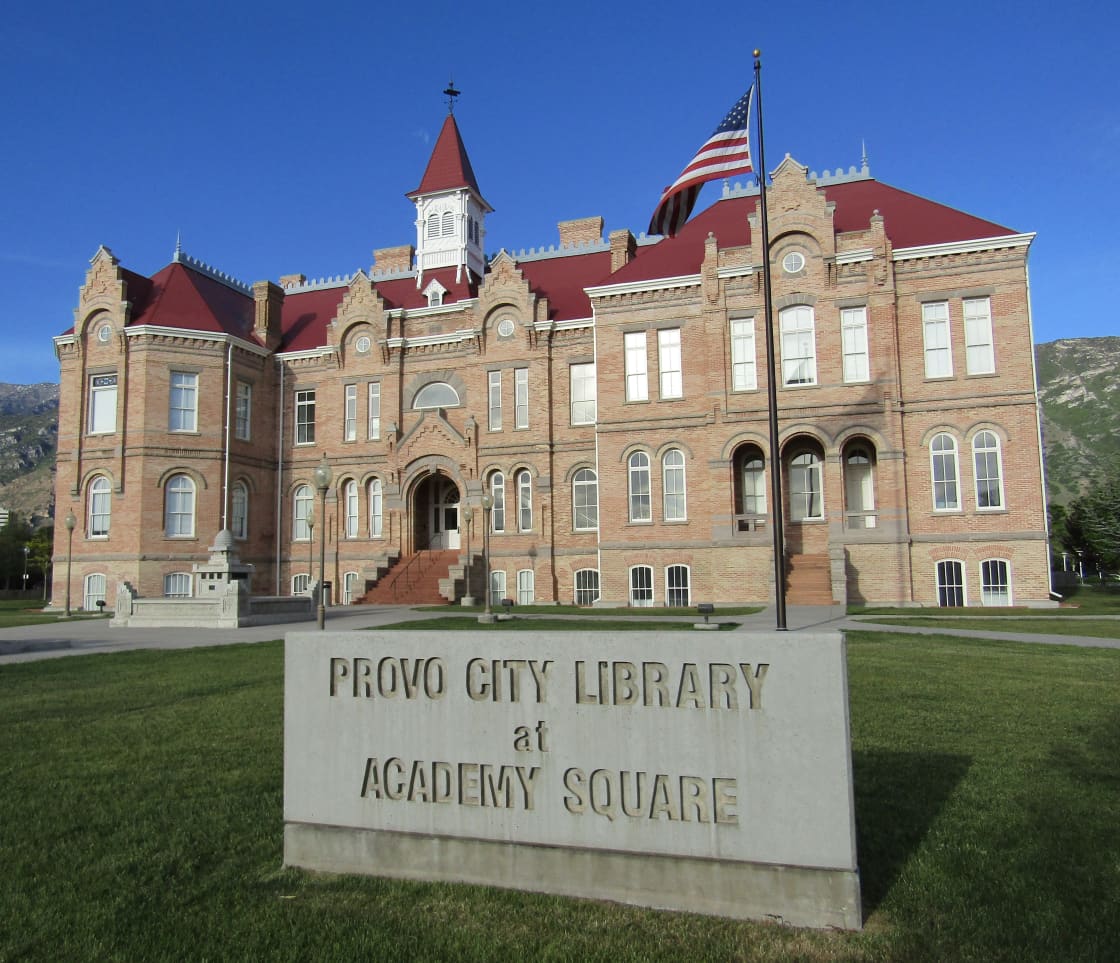
- Provo City Library at Academy Square — 550 N University Avenue, Provo. The flagship, housed in the former Brigham Young Academy building, and the subject of its own full guide on this site
- Orem Public Library — 58 N State St, Orem
- American Fork City Library — 64 S 100 E, American Fork
- Pleasant Grove Library — 30 East Center, Pleasant Grove
- Highland City Library — 5400 W Civic Center Dr, Highland
- Eagle Mountain Public Library — 1650 E Stagecoach Run, Eagle Mountain
- Payson City Library — 66 S Main St, Payson
One to check before you drive: the state directory lists Lehi City Public Library at a temporary location, 870 N 100 E, Suite 110. Temporary locations move. Confirm the address on the day rather than trusting any listing, including this one.
How to decide which card to get
A short decision path for a new arrival.
If you live in Provo or Orem — get a card at both. They are free to you, the collections differ, and there is no reason to pick one.
If you live in American Fork, Pleasant Grove, Lehi, Highland or Eagle Mountain — get your home city's free card. It already borrows at the other four. Do not pay anyone a nonresident fee until you have exhausted the cooperative.
If you live in Springville, Spanish Fork, Payson, Salem, Santaquin or Saratoga Springs — and, for children's books only, Vineyard — get your own city's free card. Reciprocity is limited, so a second card elsewhere means a fee.
If your city has no library — call your city hall first and ask whether they reimburse part of a nonresident fee, and at which library. Then buy the card that your city will help pay for, which may not be the closest one.
If you are a student — check the campus libraries too. BYU and UVU both hold collections that dwarf any city library in the county, and access rules differ for students, community members and alumni. Our study spots guide covers where people work.
The pattern underneath all of this
Utah County's library map is a good miniature of how the county governs generally: strong cities, weak county, and agreements negotiated in pairs and clusters rather than legislated across the whole.
The same shape shows up in fire and police mutual aid, in secondary water, in recreation districts, and in the way each city runs its own celebration in its own week. It is not disorganization. It is a genuine preference for municipal control, and it produces real benefits — libraries here are unusually responsive to the specific city that funds them — alongside the real cost that a family three miles from a library building may have to pay to use it.
Knowing which cluster you are in, and what your own city offers, is most of what it takes to work the system. The rest is a phone call to city hall that almost nobody makes.
The statewide layer sitting above the cities
The cities are not quite as alone as the fee structure makes them look. Above them sits the Utah State Library Division, and it does two things worth knowing about.
The first is the plumbing you have already used if you followed any address on this page. The state library maintains the official directory of library locations, which is the reason it is possible to say "sixteen locations in Utah County" with any confidence at all — no county body publishes that list, because no county body exists to publish it. When a city library moves, as Lehi's has, the state directory is the register that reflects it.
The second is the digital gateway. American Fork's own FAQ does not send patrons to a vendor — it sends them to Utah's Online Public Library, and only then onward to Libby. That framing is accurate and worth preserving: the ebook collection you borrow from is a statewide asset reached through your city card, not something your city bought.
This is why the digital and physical halves of Utah County librarianship feel so different. The physical half is more than a dozen municipal budgets defending their own shelves. The digital half is a shared state-level collection that treats a Santaquin card and a Provo card as roughly equivalent keys. Same county, two completely different logics, and the seam between them is invisible from inside the Libby app.
How to judge whether a nonresident fee is worth it
If you are outside every free option, the fee is a real purchase and deserves a moment's thought rather than a reflex.
Check the digital question first. If most of your reading is ebooks and audiobooks, and you already hold any participating card, a second card buys you very little — the consortium collection is largely the same one. Paying $125 to reach the same Libby catalog from a different direction is the most common way people waste this money.
Then check what is physically different. The reason to buy into a specific library is something that library has and yours does not: a large children's program, a strong local-history or genealogy collection, a makerspace or equipment lending, meeting rooms, or simply enough copies of new releases that holds move. Those differences are real between Utah County libraries, and they are the only thing a nonresident fee buys.
Then check the refund, per the section above, because it may change which library is cheapest for you.
Then check the term. Provo's six-month card at $62.50 is exactly half its annual rate, so there is no penalty for trying six months first. Orem's $70 six-month card against a $125 year is a slight premium for the shorter commitment. If you are unsure whether you will use it, the six-month option in Provo costs you nothing extra to find out.
And one thing worth saying plainly: libraries are not trying to extract this money from you. The fee exists because a city cannot lawfully spend its residents' property tax subsidizing a neighboring city's residents, and every library page that explains the fee says so in almost those words. Ask the staff which option fits your situation. They will tell you honestly, including when the answer is that you should not buy a card at all.
Related Guides
- The Provo City Library at Academy Square: A Complete Guide
- Provo ZIP Codes Explained
- The Best Study Spots in Provo and Orem
- Things to Do in Orem, Utah
- Utah County's Small Towns
- Toddler Activities in Utah Valley
- Moving to Provo: The Complete Guide
- Community Education in Utah Valley
- Free Passes on a Library Card in Utah Valley
- RootsTech from Utah Valley: the world's biggest genealogy conference, and its two free tiers
Frequently Asked Questions
Is there a Utah County library card?
Can Provo residents use the Orem library for free?
What is the North Utah County Library Cooperative?
How much does a nonresident library card cost in Utah County?
My city has no library. Do I have to pay full price?
I have a Provo mailing address in Provo Canyon. Can I get a free card?
Can I borrow ebooks and audiobooks with any Utah County library card?
Which Utah County cities do not have their own library?
Sources
The facts in this guide were checked against these sources. Hours, fees and rules change, so confirm anything time-sensitive with the source before you go. How we make Provo.com.
- Get a Library Card | Pleasant Grove, UT, Pleasant Grove City Library. Checked October 12, 2026.
- Reciprocal Borrowing (North Utah County Library Cooperative) | American Fork, UT, American Fork City Library. Checked October 12, 2026.
- Utah County | Utah State Library Division, Utah State Library Division. Checked October 12, 2026.
- Get a Library Card, Provo City Library. Checked October 12, 2026.
- Library Cards and Accounts, Orem Public Library. Checked October 12, 2026.