
Provo's laundry problem is not really about laundromats. It is about arithmetic in buildings that were designed a long time ago.
A great deal of housing near both campuses was built with a shared laundry room containing a handful of machines, sized for an occupancy that no longer reflects how the building is used. Four washers and four dryers is a reasonable provision for a small apartment block. It is not a reasonable provision for a building that now houses sixty students who all discovered on the same Saturday morning that they have nothing to wear.
Nothing requires a landlord to fix that. Which is precisely why the commercial laundry market in this city is healthy: it is absorbing overflow from buildings whose laundry provision is technically present and practically useless.
The three ways people do laundry here
In-unit. The best outcome and the least common in student housing. If a unit has its own washer and dryer, that fact is doing real work in the rent and is worth paying something for — the time saved over a year is substantial.
Shared building machines. Free in some buildings, coin or card in most, and universally subject to the queue. Quality varies from well maintained to destructive. A shared dryer that has not had its vent cleaned in years will take three cycles to dry a load, and you will pay for all three.
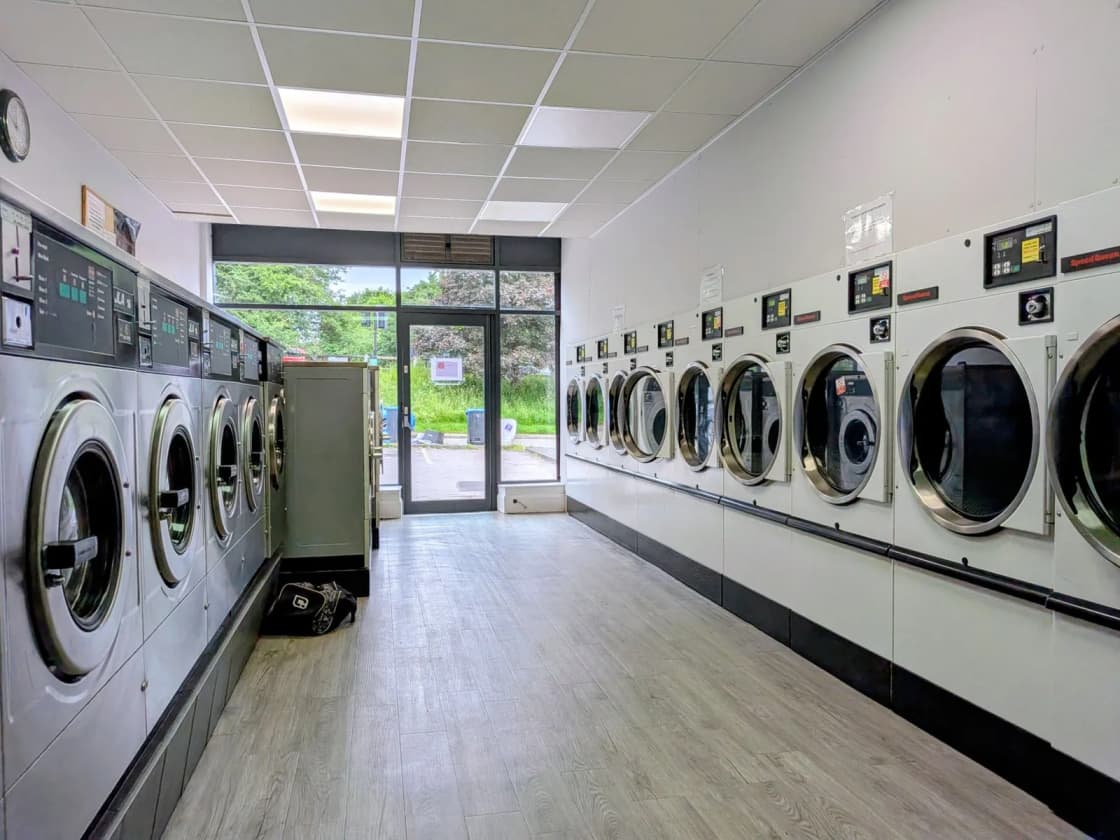
Laundromats. Higher cost per load, dramatically lower time cost, because twelve machines running simultaneously turns a full day into ninety minutes. This is the trade that most people misjudge.
The comparison people get wrong
The instinctive comparison is price per wash, and it makes the laundromat look expensive. Per load it usually is.
The comparison that matters is cost per trip against time per trip.
Three weeks of laundry through a building's shared machines, assuming you can even get two of them, is most of a Saturday: load, wait, discover the dryer is occupied, wait again, come back, find your wet washing on top of the machine. Call it five hours of fragmented attention that you cannot spend elsewhere.
The same three weeks in one large-capacity laundromat machine plus a decent dryer is roughly ninety minutes, most of which you can spend reading or working, and you leave with everything done.
If your time has any value at all — and for a student in finals or anyone working two jobs it has considerable value — the laundromat wins clearly at low frequency. It loses at high frequency. Which points at the actual strategy: fewer, bigger trips.
What it costs, honestly
Prices move with utility costs and vary by location and machine size, so any specific figure ages badly. What holds is the structure.
Budget a few dollars per wash, with large-capacity machines costing meaningfully more than standard ones. Drying is usually sold in timed increments, which is where costs run away — an underfilled dryer and an overfilled dryer both waste money, for different reasons.
The reliable saving is machine selection. A single triple-capacity washer that takes what would otherwise be three loads is nearly always cheaper than three standard machines and finishes in a third of the time. People default to the standard machines because they are cheaper individually, which is the wrong unit of comparison.
Coins, cards and apps
You can no longer assume quarters, and you cannot assume a card reader either. The market is mid-transition: some locations remain coin-operated, some have converted entirely to card or app payment, and plenty run both.
App-based systems have one genuine advantage worth seeking out: many show machine availability remotely and notify you when a cycle finishes. Knowing before you leave the house whether there are free machines removes the single most annoying failure mode of a Saturday laundry trip.
The practical instruction is to check the payment method before driving somewhere new with a full basket. It is a thirty-second look at a website that saves a wasted journey.
Hard water is doing more damage than you think
This is the local detail that most laundry advice misses entirely, and it explains a lot of otherwise baffling results.
Utah Valley water is hard. Minerals in hard water bind with detergent, which means a standard dose accomplishes less cleaning than the packaging assumes, and mineral residue accumulates in fabric over repeated washes. The symptoms are distinctive: towels that go stiff and stop absorbing, whites that drift gray, a faint stale smell in clothes that are technically clean, and colors that dull faster than they should.
The intuitive response is to add more detergent. That generally makes it worse, because undissolved excess detergent is itself a residue problem, and in a front-loading machine it contributes to the film that eventually makes the machine smell.
What works: a detergent formulated for hard water, or a water-softening additive used alongside your normal dose, or periodically running a wash with white vinegar in the rinse to strip accumulated residue. If you have inherited towels that have gone crunchy, a vinegar rinse followed by a hot wash with no detergent at all will often recover them.
Our guide to Provo's water covers where the supply comes from and why it carries the mineral load it does.
Wash-and-fold, and when paying for it is rational
Wash-and-fold is priced by weight, typically with a minimum charge, and the useful way to think about it is that you are not buying clean clothes — you are buying back several hours.
That purchase is rational in specific circumstances and not in general. Finals week. The fortnight after a move, when nothing is unpacked and everything smells of cardboard. A new baby. Illness. Two jobs and no free Saturday. A backlog that has grown large enough to be psychologically immobilising, which is a real phenomenon and one that a single paid intervention fixes.
It is expensive relative to doing routine weekly laundry yourself, and most people who try it as a permanent arrangement drift back.
Before committing, ask about turnaround, because same-day and next-day are priced differently and weekend turnaround is generally longer. Ask how they handle items that should not go in a dryer. And label or bag anything delicate rather than assuming it will be noticed.
What a good laundromat looks like, and what a bad one looks like
They are not interchangeable, and the differences are visible in about thirty seconds.
Signs of a well-run location: machines with visible service stickers and recent dates, a floor that is dry, working lights in the parking area, a posted price list rather than handwritten numbers taped over old ones, folding surfaces that are clean, and a low proportion of out-of-order signs. Staff on site during posted hours. Functioning restrooms, which matters more than it sounds if you are staying two hours.
Signs of one to avoid: standing water, a smell of mildew, dryers with lint traps that are visibly packed, several machines out of order with dust on the notices, and no phone number posted anywhere for reporting a machine that eats your money.
That last one deserves attention. Machines take money and fail to start, and the recovery route is a posted number or an attendant. A location with neither has decided that this is your problem. Photograph the machine number and your payment confirmation before you walk away from a failed cycle.
Drying is where the money goes
Most people optimize the wash and ignore the dryer, which is backwards. Washing is a fixed cost per load; drying is sold by time, and time is elastic depending on what you do.
Three things make a dryer cycle take longer and cost more than it should. Overloading is the biggest — a packed drum cannot tumble, so damp clothing sits against damp clothing and the moisture has nowhere to go. Not shaking items out as they come from the washer means everything enters as a compressed ball. And mixing fabric weights, so that a single pair of jeans keeps the whole load running while eight shirts finished twenty minutes ago.
Separating heavy items from light ones and running them on different settings sounds like more work and is usually less, because the light load finishes fast and cheap.
The other saving is not using the dryer at all where it is unnecessary. Utah Valley's air is dry enough that a folding rack indoors dries most lightweight clothing overnight without a humidity problem — one of the few genuine advantages of the climate. Anything with elastic, printed graphics or synthetic performance fabric lasts substantially longer air-dried, which turns a running cost into a saving on replacement.
Bedding, and the thing that does not fit
The single most common reason someone who normally uses building machines ends up at a laundromat is a duvet.
Domestic-sized washers cannot handle a comforter, a mattress protector or a sleeping bag, and attempting it produces a machine that will not spin and a duvet that stays wet in the middle. Front-loaders in shared laundry rooms are especially poor at this. People try anyway, the machine goes out of balance, and the building loses a washer for a week.
Large-capacity commercial machines exist precisely for this. One trip a season for bedding, sleeping bags and winter coats is a sensible use of a laundromat even for someone with in-unit machines, and it is considerably cheaper than dry cleaning the same items.
The same applies to anything that arrives after a camping trip, which in this valley is a recognized category of laundry with its own smell.
Dry cleaning is a different service entirely
Worth separating, because people conflate them. Dry cleaning uses solvent rather than water and exists for structured garments, tailoring, suits, formalwear and fabrics that water damages.
In a city with this many church services, job interviews, graduations, missionary departures and weddings, the demand for pressed formalwear is steady and year-round rather than seasonal.
Two practical notes. Check the care label before assuming something needs dry cleaning — a great many garments labeled dry-clean-only survive careful hand washing, though the risk is yours. And for anything valuable, ask what happens if the item is damaged, because liability terms vary and are usually posted somewhere you did not read.
The seasonal spike nobody warns you about
Provo's laundry demand is not evenly distributed across the year, and two moments are worth avoiding if you can.
The late-August move-in window compresses an enormous number of household formations into about a fortnight, and everything laundry-adjacent gets busy — laundromats included, because a mattress protector and three sets of bedding do not fit in a small machine.
The end of each semester produces the same effect in reverse, with the added feature that everyone is simultaneously trying to leave a rental clean enough to recover a deposit.
If your schedule is flexible, laundry on a weekday morning is a different experience from laundry on a Saturday afternoon during either of those windows.
Losing clothes: the mechanics
Unattended laundry is how people lose things, and the loss is usually mundane rather than criminal.
Somebody needs the machine. Your finished load is sitting in it. They move it, reasonably, onto a folding table, and a sock does not survive the transfer. Multiply across a semester.
The countermeasure is a timer set for two minutes before the cycle ends, and being physically present when it stops. In shared building laundry rooms, that discipline also prevents the more irritating outcome, which is somebody moving your wet clothes onto a dubious surface.
Attended laundromats — locations with staff on site — cut the risk substantially and are worth choosing if you intend to bring a laptop and work through the cycle. For late-night trips, prefer somewhere lit and covered by cameras.
If your building's machines are broken
There is a line between an inadequate laundry room and a defective one, and it has consequences.
A building with too few machines for its occupancy is a design failure and not something a tenant can generally compel a landlord to fix. A building whose machines are out of order for weeks, or whose laundry room floods, or whose dryer vents are a fire risk, is a different matter — that moves toward habitability and maintenance obligations.
Report it in writing, keep the record, and follow the escalation path rather than a verbal complaint to whoever is at the desk. Our guide to Utah renters' rights sets out the process and what a landlord is required to do.
If laundry provision matters to you, inspect the laundry room before signing. Count the machines, count the units in the building, and note how many machines have an out-of-order sign on them. That ratio tells you more about the next twelve months than the show apartment does.
A short strategy that works
- Wash full loads. Frequent small loads are the most expensive way to do laundry on every measure.
- Wash cold unless heat is needed. Heating water is the expensive part.
- Use a hard-water detergent or an additive, and use less rather than more.
- Choose the large machine over three standard ones.
- Shake items out before drying; do not pack the dryer.
- Go on a weekday morning if your schedule permits.
- Set a timer and be there when it stops.
- Check payment method and current hours before driving somewhere new.
Hours, prices and payment systems change frequently at individual locations. Everything here describes how the market works rather than what any specific business charged on any specific day — confirm current details with the location before you go.
What a care label legally means — and why "dry clean only" so often does not
The single most useful thing to understand about garment care is that the label sewn into the seam is a regulated document, and the regulation explains a puzzling fact: an enormous number of garments marked dry clean only wash perfectly well.
The rule is the Federal Trade Commission's Care Labeling Rule, 16 C.F.R. Part
423. § 423.4 puts the duty on manufacturers and importers of textile
wearing apparel — not on the store that sold it and not on the laundromat or
cleaner that handles it. § 423.1(a) defines a care label as a permanent label or
tag attached so it will not separate from the product and will remain legible
during the useful life of the product, which is why a faded, illegible label is
itself a defect in the garment rather than bad luck.
Now the provision that explains the mystery. § 423.6(b) requires that labels for
textile wearing apparel have either a washing instruction or a drycleaning
instruction — and states expressly that if either method can be used on the
product, the label need have only one of them. The manufacturer chooses. A
manufacturer that tested drycleaning and never tested washing may lawfully print
dry clean only on a garment that would survive a cold hand wash, because the
rule never asked it to establish that washing fails.
There is a real limit on the other side, though, and it is the reason the label
is not simply advertising. § 423.5(a)(5) makes it an unfair or deceptive
practice for a manufacturer or importer to fail to possess, before sale, a
reasonable basis for all regular care information disclosed. § 423.6(c) describes
what counts: reliable evidence that the product or a fair sample was successfully
tested, current technical literature, past experience, industry expertise, or
other reliable evidence. So the instruction that is printed has to be
supportable. It is the absent instruction that carries no representation.
Two warning duties are worth knowing because they affect what you can do at a laundromat.
§ 423.5(a)(2) requires a warning before sale where the product cannot be
cleaned by any cleaning procedure without being harmed — the label must say so,
in words like do not wash, do not dryclean or cannot be successfully cleaned.
§ 423.5(a)(3) is the one that matters for a shared machine. A manufacturer must
warn where any part of the prescribed regular care procedure, which a consumer
or a professional cleaner could reasonably be expected to use, would harm the
product or others being cleaned with it. That is a dye-bleed and
contamination duty. A new red garment with no such warning is representing that
it can go through a normal wash without ruining what is in with it — which is
exactly the risk you are taking when you consolidate four loads into one
large-capacity machine.
The mechanics of the instructions themselves are prescribed. Under § 423.6(b)(1)
a washing instruction must state whether to wash by hand or machine and give a
water temperature in terms such as cold, warm or hot — but it need not mention
temperature at all if regular use of hot water up to 145 degrees Fahrenheit will
not harm the product, which is why a bare machine wash means any temperature is
acceptable. Drying instructions work the same way: tumble dry with no
temperature stated means high, medium or low will do. Ironing is mentioned only
where it will be needed regularly or where a warning requires it.
§ 423.1(c) defines drycleaning as a commercial process using a common organic
solvent, which may include adding moisture up to 75 percent relative humidity,
hot tumble drying up to 160 degrees Fahrenheit, and steam pressing. That is a
harsher process than most people picture, and it is why repeated drycleaning of
wool knitwear is not a conservative choice.
Finally, exemptions exist and explain some unlabeled garments. § 423.8(a)
exempts any item of textile wearing apparel without pockets that is totally
reversible, and (b) allows manufacturers to petition for exemption where a
label would harm the appearance or usefulness of the product — but (c) requires
that the care information still reach consumers, on a hang tag, the package or
some other conspicuous place.
The practical takeaway for anyone standing in front of a bank of machines: read the label for what it does say, treat a missing washing instruction as untested rather than forbidden, and take the dye-bleed warning seriously, because that one is about the rest of your load.
Related Guides
- Provo's Water, Explained
- Utah Renters' Rights
- First-Time Renter's Checklist
- Finding Student Housing in Provo
- Storage Units in Provo
- Provo City Cemetery: Finding a Grave, Reading the Records, and the 1853 Ground Underneath It
- Tax Prep in Provo: From Free VITA Labs to Paid CPAs, and How to Tell Which You Need
- Provo for Retirees: The Other Demographic in America's Youngest College Town
- Housing Assistance in Utah County: Two Housing Authorities, Both in Provo, and the One You Need
- Hardware Stores in Utah Valley: Three Formats, and the One Most People Under-Use
- Salons & Barbershops in Provo: Where to Get a Haircut
- Furniture Shopping in Utah Valley: The Student Cycle, the Delivery Trap & Where to Actually Look
- Provo ZIP Codes, Explained: Why There Are Six and Only Three Are Places
- Phone & Computer Repair in Provo: Who Fixes What, and When Not To
- Nails & Lashes in Provo: Salons, Student Rates & What to Ask
Frequently Asked Questions
How much does a load of laundry cost at a Provo laundromat?
Do Provo laundromats still take coins?
Why is my laundry room always full?
Is wash-and-fold service worth it?
Does Provo's hard water affect laundry?
Can I leave my laundry unattended at a laundromat?
What is the cheapest way to do laundry as a Provo student?
Are there laundromats open 24 hours in Provo?
Sources
The facts in this guide were checked against these sources. Hours, fees and rules change, so confirm anything time-sensitive with the source before you go. How we make Provo.com.
- 16 CFR Part 423 Care Labeling of Textile Wearing Apparel and Certain Piece Goods, eCFR / Federal Trade Commission. Checked October 12, 2026.