
Mapleton began as a field. For its first twenty years it had no houses to speak of, only farmland on the bench above Springville that Springville families worked together and called the Union Field. Its name came later, from a stand of maples at the mouth of a canyon, and it took half a century to become a town of its own. That slow start is why Mapleton still feels the way it does: large lots, orchards in living memory, and a main street with a handful of houses that predate the town itself.
Springville's bench
When eight families founded Springville on Hobble Creek in 1850, the bench to the southeast was part of the bargain. The Utah History Encyclopedia says Springville settlers surveyed the land there less than a year after arriving. By 1856 a group of them, including Henry Claucus, Sanford Fuller, John Deal, Myron and Spicer Crandall, Henry Roylance, Stephen C. Perry and John Solomon Fuller, were leveling ground and digging a five-mile ditch from Hobble Creek to water it.
They farmed it as a cooperative venture, and the encyclopedia says that is where the name came from: the Union Field, for the settlers working it as one. Other sources, including a BYU history of the town's first meetinghouse and a 2004 Deseret News profile, call it Union Bench. Both names appear in local use. Our history of Springville covers the town the bench belonged to.
Waiting for the war to end
The bench was Ute country, and the encyclopedia's account suggests that for the first two decades of Springville's existence the settlers worked their fields from town rather than building homes out on them. These were the years of the Walker War, which began at a cabin near Springville in 1853, and of the Black Hawk War of the 1860s.
The encyclopedia is direct about what changed. A final survey of the bench was completed in the late 1860s, and development began after the Utes were moved to a reservation in 1869. That reservation was the Uintah Valley Reservation in the Uinta Basin, east of the mountains. Our page on the Timpanogos people of Utah Valley tells that removal from the side of the people who were moved.
John S. Fullmer and Cyrus Sanford were among the first to farm the bench afterward. Charles E. Malmstrom, a Swedish immigrant, moved into his home on what is now west Maple Street on December 1, 1873. By 1877, the encyclopedia counts at least eighteen families with homes on the Union Field.
The families on Main Street
Several of those early families are still visible on South Main Street.
Benjamin F. Bird crossed the plains from Nauvoo in the fall of 1850, according to a Utah State History marker, and claimed land on the bench under the Homestead Act. His grandson Roswell Darius Bird Sr., born in Springville, built a two-story brick house on that land around 1892. The marker calls it a well-preserved example of Victorian influences on owner-built houses in Utah.
A few doors down stands the log home of Levi N. Kendall. His marker says he was born in New York in 1822, came into the Salt Lake Valley with the advance guard of the first pioneer company on July 24, 1847, helped with the first plowing and planting there, and was later legally adopted by Brigham Young. He and his wife Eliza came to Mapleton in the 1880s, and the cabin was built soon after.
A school, a ward and a name
The bench got its own institutions in the 1880s. Lewis R. Perry donated an acre for a schoolhouse, which was standing by 1884; the encyclopedia gives its size as twelve by fifteen feet. A church ward followed. The encyclopedia dates it to 1887, while a 1999 Daughters of Utah Pioneers marker says Apostle Francis M. Lyman organized the Mapleton Ward on August 26, 1888, with Edwin Lucius Whiting as bishop.
That ward is where the name comes from. L.J. Whitney, who also served on the committee for the first meetinghouse, suggested "Mapleton" for a small grove of black maple trees at the mouth of Maple Canyon, according to the encyclopedia. The mountain above town, Sierra Bonita, is also known as Maple Mountain. Because the ward's members were most of the people on the bench, a BYU history of the meetinghouse explains, the town simply took the ward's name when it organized.
Matilda Wells Streeper donated an acre for the meetinghouse, and the DUP marker says a grove of trees was left standing on the lot. Construction began in 1889 and cost about $3,500. The brick building measured 58 by 30 feet, with tall pointed windows, and its pine benches could be cleared away for dances while heavy curtains split the room into eight classrooms. The marker says a bucket brigade put out an attic fire around 1900.
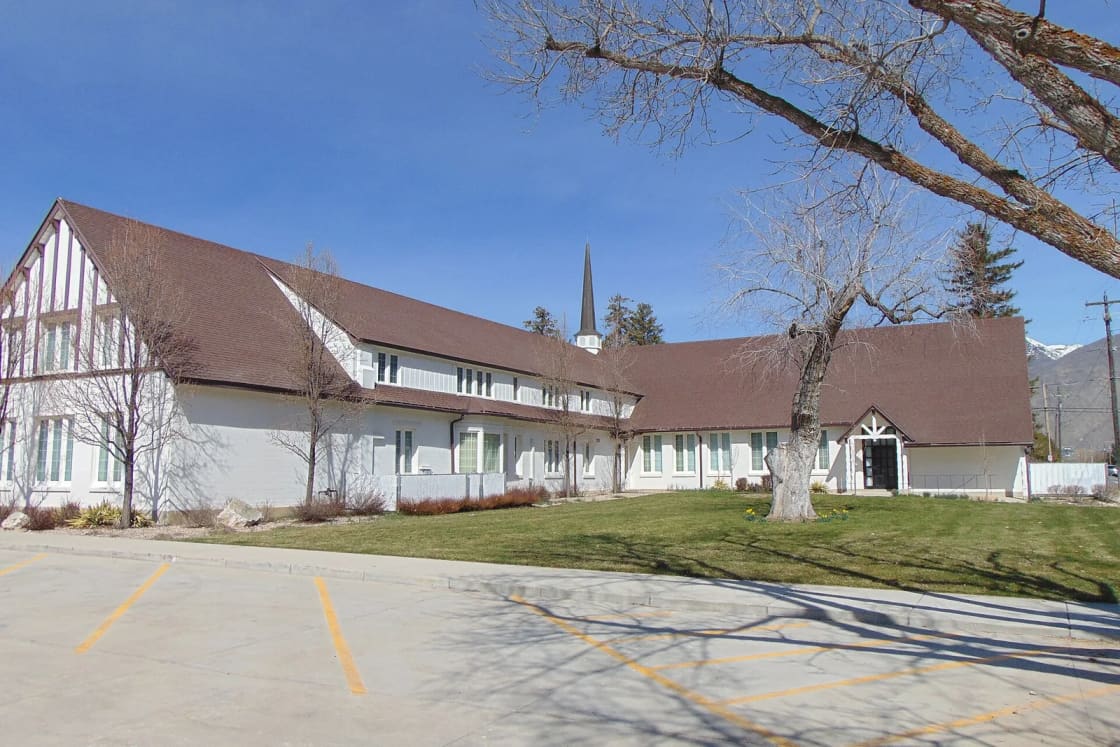
The date it was finished is another small disagreement. The BYU history says it was dedicated in 1892 and completed in 1893; the DUP marker gives a dedication date of April 30, 1899. It was torn down in 1936, during the Depression, as a work project that let residents earn food vouchers, and its replacement was dedicated on April 28, 1941. That chapel is still in use.
The town of 1901
On September 3, 1901, Aaron Johnson Jr. and 110 other adults petitioned Utah County to organize the bench as a town, and the county agreed. The encyclopedia lists the first town board: John R. Bromley as president, with trustees John H. Lee, Christian W. Houtz, John Tuckett and Richard Mendenhall, who was later replaced by William T. Tew.
The new town built what a farm town needed. Residents put up a recreation hall by public donation in 1911. Utah Power and Light had an electric franchise by 1913, and a town water system was in place by 1918, with a culinary water system celebrated in 1930. The encyclopedia adds that water, especially in dry years, has remained a problem.
The women of the ward ran their own institution. The Mapleton Ward Relief Society Hall, according to a 2023 DUP marker, was where the Relief Society met, held activities and gave out food and clothing to people in need. The women raised and sold wheat to fund a granary for storing and distributing grain. They outgrew the hall in 1917.
A city, and then a suburb
Mapleton became a third-class city in 1948. A 2004 Deseret News profile gives April 1, 1948 as its incorporation date, which describes that change of status rather than the original 1901 town.
The Deseret News profile also notes that early settlers had planted cherry orchards on the north bench. By 1990 the encyclopedia described a mixed population of old farm families, a native-born majority and newcomers from California. The census then counted 5,809 residents in 2000, 7,979 in 2010 and 11,365 in 2020. In 2004 the city's own government, with about 30 employees, was its largest employer.
Mapleton's large lots are a choice as much as a legacy. Our living in Mapleton guide and Mapleton neighborhoods guide describe what that means for the city now. Its summer celebration, Mapleton Pioneer Days, still takes its theme from the settlers.
See it today
Most of what survives is on one block of South Main Street, which makes Mapleton an easy fifteen-minute history stop.
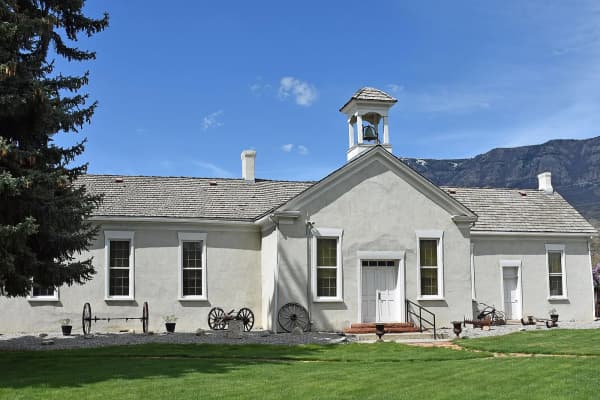
Mapleton Towne Square, 115 South Main Street. The rebuilt Relief Society Hall, dismantled brick by brick in 2019 and reassembled by volunteers from the original materials, finished in 2021. A 2023 DUP marker (number 593) tells its story.
Roswell Darius Bird Sr. House, at the same address on South Main. The circa-1892 brick house, with a Utah State History historic site marker (N-375). Private.
Levi Kendall's Home, 165 South Main Street. The log cabin of a member of the 1847 advance company, with a marker. Private.
Site of the first meetinghouse, 31 West Maple Street. A 1999 DUP marker (number 515) stands outside the 1941 chapel that replaced it; the BYU history notes a plaque outside and historical photographs inside.
Maple Canyon. The canyon whose maples named the town is in the mountains above Mapleton. For the neighboring canyon, see our Hobble Creek Canyon guide; its creek watered Mapleton's first fields.
Frequently Asked Questions
How did Mapleton get its name?
What was Mapleton called before?
When was Mapleton settled?
When was Mapleton incorporated?
Was Mapleton part of Springville?
What is the Relief Society Hall in Mapleton Towne Square?
How fast has Mapleton grown?
Where can I see Mapleton's history?
Sources
The facts in this guide were checked against these sources. Hours, fees and rules change, so confirm anything time-sensitive with the source before you go. How we make Provo.com.
- The Walker War, Utah Division of State History, History To Go. Checked October 20, 2026.
- Mapleton's first meetinghouse (Logan Goulding), Intermountain Histories (BYU). Checked October 20, 2026.
- Mapleton Ward Relief Society Hall (DUP marker 593), Historical Marker Database. Checked October 20, 2026.
- Roswell Darius Bird, Sr. House (Utah Historic Site N-375), Historical Marker Database. Checked October 20, 2026.
- Levi Kendall's Home, Historical Marker Database. Checked October 20, 2026.
- Site of First Mapleton Meeting House (DUP marker 515), Historical Marker Database. Checked October 20, 2026.
- Mapleton (Utah History Encyclopedia), University of Utah Press / Utah Education Network. Checked October 20, 2026.
- Mapleton illustrated, Deseret News. Checked October 20, 2026.
- 2020, 2010 and 2000 Decennial Census redistricting data (P1), U.S. Census Bureau via USAFacts connector. Checked October 20, 2026.