
More on The South Valley: every guide we have published there, in one place.
Mapleton is the city the biggest story in Utah County simply does not touch.
For two years the valley's conversation has been the Alpine School District split — the 2024 ballot measure, the dissolution on 30 June 2027, the three successor districts standing up on 1 July 2027, the arguments about boards and boundaries and tax bases. That conversation has been loud enough to wash south over cities it has nothing to do with, and Mapleton is one of them.
Mapleton is in Nebo School District and always has been. It was never part of Alpine. Nothing about its district is changing. In a valley where a great many buyers are currently trying to price an unresolved governance question into a purchase, Mapleton is a place where that question does not exist.
What does shape a purchase here is different and more physical: how far back from the freeway you are willing to sit, how much land you want to maintain, and the fact that the high school your children attend is in the next city over.
This guide is the area-by-area companion to our broader guide to living in Mapleton.
The one thing to know before you compare anything
Mapleton has no official neighborhoods.
Provo City does, through its Neighborhood District Program, in which neighborhoods are grouped into districts with volunteer boards, which is why our Provo neighborhoods guide can be organized around them.
Mapleton has nothing of the kind, and it is a small enough city that even the informal names are thin on the ground. What people refer to is a subdivision name on the newer edges, or plain geography everywhere else: the east bench, the old town, the west side.
That is fine as orientation and useless as governance. Zoning, animal rights, outbuilding allowances, irrigation water shares and school assignment are all parcel-level facts. None of them can be read off an area name, and in a city where people specifically move to keep horses, the gap between "this street looks rural" and "this lot is zoned for what I want" is where the expensive surprises live.
Mapleton at a glance
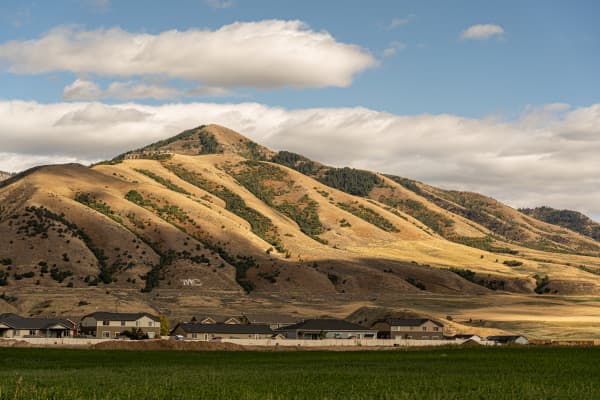
Mapleton sits at the foot of Maple Mountain in south Utah Valley, wedged between Springville to the north and Spanish Fork to the south, set back from I-15 against the Wasatch foothills.
That set-back is the founding decision of the modern city and everything else follows from it. Where its neighbors built out toward the freeway and the commerce that comes with it, Mapleton went the other way: fewer strip malls, bigger lots, custom homes, and an established horse culture. It is a premium, semi-rural suburb by deliberate choice rather than by accident of geography, and it has held that line while the cities on either side of it grew fast.
The result is a small city with a high median household income, strong Nebo schools, real mountain views, and noticeably less of the commercial convenience that its neighbors take for granted.
The school seam, which is the interesting part
Here is the fact that catches people out.
Mapleton has its own junior high — Mapleton Junior High — and several elementary schools inside the city. It does not have its own high school. Many Mapleton high schoolers attend Maple Mountain High School, at 51 N 2550 E in Spanish Fork.
So the high school is across a city line, and it is shared. Maple Mountain serves students from Mapleton and from Spanish Fork both. Which means:
A Mapleton address and a Spanish Fork address can send children to the same high school.
That single sentence does more work than anything else in this guide. It means the two cities are not the separate school markets that their very different housing products imply. It means a family choosing between a large lot in Mapleton and a master-planned house in Spanish Fork may be choosing between two housing markets and one school. And it means that "the schools" is not the differentiator between those two cities that a lot of listings imply it is.
There is a second wrinkle. Spanish Fork is itself split between two high schools — Spanish Fork High and Maple Mountain — and the boundary between them has shifted as the south valley has grown. Our Spanish Fork neighborhoods guide covers that side of the seam.
Which means the assignment is address-level on both sides of the city line, and it has moved before. Verify the specific parcel with Nebo rather than reasoning from the city, and do it before you write an offer rather than after.
The district story: what is not happening here
It is worth being explicit about the negative, because the absence is the selling point.
The three-way split of Alpine School District affects the northern valley: Alpine, American Fork, Cedar Hills, Highland, Lehi and part of Draper go to Aspen Peaks; Eagle Mountain, Saratoga Springs, Cedar Fort and Fairfield go to Lake Mountain; Orem, Lindon, Pleasant Grove and Vineyard go to Timpanogos. Alpine dissolves 30 June 2027 and the successors are operational 1 July 2027.
Nebo — which serves Springville, Spanish Fork, Mapleton, Salem, Payson, Santaquin and south — was never part of Alpine and is not part of the reorganization. Our guide to the Alpine School District split has the full picture.
For a buyer, that is worth real money in certainty rather than in dollars. North-county purchases right now carry a set of open questions: which board will run this district, what will the new tax rate be, will attendance boundaries be reviewed by an administration that does not yet exist. In Mapleton, none of those questions apply. The district you research today is the district your children will attend in.
The areas
The east bench, against the mountain
The eastern edge of the city, climbing toward the Maple Mountain foothills, is where Mapleton's reputation was built.
This is the large-lot, custom-home, view-oriented part of the city, and it is where the equestrian character is most concentrated. Lots are big enough to be useful rather than decoratively large. Outbuildings, arenas and pasture are ordinary rather than exceptional. The mountain is immediately there, not a view in the distance.
The trade-offs are the ones that come with any foothill position: more snow, later melt, steeper approaches, and a wildfire exposure question at the mountain interface that is worth taking seriously along the whole Wasatch front. Add to that the fact that everything is further — from the bench, even a trip to the freeway starts with a drive across the city.
Land here is also work. A large lot with pasture and animals is a maintenance commitment measured in hours per week, and the buyers who are happiest on the east bench are the ones who wanted that commitment rather than the ones who wanted the view and inherited the acreage.
Reads as: largest lots, strongest horse culture, best views, most set-back.
The older central area
Around the historic core, the city is older, denser and more conventionally townlike. Stock is mixed across eras, trees are mature, and the trips to city services and to the schools inside the city are short. How that core grew out of Springville's farm fields is in our short history of Mapleton.
This is the part of Mapleton that feels like a small town rather than an estate district, and for a lot of buyers it is the better fit — much of what people like about the city is available here without the acreage and the maintenance that comes with the bench.
Lots are still generous by valley standards. They are not east-bench lots, and the animal question is much more parcel-by-parcel here.
Reads as: oldest, most walkable within itself, most mixed stock, most practical.
The west side toward Springville and the freeway
Moving west, the ground flattens and the city becomes more conventionally subdivided. This is the closest part of Mapleton to Springville, to the freeway approach and to the commercial services that Mapleton itself largely does not have.
For a commuter, this is the sensible end of the city. It shaves real minutes off every trip and it puts you nearest the shops, the fuel and the errands that otherwise mean a drive.
What you give up is the thing people move to Mapleton for. This is the least distinctive part of the city, the part that most resembles the neighboring cities, and the part where the premium is hardest to justify on anything other than position.
Reads as: flattest, quickest out, closest to services, least characteristic.
The agricultural edges
Threaded around and between the built areas are the working and formerly working agricultural parcels that the city grew out of. These are not a neighborhood; they are the underlying land use that the rest of Mapleton was subdivided from, and they are still visible.
This is where the irrigation question becomes concrete. Water shares in south Utah Valley are property interests with their own history and their own transfer rules, and they do not automatically come with a parcel just because the parcel has a ditch running past it. A buyer who intends to irrigate pasture needs to establish what water rights attach, in writing, as a distinct exercise from the purchase itself.
What differs between these areas
Three things, and everything else follows:
Lot size and what you can do on it. East bench largest, central generous, west side conventional. Animal rights and outbuilding allowances track roughly with this and are decided parcel by parcel.
Set-back from the freeway. West side closest, east bench furthest. This is the commute in one variable.
Elevation. East is up against the mountain, west is flat. This drives snow, views, and how the street was laid out.
School district is the same across the whole city — Nebo, unchanged. High school is Maple Mountain for most of the city, in Spanish Fork, with an address-level boundary that has moved before.
The commute, priced honestly
Mapleton's set-back is not an accident and it is not free.
Because the city sits back against the foothills rather than out toward the interstate, reaching I-15 means crossing to Springville or Spanish Fork first. Every trip inherits those minutes. Provo is close. The Lehi tech corridor is a real haul, and Salt Lake City is a long daily drive on I-15 with the ordinary peak-hour problems. There is no FrontRunner station in Mapleton, so this is a driving commute in every direction.
That is the honest trade for what the city is. If you work in Provo or the south valley, it is very manageable and the quiet is close to free. If you work in Silicon Slopes, drive it — at your real departure time, in winter — before you commit to it. The distance does not feel the same in February as it does on a September afternoon.
Our comparison of the south-valley cities and of Springville is worth reading alongside this if the commute is the binding constraint, because both of those cities sit closer to the freeway and sell a different balance.
The equestrian question, in practical terms
People move to Mapleton for horses. It is one of the few places in the valley where that is a mainstream reason rather than an unusual one, and the culture is established rather than aspirational.
But the mechanics are parcel-level and they are where deals go wrong:
- Zoning determines what animals you may keep and how many. It varies within the city and it does not follow the visual character of a street.
- Outbuilding rights — barns, arenas, run-in sheds — are a separate permission from the animal allowance.
- Water for pasture is a property interest of its own, with its own transfer process. Do not assume it comes with the land.
- Setbacks and manure management have rules, and neighbors in a semi-rural city that is steadily gaining non-agricultural residents are increasingly likely to know them.
- HOA covenants, where they exist on newer subdivisions, can be stricter than the city's zoning and frequently are.
The general rule: the rural look of a road is evidence about the road, not a permission for the lot. Two visually identical properties can differ on every point above. Confirm in writing, on the parcel, before closing.
Renting in Mapleton
Rental supply here is thin, and structurally so. Mapleton was built as an ownership product for people who wanted land, and there is very little purpose-built multifamily inventory. What exists is mostly individual houses, basement apartments and accessory units.
If you want to try the city before buying, expect a patient search and expect houses rather than complexes. Renters in a small-landlord market should read our guide to Utah renters' rights — the statutory rules are identical to those governing a large Provo complex, and an owner renting out one house is far less likely to have them at their fingertips.
What the map doesn't tell you
The high school is in another city. Maple Mountain is in Spanish Fork and serves both cities. It is the single most important structural fact about Mapleton schooling and it does not appear on a city map.
Commercial services are deliberately thin. Mapleton has chosen not to build the retail its neighbors have. Groceries and errands generally mean Springville or Spanish Fork. That is not a gap in the city; it is the city's stated preference, and it is permanent enough to plan around.
Large lots are labor. The maintenance load on an acre with pasture is not a rounding error, and it is the most common thing east-bench buyers underestimate.
Winter is a bench climate. The east side holds snow, and the approach roads climb. Look at the driveway grade in the season it matters.
Nebo is a large district covering a lot of geography. Springville, Spanish Fork, Mapleton, Salem, Payson, Santaquin and south. Its scale is a stability advantage and it also means Mapleton is a small constituency inside it.
Choosing in one pass
- You want land, horses and the mountain → the east bench, and check zoning, outbuildings and water on the specific parcel.
- You want the city's character without the acreage → the older central area.
- You want Mapleton's address and the shortest drive → the west side.
- Certainty about your school district matters to you → Mapleton generally, because Nebo is not part of the reorganization and will not be.
- Your children's high school matters to you → verify with Nebo for the parcel, because Maple Mountain's boundary with Spanish Fork High has moved before.
Why Mapleton stayed small
Cities do not stay low-density by accident in a valley growing this fast. Mapleton itself has grown quickly, from about 11,400 residents in the 2020 Census base to about 16,300 in the Census Bureau's July 2025 estimate. Mapleton's character is the result of repeated, deliberate choices, and understanding that tells you something useful about how it will behave in the future.
The pattern is consistent: larger minimum lot sizes than neighboring cities, limited commercial zoning, and a general preference for residential land use over the retail and light industrial that generate municipal revenue. Springville and Spanish Fork made different choices and got different cities — more shops, more jobs, more traffic, more tax base, more housing.
The trade Mapleton made is the one you are buying into. Lower commercial tax base means the residential property tax carries proportionally more of the municipal load. Limited retail means groceries and errands happen in another city. Large minimum lots mean the housing that gets built is expensive to build and expensive to buy, which constrains supply and holds prices up.
This matters for a buyer in one specific way: do not buy here expecting it to become more convenient. The convenience is not coming. If the absence of a grocery store within the city is a problem for you now, it will still be a problem in ten years, because the city has consistently chosen not to solve it. If the absence is the point, that choice is durable and you can rely on it.
Comparing Mapleton to its neighbors
The three south-valley cities that buyers realistically compare are Mapleton, Springville and Spanish Fork, and they are different products rather than different price points on the same one.
Springville is the established, full-service city of the three, with a real downtown, an arts identity, the most mixed housing stock and the closest freeway access. It is the most conventionally urban option in the south valley. Our Springville neighborhoods guide covers it.
Spanish Fork is the growth story: the largest of the three and adding the most residents, with the most master-planned inventory, its own municipal utilities including a city-run internet and television service, and two high schools splitting the city. More house for the money, and more of the trade-offs that come with rapid growth.
Mapleton is the low-density option. Fewer services, larger lots, higher entry point, more land, and a settled district. It is the choice for buyers who have decided that space and quiet outrank convenience.
All three are in Nebo. None of them is touched by the Alpine reorganization. So unusually for Utah County right now, the comparison between them is a straightforward comparison of housing and location, without a governance question layered on top.
The county services headquartered here
For a small city, Mapleton punches above its weight in one specific respect: it hosts county-level service infrastructure that serves a much wider area than the city itself.
That is worth knowing for two reasons. It brings some traffic and activity that a city of this size would not otherwise generate. And it means residents have local access to services that people in comparable small cities have to drive for.
Library access, as in several Utah County cities, works differently from what a newcomer assumes, and it is worth establishing how it works for your address rather than discovering it when you need a card. Our living in Mapleton guide sets out the local arrangements.
Related Guides
- Living in Mapleton
- Nebo School District
- The Alpine School District split, explained
- Spanish Fork neighborhoods
- Springville neighborhoods
- Living in Springville
- Living in Salem
- Living in Payson
- Utah renters' rights
- Payson neighborhoods
- Lindon neighborhoods
- Mapleton Pioneer Days
Frequently Asked Questions
Is Mapleton affected by the Alpine School District split?
Which high school serves Mapleton?
What are the best neighborhoods in Mapleton Utah?
Can you keep horses in Mapleton?
Are these official neighborhoods with defined boundaries?
How bad is the commute from Mapleton?
Why is Mapleton more expensive than Spanish Fork or Payson?
Why doesn't this guide publish home prices for Mapleton?
Sources
The facts in this guide were checked against these sources. Hours, fees and rules change, so confirm anything time-sensitive with the source before you go. How we make Provo.com.
- Annual Estimates of the Resident Population for Incorporated Places in Utah, 2020-2025 (SUB-EST2025), U.S. Census Bureau. Checked October 12, 2026.
- Search for Public Schools: Maple Mountain High, Mapleton Junior High, Mapleton School, National Center for Education Statistics. Checked October 12, 2026.
- Public School Directory, Mapleton City. Checked October 12, 2026.
- Neighborhood District Program, Provo City. Checked October 12, 2026.