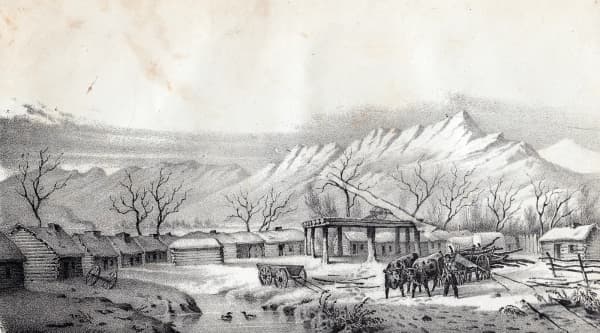
Springville is the only city in Utah County named for a piece of tack that came off a horse.
The story is small and well attested and it stuck, which is more than most founding anecdotes manage. In 1849, by the city's own account, traders Oliver B. Huntington and Barney Ward were in the area, and a hobbled horse lost its iron hobbles in the creek. Hobbles are the loose restraints tied around a horse's forelegs so it can graze without wandering; put a hobbled horse near a creek and eventually it walks into the creek and the hobbles come off. The place became Hobble Creek, and the name went on the map.
Then the town grew up, acquired a fort with springs beside it, and renamed itself Springville — the respectable name, the one that went on the letterhead. Both names survive, which is the useful thing about them. And then this farming town of a few thousand people did something none of its neighbors did: it became the place where the visual arts in Utah started.
Before anyone stayed
The Dominguez–Escalante expedition passed through Utah Valley in 1776, and the valley's written record begins with them rather than with anyone who settled it. Nobody built anything on Hobble Creek for another seventy-odd years.
The scouting that mattered happened in 1849. A group led by William Miller and James Mendenhall came south from the Provo River area, looked over the Hobble Creek country and liked it. The Oliver B. Huntington party — the one with the unlucky horse — was in the same season and the same neighborhood.
The settlement itself is precisely dated: September 18, 1850. Eight pioneer families came, led by Aaron Johnson, having crossed the plains to the Salt Lake Valley and then been directed by Brigham Young to keep going roughly fifty miles further south. The names in the first company include Johnson, Myron N. Crandall, John W. Deal and William Miller, who had scouted it the year before and evidently meant it.
Fifty miles further south was not a small instruction in 1850. It meant leaving the established valley for a place with a creek, a lot of grass and no neighbors.
What eight families were taking on
It is worth being concrete about what the September 1850 arrival involved, because "settled in 1850" flattens it.
Eight families is perhaps forty or fifty people. They arrived in the third week of September, which in Utah Valley means somewhere between six and ten weeks before winter closes in, on ground where nothing had been built. Shelter had to come before anything else, then water had to be brought out of the creek and onto the fields before the following spring, because a settlement that missed its first planting season did not get a second chance at it. Every Utah Valley town of this era has the same compressed opening: arrive late in the year, survive, dig, plant.
What made Hobble Creek workable was that the creek was reliable in a way the streams further north were not. Lehi had to borrow water from another town's river. Orem's bench sat above the water and stayed empty for a generation. Springville's founders had a live stream running through the middle of their ground, which is why eight families in September could become an incorporated city inside three years.
The trade-off arrived later. A creek is enough for a village and not enough for a farm economy, and the ceiling that put on Springville is why the irrigation projects of the early twentieth century mattered so much here.
The incorporation date nobody agrees on
Springville was incorporated in 1853. That much every source says.
The day is another matter, and it is worth stating rather than quietly picking one. Encyclopedia infoboxes give April 4, 1853. The body text of some of those same articles says February 1853. Another reference gives February 13, 1853 specifically. It is entirely possible to read a single page and come away with two different answers.
The likeliest explanation is the ordinary one for territorial incorporations: a legislative act has a passage date, an approval date and an effective date, and different compilers latched onto different ones. But that is a reasonable guess rather than something demonstrated, so the honest position is that Springville's year is 1853 and its day is contested. Anyone who needs the precise date should go to the territorial act itself rather than to any summary, this one included.
For comparison, its neighbors are much better pinned down: Lehi was incorporated on February 5, 1852, and American Fork on June 4, 1853 under a different name entirely. Springville sits between them in time and behind them in documentation.
From Hobble Creek to Springville
The renaming followed the fort. The settlers built Fort Springville, named for the springs there, and as the community grew past being a creekside camp the fort's name displaced the creek's.
What is interesting is how little the old name gave up. Hobble Creek is still the creek. It is still the canyon and the canyon road, still the golf course, still a school. Most towns that rename themselves bury the previous name; Springville kept its working name in the landscape and its formal name on the sign, and it has run both for a hundred and seventy years without anyone finding it confusing. Our guide to Hobble Creek Canyon covers the canyon side of that split.
The fort, and why the name changed
Fort Springville is the hinge between the two names, and the reason the change happened when it did.
Utah Valley settlements built forts in the early 1850s for the same reason across the board: relations with the Ute people deteriorated badly, the Walker War broke out in 1853, and scattered farmsteads were consolidated behind walls on instruction from territorial and church leadership. Springville was no exception, and the fort here had springs at it.
That detail is what did the renaming. A community that has just moved everybody inside one walled compound now has a single obvious reference point, and the reference point had a feature worth naming it for. The creek was three years of habit; the fort was where everyone lived. Springville stopped being a description of where the farms were and became the name of where the people were.
It is a small mechanism and it repeats across the territory. Consolidation into forts in the 1850s is one of the quiet reasons so many Utah town names date from that decade rather than from first settlement.
Freight, rails and steel
Springville sat on a road that mattered before it sat on a railroad. From 1855 until the late 1860s, trains of freight wagons ran each winter between Los Angeles and Salt Lake City along the corridor through this end of the valley, and a town on that route saw traffic, custom and news that a town off it did not. The railroad reaching Utah in the late 1860s ended the wagon era, and Springville later got its own rail access.
Water arrived as infrastructure rather than as luck. Early farming here was subsistence work limited by what the creek could be made to do, and it was the Strawberry Valley Project in the early twentieth century — one of the more consequential engineering efforts in Utah County's history, covered in our Strawberry Valley Project explainer — that turned the south end of the valley into serious agricultural country. Sugar beets and fruit orchards followed.
Then, in the mid-1920s, Columbia Steel of San Francisco built its Ironton plant between Provo and Springville. Construction began in 1924, and the plant was dedicated in November 1926.
That deserves a flag, because Utah County's steel history is almost always told as a Geneva story, and Geneva was built during the Second World War on the west side of Orem, in what is now largely Vineyard. Columbia Steel's Ironton plant is nearly two decades earlier and a different plant. The county had a steel industry before it had Geneva, and it was here. Anyone reading about "steel in Utah Valley" and picturing only the wartime mill is missing the first chapter.
The part that makes Springville unusual
Every Utah town of this vintage has a settlement story, a fort, a creek and a rail date. Springville has one thing none of the others do, and it started absurdly early.
In 1848 — two years before there was a Springville at all — the pioneer artist Philo Dibble was at Winter Quarters in Nebraska imagining the creation of a fine-arts museum or gallery for the Latter-day Saints. Dibble, who lived from 1806 to 1895, eventually moved to Springville in 1858, and he spent the following years doing something no one else in the territory was doing: showing people art. He exhibited panoramic paintings on religious and historical subjects. He displayed death masks of Joseph and Hyrum Smith. He gave magic-lantern slide presentations of famous paintings to audiences who had, in many cases, never seen a painting.
The retired director of the Springville Museum of Art, Vern Swanson, put the effect plainly in a written history: Dibble created a climate of interest in the visual fine arts in Springville within eight years of the city's founding.
That is the whole explanation for Art City, and it is an odd one. The arts did not come to Springville because it was wealthy or large or near a capital. They came because one man arrived early with a specific ambition and kept showing people pictures.
1903, and the high school
The museum's own collection has a startling origin: it began at a high school.
In 1903 the artists John Hafen and Cyrus E. Dallin donated work to Springville High School. Dallin is a name worth pausing on — a Utah-born sculptor of national standing — and the gift set a pattern. Students, graduating classes and local artists kept adding to the collection over the following decades, which is why the museum's centenary exhibitions talk about the students who built Art City rather than about a founder or a benefactor.
The building came in 1937, put up through a combination of Works Progress Administration involvement, city money and private funding, and dedicated by David O. McKay. It stands on 400 South in a Spanish Colonial Revival style that is itself part of the appeal. Its collections run well past local work — Utah art, early Americana, a substantial Soviet collection and the European Steed collection.
The annual Spring Salon has now run for a century. Our Springville Museum of Art guide covers visiting it; what matters historically is that a town of this size built and has kept a serious museum for ninety years, on the strength of an interest one settler cultivated in the 1860s.
What is in the museum
The collection deserves more than a mention, because its shape is the argument for the whole Art City claim.
It is not a local-history display with paintings in it. It holds Utah art in depth, as you would expect, but also early Americana, the European Steed collection, and a substantial body of Soviet work — an unusual holding for any American museum and an unexpected one in a city of thirty-five thousand people in Utah County. The building itself, Spanish Colonial Revival and purpose-built in 1937, is treated by the institution as part of the collection rather than as a container for it.
The other unusual feature is how the collection was assembled. There was no founding millionaire. It accumulated from artists giving work, from graduating classes buying pieces, and from a century of the annual Spring Salon feeding acquisitions back into the museum. That is why the centenary exhibition was framed around the students who built Art City rather than around a patron. A collection built by high school graduating classes over ninety years is a strange and rather moving thing to find in a farm town.
What the twentieth century did
Springville's later history is the standard Utah County arc with one difference: it kept the identity.
The population reached 35,268 at the 2020 census. Interstate 15 pulled the valley's growth pattern into a north–south corridor and made Springville a practical commute to both Provo–Orem and Salt Lake. The orchards and beet fields largely went. The downtown grid did not, and neither did the arts calendar — Art City Days is a week-long summer festival built directly on that identity rather than on a crop or an industry, which is unusual among Utah town celebrations.
The comparison with its immediate neighbor is instructive and we cover it separately in Spanish Fork vs. Springville. Two cities, adjacent, founded within a year of each other, similar size. One built its identity on an immigrant story and a canyon; the other built its on a museum.
What is still standing, and what is only a name
Springville is easier to read on the ground than most Utah County cities, because the layers did not get bulldozed.
The museum is the obvious survivor and the deliberate one. The downtown grid is the accidental one: it is a nineteenth-century plan, laid out when a block was a walking distance rather than a driving one, and it still behaves that way. A visitor who parks once and walks is reading the 1850s survey without being told about it.
Hobble Creek is the strangest survival. The name lost the argument about what the city would be called and then quietly won everywhere else. The canyon is Hobble Creek Canyon. The stream is Hobble Creek. The golf course carries it, and so does a school. A stranger driving the canyon road will hear the old name a dozen times before anyone mentions Springville, which is not how abandoned place names usually behave.
What has gone is the economy. The orchards and beet fields that the Strawberry Valley water made possible are largely subdivisions. Columbia Steel's Ironton plant is not what anyone means when they say steel in Utah County. The freight road to Los Angeles is an interstate on a different alignment. The town kept its plan, its creek name and its museum, and let the rest go — which, as a set of choices about what to hold on to, is unusually coherent.
The through-line
Springville's history reads as a series of names that outlasted the things that caused them. A horse's hobbles named a creek that named a town that renamed itself, and the old name stayed on the landscape anyway. A settler's enthusiasm for pictures in the 1860s named a city that still calls itself Art City in 2026. A steel plant arrived in the 1920s and left, and the county's steel story got told about somewhere else.
That is a place with a long memory and a slightly stubborn one, which is roughly what a visitor finds. For the present-day city, see living in Springville and things to do in Springville; for the neighbors across the same century, a short history of Spanish Fork, a short history of Orem and a short history of Provo.
Frequently Asked Questions
Why is Springville called Springville?
What was Springville called before?
When was Springville settled?
When was Springville incorporated?
Why is Springville called Art City?
How old is the Springville Museum of Art?
Was there industry in Springville?
Where can I see Springville's history in person?
Sources
The facts in this guide were checked against these sources. Hours, fees and rules change, so confirm anything time-sensitive with the source before you go. How we make Provo.com.
- 2020 Decennial Census P1 (Springville city), U.S. Census Bureau. Checked October 12, 2026.
- About the City, Springville City. Checked October 12, 2026.
- Historical Downtown and Main St.: How Springville Came to Be, Springville City. Checked October 12, 2026.
- Springville multiple property NRHP documentation, National Park Service. Checked October 12, 2026.
- Provo Mayor Oscar Keilgaard Hansen, Provo City Library. Checked October 12, 2026.