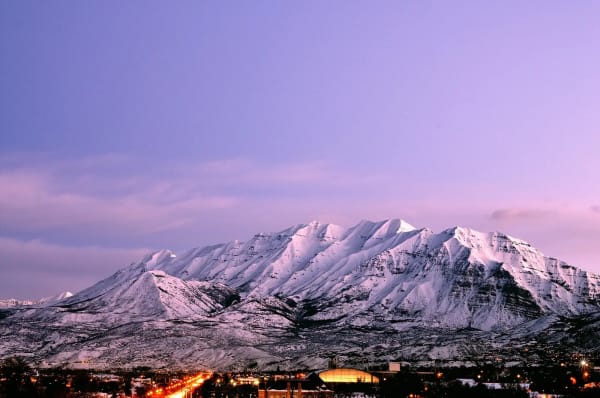

Utah Valley uses the name constantly. A mountain, a cave system, a high school, a hospital, a school district, a storytelling festival. Most people here say Timpanogos several times a month without ever having been told who the Timpanogos were.
The short answer is that they were the people who lived here — around the lake, along the rivers, up into the canyons — when the first Europeans wrote anything down about this valley, and when Mormon settlers arrived in 1849 to stay.
The longer answer includes two episodes of violence within thirteen months of that arrival, and a question about identity that courts, scholars and the tribe itself still answer differently. This page tries to lay out what is documented, and to be honest about what is not settled.
Before the name was a mountain
When the Spanish Dominguez–Escalante expedition came through in 1776 — the first European party to record this valley — they found a substantial population living around the lake and described them favorably.
The expedition recorded several names. Lagunas, meaning lake people, for their relationship to the water. Forms of Timpanogotzis. Other variants appear across later sources: Timpanogot, Timpannah, Timpiavat.
The name attached to the geography before it attached to the peak. Utah Lake was Lake Timpanogos. The river carried the name. Only later did it settle onto the mountain that now dominates every photograph taken in this valley.
Their territory was not small. Accounts place it running from Utah Lake east toward the Uinta Mountains and south into what is now Sanpete County — and by the time settlement began they were among the principal Native groups of the region by population, territory and influence.
Why Utah Valley specifically
The valley was not incidental to them. It was among the best places to live in the Great Basin, and the reason is the water.
Utah Lake is a large freshwater lake in an arid region, and it supported an enormous fishery. Several rivers descend from the Wasatch into it, running year-round from snowmelt. The canyons behind provided timber, game and summer range. The valley floor produced plant foods.
The fishery is the key. A reliable protein source at this scale allowed a more settled pattern of life than the surrounding desert supported. This is why the Spanish met a substantial population here rather than a small mobile band, and it is why the valley was worth fighting over.
It is also, precisely, why the settlers wanted it. Two peoples wanted the same water and the same fish, and the ecology could not carry both. Our Utah Lake guide covers what that lake is now; it was a different body of water then.
The identity question, which is not settled
Here the page has to slow down, because this is disputed and the dispute has stakes.
The scholarly and governmental position has generally classified the Timpanogos as Ute. Reference sources note the classification while acknowledging real difficulty — their language has been hard to place, much surviving communication happened in Spanish or English, and their leaders spoke several Numic dialects. Those same sources concede they may have been a Shoshone band, since other Shoshone bands occupied parts of Utah.
The Timpanogos Nation's own position is unambiguous and different. It states that it is Snake-Shoshone, that it descends from a named line of chiefs including Walkara, Kanosh, Tabby, Arropeen, Black Hawk, Tintic, Sowiette and Sanpitch, and — directly — that the term "Utah Indian" does not mean "Ute Indian."
We are not going to resolve that here, and we would be wrong to try. What we can say is why it matters. This is not a labeling preference. The tribe's argument is that the Uintah Valley Reservation was set aside for Shoshone people rather than for Utes, and that argument runs underneath claims about land, water and hunting rights. Identity is the foundation the legal claims stand on.
Battle Creek, 1849
The first violence came in early March 1849, at what is now Pleasant Grove.
A company of Mormon men went into Utah Valley over cattle taken from the Salt Lake Valley — two peoples competing for the same resources in a hard season. Brigham Young's instruction, as recorded, was to take such measures as would put a final end to the depredations in future.
The encounter that followed is known as the Battle Creek massacre, and it gave Pleasant Grove's canyon and creek their names. It happened before the settlement of Utah Valley proper: days later, Young ordered families to colonize the valley, with John S. Higbee presiding.
The sequence is worth holding onto. The killing came first, then the settlement.
Fort Utah, 1850
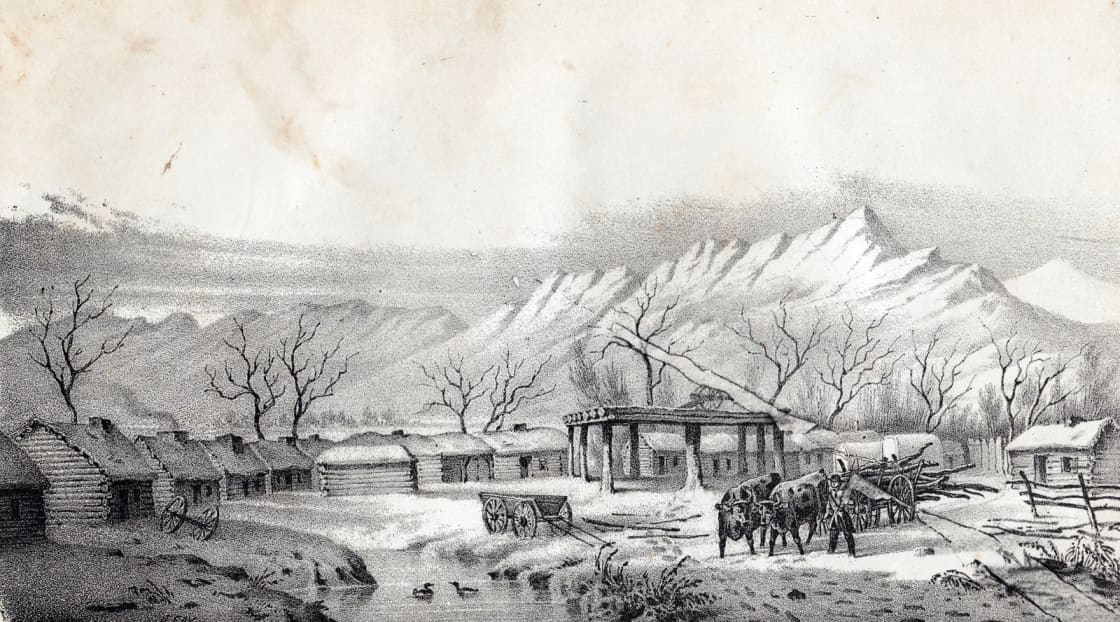
The second and larger episode came the following winter, and it happened inside what is now Provo.
In February 1850, after continued disputes over cattle and a winter of hunger, a Mormon militia force surrounded a Timpanogos encampment on the Provo River and laid siege, using firearms and a cannon.
The recorded outcome: many Timpanogos killed, with accounts of the numbers varying, and casualties among the militia as well. Two groups fled overnight — one south, one east into Rock Canyon — and both were pursued and captured, and the men among them executed. Women, children and a few men were taken prisoner to Fort Utah and later moved north to the Salt Lake Valley.
Even the name is contested. It appears in sources as the Battle at Fort Utah, the Fort Utah Massacre and the Provo River Massacre. Which name a source uses tells you a good deal about how it understands the event.
The geography should land for anyone who lives here. This happened on the Provo River, and the pursuit went into Rock Canyon — a canyon thousands of people hike and climb every year, almost none of whom have been told.
The Black Hawk War
The longer conflict came fifteen years later and reached far beyond this valley.
Utah's own state history encyclopedia calls the Black Hawk War the longest and most destructive conflict between pioneer settlers and Native people in Utah history. The conventional start date is 9 April 1865, in Manti, where a dispute over cattle killed and eaten by starving Indians escalated when a settler — described in the state's account as irritated and apparently inebriated — pulled a young chieftain from his horse.
The delegation left promising retaliation. Within days, Antonga Black Hawk and others had killed five settlers and driven off hundreds of cattle. The fighting spread across central and southern Utah and continued for years.
A note on the name, because it confuses people: this is unrelated to the 1832 Black Hawk War in Illinois and Wisconsin. Different conflict, different continent-side, different Black Hawk. They share only a name.
The standard modern scholarly treatment is by the historian John Alton Peterson, whose work is the starting point for anyone reading seriously about it.
What happened after
The outcome was removal. Native people across Utah were pressured onto reservation land, and for the people of this valley that meant the Uintah Valley Reservation in the Uinta Basin — established by executive order in the 1860s, east of the mountains and away from the lake.
The population loss across this period was severe, through violence, displacement, hunger and introduced disease. Figures cited vary widely by source and by definition, and this page is not going to assert a number it cannot stand behind.
What is not in dispute is the direction. A people who were the principal population of this valley in 1847 were substantially gone from it within a generation, and the valley filled with settlements that took their names from the geography the Timpanogos had named.
The recognition dispute, as it stands
Descendants are still here, and the legal question is still open.
The group asserting itself as the Timpanogos Nation is not on the Bureau of Indian Affairs list of federally recognized tribal entities. It has pursued acknowledgment through the Department of the Interior's process and has litigated related claims in federal court.
Those cases have not gone its way. Federal courts addressing hunting and fishing rights on the Uintah and Ouray Reservation noted the group's non-recognized status and dismissed the claims — one district judge doing so explicitly on that basis, an earlier ruling holding that administrative remedies had to be exhausted first. Reporting at the time described several hundred Timpanogos members living on the reservation and unable to obtain permits from the Ute Indian Tribe, which administers them.
Federal recognition is not a formality. It determines sovereignty, eligibility for services, and standing to bring claims at all. A group without it can be simultaneously acknowledged by historians as descending from a real people and unable to act as a tribe in law — which is roughly where this stands, and it is why an attorney in one of these cases described the outcome as leaving his clients without an identity.
We are documenting this as contested because it is contested. The tribe's position, the scholarly consensus and the courts' holdings do not agree, and a local guide that flattened them into one clean sentence would be misinforming its readers about the state of the question.
The legend that is not a legend
Many people who grew up in Utah Valley learned a story about a maiden and a chief and the shape of the mountain.
That is not Timpanogos history. It was written by a BYU track coach in 1922, and our guide to the legend of Timpanogos covers who wrote it, why, and how it spread so completely.
It is worth naming the harm rather than treating it as a curiosity. A fabricated romance occupies the cultural space where the actual history of a people should be. Ask most residents what they know about the Timpanogos and you will get the invented story, not Battle Creek or Fort Utah. The legend did not just fill a gap — it made the gap comfortable.
The names that survive, and what they were attached to
A surprising amount of Utah's map is Timpanogos vocabulary, and most of it is used by people with no idea of the reference.
Timpanogos itself covers a mountain, a cave system, a high school in Orem, a hospital, a school district taking effect with the Alpine district's split, and a storytelling festival. Utah — the state's own name — derives from the same family of terms the Spanish recorded for the people here, which is why the phrase "Utah Indian" appears in nineteenth-century documents and why the Timpanogos Nation is at pains to say it did not mean Ute.
Individual leaders are on the map too. Tintic, whose name attaches to a mining district and a valley west of here. Sanpitch, in the Sanpete Valley and the Sanpitch Mountains. Walkara — anglicized to Walker — in Walker Lane and other features. Kanosh, a town in Millard County. Sowiette, in a Provo park.
These were people. The park is named after a man who was alive when this valley changed hands, and almost nobody who parks there knows that.
The leadership, and why the genealogy is disputed too
The Timpanogos Nation traces itself through a named line of chiefs and describes them as a royal bloodline: Sanpitch, Walkara, Arapeen, Tabby, Ammon, Sowiette, Kanosh, Grospeen, and Antonga Black Hawk.
Some of these names are among the best-documented Native figures in nineteenth-century Utah. Walkara was a formidable and widely known leader, trader and raider whose activities ranged far beyond this valley. Sowiette is remembered in settler accounts as having argued against attacking the settlements. Antonga Black Hawk led the war that carries his name.
The relationships between them are contested, along with everything else. The tribe presents a specific genealogy in which most of these figures were brothers, sons of a leader remembered as Moonch or Old Elk, and in which Black Hawk was a nephew to several of them. Independent writers working on this material have also raised chronological objections to some standard accounts — arguing, for instance, that the timeline conventionally attached to Black Hawk does not fit all the events he is credited with.
We record the tribe's account as the tribe's account, and note that it is not universally accepted. What is not in doubt is that these were real people who led real communities through the destruction of their world.
Why there was never a treaty that settled it
One structural fact explains a great deal about the modern legal situation, and it is easy to miss.
The United States never ratified a treaty with the Native people of Utah Valley that resolved title to this land. A treaty was negotiated in the 1860s — the Spanish Fork treaty — and the Senate did not ratify it. What followed instead was executive action: the reservation in the Uinta Basin was established by executive order, and removal proceeded regardless of the treaty's fate.
That matters now because treaties are the foundation of most tribal legal claims in the United States. A tribe with a ratified treaty has a document to point at. A tribe whose treaty was never ratified is arguing from aboriginal title, executive orders and historical continuity — a harder case in every respect.
It is a substantial part of why the Timpanogos Nation's claims have run into difficulty in federal court, and why its route to recognition runs through the Interior Department's administrative process rather than through enforcing an agreement. The land changed hands without the legal instrument that usually records such a change, and the absence of that paper is still doing work a century and a half later.
Where to learn more, and how to read it
Read the tribe's own material. The Timpanogos Nation maintains a website presenting its position in its own words. Whatever the legal status, a people's account of themselves is a primary source.
Read the scholarly and state material. Utah's state history resources, including the Utah History Encyclopedia's treatment of the Black Hawk War, are online and free. Peterson's work is the standard modern history.
Visit the institutions. BYU's Museum of Peoples and Cultures is the campus archaeology and world-cultures museum, and the Hutchings Museum in Lehi holds regional material. Our museums guide covers both.
And read them against each other. On a question where the sources disagree, reading only one is how people end up confident and wrong.
Standing where it happened
Most of these places carry no marker.
The Provo River runs through the middle of the city. Rock Canyon is a busy trailhead. The Fort Utah site is a park with a replica fort. People use all of them daily, for ordinary reasons, and there is nothing wrong with that.
But there is a difference between not knowing and knowing. Once you know that people were pursued into Rock Canyon and killed there in the winter of 1850, the canyon does not stop being a place to hike. It becomes a place to hike that also happens to be that.
That is the modest thing this page is asking for: not solemnity, but accuracy — the willingness to say who was here, what happened to them, and that the argument about their descendants is still going on.
Related Guides
- The Legend of Timpanogos
- Provo History
- Museums in Provo
- Hutchings Museum, Lehi
- Utah Lake Guide
- Pioneer Day Explained
Frequently Asked Questions
Who were the Timpanogos?
Were the Timpanogos Ute or Shoshone?
What happened at Fort Utah in 1850?
Is the Timpanogos Tribe federally recognized?
What was the Black Hawk War in Utah?
Why is the mountain called Timpanogos?
Where can I learn about this history in Utah Valley?
What should I know before visiting sites connected to this history?
Sources
The facts in this guide were checked against these sources. Hours, fees and rules change, so confirm anything time-sensitive with the source before you go. How we make Provo.com.
- A History of Utah's American Indians, Chapter 5, Utah Division of State History (History to Go). Checked October 12, 2026.
- Black Hawk War (Utah History Encyclopedia), Utah Division of State History (History to Go). Checked October 12, 2026.
- Historic Provo: Fort Utah, Provo City Library. Checked October 12, 2026.
- The Legend of Timpanogos, National Park Service. Checked October 12, 2026.