During the Depression, the Civilian Conservation Corps put tens of thousands of young men to work in Utah's mountains, deserts and parks. They built roads, trails, dams and telephone lines, fought fires and reseeded rangeland, and a good deal of that work is still in use: a swinging bridge over the San Rafael River, the road over Hell's Backbone, Zion's South Entrance. The first CCC camp in Utah was in American Fork Canyon, and Utah County's history records a long list of local projects. This guide covers what the crews did in Utah County and statewide, and where you can see the work now.
Quick facts
| Question | Answer | Source |
|---|---|---|
| Years in Utah | May 1933 to July 1942 | Utah History Encyclopedia |
| Camps | 116 at various times, in 27 of 29 counties; usually 30 to 35 at once | Utah History Encyclopedia |
| Utah men employed | 22,074: 16,872 junior enrollees, 746 Indian enrollees and 4,456 supervisory staff | Utah History Encyclopedia |
| Men from other states | 23,833 on Utah projects | Utah History Encyclopedia |
| Pay | $30 a month, $25 of it sent home | Utah History Encyclopedia |
| Spent in Utah | Nearly $53 million | History of Utah County |
| First camp | About 10 miles up American Fork Canyon; barracks begun May 17, 1933 | History of Utah County |
How it worked
In Utah, historian Kenneth W. Baldridge wrote in the Utah History Encyclopedia, the camps were split among the federal agencies that directed the work:
- Forest Service, 47 camps: canyon loop roads, trails and telephone lines.
- Division of Grazing, 24 camps: erosion control and reservoirs.
- Soil Conservation Service, 8 camps: range reseeding.
- National Park Service, 7 camps: mostly in Zion and Bryce Canyon.
- Bureau of Reclamation, 6 camps: irrigation work, including Midview Dam in the Uinta Basin.
Enrollees earned $30 a month and sent $25 of it home. Baldridge figures that the wages of Utah enrollees and local experienced men put more than $125,000 a month into the state's economy.
The crews were also an emergency force. A 5,500-man fire brigade fought forest fires; in 1934 alone the CCC logged nearly 12,000 man-days on fires, more than a quarter of its firefighting time over nine years. In the winter of 1936 to 1937, crews hauled feed 35 miles to save sheep near Vernal, and a relief caravan from a St. George camp carried 12 tons of feed 52 miles to Little Tank, Baldridge writes.
In Utah County
Richard Neitzel Holzapfel's History of Utah County gives the local record:
- The first camp. About ten miles up American Fork Canyon, where construction of two barracks began on May 17, 1933, with 40 enrollees. It was the first CCC camp completed in Utah.
- Range and hillsides. A 1933 pilot range-reseeding program in Sheep Creek, between Spanish Fork and Springville, succeeded, and mountain contour terracing was finished in Little Rock Canyon near Provo the same year. The Forest Service supervised erosion-control work on the Wasatch slopes above the valley.
- Water. Preliminary work began in 1933 on Deer Creek Dam and the Provo River Project.
- Timpanogos Cave. Crews built a trail from the middle of the Timpanogos Cave Trail around the cliffs to the entrance of Hansen Cave, finished in 1936. Our Timpanogos Cave history, drawing on the Park Service's administrative history, describes a messier, staged trail record.
- Community work. Enrollees helped with a volunteer project at Pleasant Grove Elementary School, prepared grounds and planted lawns at Mutual Dell, the church campground in American Fork Canyon, and with BYU installed 5,000 feet of pipe for a sprinkler system at Aspen Grove.
- A city camp. Provo had the only "metropolitan area" camp in Utah, supervised jointly by the National Park Service and the city. In 1934, Provo received the largest allotment of CCC workers among Utah Valley communities.
On the lakeshore, Utah State Parks says local boaters wanted a launch they could use all year, and "in 1933, an application requesting the help of the Civilian Conservation Corps was made." A marina was completed within a few years, Provo City then built shoreline picnic and camp facilities, and the site opened as Utah Lake State Park in 1967.
Where you can still see the work
Drive times are OpenStreetMap (OSRM) routing estimates from downtown Provo without traffic, rounded to the nearest 5 minutes.
| Place | What the CCC did | Source | From Provo |
|---|---|---|---|
| Utah Lake State Park, Provo | Marina, after a 1933 request for CCC help | Utah State Parks | About 5 miles, 10 min |
| Timpanogos Cave, American Fork Canyon | Trail section to Hansen Cave, finished 1936 | History of Utah County | About 19 miles, 30 min |
| San Rafael Swinging Bridge, Emery County | 160-foot suspension bridge, 1937 | Bureau of Land Management | About 130 miles, 3 hr 35 min |
| Hell's Backbone Road, Garfield County | Road between Escalante and Boulder, completed 1933 | Living New Deal | About 207 miles, 4 hr 15 min (to Boulder) |
| Zion National Park | South Entrance Station, South Campground amphitheater, Canyon Junction dam, Watchman Trail | National Park Service | About 265 miles, 4 hr 35 min (to the visitor center) |
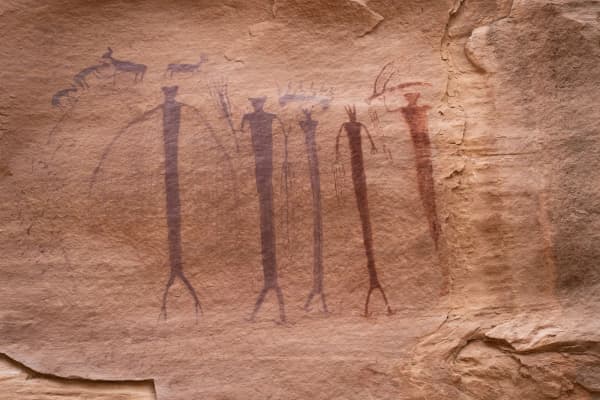
The San Rafael Swinging Bridge. The BLM calls it "Utah's oldest intact suspension bridge," built by the CCC in 1937 and used until the bridge beside it was built in 1990. It stands at the BLM's San Rafael Swinging Bridge Campground, where Buckhorn Wash meets the San Rafael River; campsites are $15 a night with a 14-day limit and no drinking water. Our Buckhorn Wash guide covers the rock art panel up the road.
Hell's Backbone. The Living New Deal project, which documents New Deal public works, says the CCC set up camp FS-18 on Escalante Mountain in 1933 and completed the road in September 1933, allowing vehicle traffic between Escalante and Boulder for the first time. Hell's Backbone Bridge carries the road over Sand Creek. The Utah History Encyclopedia says CCC crews built roads around Boulder from 1933 to 1941. Our Scenic Byway 12 guide covers the paved route between the two towns.
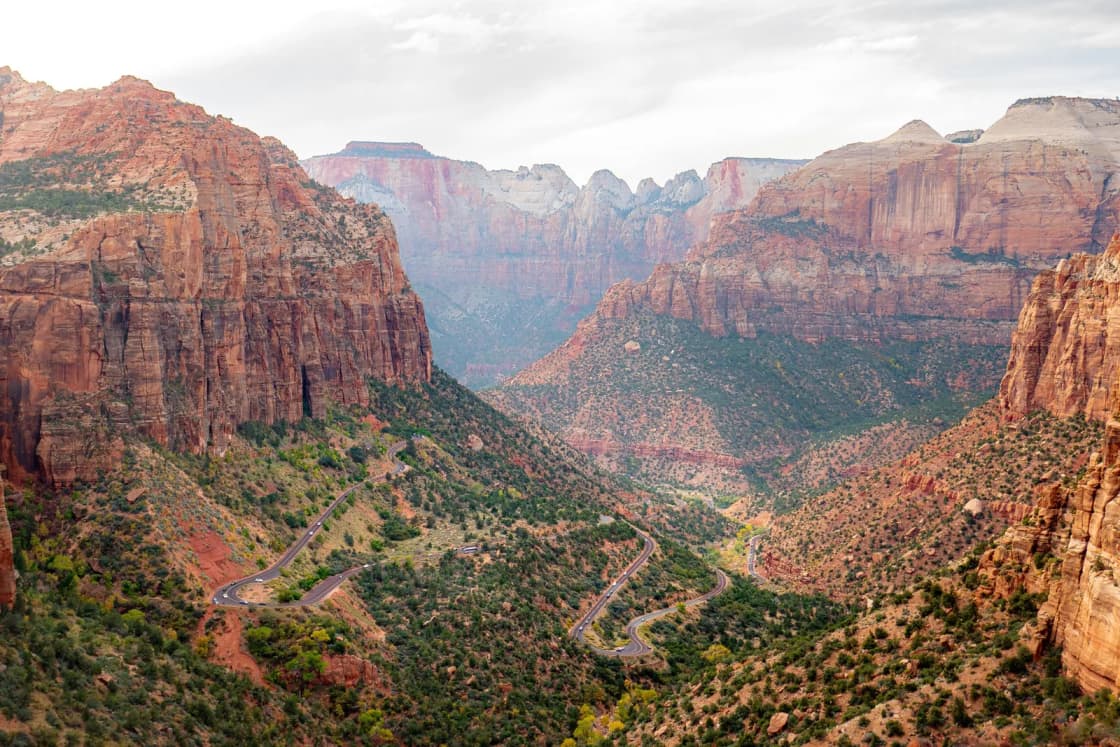
Zion. The Park Service's page on the CCC in Zion lists the South Entrance Station, built about 1934 and still in use; the South Campground amphitheater, finished in 1935; trees and irrigation ditches in South Campground; a 1936 diversion dam on the Virgin River, now called the Crawford Dam, at Canyon Junction; slope grading on the Nevada Switchback of State Route 9 below the Zion-Mount Carmel Tunnel, about 1938; and the Watchman Trail, entrance monuments, park housing, flood-control structures and retaining walls. Zion's camps were NP-1 at Blue Springs on the Kolob Terrace (1933), NP-2 on the west side of the Virgin River (1934) and NP-4, Bridge Mountain Camp, on the east side (1934 to 1935); the Park Service places the canyon camps near today's South Campground and Watchman Housing. In summer the men moved to Bryce Canyon's NP-3, and a seasonal stub camp worked at Cedar Breaks, the Park Service says.
How it ended
The CCC folded in July 1942. With the country at war, the Depression was over, Army officers were reassigned and most camp personnel went into the armed services or defense work, Baldridge writes. The Salt Lake Tribune's editorial of July 3, 1942, said of the program: "More than all else it aided youth to get a new grip on destiny."
Related reading
- Timpanogos Cave: discovery, the CCC trail story and the cave's name
- Deer Creek Dam and the Provo River Project
- Utah Lake State Park
- American Fork Canyon
- The history of skiing in Utah and the first resorts
- Zion and St. George from Provo
- Provo history
Frequently Asked Questions
When was the Civilian Conservation Corps in Utah?
How many CCC camps were in Utah?
Where was the first CCC camp in Utah?
What did the CCC build in Utah County?
What did the CCC build in Zion National Park?
Did the CCC build the San Rafael Swinging Bridge?
How much were CCC workers paid?
Sources
The facts in this guide were checked against these sources. Hours, fees and rules change, so confirm anything time-sensitive with the source before you go. How we make Provo.com.
- The Civilian Conservation Corps (Kenneth W. Baldridge, Utah History Encyclopedia, 1994), Utah Historical Society, History to Go. Checked November 27, 2026.
- "Alphabet" Agencies in Utah County (Richard Neitzel Holzapfel, A History of Utah County), Utah Historical Society, History to Go. Checked November 27, 2026.
- CCC Camps in Utah, National Park Service, Zion National Park. Checked November 27, 2026.
- The CCC: Then and Now, National Park Service, Zion National Park. Checked November 27, 2026.
- San Rafael Swinging Bridge Campground, Bureau of Land Management. Checked November 27, 2026.
- Utah Lake State Park: Discover, Utah State Parks. Checked November 27, 2026.
- Hell's Backbone Road, Boulder UT, The Living New Deal. Checked November 27, 2026.