
The 2002 Winter Olympics were a construction project as much as a sporting event: the Oval, the Utah Olympic Park and the ice arenas, and they came alongside a wave of highway and transit work. The 2034 Games are designed to be the opposite. Utah won them on reuse, and the organizers' plan builds almost nothing new. That changes the question for Utah Valley. The effect here will be smaller, later and more concentrated than in 2002, and much of what people attribute to "the Olympics" will be regional growth that would have come anyway. This is the eight-year read on what 2034 does, and does not do, to housing, traffic and jobs in Utah County.
Jobs and money: a statewide lift, late
In July 2024 the Kem C. Gardner Policy Institute estimated that hosting would bring $2.6 billion in net new direct spending to Utah from 2024 through 2034. Run through the institute's economic model, that becomes $6.6 billion in total economic output, about $3.9 billion in gross domestic product, $2.5 billion in personal income and 42,000 job-years of employment.
Three things matter about those numbers for Utah Valley:
- They are statewide. The study does not break out Utah County, and nearly all the venues are in Salt Lake City and the mountains.
- They arrive late. About two-thirds of the impact comes during the Games themselves. The institute's director described a crescendo: little spending in the early years, then a sharp rise through 2032, 2033 and 2034.
- They are estimates. The 2002 Games cost $4.3 billion, including $2.2 billion in construction, and the institute puts their total impact at $7.5 billion in today's dollars. The 2034 figure is lower largely because so little is being built. Not every economist accepts such estimates; the Salt Lake Tribune quoted one who doubted this one.
Organizers said the budget, about $2.83 billion to run the Games and close to $4 billion with legacy funding and shared revenues, would be privately raised, largely from sponsorships, broadcast rights and tickets. They budgeted $31.2 million for permanent capital investments, against $286.7 million in today's dollars in 2002, plus $206.2 million for temporary infrastructure, signs and wayfinding.
Traffic and transit: the train is the real story
The IOC's summary of the plan says no additional transport infrastructure is being built for the Games. The biggest transit change in Utah Valley's future is a regional project that officials openly tie to 2034: FrontRunner 2X.
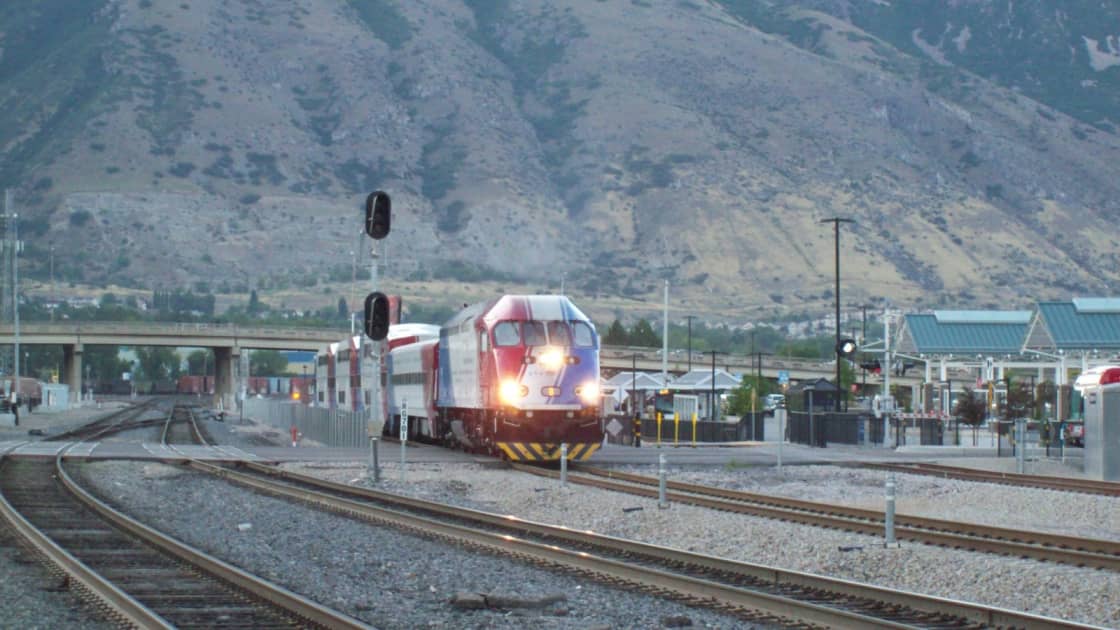
FrontRunner runs every 30 minutes at peak times now, because most of its line between Ogden and Provo is single track. The 2X project adds 26.1 miles of double track in 11 places, including a short but important segment north of Provo, along with a new station, 10 trainsets and a maintenance facility. When it is done, trains are planned every 15 minutes at peak times and every 30 minutes all day.
In August 2026 the Federal Transit Administration moved the project into the engineering phase of its grant program, a step toward nearly $1.3 billion in federal funding. Construction is anticipated from 2027 through 2030, subject to finishing that process; entering engineering is not the same as having the money. If the schedule holds, Utah Valley would have 15-minute trains for three or four years before the Games. For how FrontRunner works from here now, see FrontRunner From Provo.
At Games time, the most visible local traffic will be around Peaks Ice Arena in Provo, which is planned as an Olympic hockey venue. Expect game-day crowds along Seven Peaks Boulevard and the east Provo streets around it for the hockey days of February 2034.
Housing: not an Olympic program
No Olympic housing is planned in Utah Valley. The athletes' village is at the University of Utah, as in 2002, and the bid secured 21,000 hotel rooms years ahead of the Games. Visitors are likely to fill hotels and short-term rentals during the Games weeks, including in Utah County near FrontRunner and Peaks Ice Arena.
What the Olympics will not do is set Utah County's housing prices. Those are driven by growth: the Gardner Institute's comparison of 2002 and 2034 expects a Utah that is larger, older and more diverse, with an economy nearly twice the size it was in 2002. For what housing costs here now, see What Rent Actually Costs in Provo and the Cost of Living in Provo.
The eight-year calendar
- 2024: Utah elected host on July 24.
- 2026: FrontRunner 2X enters the federal engineering phase in August.
- 2027 to 2030: FrontRunner 2X construction, if the grant is completed.
- 2030: the target for 15-minute FrontRunner service.
- 2032 to 2034: the spending crescendo the Gardner Institute expects.
- February 10 to 26, 2034: the Olympic Winter Games, with the Paralympic Winter Games to follow.
What to watch
- The federal grant. FrontRunner 2X needs its full funding agreement.
- The venue plan. It has already changed once, when hockey moved to the Delta Center.
- Peaks Ice Arena. It is Utah County's one competition venue.
- The volunteer call. See Volunteering for 2034.
Related Guides
- The 2034 Winter Olympics: Every Venue
- Volunteering for 2034
- Utah Valley's Olympians
- FrontRunner From Provo
- Getting Around Provo: FrontRunner, UTA and Commuting
- Peaks Ice Arena
- What Rent Actually Costs in Provo
Frequently Asked Questions
How much will the 2034 Olympics add to Utah's economy?
Will the 2034 Olympics build new roads or housing?
Will FrontRunner run every 15 minutes before the Olympics?
Who pays for the 2034 Olympics?
When will Utah Valley feel the Olympics?
Where is the 2034 athletes' village?
How many hotel rooms did the 2034 bid secure?
What is FrontRunner 2X?
Sources
The facts in this guide were checked against these sources. Hours, fees and rules change, so confirm anything time-sensitive with the source before you go. How we make Provo.com.
- FrontRunner 2X advances to final phase of process for nearly $1.3 billion federal grant, Utah Department of Transportation. Checked October 12, 2026.
- Milestone for Utah's FrontRunner 2X Commuter Rail, Federal Transit Administration. Checked October 12, 2026.
- FrontRunner 2X Project Profile, Federal Transit Administration. Checked October 12, 2026.
- FrontRunner 2X, UTA/UDOT. Checked October 12, 2026.
- Olympics and Paralympics in Salt Lake City, Salt Lake City Mayor's Office. Checked October 12, 2026.