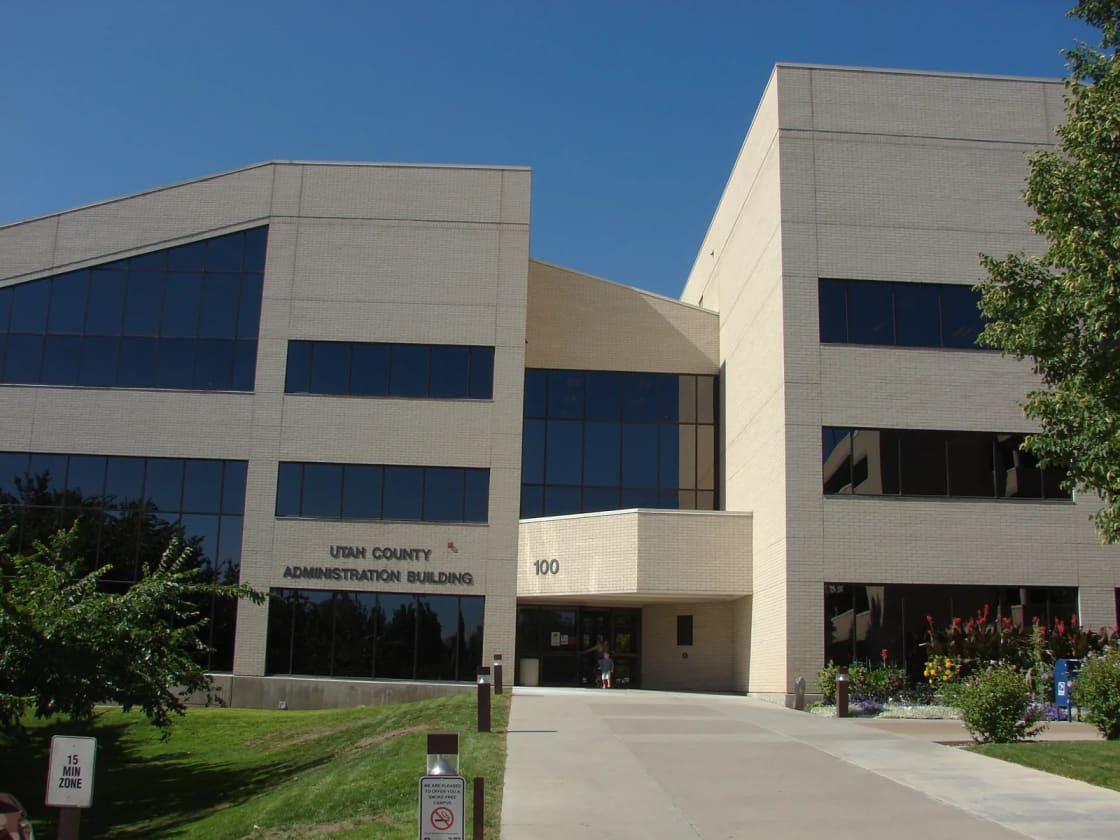

Provo residents can usually name their mayor. Very few can name a single county commissioner — and the county commission decides a category of things that the city cannot touch.
Three people run Utah County. Not seven, not fifteen. Three.
The structure, and why three is the number that matters
Utah County is governed by a three-member Board of County Commissioners serving staggered four-year terms.
The staggering is deliberate: seats turn over at different elections so the entire board cannot be replaced in a single cycle. It buys institutional continuity at the cost of making the board slower to change direction.
The more consequential feature is the number itself, and specifically that a commission form combines the executive and legislative functions. The same three people write county ordinances, adopt the budget, and supervise the departments that carry both out.
Compare this with how Provo works, where an elected mayor runs the administration and a separate seven-member council legislates, with a veto and an override sitting between them. Provo's structure is built around friction. The county's is built around speed.
Neither is inherently better. But three-person governance has arithmetic that a larger body does not:
- Two is a majority. Any two commissioners can adopt a budget, pass an ordinance or set policy.
- Two is also a quorum. Which means two commissioners discussing county business informally can raise open-meeting questions that would not arise if the same conversation happened between two members of a seven-person council.
- There are no coalitions, only pairs. On a larger body, a minority can organize, negotiate and occasionally assemble a majority. On a three-member board, a commissioner who is outvoted is simply outvoted.
Each commissioner also holds an assigned portfolio of departments to oversee. Recent published assignments have distributed departments across areas including the Children's Justice Center, the Assessor, the County Attorney's Office, the county Justice Court and the Clerk's Office in one portfolio; the Clerk, Auditor and Information Systems in another; and Public Works, Community Development and the Treasurer in a third.
Two cautions about that. The published descriptions overlap in places, which suggests either shared oversight or documentation that has not fully caught up. And assignments change when the board changes. Confirm the current portfolio before routing anything that matters.
What the commission controls
This is the part worth committing to memory, because misdirected effort is the default outcome here.
The jail and the sheriff. County corrections and countywide law enforcement are county functions. Your city police department is not the sheriff, and the sheriff does not answer to your mayor.
Roads outside city limits. County roads, not city streets. If the road is inside Provo, it is Provo's — and if it is a state route running through Provo, it is UDOT's. That three-way split explains a lot of confused complaints about who is supposed to fix a given stretch of asphalt.
Public health. The county health function covers a wide range, including the vehicle emissions program that determines whether you can renew your registration. Utah County is one of a few Utah counties operating an emissions program, and the rules are set at county level rather than by the state — which is precisely why car ownership in Utah Valley works differently here than it does two counties south.
The justice court, and county-level judicial administration. Distinct from the state district court, which handles a different tier of cases entirely. Which court has your matter is covered in the Utah County courts guide.
Unincorporated land use. Land that is not inside any city is governed by the county — its zoning, its development approvals, its building permits. This is why the same project can be a county decision or a city decision depending on an invisible boundary.
The countywide budget. Everything above is funded here, and the budget is where the commission's power is least visible and most complete.
What it does not control
Your building permit. Your business license. Your utility bill. Your street's plow route. Your city's code enforcement. Your municipal election. All of those belong to the city you live in.
And, importantly, elections are not the commission's. Ballots, the voter roll and certification belong to the separately elected County Clerk. The commission funds that operation, which is a genuine form of influence, but it does not run it.
2026: two of three seats
Utah County's staggered terms put two of the three commission seats on the 2026 ballot, which is a majority of the board in a single election.
Two developments are already on the public record. Commissioner Amelia Powers Gardner did not appear on the June 2026 Republican primary ballot for either seat. And Michelle Kaufusi, who served as Provo's mayor from January 2018 until January 2026, filed for commission Seat A shortly after leaving city office.
We are deliberately not publishing a candidate list. Filing periods, primaries and withdrawals reshape a field repeatedly, and a candidate list on a guide page is stale almost immediately and then keeps being read. The county elections office is the authoritative source, and our voting guide covers how to get a ballot and what the deadlines are.
What is worth saying is structural rather than electoral: a two-seat election on a three-seat board is a control election. Whoever wins those two seats can, between them, adopt a budget and pass an ordinance. Turnout in county races is routinely a fraction of turnout in the presidential race at the top of the same ballot, which means a small number of voters decide it.
How to follow it, and how to be heard
The commission holds regular public meetings. Agendas and minutes are prepared and kept by the County Clerk's office, which is the same office that runs elections and issues marriage licenses — a duty combination that makes more sense once you notice that all of it is record-keeping.
Two features of Utah's open meeting framework are worth knowing because they change how you should participate:
Agendas must be noticed in advance, and a body generally cannot act on what was not noticed. This is why a matter you care about cannot simply appear and be decided. It also means that getting an item onto an agenda is the real goal, and raising it during general comment is step one rather than the finish line.
Minutes are the durable record. They are what anyone reconstructing a decision reads afterwards, including journalists, residents and future commissions. If you want to know how something happened, the minutes archive is the primary source and everything else is commentary.
For meeting times, locations and the specific public comment procedure, read the current agenda rather than any guide, including this one. Those details move, and the agenda is authoritative about its own meeting.
The habits that work for following Provo City Council transfer directly: subscribe to notices rather than checking, read the packet rather than attending cold, and understand that the substantive discussion frequently happens before the meeting where the vote is taken.
The form-of-government question
Utah law provides a process by which counties can study alternative forms of government and put a change to voters — a county council with a separately elected executive, for instance, or a council-manager arrangement.
Whether a three-member commission is the right structure for a county with more than half a million residents is a question that has been raised in Utah County more than once, and the arguments are not hard to reconstruct. Concentration produces speed and clear accountability; it also means two people can decide anything, and that a single retirement reshapes a majority.
We are not going to tell you how any particular proposal turned out, because we have not verified it to the standard this site uses for civic facts, and study commissions, ballot propositions and their outcomes are described inaccurately in secondary sources with some regularity. If you are researching this, go to the county elections office's own canvassed results for the year in question. An unverified claim about how a county changed — or did not change — its own government is exactly the kind of thing that gets repeated for a decade.
Where county money comes from, and why that shapes everything
You cannot understand a county commission without understanding that its revenue is structurally different from a city's.
A Utah city has a broad toolkit: property tax, its share of sales tax, utility revenue where it runs its own utilities, franchise fees, and a wide range of permit and service charges. Provo runs its own power utility, which is unusual and which gives the city a revenue and operational profile most municipalities do not have.
A county's toolkit is narrower and its obligations are less discretionary. Counties carry statutorily mandated functions — corrections, elections, courts administration, public health, the assessment and collection machinery for property tax across every city inside the county. Those are not programs a commission can decide to stop doing when revenue tightens. They are the job.
The result is a budget with a large mandatory core and a comparatively small discretionary margin, which explains something residents often find baffling: why a county with a substantial total budget can seem unable to fund a specific improvement. Most of the money arrived attached to a duty.
It also explains why property tax generates more heat at the county level than almost any other subject. The county assesses, bills and collects property tax for taxing entities across the county — including cities and school districts whose rates the county does not set. So the county sends the notice for money it does not keep, and receives the complaints for rates it did not choose. Our property tax guide walks the chain of who sets what, which is the least intuitive thing in Utah local government.
Unincorporated Utah County is larger than it looks
When people picture Utah County they picture the cities strung along the valley floor: Provo, Orem, Lehi, Spanish Fork, American Fork.
Most of the county's land is not any of those.
Everything outside a municipal boundary is unincorporated, governed directly by the county rather than by a city. That includes a great deal of mountain and canyon terrain, agricultural land, and pockets of housing that sit between incorporated areas without belonging to any of them.
For residents of unincorporated land, the county is the local government in the ordinary sense — the entity that issues the building permit, sets the zoning, decides a neighbor's development application, and maintains the road. There is no city to appeal to and no mayor to email.
This matters for people who live in cities, too, for two reasons. Development on unincorporated land immediately adjacent to a city affects that city's traffic, schools and services while being decided by a body city residents may not have voted for. And the boundary itself moves: annexation shifts land from county jurisdiction into a city's, changing who decides everything about it. Some of the sharpest local land-use fights in this valley have been fundamentally about which government gets to decide, rather than about the project at all.
Several of the county's smaller towns exist in close relationship with unincorporated land, and the distinction between "in town" and "just outside" is frequently invisible from the road and decisive on paper.
What to ask a commission candidate
Two of three seats are on the 2026 ballot, and county races get a fraction of the scrutiny municipal races do. A few questions do real work:
- Which mandated county function is currently underfunded, and what would you cut to fund it? The county budget is mostly obligations. A candidate who talks only about additions has not read it.
- What is your position on annexation? It determines who governs the fastest-changing land in the county.
- Should Utah County keep the three-member commission form? There is no wrong answer, and there is a revealing non-answer.
- What does your department portfolio oversight involve? Commissioners supervise departments. A candidate who has not thought about which ones is running for a job they have not examined.
- How would you handle being the minority vote on a three-person board? On this body, that is a real and recurring condition, and how a person answers it says most of what you need to know.
The meeting you should attend
If you take one procedural habit from this page, make it this: the meeting where a decision is announced is almost never the meeting where it was made.
On land use, the sequence usually runs staff review, then a planning body recommendation, then the commission's public hearing and vote. By the hearing, the analysis is written, the applicant has negotiated, and the commissioners have read a packet you could also have read. Turning up cold to object is turning up at the end of a process that was open the whole time.
The packet is the lever. It is published in advance with the agenda, it contains the staff analysis and the actual proposal rather than a summary of it, and reading it converts two minutes at a microphone from a complaint into an argument that engages what is in front of the board. Commissioners notice the difference immediately, because almost nobody does it.
Subscribe to the notices. Read the packet. Speak to what is in it.
Practical routing, in one list
When something goes wrong and you do not know whose problem it is:
- Pothole, streetlight, missed collection, water pressure, barking dog, code complaint — your city. In Provo, that is 311 at (801) 852-6000.
- Building permit, business license, zoning inside a city — that city.
- Zoning or a permit on unincorporated land — the county.
- Jail, sheriff, county roads — the county.
- Emissions, restaurant inspections, public health — the county.
- Ballot, registration, marriage license, passport — the County Clerk.
- Deed, mortgage, parcel map, ownership — the County Recorder.
- Property valuation — the Assessor. Tax bill — the Treasurer.
- A court case — the state court system, not the county.
Getting this right the first time is worth an entire morning, and it is the single most useful thing on this page.
The Chapter That Governs All of This Changed Its Number in November 2025
Go looking for the statute that defines a Utah county commission and almost every result you find
will be wrong — not wrong in substance, but wrong in address. Utah recodified the whole of Title 17
through two bills passed in the 2025 First Special Session, SB 1006 and SB 1007, and the new
numbering took effect on November 6, 2025. Chapter 52a, Changing Forms of County Government,
became Chapter 62. The county clerk chapter and the sheriff chapter moved too. Each
renumbered section on the Legislature's site notes its history, which is the most reliable bridge
between an old citation and a live one. If a page you are reading cites
17-52a-201, it was written before November 2025 and nobody has touched it since.
The substance is worth the trouble of finding. Utah Code § 17-62-102(2) says every county shall operate under one of exactly four forms: the county commission form, the expanded county commission form, the county executive and council form, or the council-manager form. Subsection (3) makes the county commission form the default — a county operates under it unless its voters adopt an optional plan.
Section 17-62-201 explains the thing that most surprises people the first time they sit in a commission meeting. Subsection (2) sets the commission at three members. Subsection (3) then says the commission is both the county legislative body and the county executive, holding the powers of a legislative body under Chapter 64 and the powers of an executive under Chapter 65. There is no separately elected county mayor and no council sitting across from one. The same three people write the ordinance, adopt the budget, and then administer both. Terms run four years under Subsection (4)(a).
That structure is changeable, and the statute names who may change it. Under § 17-62-303, registered voters can initiate adoption of an optional plan by petition; under § 17-62-302 the legislative body can start the same process itself. Voters may petition either for a study committee (§§ 17-62-401 through -403) or to adopt a specific optional plan, and a proposed plan goes through county attorney review for conflicts with statute (§ 17-62-405) before finally reaching an election (§ 17-62-501). It is a long road by design. It is also a citizen-initiated one.
What the Open and Public Meetings Act Actually Guarantees You
The commission's obligations to you as a spectator are not courtesy. They sit in Utah Code Title 52, Chapter 4, and they are unusually specific.
Notice. Section 52-4-202(1)(a)(i) requires not less than 24 hours' public notice of each meeting, and Subsection (1)(b) says that notice must include the agenda, the date, the time and the place. A body that publishes a time and place but no agenda has not given notice. Under Subsection (3)(a), the requirement is satisfied by publishing a class A notice under § 63G-30-102, which is what puts county agendas on the Utah Public Notice Website rather than only on a noticeboard. Subsection (5) is the escape hatch: an emergency meeting may disregard the 24 hours if unforeseen circumstances require it, but the body must still give the best notice practicable.
The record. Section 52-4-203(1) requires both written minutes and a recording of every open meeting — not one or the other. The recording must be complete and unedited from commencement through adjournment under Subsection (3)(a). The minutes must name who was present and absent, carry the substance of everything proposed, discussed or decided, and record each vote by individual member — in list format, by category, by name, under Subsection (2)(c). This is why "the commission approved it unanimously" is a claim you can check rather than accept.
Closing a meeting. Under § 52-4-204(1)(a), a closed session requires a quorum, an open meeting for which notice was already given, and a vote of two-thirds of the members present to close it. The reason has to be recorded.
Consequences. Section 52-4-302 makes a final action taken in violation of the open-meeting, notice or electronic-meeting provisions voidable by a court, with a 90-day window to sue — 30 days where the action concerns bonds. Section 52-4-303 puts enforcement on the attorney general and county attorneys, lets any person denied a right under the chapter sue to compel compliance, and allows the court to award attorney fees and costs to a successful plaintiff. The remedy is short- fused and it is real, which is the argument for reading an agenda the day it posts rather than the week after the vote.
Related guides
- What Is on Your Utah County Ballot in November 2026
- The Provo Mayor's Office
- The Utah County Clerk
- Voting in Utah County
- The Utah County Courts, Explained
- Property Tax in Utah County
- Looking Up Property Records in Utah County
- How to Actually Follow Provo City Council
- Utah County's Small Towns
- Who Decides What in Utah Valley — the county's 39 registered notice bodies, and the 25 city governments beside them
- The Utah Caucus System Explained
Frequently Asked Questions
How is Utah County governed?
How many commissioners does Utah County have?
When are Utah County commission seats up for election?
What does the county commission control that the city does not?
Where do Utah County commission meetings happen and can I speak?
Did Utah County ever try to change its form of government?
Who runs elections, the commission or the clerk?
How do I find out which commissioner handles my issue?
Sources
The facts in this guide were checked against these sources. Hours, fees and rules change, so confirm anything time-sensitive with the source before you go. How we make Provo.com.
- Official Ballot for Utah County, June 23, 2026 Republican Ballot, Utah County Elections. Checked October 12, 2026.
- Candidate Information, Utah County Elections. Checked October 12, 2026.
- Utah Code 17-62-201 County commission form of government, Utah Legislature. Checked October 12, 2026.
- Utah Code 17-62-102 Forms of county government, Utah Legislature. Checked October 12, 2026.
- Utah Code 17-62-302, 17-62-303, 17-62-405, Utah Legislature. Checked October 12, 2026.
- Utah Code 52-4-202, 203, 204, 302, 303, Utah Legislature. Checked October 12, 2026.
- S.B. 1006 Title 17 Recodification General Provisions and County Officers; S.B. 1007, Utah Legislature. Checked October 12, 2026.