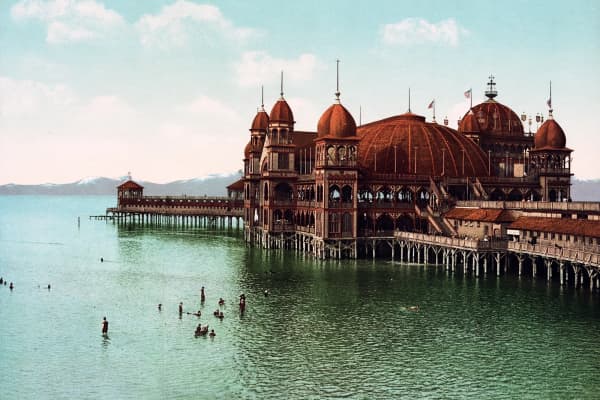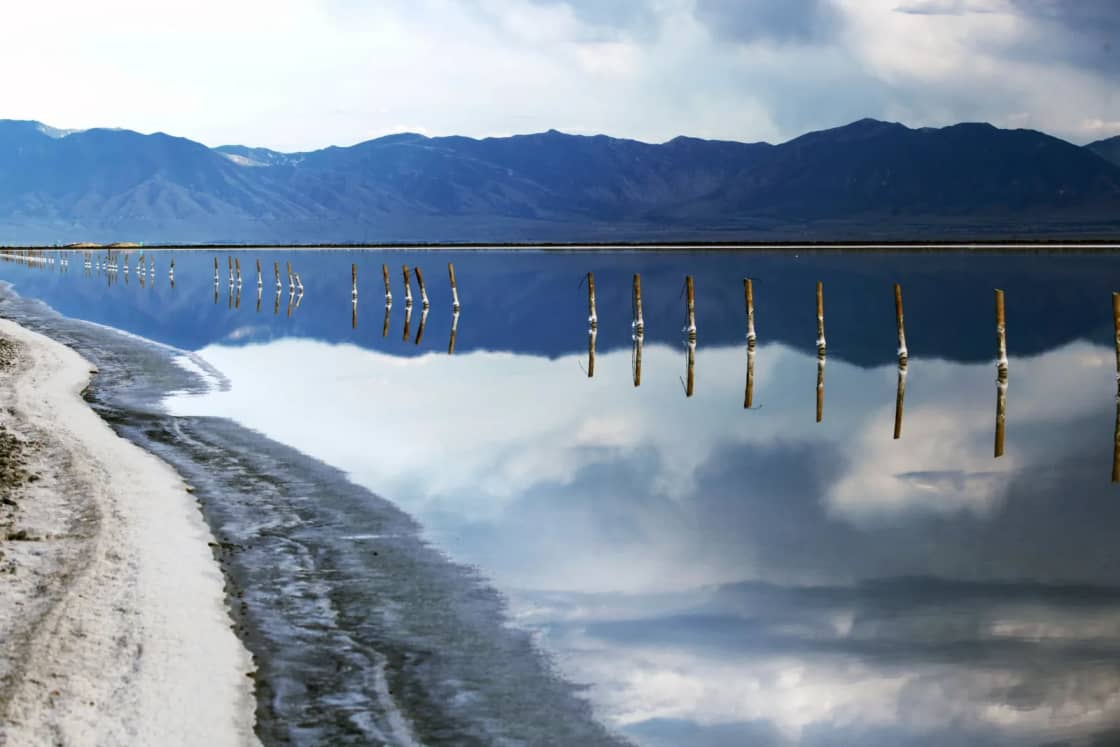
For its first 35 years, the transcontinental railroad in Utah climbed around the north end of the Great Salt Lake and over Promontory Summit. Then the Southern Pacific built straight across the lake on a wooden trestle nearly 12 miles long. The Lucin Cutoff made Promontory a backwater, and the rock causeway that replaced the trestle in 1959 still divides the lake in two. This is the story of the line, the trestle and the causeway, from Utah's county and state histories.
Quick facts
| Question | Answer | Source |
|---|---|---|
| Built by | Southern Pacific, under Edward H. Harriman | History of Box Elder County |
| Length, Ogden to Lucin | 102 miles: 13 miles of fill and nearly 12 miles of trestle across the lake | History of Box Elder County |
| Distance saved | 44 miles, and hundreds of feet of grade | History of Box Elder County |
| Opened | Trestle finished late 1903; freight March 6, 1904; passengers Sept. 18, 1904 | National Park Service; History of Box Elder County |
| Labor and cost | 3,000 men; over $8 million | History of Box Elder County |
| Trestle replaced | 1959, by a rock-filled causeway | Utah Division of Forestry, Fire and State Lands |
| Causeway breach | 2016; 180 feet wide; berm raised 4 feet in July 2022 | Utah Division of Forestry, Fire and State Lands |
Why build across a lake
The 1869 line ran north of the lake and over Promontory Summit. Edward H. Harriman, who controlled the Southern Pacific, judged that the helper engines needed there were expensive and that growing traffic made operating "the steep and crooked old line" increasingly difficult, Frederick M. Huchel writes in his History of Box Elder County. The answer was to go straight west from Ogden across the water.
The finished cutoff ran 102 miles from Ogden to Lucin, near the Nevada line, including 13 miles of fill and nearly 12 miles of trestle across the Great Salt Lake. It saved 44 miles of track and "hundreds of feet in grade," and eliminated the climb over Promontory Summit and a crossing near Kelton, Huchel writes.
Building it
Huchel's numbers give a sense of the job:
- Timber. Something like 25,000 piles were needed, mostly Oregon fir, at about $60 each delivered; 38,256 trees were cut to make them. The railbed took 2 million board feet of redwood decking. A later estimate from Cannon Structures, cited in the history, put the trestle at about 30 million board feet of Douglas fir and 2 million of redwood.
- Machines. 25 steam pile drivers, about 1,000 cars, 80 locomotives and 8 steam shovels.
- People and money. The project "required the labor of 3,000 men" and "cost over $8 million." Crews worked ten-hour shifts, day and night, and paid $4 a week for board.
- The lake bottom fought back. When a trial train crossed the old Bear River bed on March 24, 1903, the embankment settled under it.
The sources date the opening differently, depending on the milestone. Utah's Division of Forestry, Fire and State Lands says the Southern Pacific built the line in 1902. The National Park Service says the trestle was completed across the lake in late 1903. Huchel counts "one and one-half years of actual construction," with freight trains using the cutoff from March 6, 1904, and passenger trains from Sept. 18, 1904.
What happened to Promontory
The old route did not close at once. It "became a secondary line supplying large ranches in the area up until the late 1930s," the Park Service says, with only local runs after 1938. In 1942 the rails were removed and relaid in military depots for the World War II effort. Today Golden Spike National Historical Park marks the 1869 meeting point, about 130 miles and 2 hours 25 minutes from downtown Provo by an OpenStreetMap (OSRM) routing estimate.
From trestle to causeway
The wooden trestle carried trains until the late 1950s. In 1959 it was replaced by a rock-filled causeway with two culverts, the state's Division of Forestry, Fire and State Lands says; the Great Salt Lake Ecosystem Program, part of the Division of Wildlife Resources, says the causeway was built alongside the trestle. The culverts later sank and were filled in, which slowed the flow of water between the lake's north and south arms.
The old trestle outlived its use. Huchel noted in 1998 that Cannon Structures was dismantling it, and the Ecosystem Program says Cannon bought all of the trestle wood in the 1990s and sells it as decorative flooring, walls, cabinets, siding and other materials.
The breach and the berm
In 2016 a 180-foot section was removed to connect them through an open channel, restoring flow between the arms and improving rescue boat access to the north arm, the Division of Forestry, Fire and State Lands says.
By 2022 the flow through the breach had become a concern. With freshwater inflows declining, the north arm's water grew saltier and denser and flowed south along the bottom of the breach, while lighter south arm water rode over it, the division explains. That pushed up salinity in the south arm, which threatens brine shrimp and the migratory birds that feed on them. In July 2022, contractors raised the berm in the bottom of the breach by four feet to reduce mixing, a design meant to limit north-to-south flow while still letting south arm water move north. The state and the U.S. Geological Survey said they would keep monitoring to decide whether more work was needed.
For the salinity numbers themselves, see our guide to why the Great Salt Lake is salty, and for lake levels, what the Great Salt Lake water-level numbers mean.
Related reading
- Utah's railroads beyond the Golden Spike
- Spiral Jetty, Golden Spike and the Promontory day from Provo
- The Sun Tunnels and the west desert
- Antelope Island from Provo
- Ogden from Provo
- The transcontinental railroad at Promontory, 1869
Frequently Asked Questions
What is the Lucin Cutoff?
When did the Lucin Cutoff open?
Why was the Lucin Cutoff built?
What happened to the wooden trestle?
What happened to the railroad over Promontory?
Why was the railroad causeway breached in 2016?
Sources
The facts in this guide were checked against these sources. Hours, fees and rules change, so confirm anything time-sensitive with the source before you go. How we make Provo.com.
- The Lucin Cutoff (Frederick M. Huchel, A History of Box Elder County), Utah Historical Society, History to Go. Checked November 27, 2026.
- Frequently Asked Questions, National Park Service, Golden Spike National Historical Park. Checked November 27, 2026.
- Great Salt Lake Causeway Berm Raised 4 Feet to Protect Salinity Levels (Sept. 22, 2022), Utah Division of Forestry, Fire and State Lands. Checked November 27, 2026.
- Wood (Industries), Utah Division of Wildlife Resources, Great Salt Lake Ecosystem Program. Checked November 27, 2026.