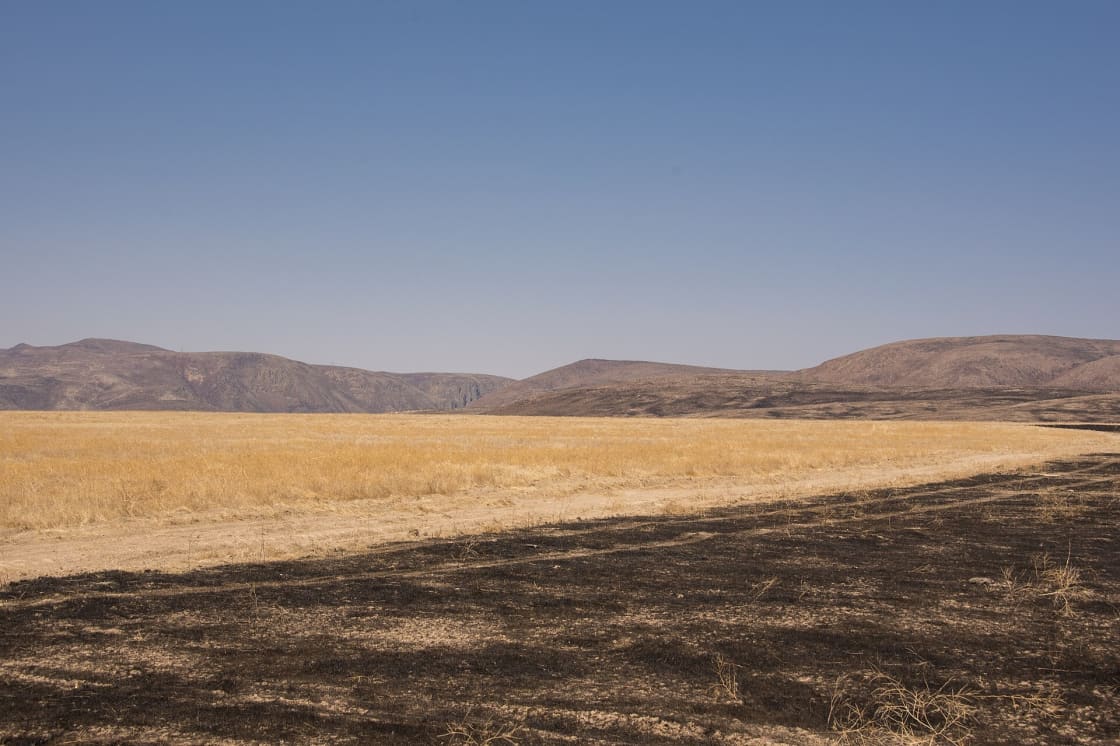

The Utah Valley bench is one of the most desirable places to live in the state and one of the more exposed. The same slope that produces the view produces the fire behavior: steep ground, an arid summer, cured grass and brush, and a wind pattern that moves fire uphill fast.
Most homes lost in fires of this kind are not consumed by an advancing wall of flame. They are ignited by embers — sometimes thousands of them, sometimes long after the fire front has passed — that find something combustible touching the structure.
That single fact reorders everything about what is worth doing.
The short version
Embers, not flame, take most houses.
The first five feet is the highest-value work you can do. Nothing combustible against the structure.
Three zones: immediate (0–5 ft), intermediate (5–30 ft), extended (30–100 ft or the property line).
Break the continuity of fuel, do not clear the lot.
Home hardening competes with clearing for first priority: vents, gutters, decks, roof.
Spring is the window for heavy work. Gutters twice a year.
Requirements are local. Title 65A, Ch. 8 frames the state role; your city sets what binds you.
Where the interface is, and why Utah Valley's is unusually sharp
The wildland urban interface is where development meets undeveloped wildland vegetation. In much of the country that boundary is a gradient — suburbs thinning into woodland over several miles.
In Utah Valley it is a line you can see from the freeway. Subdivisions run up the bench and stop, and above them the Wasatch front rises in grass, oak brush, maple and scattered conifer. The transition frequently happens across a single street.
That sharpness has two consequences.
Exposure is concentrated. The homes on the uphill edge of a bench subdivision carry a materially different risk than homes four streets down, even though nothing else about the properties differs.
Slope amplifies everything. Fire moves faster uphill because flames preheat the fuel above them. A slope that makes for a good view makes for fast fire behavior, and a house sitting at the top of a draw is at the top of a chimney.
The same geometry applies at every canyon mouth along the valley — Provo Canyon, Rock Canyon, Hobble Creek, Spanish Fork Canyon, American Fork Canyon — where drainages funnel wind and where homes sit close to continuous fuel.
Utah addresses wildland fire principally through Title 65A, Chapter 8 of the Utah Code, which frames the state division's responsibilities in terms of preventing and suppressing the spread of fire on nonfederal forest, range, watershed or wildland urban interface land in the state, encouraging landowners to conserve, protect and manage land, and taking action the division considers appropriate to manage wildland fire and protect life and property on such land. The chapter also provides for cooperative fire protection agreements between the division and eligible entities — counties, municipalities and certain districts with wildland fire suppression responsibility and cost responsibility — under § 65A-8-203, with agreements running terms of no more than five years and renewable while the entity continues to qualify.
That is the state architecture, and it tightened in 2025. House Bill 48 (Wildland Urban Interface Modifications) required every city and county to adopt and enforce the Utah Wildland Urban Interface Code by January 1, 2026. The Division of Forestry, Fire and State Lands maps a high-risk WUI boundary (check your address at wildfirerisk.utah.gov), sets risk-based fees for structures inside it, which counties collect, and runs lot (triage) assessments that owners can request. The division is plain that mitigation and home hardening are paid for by the homeowner. What binds you day to day still arrives through your city or county: the adopted WUI code, vegetation ordinances, and conditions attached at the time of construction. Ask your city directly rather than assuming.
Zone 1: the immediate zone, zero to five feet
This is the smallest zone and it does more work than the other two combined.
The objective is simple: nothing that will burn should be touching or immediately adjacent to the structure. Embers accumulate against walls, in corners, and against anything that interrupts airflow. If what they land in is combustible, the ignition is directly against the building.
What comes out:
Bark mulch and wood chips against the foundation. This is the most common single defect on Utah Valley bench homes and the easiest to fix. Bark mulch is an excellent ember receiver. Replace it in this band with gravel, decorative rock, pavers or bare soil.
Junipers, arborvitae and other resinous shrubs against the house. These species carry volatile oils and dead interior material, and they burn with startling intensity. A mature juniper against a wall is a torch pre-positioned at the structure.
Woodpiles, propane tanks, and stored combustibles on decks, against walls, or underneath the deck.
Plastic bins, patio cushions, door mats, brooms, and the general accumulation that lives against the back of a house.
Dead leaves and needles from gutters, roof valleys, and the corners where wind deposits them.
The hardening work in this zone matters as much as the clearing:
Gutters. Clean them, at least twice a year. A gutter full of cured needles is a linear ember trap running the length of the roof edge.
Vents. Attic, crawlspace and foundation vents are direct pathways for embers into the structure. Fine metal mesh screening is the standard remedy, and it is inexpensive relative to what it protects.
Under the deck. An open deck over dry ground with stored material beneath it is one of the most reliable ways to lose a house. Clear it, and consider enclosing with a screened, non-combustible skirt.
Gaps. Where the roof meets the wall, where siding meets the foundation, and anywhere else an ember can lodge out of sight.
If you do nothing else described in this article, do this zone. It is small, it is cheap, and it removes the mechanism by which most houses are lost.
Zone 2: the intermediate zone, five to thirty feet
The objective here shifts from ignition prevention to fire behavior modification. You are trying to ensure that a fire arriving in this band drops out of the canopy, slows down, and loses intensity before it reaches the structure.
The organizing concept is fuel continuity. Fire spreads where fuel is connected — horizontally across continuous grass and brush, and vertically from the ground into the canopy via what are called ladder fuels.
Remove ladder fuels. Low branches, brush growing under trees, and anything that lets ground fire climb. Pruning lower limbs on mature trees is the standard prescription, with the height depending on the tree.
Space tree crowns. Continuous canopy carries crown fire. Breaking the connections between crowns interrupts it.
Break up the ground fuels. Islands of planting separated by gravel, hardscape, irrigated lawn or bare ground rather than one continuous bed.
Keep grass short. Cheatgrass is the dominant fine fuel on the Utah bench, it cures early, and it burns fast. A mowed band is a meaningful interruption.
Move the woodpile out of this zone entirely, ideally to the extended zone and uphill of nothing.
Watch the fence. A wooden fence running from wildland vegetation directly to the house is a fuse. Non-combustible fencing, or a non-combustible section where it meets the structure, breaks the connection. This is worth coordinating with a neighbor, and it intersects with the municipal rules covered in our guide to fences, sheds and setbacks.
Plant selection in this zone matters, and it aligns well with water considerations. Low-growing, well-irrigated, high-moisture plantings resist ignition better than dry ornamentals. Our guide to waterwise landscaping in Utah Valley covers species that suit the climate — with one caution worth naming: waterwise and fire-resistant are not synonyms, and several popular drought-tolerant ornamentals, junipers foremost among them, are poor choices near a structure.
Zone 3: the extended zone, thirty to one hundred feet
The objective is no longer to protect the house directly but to reduce the energy of an approaching fire and to give firefighters somewhere to work.
This zone is about thinning rather than clearing. Remove dead and downed material, thin dense stands, keep grass and brush managed, and maintain separation between groups of vegetation. Mature, well-spaced trees can remain — a healthy spaced canopy is not the problem.
Two Utah Valley-specific notes.
Gambel oak. The oak brush that covers much of the Wasatch front is a difficult fuel: dense, persistent, and it resprouts vigorously. Managing it is ongoing work, not a one-time project.
Property lines and public land. A great many bench properties abut city open space, county land, or federal ground, and your defensible space obligations stop at your line. Where the fuel continues onto public land, the productive route is to ask the managing agency about their fuel treatment program, and to coordinate with neighbors. A single well-managed lot in a row of unmanaged ones is much less effective than a block that acts together.
Home hardening, which is half the answer
Vegetation management gets the attention. The structure itself deserves equal weight.
Roof. The single most important structural element. A Class A rated roof assembly is the standard. Keep valleys and the roof surface clear of debris, and pay attention to where the roof meets a wall.
Vents. Screened with fine metal mesh, as above.
Eaves and soffits. Enclosed soffits reduce ember entrapment under the roof edge.
Windows. Multi-pane glazing performs substantially better under radiant heat than single pane. Window failure lets embers into the interior, and an interior ignition is generally unsurvivable for the structure.
Siding. Non-combustible or ignition-resistant materials, with attention to the bottom edge where it meets the ground.
Decks. Non-combustible or ignition-resistant decking, and nothing stored underneath.
Chimneys. A spark arrester is standard, and a chimney in poor condition is a hazard in both directions — see our guide to chimney and fireplace safety.
Not all of this is affordable at once. The sequencing that gets the most risk reduction per dollar is roughly: clear the immediate zone, clean and screen, then vegetation in the intermediate zone, then structural upgrades as they come due through ordinary replacement cycles. Replacing a roof at end of life with a Class A assembly costs little more than replacing it with something else.
Access, water and the things people forget
Address visibility. Reflective numbers, legible from the street, at night, in smoke.
Driveway access. Engine access requires width, overhead clearance and somewhere to turn around. Overgrown driveways on steep bench lots are a recurring problem, and a driveway an engine cannot use is a driveway that will not be used.
Gates. If gated, firefighters need a way through.
Water. Know where your shutoffs are. Where a property has a cistern, pond or pool, note it — those can matter to suppression.
Utilities. Know where and how to shut off gas and electricity.
Evacuation. Have more than one route out. Bench subdivisions frequently have limited egress, and a plan made in advance is worth considerably more than one made under smoke.
Insurance, honestly
Wildfire risk assessment at the individual property level has become more granular across the West, using mapping, modeling and aerial imagery. In higher-risk areas that assessment can influence availability, pricing and the conditions attached to a policy, and some carriers ask directly about defensible space and home hardening.
What that means for any particular homeowner varies by carrier and changes over time, so the reliable step is to ask your own insurer two questions: what do you assess, and what documentation do you accept? Photographs of completed work, dated, are worth keeping either way.
Two related points. Check whether your policy's dwelling coverage reflects current rebuilding costs rather than a figure set years ago. And keep an inventory — photographs of each room, and receipts for significant items — stored somewhere that is not inside the house.
The seasonal rhythm
Late winter and early spring. The main window for heavy work — thinning, pruning, removing ladder fuels — before cheatgrass cures, before restrictions, and while vegetation is green.
Late spring. Gutters and roof. Clear the immediate zone. Mow before the grass dries.
Summer. Maintenance only, and be careful with equipment. Mowers, trimmers, grinders and chains striking rock are documented ignition sources across the West, and the hot afternoon is the wrong time. Watch for fire restrictions, which are issued locally and change through the season.
Autumn. Gutters again after leaf drop. Move the woodpile away from the house for the season rather than toward it.
One lot is not enough, and the block knows it
Defensible space works at the scale of a neighborhood better than it works at the scale of a parcel.
A single well-managed lot in a row of unmanaged ones is a house with a cleared perimeter surrounded by fuel that will burn at full intensity right up to the property line. The radiant heat and the ember load are produced by the block, not by your yard. Structure-to-structure ignition is a documented mechanism in interface fires: houses close together transmit fire to each other directly once one is burning, and at that point the vegetation is no longer the issue.
This is an awkward truth because you cannot make a neighbor do anything. What tends to work is unglamorous:
Do the shared edges together. A fence line, a shared slope, a strip between two driveways. Two households splitting the cost of removing a run of juniper along a common boundary get more risk reduction each than either gets alone.
Use the HOA if there is one. Landscaping standards, common-area maintenance and species restrictions are exactly the levers an association already controls, and common areas on bench subdivisions are frequently the largest unmanaged fuel on the block.
Ask the agency next door. Where a subdivision abuts city open space, county land or federal ground, the managing agency generally has a fuels program and a schedule. Asking where your area sits in that schedule costs a phone call.
Deal with the vacant lot. An unbuilt parcel with three seasons of cured cheatgrass is the most dangerous thing on many bench streets, and cities often have a weed abatement mechanism for exactly this.
Renters, condominiums and the people who cannot cut anything
A large share of Utah Valley households cannot legally modify the vegetation around the building they live in.
That does not leave nothing to do. Clear what is yours: the balcony or patio, which is frequently where combustible storage accumulates directly against a wall. Keep the area immediately outside your door free of anything that will catch. Know where the building's shutoffs are and know both routes out of the complex.
Then put the rest in writing to the landlord or the association. Gutters full of needles, junipers against the building, storage under a deck, an unscreened crawlspace vent — these are the association's or owner's responsibility, and a dated written request establishes that they were on notice. Our guide to renters' rights in Utah covers how habitability requests are made and what a landlord's obligations are.
Renters insurance is the other half. It covers your possessions and, importantly, additional living expenses if the building becomes uninhabitable — which in a fire event is the cost most people have not thought about.
Related Guides
- Fences, Sheds and Setbacks in Utah Valley — the fence that runs from wildland to your wall
- Waterwise Landscaping in Utah Valley — species for this climate, with the juniper caveat
- Chimney and Fireplace Safety in Utah Valley — spark arresters and inspection
- Spring Runoff and Flood Risk in Utah Valley — the other seasonal hazard on the same slopes
- Earthquake Preparedness in Utah Valley — the shared ground of household emergency planning
- Tree Removal in Utah Valley — when thinning becomes a removal job
Frequently Asked Questions
What is defensible space and how far out does it go?
Why does the first five feet matter so much?
Is defensible space required by law in Utah?
What is the wildland urban interface?
What is the most common way a house is lost in a wildfire?
Do I have to remove all the trees around my house?
When should I do this work in Utah Valley?
Does defensible space affect my homeowners insurance in Utah?
Sources
The facts in this guide were checked against these sources. Hours, fees and rules change, so confirm anything time-sensitive with the source before you go. How we make Provo.com.
- Community Preparedness (HB 48 FAQ), Utah Division of Forestry, Fire and State Lands. Checked October 12, 2026.
- Utah HB 48: Wildland Urban Interface Modifications, Salt Lake County Emergency Management. Checked October 12, 2026.
- H.B. 48 Wildland Urban Interface Modifications (2025), Utah Legislature. Checked October 12, 2026.