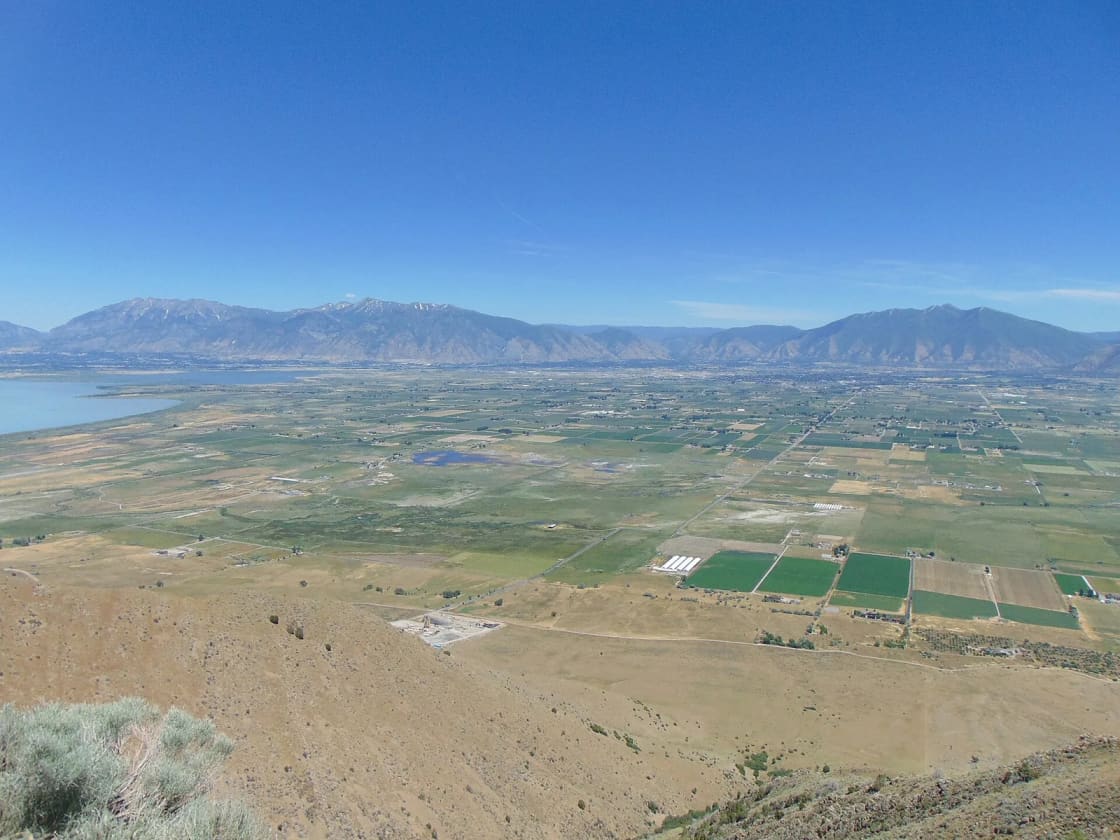

Stand anywhere in Provo and look east. That abrupt wall of mountain rising out of a flat valley floor is not a coincidence of scenery. It is a landform produced by earthquakes, one increment at a time, over hundreds of thousands of years.
The Wasatch fault is the boundary that made it. The mountains are the footwall going up; the valley is the hanging wall going down. Every foot of that relief was purchased by ground motion.
Which makes the local hazard question unusually concrete. The fault is not an abstraction under a distant plain. It runs along the base of the range, through the built-up edge of the valley, past neighborhoods people live in now.
What the forecast says
The Utah Geological Survey and the U.S. Geological Survey established the Working Group on Utah Earthquake Probabilities to produce a formal forecast for the Wasatch Front, and its published 50-year results are the numbers worth knowing.
There is a 57% probability of one or more magnitude 6.0 or greater earthquakes in the Wasatch Front region in the next 50 years, and a 43% probability of one or more magnitude 6.75 or greater.
Within that 43%, the contributions are broken out. The Wasatch fault zone itself accounts for 18%. Other faults in the region — 45 of them, less well studied — account for a further 25%. The Oquirrh–Great Salt Lake fault zone accounts for around 6%, and background earthquakes contribute to the magnitude 6.0 figure but are not assigned a magnitude 6.75 probability.
Two things follow that people routinely get wrong. First, these are regional probabilities, not Provo-specific ones. Second, most of the regional risk of a large earthquake does not come from the Wasatch fault. It comes from everything else added together.
The 2020 Magna earthquake was a forecast event
When a magnitude 5.7 struck near Magna in March 2020, it was widely treated as a surprise. It was not.
The 2016 forecast had put the chance of one or more magnitude 5 or larger earthquakes in the region at roughly 93% over 50 years. An event of that size was not merely possible; it was the expected case. What Magna demonstrated was not that the models were wrong but that a moderate earthquake here does real damage to unreinforced masonry while leaving modern construction largely intact.
That is a preview worth taking seriously, because the events the forecast is really about are far larger.
Segments, recurrence, and the shape of the hazard
The Wasatch fault zone is not one continuous rupture surface. Studies have divided it into ten structural segments, each roughly 30 to 60 kilometers long — about 19 to 37 miles.
The central five segments have been active during the Holocene, the last 10,000 years, and produce magnitude 7.0 earthquakes on the order of every 900 to 1,300 years. Trenching studies have documented at least 22 surface-faulting earthquakes on the Wasatch fault in the past 6,000 years.
Published lengths for the zone as a whole vary depending on where the fault is considered to begin and end, which is why the figure you find changes between sources. What does not change is the shape of the problem: a segmented fault, each segment capable of a major earthquake on its own, running along the base of the range where nearly everyone lives.
The number that looks reassuring, and is not
Here is where Provo's specific situation gets interesting, and where a lot of casual coverage lands on the wrong conclusion.
The USGS describes the most recent earthquakes on the Weber, Provo and Nephi segments as having occurred 200 to 700 years ago. Against an average recurrence of 900 to 1,300 years, that is recent. A segment that ruptured a few centuries ago has, on a simple elapsed-time model, released its accumulated strain and started over.
So time-dependent models assign the Provo segment comparatively low short-term odds — in one published analysis, segment-specific probabilities on the Weber, Provo and Nephi segments came out well below the regional and fault-wide estimates, precisely because elapsed times there are short relative to average recurrence. Meanwhile Salt Lake City and Brigham City, which have waited far longer, score higher.
Read carelessly, that says Provo is the safe part of the Wasatch Front. It says nothing of the kind.
The stress-transfer finding
Earthquakes are not independent events on a clock. When one segment ruptures, it changes the stress on its neighbors — sometimes relieving it, sometimes loading it further.
Researchers have modeled how stress shifts across the central Wasatch fault zone after each rupture. Its broad finding is that a quake on one segment can add stress to its neighbors, so a segment that ruptured recently is not necessarily safe.
The authors' conclusion is the part that matters. For segments that have gained stress, the probability of a large earthquake may be underestimated by approaches that do not account for stress transfer.
That is a genuine scientific disagreement about how to weight the Provo segment, and it is worth presenting as one rather than resolving it here. The elapsed-time reading and the stress-transfer reading are both defensible, they point in different directions, and the honest summary is that the low-elapsed-time number is not the whole picture.
Provo's shaking risk is not only Provo's segment
There is a second reason the segment-by-segment framing misleads, and it has nothing to do with modeling choices.
Ground shaking does not stop at a segment boundary. A magnitude 7 on the Salt Lake City segment to the north would also shake Utah Valley hard.
So the practical question for a household here is not "when will the Provo segment go." It is "what happens to this building when any of several nearby segments goes." Those are different questions with different answers, and the second one has a much higher probability attached.
Unreinforced masonry is the local weak point
If there is one structural fact worth knowing about Utah Valley housing, it is this one.
Unreinforced masonry — brick or stone laid without steel reinforcement — is strong under vertical load and weak under the horizontal, reversing load an earthquake delivers. Walls crack, corners separate, parapets and chimneys fail, and in severe cases the walls come away from the floors and roof they were supporting.
Utah has a great deal of this construction, and it is concentrated in exactly the older neighborhoods people find most appealing. Provo's historic housing stock is full of brick built long before seismic provisions entered the building code. Our guide to Provo's Tree Streets neighborhood describes the era and character of much of that housing.
If you own an older brick home here, the useful step is a structural engineer's assessment rather than an internet diagnosis. Retrofit approaches exist — bolting the frame to the foundation, bracing cripple walls, anchoring walls to floors and roof — and they vary enormously in cost and disruption depending on what you have.
The valley floor is soft, and that matters
Bedrock and sediment do not shake the same way. Deep, loose, water-saturated sediment can amplify ground motion and, in the worst case, liquefy — losing strength and behaving temporarily like a fluid, which is how buildings tilt and buried tanks float upward.
Utah Valley sits on basin fill, and the lower ground near Utah Lake has both the sediment and the shallow groundwater that liquefaction requires. The Utah Geological Survey publishes hazard mapping, including liquefaction potential, and it is worth looking at your own address rather than assuming.
This is not a reason to avoid the valley floor. It is a reason to know which set of hazards applies where you live, because the answer differs meaningfully between the bench and the lakeshore.
Drop, cover, hold on
During shaking, the instruction is simple and the reasoning is worth understanding.
Drop to your hands and knees before the shaking drops you. Cover your head and neck, getting under a sturdy table if one is nearby, or against an interior wall away from windows, mirrors and tall furniture. Hold on to whatever is sheltering you, because furniture slides during strong motion and shelter you are not holding will leave you.
Do not run outside. The exterior of a building during shaking is where façade material, glass and parapets land. If you are in bed, stay there and protect your head with a pillow. If you are driving, pull over clear of overpasses, poles and power lines, and stay in the vehicle.
The counterintuitive part is that the exits people instinctively run for are the most dangerous places to be standing.
The kit, assessed
Emergency kit lists have a way of becoming so ambitious that nobody starts. So here is the order that matters.
Water first, because it is the thing with no substitute. Plan around one gallon per person per day, a figure that includes hygiene and food preparation rather than drinking alone. Include pets.
Light and information next — a flashlight with spare batteries and a battery-powered radio. Provo's own outage guidance recommends the same combination for far more routine failures.
Medications, because a several-day gap in a prescription is a real medical problem and pharmacies may be closed or inaccessible.
Sturdy shoes and work gloves by the bed. Broken glass is the most common post-earthquake injury and it is entirely preventable.
Food that needs no cooking, a first aid kit, and copies of important documents.
Then the two things people forget. A wrench or tool for the gas shutoff, kept where the shutoff is. And a plan for reunification — where the household meets and who the out-of-state contact is, since long-distance calls sometimes connect when local ones will not.
The gas question, answered properly
Do not shut off your gas as a reflex after shaking stops.
Shut it off if you smell gas, hear hissing, or see damage to a gas appliance or line. Those are evidence. Absent evidence, leaving it on is usually correct, because turning gas back on requires the utility, and after a widespread event that queue can run long. A household that shut off gas unnecessarily may be without heat and hot water for a while in exchange for nothing.
Know where the shutoff is before you need it, and keep the right tool with it.
Aftershocks, and the days after
The main shock is not the whole event. Aftershocks follow large earthquakes for weeks and occasionally months, decaying in frequency but not in a way that guarantees the next one is smaller. Buildings damaged but standing after the main shock are the ones aftershocks bring down, which is why re-entering a cracked structure to retrieve belongings is a bad trade.
Plan for lifelines to be interrupted rather than merely inconvenienced. Water mains break; a valley-wide event could leave the culinary system unusable or unsafe for a period measured in days rather than hours. Electricity generally returns before water does. Roads matter too — the Wasatch Front's north-south capacity runs through a small number of corridors, and canyon roads are exposed to rockfall.
The practical translation is that self-sufficiency for several days is the planning target, not several hours. That is the difference between a kit that holds a couple of water bottles and one that holds a case.
Insurance is a separate decision
Standard homeowners and renters policies in Utah generally do not cover earthquake damage. Earthquake coverage is typically a separate policy or endorsement, and it usually carries a deductible expressed as a percentage of the insured value rather than a flat dollar figure — which can be a substantial sum on a house.
Whether that math works for you depends on your building, your equity and your risk tolerance, and it is a decision rather than an obvious yes. The mistake to avoid is assuming you already have the coverage. Read the policy or ask your agent directly.
The ShakeOut, and why rehearsal matters
Utah runs an annual statewide earthquake drill, the Great Utah ShakeOut, in which schools, businesses, agencies and households practice drop, cover and hold on simultaneously. Registration is free and individuals can sign up alongside organizations.
It is easy to be cynical about a scheduled minute of crouching under a desk. Don't be. The first seconds of real shaking are disorienting, and what people do in them is whatever their body already knows. A household that has physically rehearsed the motion once behaves measurably differently from one that has only read a list.
Pair it with the five-minute version: walk your home and ask what falls. Bookcases, water heaters, televisions and heavy mirrors over beds are the usual answers, and straps and brackets are inexpensive.
Related guides
- Furniture Shopping in Utah Valley: The Student Cycle, the Delivery Trap & Where to Actually Look
- Provo's Noise Ordinance: What 55 Decibels Actually Sounds Like
- Provo's Elevation: How High It Is and What That Actually Changes
- Yoga in Provo: Nobody Licenses Your Teacher, and the Studio May Owe You a Bond
- Family Court in Utah County: The 30 Days, the Two 90s, and What the Forms Assume You Know
- Provo for Retirees: The Other Demographic in America's Youngest College Town
- Where Provo's Water Actually Comes From
- What Provo Can Actually Cite You For: Weeds, Junk Vehicles and the Nuisance Code
- How to Actually Follow Provo City Council (and Be Heard at One)
- Dog Grooming in Provo: There Is No License to Check, So Here Is What to Ask Instead
- Recycling & Garbage in Provo: The Actual Rules (2026)
- Dry Cleaning & Alterations in Provo: Suits, Missions & Wedding Deadlines
- Spring Runoff and Flood Risk in Utah Valley Power outages in Provo covers the utility side of a shorter emergency and much of the same household preparation, and Provo weather covers the seasonal hazards that are far more likely to disrupt an ordinary year. If your home is old enough to have unreinforced masonry, it is also old enough that asbestos and lead are worth understanding before any retrofit work disturbs a wall.
The short answer
The regional 50-year forecast is 57% for magnitude 6.0 or greater and 43% for 6.75 or greater, with the Wasatch fault itself contributing 18 points of that second figure.
The Provo segment ruptured recently enough that elapsed-time models rate it lower than Salt Lake City's — but stress-transfer modeling suggests those models may understate it, and a Salt Lake City rupture would shake Provo hard regardless. Treat the reassuring number with suspicion.
Then do the cheap things. Water, a flashlight, shoes under the bed, straps on the bookcase, a family meeting point, and one rehearsal of drop, cover and hold on. If you own older brick, get a structural opinion. None of it is expensive, and all of it is easier to do on a quiet Tuesday than the alternative.
Frequently Asked Questions
How likely is a large earthquake along the Wasatch Front?
When did the Provo segment of the Wasatch fault last rupture?
Does that mean Provo is relatively safe?
What is the biggest structural risk in older Provo homes?
How much emergency water should a household store?
Should I shut off the gas after an earthquake?
What should I do during the shaking itself?
What is the Great Utah ShakeOut?
Sources
The facts in this guide were checked against these sources. Hours, fees and rules change, so confirm anything time-sensitive with the source before you go. How we make Provo.com.
- Earthquake Forecast for the Wasatch Front Region of the Intermountain West (Fact Sheet 2016-3019), U.S. Geological Survey. Checked October 12, 2026.
- Earthquakes.Utah.gov (home page and FAQ), Utah Division of Emergency Management / Utah Geological Survey. Checked October 12, 2026.
- Utah Earthquake Probabilities (Working Group on Utah Earthquake Probabilities), Utah Geological Survey. Checked October 12, 2026.
- How Big and How Frequent Are Earthquakes on the Wasatch Fault?, U.S. Geological Survey. Checked October 12, 2026.