
Most home services in Utah Valley are the same trade they would be anywhere else, adjusted for the weather. Window cleaning is not. The water that comes out of the ground here does something specific to glass, and the difference between a homeowner who understands that and one who does not is measured in thousands of dollars over the life of a house.
The short version: in this valley, window cleaning is not a cosmetic service. It is maintenance on a material that is being slowly damaged.
What hard water is doing to your glass
Utah Valley's culinary water is hard — it carries a substantial load of dissolved minerals, principally calcium and magnesium, picked up as groundwater moves through the limestone and other mineral-rich rock of the Wasatch. Our guide to hard water in Provo covers what that means for plumbing, appliances and skin.
On glass, the mechanism is straightforward and unforgiving.
A droplet of hard water lands on a window. In this climate — dry air, strong sun, high elevation — it evaporates quickly, often before it can run off. The water leaves. The dissolved minerals do not. What remains is a ring of calcium and magnesium deposits bonded to the surface.
Repeat that a few hundred times over a summer and you have a haze. Repeat it over several summers and you have something worse.
The part that turns cleaning into repair
Here is the fact that separates this from ordinary dirt: hard water deposits left on glass long enough stop sitting on the surface and start eating into it.
Glass is not chemically inert. Over time, mineral deposits — helped along by ultraviolet exposure, which this valley has in abundance at 4,500 feet — interact with the silica in the pane and produce etching: microscopic pitting in the glass itself.
Etched glass looks like a permanent cloudy film that no cleaner touches, because there is nothing left to remove. The surface is damaged.
At that point the options are:
Polishing. Abrasive compounds, typically cerium oxide, mechanically remove a thin layer of glass. It is skilled work, it costs far more than cleaning, and results range from complete restoration to visible improvement.
Replacement. For severely etched panes, this is sometimes the cheaper honest answer.
The practical consequence is a maintenance argument rather than an aesthetic one. Regular cleaning is not about how the house looks. It is about not letting deposits sit long enough to etch. People who clean their windows twice a year rarely face this. People who go five years sometimes do.
The real culprit is your sprinklers
If you take one thing from this page, take this one.
Rain is soft water and does very little damage to glass. The water that ruins windows in Utah Valley is culinary water from misaimed sprinkler heads, and in many neighborhoods it hits the same windows several times a week for the entire irrigation season.
Look at almost any house here with badly spotted lower windows and you will find a sprinkler head pointed at it. The pattern is usually obvious once you know to look: damage concentrated on one elevation, worst at the bottom of the pane, fading with height.
The fix costs almost nothing relative to the damage. Adjust the arc, swap the nozzle, or move the head. Doing this before paying for a cleaning is the difference between buying a result and buying a temporary one.
There is a wrinkle worth knowing. Some Utah Valley homes irrigate with secondary water — untreated water delivered through a separate system — and that water frequently carries a higher sediment and mineral load than culinary water does, along with material that stains rather than just spots. Our guide to secondary water in Utah Valley explains which areas have it and how the systems work. If your sprinklers run on secondary water and hit the house, the urgency of redirecting them goes up, not down.
What else this climate does to windows
Hard water is the headline. It is not the only thing.
Dust and construction. The valley is dry and, in large stretches, actively being built on. Fine dust settles constantly, and homes near active subdivisions collect a different volume of it. Wind events move a lot of material at once.
Pollen. Spring cottonwood and grass pollen coats glass and screens heavily enough to be visible.
Winter inversion. The particulate that accumulates during a valley inversion deposits on everything, including windows, and it is greasier than ordinary dust.
Sun. High-elevation ultraviolet exposure degrades window film, dries out sealants and accelerates the mineral bonding described above. It is also why the south and west elevations of a house almost always look worse than the north.
Sprinkler-adjacent staining. Beyond minerals, irrigation water splashes soil onto lower panes, and mud dries into place.
What a job should include
Scope is where quotes diverge and where dissatisfaction comes from. A thorough residential job normally covers:
Exterior glass, scrubbed and squeegeed rather than sprayed and wiped.
Interior glass, which is a different job with different risks — furniture, floors, blinds — and is sometimes priced separately.
Screens, either cleaned in place or removed, washed and reinstalled. Removal is better and takes longer.
Tracks and sills, vacuumed and wiped. This is the step most often skipped and most often noticed.
Detailing the edges, which is the difference between clean glass and a clean window.
Hard-water restoration is not part of a standard cleaning anywhere and should be quoted separately after someone has physically looked at the panes.
How pricing works here
Residential window cleaning is generally priced per pane or per window, often against a minimum charge that makes very small jobs uneconomical.
The variables that move a quote:
Pane count, which is the base. A window divided into grids counts as more work, and homes with many small divided panes cost meaningfully more than the window count suggests.
Interior plus exterior, or exterior only. Exterior-only is common and cheaper.
Height. Second-story exterior work changes the equipment and the risk. Anything requiring work above a roofline or on steep terrain changes it again.
Screens, tracks and sills, included or added.
Condition. A house that has not been cleaned in six years is not the same job as one on a twice-yearly schedule, and an honest company will say so at the quote rather than at the invoice.
Access. Landscaping, window wells, fences and dogs all cost time.
Get it in writing, itemized. The most common dispute in this trade is not price but scope.
Purified-water systems, and why they suit this valley
The method worth understanding as a customer is deionized or purified water cleaning.
Water is run through a filtration and deionization system that strips out its dissolved minerals. The resulting water is aggressive at picking up dirt and, critically, dries without leaving deposits — because there is nothing in it to leave. It is applied with a soft brush on a telescoping pole, often from the ground, and needs no squeegee and no detergent.
Two advantages matter here specifically. In a hard-water region, rinsing with water that contains no minerals removes the last step where spots normally get introduced. And reaching upper stories from the ground removes a large share of the ladder work, which is the main way people get hurt in this trade.
The honest limitation: purified water is a maintenance method. It works beautifully on glass in reasonable condition and it will not remove years of bonded mineral buildup, which still requires direct scrubbing or restoration. A company that offers only pole work on a badly damaged house is offering you the wrong service.
Storm windows, double panes and the fogging that is not dirt
A recurring frustration in this valley is a window that looks dirty from inside and outside and cannot be cleaned from either side. That is usually not dirt at all.
Modern windows are insulated glazing units — two or three panes with a sealed, sometimes gas-filled cavity between them. The seal is what makes the unit work, and seals fail. When one does, moisture enters the cavity and condenses on interior surfaces of the glass that nobody can reach.
The signature is unmistakable once you know it: a haze or visible droplets that change with temperature and time of day, appear between the panes rather than on them, and often start at one corner. Sometimes there is a faint mineral outline where water has repeatedly condensed and dried.
No cleaner fixes this. The unit has failed, and the repair is replacing the glazing unit — frequently possible without replacing the whole window and frame, which is worth asking about because it is considerably cheaper.
The reason this belongs in a window cleaning guide is that people routinely pay for repeated cleanings trying to solve it. A competent cleaner will identify a failed seal on sight and tell you not to spend the money. That is one of the better tests of who you have hired.
Utah's temperature swings are hard on seals. A valley that can move forty degrees between a January night and a July afternoon, at elevation, with intense sun, works those units continuously.
The timing question, and why autumn matters more than spring
Most people book window cleaning in spring, when the house looks worst and the weather turns pleasant. Spring is a fine time to clean. Autumn is the more important one, and the reasoning is specific to this climate.
Through the irrigation season, sprinklers deposit minerals on the glass. Irrigation typically shuts down in autumn, when systems get winterized — our guide to sprinkler winterization covers the timing and why it is not optional here.
If you clean in autumn, immediately after the sprinklers stop, you remove a full season's mineral load and then the glass sits through five or six months during which nothing is spraying it. If you skip autumn and clean in spring instead, those same deposits sit on the pane all winter — which is exactly the dwell time that produces etching.
There is a second reason. Winter in the valley means inversion, and inversion means particulate settling on everything for weeks. Going into that season with clean glass is better than going into it with a mineral base coat for the particulate to bond to.
The practical rule: if you can only afford one cleaning a year, make it the one right after the sprinklers go off.
Commercial and multi-story work is a different trade
Everything above concerns houses. Storefront and building work operates under different rules, and it is worth knowing the boundary if you own a business here.
Ground-floor storefront glass is close to residential work, done more frequently — many downtown Provo and Orem businesses run weekly or fortnightly service, because glass at street level with constant hand contact shows everything.
Above that, the work becomes a specialty involving lifts, boom equipment, or rope descent systems, along with the training, certification and insurance those require. It is not a service a residential window cleaner extends into casually, and a company that offers to do your four-story building off extension ladders is offering something you do not want to accept liability for.
For business owners, the useful questions are what equipment they intend to use, whether they carry the specific coverage for it, and whether the building's own management already contracts the exterior — which, in multi-tenant buildings, it frequently does above the ground floor.
Hiring: what distinguishes companies
Window cleaning has an extremely low barrier to entry. Anyone with a ladder and a squeegee can begin on a Saturday, which means quality varies enormously.
Insurance, confirmed rather than claimed. Ask for liability coverage and, if they have employees, workers' compensation. This trade involves ladders and other people's glass. Ask to see the certificate.
Whether they carry hard-water experience. Ask directly what they do about mineral deposits. A company that says everything comes off with soap has not worked here long. A company that distinguishes surface deposits from etching, and says plainly that etching may not fully clear, is telling you the truth.
What happens if a pane breaks. Old windows, especially with painted or corroded frames, sometimes fail. Get the answer before, not after.
Screens and tracks, explicitly. See above.
Seasonal availability. Exterior work in this valley compresses into a window between the last frost and the first, and it competes for the same weeks as every other outdoor trade. Our guide to handyman services covers why autumn is the crunch season for exterior work generally, and window cleaners feel it the same way. Book spring and autumn slots early.
Written scope. Repeatedly, because it is the thing that goes wrong.
Doing it yourself, properly
For ground-floor exteriors and all interior glass, a homeowner with the right three tools will beat a professional using the wrong ones.
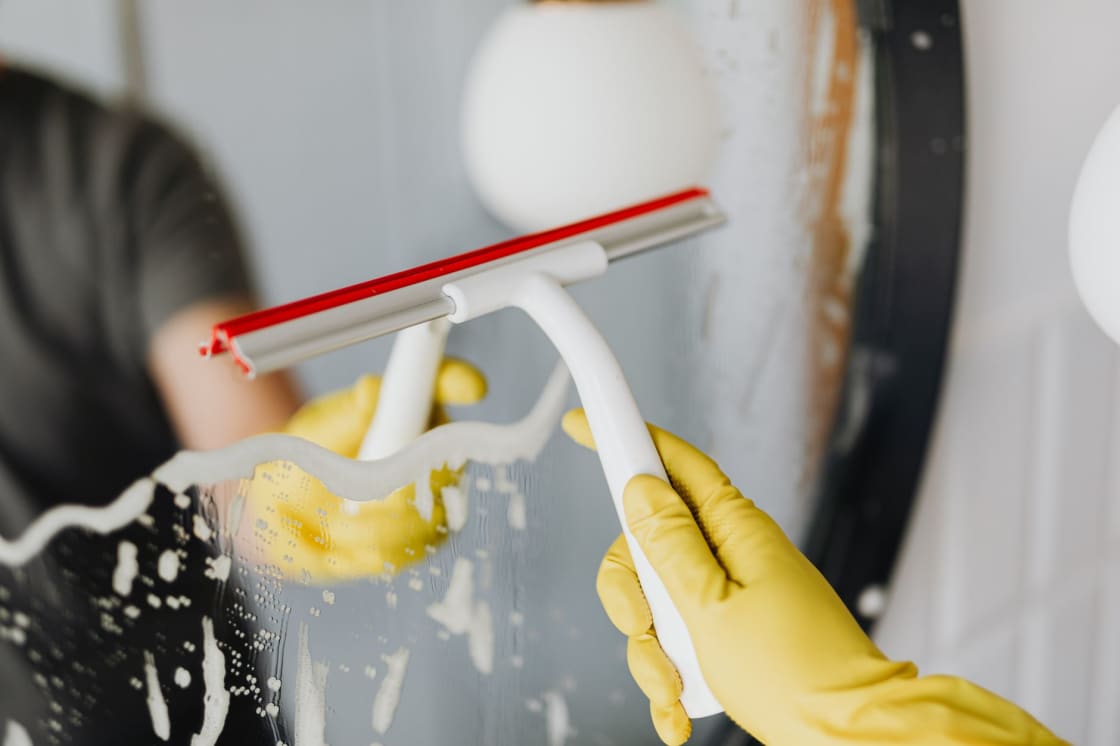
A squeegee with a good rubber blade, replaced when it nicks. A scrubber or microfiber sleeve to loosen dirt. A bucket with a small amount of dish soap. That is the professional method, and paper towels with spray cleaner is not a cheaper version of it — it is a different and worse method that leaves lint and streaks.
Technique: wet and scrub the whole pane, then pull the squeegee in overlapping strokes, wiping the blade after each pass, and finish the perimeter with a cloth. Work in shade or early morning, because glass drying in direct Utah sun before you can squeegee it is the main cause of streaks here.
For mineral spots, an acidic cleaner — commercial hard-water products, or diluted white vinegar for light deposits — with dwell time and a non-scratch pad. Test in a corner. Never use anything abrasive enough to scratch glass, and stop if the haze does not respond, because at that point it is etching and more scrubbing will not help.
What to leave alone: anything requiring a ladder taller than a step stool. The savings are not worth an emergency room visit, and this is the injury that shows up every year.
The order of operations that saves money
If you do nothing else, do these in this sequence.
First, redirect any sprinkler head hitting the house. It is cheap, it takes an afternoon, and it stops the damage.
Second, get an assessment of the current condition before booking a routine cleaning, if the glass is visibly hazy. You want to know whether you have deposits or etching, because those are different services at very different prices.
Third, set a twice-a-year rhythm and keep it. Late spring and early autumn.
Glass is one of the more expensive surfaces in a house, and it is the one most homeowners here treat as self-maintaining. In a hard-water valley with a long irrigation season, it is not.
One last note for anyone buying a house here. Hazy lower windows on one elevation are worth ten seconds of attention during a walkthrough, because they tell you two things at once: that the irrigation has been hitting the house, and that nobody has been dealing with it. Neither is a reason to walk away from a property, and both are worth a look at the sprinkler layout before you take possession — along with the other Utah-specific things worth checking on a house in this valley.
Frequently Asked Questions
Why do windows in Utah Valley get so spotted?
Can hard water stains be removed from glass permanently?
How much does window cleaning cost in Utah Valley?
How often should windows be cleaned here?
Should I fix my sprinklers before paying for window cleaning?
Do window cleaners do screens, tracks and sills too?
Is it worth hiring someone rather than doing it myself?
What is purified or deionized water cleaning?
Sources
The facts in this guide were checked against these sources. Hours, fees and rules change, so confirm anything time-sensitive with the source before you go. How we make Provo.com.
- 2025 Water Quality Report, Provo City. Checked October 12, 2026.
- Hardness of Water | U.S. Geological Survey, U.S. Geological Survey. Checked October 12, 2026.
- Ultraviolet (UV) Radiation and Sun Exposure | US EPA, U.S. Environmental Protection Agency. Checked October 12, 2026.