
Cleaning a house is the same everywhere. Hiring someone to clean a house in Provo is not, and it comes down to three local facts that reshape the whole transaction.
The rental market here empties and refills twice a year on a schedule everyone knows, so demand for cleaning is not a smooth line — it is two spikes with long flat stretches between. The water is hard enough that half of what people call dirt is mineral deposit, which behaves differently and resists the products most people reach for. And a large share of the housing stock ends its tenancies with a formal cleaning check against a written list, which is a graded exam rather than a tidy.
Get those three right and the rest is ordinary.
The two weeks that control the calendar
Utah Valley turns over in late April, when winter contracts end and much of the student population leaves, and again across the second half of August, when everyone arrives at once. Movers know this — our guide to hiring movers in Utah Valley describes the same crunch from the other side — and cleaning crews live inside it just as hard.
What that means in practice is that a move-out clean booked three days out in early June is routine, and the same call in the third week of August gets you a waiting list. The crews are not gouging; they are finite, they work daylight hours, and every unit in a 200-door complex wants the same Thursday.
Book the moment you have a date. If your contract ends inside one of those windows, treat the cleaner as a reservation you make alongside the moving truck, not as an errand you run at the end.
The flip side is good news. If you want recurring service and you are flexible about the start date, the quiet months — roughly late September through early April, minus the holidays — are when good crews have capacity and are willing to build a schedule around you.
Hard water is not dirt
Provo's water comes out of carbonate geology. Water moving through limestone and dolomite dissolves calcium and magnesium along the way, and that dissolved mineral is what hardness means. Every community along this front deals with it; our explainer on where Provo's water comes from covers the geology in more detail.
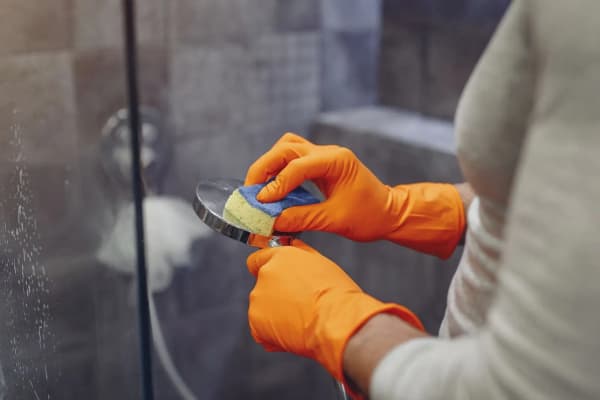
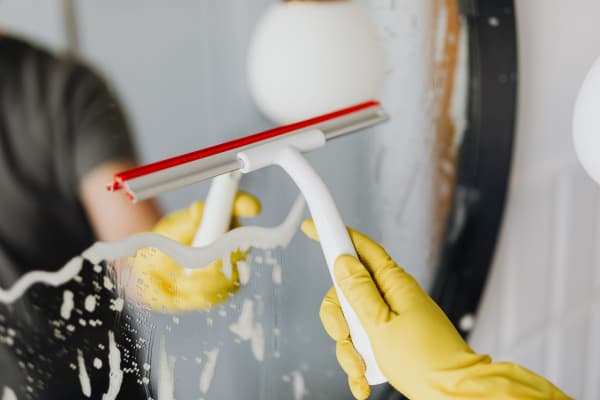
For cleaning, the consequence is specific. Mineral leaves the water and deposits on surfaces as scale: the film on a shower door that fogs it permanently, the white crust at the base of a faucet, the ring in a toilet at the waterline, the haze on glassware coming out of a dishwasher.
None of that is grease and none of it responds well to general-purpose spray. Scale is a mineral salt, and it comes off with acid and dwell time — the standard household approaches use vinegar or a citric-acid product, left to sit rather than wiped immediately, sometimes more than once. A cleaner who understands local water builds that dwell time into the visit. A cleaner who does not will scrub a shower door hard for twenty minutes and leave it looking about the same.
Two practical notes. First, ask before an acid goes onto natural stone: vinegar and citric acid etch marble, travertine and some limestone counters, and a well-meant descaling can permanently dull them. Second, glass has a point of no return. Once scale has been on a shower door long enough to etch the surface, no product recovers it, and a cleaner telling you the door needs replacing rather than more scrubbing is being honest with you.
The cleaning check is a different product
A great deal of Provo housing ends a contract with an inspection against a written checklist, and the list is longer and more literal than most people expect. Ovens and refrigerators inside, not just wiped. Behind and beneath appliances. Blinds slat by slat. Baseboards, door frames, light fixtures, vent covers, window tracks, the tops of cabinets. Some lists specify the state of the drip pans.
Three things follow.
Get the list before you get quotes. It is the specification. Handing it to a cleaning company converts a vague ask into a defined job, and a company that has worked local turnovers will read it and know immediately what it is being asked for.
Ask who is checking and what the standard is. Different complexes run this differently — some by their own staff, some by a contracted inspector, some with a re-check window if you fail the first pass. Whether there is a re-check changes how much risk you are carrying.
Understand the money. Failing means the property does the work and charges you, and the charge is generally higher than hiring the same work yourself would have been. Deposit deductions in Utah are governed by statute and by your lease rather than by the leasing office's preferences, and if you think a charge is unreasonable, our guide to renters' rights in Utah is the place to start.
One more thing worth saying plainly: if a complex requires professional carpet cleaning at move-out, ask to see that requirement in the lease. It is common, it is frequently legitimate, and it is also occasionally asserted verbally when the written contract says something narrower.
Three products, not one
Most confusion in a first phone call is that the customer and the company are describing different jobs.
A recurring clean is maintenance. Surfaces, floors, bathrooms, kitchen, dusting, trash. It assumes the house is basically in order and keeps it there. It is priced on the assumption that the last visit happened.
A deep clean is the reset: everything in the recurring list plus the things that accumulate — inside appliances, baseboards, blinds, grout, behind furniture, the accumulated scale. Most companies require one before starting a recurring schedule, which is not a sales tactic. It is how they establish the baseline the recurring price assumes.
A move-out or move-in clean is a deep clean of an empty space, judged against somebody else's standard. Empty makes it faster in some ways and slower in others, since everything previously hidden by furniture is now visible and in scope.
Know which one you are buying, and say the words. "Just a clean" produces a quote for one thing and an expectation of another.
What is almost never included by default
Ask specifically about each of these, because the honest answer varies by company and the assumption cuts both ways:
Inside the oven and inside the refrigerator. Interior windows, and whether that means glass only or tracks and sills. Exterior windows, which is usually a separate trade entirely — our guide to window cleaning in Utah Valley covers why that trade exists separately here and what hard water does to the glass. Blinds. Walls and spot-cleaning marks. Laundry. Dishes, and whether they will run a dishwasher or leave a full sink. Pet messes and litter boxes. Garages. Balconies. Anything above standard reach, since many companies cap ladder work for insurance reasons.
None of these are unreasonable to exclude. All of them are unpleasant to discover missing when you are trying to pass an inspection at four in the afternoon.
Vetting, without a licensing board to lean on
Nobody at the state is checking cleaning companies, so the checking is yours. The good news is that it is quick.
Confirm the business is real. A registered entity name, a city business license for where it operates, a phone number that a person answers. The Provo business license guide covers what the local layer looks like.
Ask for a certificate of insurance, not a claim of insurance. General liability is the coverage that pays when something in your house gets broken or damaged. A certificate is a document; "we're fully insured" is a sentence.
Ask about workers' compensation and about who is coming. A company with employees carries workers' comp, which is the thing standing between an injury in your kitchen and a conversation with your own insurer. A company that sends independent contractors may not, and the answer changes your exposure. It also changes consistency: employee crews tend to be the same faces week to week, which most people prefer.
Ask about background checks and about turnover. Both, not just the first. A firm that screens carefully but replaces its whole crew every quarter is a different proposition from one whose people have been there for years.
Get the scope in writing and the price structure explicitly. Hourly, flat rate by home size, or by the job. Hourly is honest for unpredictable work but open-ended; flat is predictable but depends on the estimate being right, which depends on someone having seen the space. For a first deep clean or a move-out, an in-person or video walkthrough produces a far better number than a bedroom count over the phone.
We keep a general protocol for vetting anyone who works on your house in hiring home pros in Utah Valley, and most of it transfers directly.
Carpet cleaning is its own trade
People search for it in the same breath and then hire the same company, which is usually a mistake. Carpet cleaning is equipment-dependent work with its own failure modes.
The main method worth asking about is hot water extraction — the process most people call steam cleaning — which injects heated solution and immediately vacuums it back out. The alternatives, low-moisture and encapsulation systems, dry faster and are useful for commercial carpet and for maintenance between deep cleans, but they remove less.
The questions that matter: how long until the carpet is dry and walkable, what the technician does about spots that reappear a day later, whether furniture moving is included, and whether they treat pet contamination as a separate service. That last one is not upselling. Pet urine soaks through carpet into the pad and sometimes the subfloor, and surface cleaning does not fix it; the smell returns with the next humid day.
Drying is where Utah helps you. The valley's low relative humidity means extraction-cleaned carpet dries faster here than in most of the country, and in summer you can accelerate it further with a fan and open windows. In January, with the house sealed against an inversion, it takes considerably longer — worth planning around if the carpet has to be dry before an inspection.
Access, keys and codes
Once you are not home during visits, you have to solve entry, and the options are not equivalent.
A door code is the cleanest answer. Codes can be issued individually, revoked in seconds, and on most systems they leave a log of who came and when. Give the cleaning company its own code rather than sharing the family one, and rotate it if the crew changes.
A key is the traditional answer and requires a conversation: where is it kept between visits, who has access to it, what happens when an employee leaves. Reputable firms have answers ready. If you are handing over a key, our guide to locksmiths in Provo is worth reading first — the same page explains why rekeying after a move is the one job nobody schedules and everybody should.
A lockbox is the compromise, and it is only as good as its code discipline, which in practice means it is only as good as how often the code changes.
Whichever you choose, tell the company how to handle pets, alarm systems and parking. Parking in particular: in a Provo complex, a crew that parks in the wrong stall for two hours can get itself towed, which turns your clean into somebody's afternoon at an impound yard. Our guide to towing and impound in Provo explains exactly how quickly that happens.
Dust, seasons and what to expect
Utah Valley generates dust. Dry summers, construction in every direction, wind coming down the canyons, and an inversion season that traps particulate in the valley for days at a stretch. Households here notice surfaces dusting faster than they did elsewhere, and it is not imagination.
The consequences for a cleaning schedule are modest but real. Filters matter more, both furnace and any standalone units, and no cleaning schedule compensates for a filter that has not been changed. Entry mats do disproportionate work. And in inversion months, when the house is closed up for weeks, allergy-prone households usually find that moving from a monthly to a biweekly rhythm is the single change they feel.
Getting your money's worth
Pick up before they arrive. Cleaners charge for time, and time spent relocating your belongings is time not spent cleaning. Ten minutes of clearing counters and floors buys you a noticeably better result.
Say what you care about. Every household has one thing that determines whether the house feels clean, and it is different for everyone — the kitchen floor, the shower glass, the smell. Say it out loud on the first visit and it will get attention on every visit after.
Give feedback immediately and specifically. A good company fixes a missed room without argument if they hear about it the same day; nobody can act on a review left three months later.
And build the relationship. The most valuable cleaner is not the cheapest quote but the one who has been in your house forty times, knows the stone counter cannot take vinegar, knows which door sticks, and notices the leak under the sink before you do.
Who is working in your house, and why it decides what happens if they get hurt
The vetting section above deals with trust and competence. There is a second question underneath it that almost nobody asks until something goes wrong, and it has a clean answer that is worth knowing in advance: is the person cleaning your house an employee of a company, or an individual working for themselves?
This is not a quality distinction. Some of the best cleaners in the valley are sole operators, and some of the worst experiences people have are with large outfits that rotate crews weekly. It is a liability distinction, and it changes what happens in the two scenarios that cost money.
Scenario one: someone is injured in your home. A cleaner who is an employee of a company is covered by that company's workers' compensation arrangements, and an injury on your property is handled inside that system. An individual working for themselves generally is not covered by anyone's workers' compensation, because there is no employer. If that person is hurt on your stairs, the question of who pays lands somewhere much closer to you and your homeowner's policy than most homeowners assume.
Scenario two: something is damaged or goes missing. A company carrying general liability coverage and a bond has a mechanism for this, and the mechanism is the reason those things exist. A sole operator may carry the same coverage — many do, and the good ones will say so without being asked twice — or may carry none, in which case the remedy is a conversation and, failing that, small claims court.
The questions that settle it in ninety seconds
- "Are you insured, and can you send me proof?" The proof is a certificate of insurance, and the ask is completely routine. Anyone who takes offense at it has told you something.
- "Is the person who comes to my house your employee?" Some companies operate as a booking platform for independent contractors, which is a legitimate model and a materially different one. It is usually disclosed somewhere in the terms; it is faster to just ask.
- "Will it be the same person each visit?" This is a quality question and a security question at once. Consistent assignment is the single biggest predictor of a good long-term cleaning relationship, and it also means one fewer set of keys in circulation.
- "What happens if something breaks?" You want an answer that describes a process, not one that describes an attitude.
A note on paying cash. Discounted cash rates are common and they are not automatically a problem. But if the arrangement is informal enough that there is no invoice, no business name and no coverage, then you are not saving fifteen percent on a service — you are self-insuring the whole thing and taking the discount as compensation for it. That can still be the right trade for a small, occasional job. It is a poor one for a weekly key-holder with a house code.
Related guides
- Lawn Mowing and Yard Care in Utah Valley: Timing, Hiring, and the Secondary Water Trap
- Hiring a Roofer in Utah Valley: The License Class Most Homeowners Check Wrong
- Finding a Plumber in Provo: Who Owns Which Pipe, and What Actually Breaks Here
- Waterwise Landscaping in Utah Valley: Lawns, Localscapes & Actually Saving Water
- Tree Removal in Utah Valley: The Tree Out Front Probably Isn't Yours
- Finding an Electrician in Provo: The Supervision Rule Nobody Explains
- Chimneys and Fireplaces in Utah Valley: Even an EPA-Certified Stove Is Illegal on a Mandatory Day Laundromats in Provo and dry cleaning and tailoring in Provo cover the other half of keeping a household running, and storage units in Provo covers where the excess goes during a turnover.
The short answer
Book around the calendar, not around your own convenience — late April and late August are sold out and everything else is available. Treat mineral scale as a separate problem from dirt, because it is. If you are facing a cleaning check, get the written list before you get quotes and hand it to whoever you hire. Ask for a certificate of insurance and an answer about workers' compensation rather than accepting "bonded and insured" as a phrase.
Then find someone good and keep them. The whole thing gets easier on the fifth visit.
Frequently Asked Questions
Do house cleaners need a license in Utah?
What does bonded and insured mean?
When should I book a move-out clean in Provo?
Why does everything in my bathroom look cloudy no matter how much I scrub?
Is a cleaning check the same as a move-out clean?
Who is liable if a cleaner is injured in my home?
How often should a recurring clean happen?
Should I be home while the cleaners work?
Should I ask a house cleaner whether they are insured?
Is it better to hire a cleaning company or an individual cleaner?
Sources
The facts in this guide were checked against these sources. Hours, fees and rules change, so confirm anything time-sensitive with the source before you go. How we make Provo.com.
- Utah Code 57-17-3 Application of deposit / return, Utah Legislature. Checked October 12, 2026.