
If you live anywhere on Provo's west side, or in Lakeview, or along the lake road in Vineyard, you already know this program exists. You just may not know what it's called.
The small aircraft that turn the same patterns overhead most days — the ones that reliably prompt a neighborhood group post asking whether something is wrong — belong to Utah Valley University's School of Aviation Sciences, which trains pilots out of Provo Municipal Airport and is one of the largest users of that field alongside the airport's other flight schools.
It's one of the largest collegiate aviation programs in the country, it's the reason PVU is far busier than its fourteen-ish daily commercial departures suggest, and it is arguably the most economically distinctive thing in Utah Valley that most residents can't name. Here's what it is.
The short version
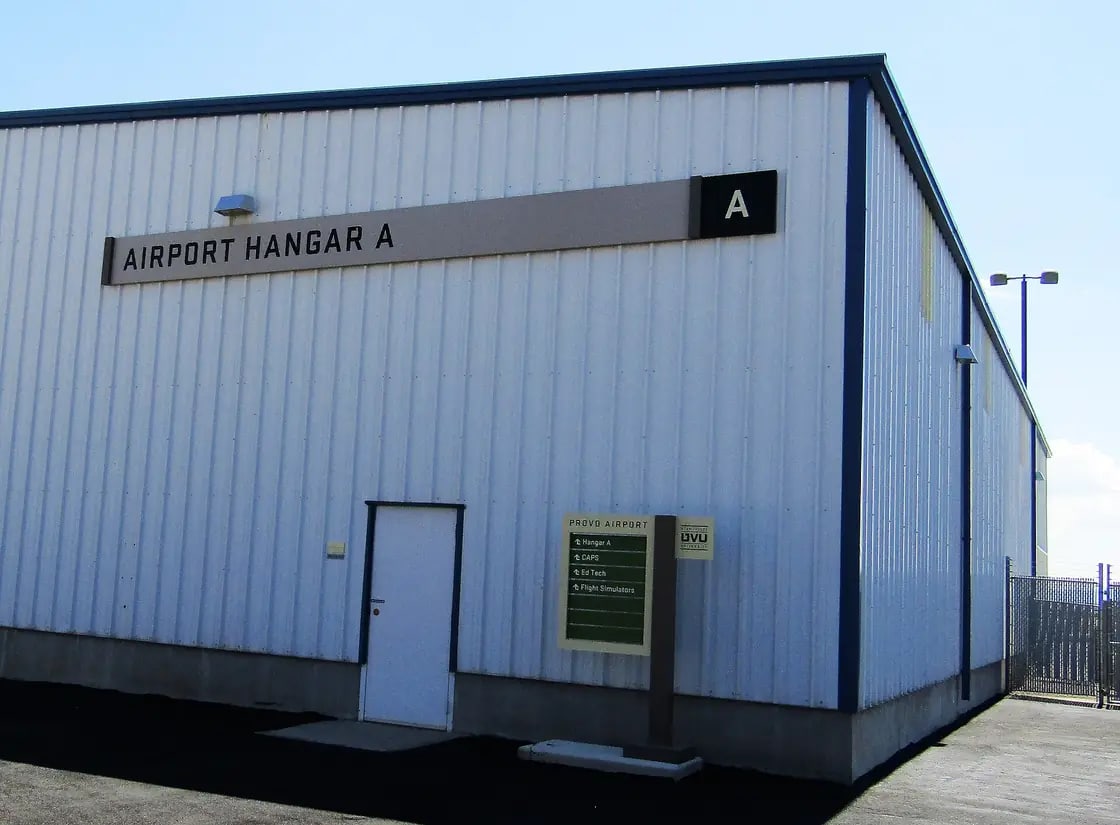
UVU runs a full aviation school out of a dedicated campus at the airport, about seven miles south of the main Orem campus. Students earn four-year degrees while completing FAA flight certification, and graduates leave for airlines, cargo carriers, and corporate flight departments.
The scale is what surprises people: 25 aircraft, simulators, in-house maintenance, and enough daily flying to be a major share of the traffic at a commercial airport.
What you can study
The program is broader than "learn to fly," and the distinction between its tracks is the single most useful thing for a prospective student to understand.
Bachelor of Science, Professional Pilot. This is the flying degree. FAA flight training is built into the curriculum, and graduates leave with a minimum of a Commercial Pilot Certificate. Students can use electives to stack additional ratings on top of that, up through multi-engine instructor. It's the track that leads to an airline cockpit, and it's the one with the flight costs attached.
Aviation Administration / Management. The ground-side degree — the operational, business, and regulatory side of the industry. Airports, airlines, and aviation companies employ far more people who don't fly than people who do, and this is the path into those roles. It carries no flight training requirement, which also makes it the track available to students whose medical certification or budget rules out the cockpit.
Associate degrees. A shorter path, including an Associate of Applied Science that does involve flight training.
Online options. Both bachelor's degrees are offered online as well as on campus. For the Professional Pilot track, online students complete the academic coursework remotely and do their flight training at an FAA-approved school of their choosing anywhere in the country. That flexibility is real and it's how the program reaches students who will never set foot in Utah — but be clear-eyed about the tradeoff: you're getting UVU's curriculum and someone else's flight instruction, and UVU explicitly does not vet or partner with those outside schools.
One boundary worth stating plainly: UVU does not train helicopter pilots. Rotorcraft certificates earned elsewhere can transfer in toward the management degree and the associate program, but there is no helicopter flight training here.
The fleet, and why it matters
Twenty-five aircraft, built around two types.
The Diamond DA40 XLT is the primary single-engine trainer — a modern composite aircraft rather than the aging Cessnas that populate a lot of flight schools. The Piper PA-44 Seminole handles multi-engine training. Both are equipped with glass-cockpit avionics, meaning students learn on the computerized flight displays they'll encounter professionally rather than on analog gauges they'd have to unlearn.
Behind the flying, the school runs its own maintenance operation. Doing it in-house means aircraft downtime is managed by the same organization that schedules the training, which is the difference between a grounded plane costing you a week and costing you a semester.
Ask whether a given course runs under the FAA's structured Part 141 curriculum, which permits certain certificates at lower flight-hour minimums than the open-ended Part 61 path most independent instructors use.
Add flight simulators and the picture is a program built to move students through certification efficiently, which is the whole ballgame in an industry where every additional flight hour is billed.
Getting in is the hard part
This is where prospective students most often misjudge the situation. Being admitted to UVU does not admit you to flight training. They're separate processes, and the second one is competitive.
To be considered for flight training, you generally need to:
- Already be admitted and enrolled at UVU
- Meet the program's prior-coursework requirement, which an aviation advisor can explain
- Hold the FAA medical certificate the program specifies
- Meet the program's minimum age to begin flying
Selection runs into the private pilot ground course first; students accepted into it are then required to take the private pilot flight course the following semester. Application windows open on fixed dates each semester and stay open about three weeks — miss the window and you wait a full term.
The constraint nobody mentions until it's relevant: the program is currently not accepting new students directly into commercial, multi-engine, or flight instructor training, and direct entry into instrument training is limited and requires an advisor conversation. If you arrive with ratings already in hand expecting to plug in at your level, that may not be available. This reflects capacity in a program with more demand than airplanes, and it's the kind of thing that changes — which is exactly why you should confirm it with an aviation advisor rather than trusting any article, this one included.
The money conversation
UVU lists academic tuition and flight training fees separately, and there's a reason nobody publishes a single confident number for what a pilot certificate costs there.
Flight training is billed by the hour. How many hours you need depends on weather, aircraft availability, scheduling, and — more than students expect — how thoroughly you prepare between lessons. Two people in the same cohort can finish the same certificate with a meaningful gap in total cost, and the FAA's published minimum hours are a floor that very few people land on.
What's fair to say:
- The Professional Pilot track costs substantially more than the management track, because flight fees stack on top of tuition.
- Federal financial aid applies, and for students flying at UVU's own Provo facility, flight training costs fall within that allotment.
- The program is VA-approved, with real conditions attached. Where you fly and which courses are covered both affect eligibility. Veterans should have this conversation with a UVU advisor early, not after enrolling.
- Budget above the estimate. Every experienced flight student says this and every new one discovers it independently.
For current rates, UVU's aviation tuition page is the only source worth trusting; anything secondhand ages badly.
What the path looks like
Prospective students often picture four years of flying. The reality is a staircase of discrete FAA certificates, each with its own written exam, oral exam, and checkride with an examiner, stacked on top of a normal course load.
The rough sequence:
Private pilot comes first — ground school, then flight training to the point where you can fly a single-engine aircraft solo and carry passengers. This is the certificate that separates people who finish from people who don't, and it usually arrives in the first year or two.
Instrument rating follows, and it's the one working pilots describe as the genuine difficulty spike. Flying by reference to instruments alone, in cloud, on air traffic control clearances. It's also the rating that makes you useful, because weather stops being a hard stop.
Commercial certificate is the legal threshold for being paid to fly, and it's what the Professional Pilot degree guarantees at graduation. Multi-engine and flight instructor ratings sit on top as electives.
Then comes the part the degree doesn't cover: hours. Airlines require far more flight time than a degree produces, and the standard bridge is instructing — newly certificated instructors teach the next cohort of students while building their own totals. That's a real job with modest pay that typically runs a year or two, and it's why a graduating flight student is not yet an airline pilot.
Restricted-ATP provisions do shorten that runway for graduates of approved four-year collegiate programs relative to the general 1,500-hour rule, which is a substantial part of the case for doing this through a university at all rather than an independent flight school. Confirm the current qualifying requirements with an advisor — the details are specific and they've been revisited before.
The student experience, honestly
A few things that current and former students consistently raise, worth weighing before committing.
The commute is real. The airport campus is seven miles from Orem, and a schedule mixing general education courses in Orem with flight blocks in Provo means driving between them regularly. Students without reliable cars find this difficult; our UVU commuter guide covers the general problem, but flight students have a harder version of it.
Scheduling is the constraint, not ambition. Aircraft, instructors, and weather all have to line up. Winter inversions and summer thunderstorms both cancel lessons, and a canceled flight isn't easily rescheduled into a full block. Students who treat flight training as something to fit around everything else tend to fall behind and pay for it twice — once in time, once in the extra hours that skill decay requires.
Ground preparation is where the money is saved. The single most repeated piece of advice from people who finished efficiently: arrive at each lesson having already chair-flown it. Hours spent on the ground are free. Hours in the airplane are not.
Why the valley hears it
Now the part that affects people who will never enroll.
UVU's flight operations are a large share of the traffic at Provo Municipal Airport. Training flights aren't like commercial departures — a student pilot practicing landings flies the same rectangular circuit over and over, which is why the same aircraft appears to pass your house repeatedly on a Tuesday afternoon. That's not a problem with the plane. That's the lesson.
The school is aware of the friction and has taken steps: designated training and practice areas that route flying away from the denser parts of the valley where possible, and altitude floors over those areas. Whether that's sufficient depends a great deal on which neighborhood you live in, and it's a live topic on the west side as housing pushes closer to the field.
It also intersects with the airport's own growth. PVU has been through a significant terminal expansion and its commercial service has expanded well beyond what the old facility could handle — our guide to flying out of Provo Airport covers the passenger side of that story. More commercial traffic and a large training operation share one field, and the tension between them is a permanent feature rather than a passing phase.
Is it worth it?
For the right student, the case is strong. This is a large, well-equipped, established program with a fleet that isn't held together with hope, maintenance handled in-house, and industry relationships — the school cites partnerships with ten airlines — that matter in an industry where hiring runs in cycles and connections shorten the wait.
The honest caveats belong next to that.
Aviation hiring is cyclical, and the pipeline you enter as a freshman is not necessarily the market you graduate into. Airline hiring booms and freezes have both happened inside a single four-year degree.
The debt is real. Flight training on top of tuition produces a number that requires a genuine plan, particularly given that the first jobs after certification — most commonly instructing — pay modestly while you build hours.
The medical certificate is a gate, not a formality. Conditions that don't affect ordinary life can affect certification. Anyone considering the professional pilot track should pursue the medical early, before committing money to a degree path that depends on it.
And the management track deserves more consideration than it gets. Students arrive wanting to fly and treat administration as the consolation prize. The industry does not see it that way, and the careers on that side are stable, well compensated, and considerably less exposed to hiring cycles and medical certification.
The bigger picture
Utah Valley's economy gets described in terms of software, universities, and construction. The aviation school is a genuine fourth thing — a program pulling students from across the country and internationally into a small airport on the shore of Utah Lake, and sending them out into an industry that has nothing to do with the valley itself.
It's sitting in plain sight two miles from downtown Provo, and most residents know it only as the noise. Worth knowing what the noise is.
It's also, for a certain kind of teenager in this valley, the most accessible route into a career that usually looks like it belongs to somebody else. A degree, a medical certificate, and a lot of early mornings at a small airport on the edge of a lake — that's the whole entry requirement. Comparatively few industries with that ceiling have a front door this close to home.
For everything else about the university — housing, commuting, the campus itself — the UVU guide is our hub, and BYU vs. UVU is the honest comparison for anyone choosing between the two.
The credential that matters here is not the university's
Anyone comparing flight programs runs into a confusing pile of approvals, and it is worth being clear about which one governs what you can do with the training.
A university's institutional accreditation — for UVU, by the Northwest Commission on Colleges and Universities — applies to the institution as a whole. It is what makes credits transferable and federal financial aid possible, and it is a real and meaningful standard. What it explicitly does not do is certify individual programs. NWCCU is not a programmatic accreditor, and an institution's accreditation is not a statement about any particular department's quality, its equipment, or its outcomes.
For flight training, the operative approval is the Federal Aviation Administration's, under the certificate structure described above. That is the credential that determines what a training course can count for, what minimum hours apply, and what the FAA will recognize when you present your logbook. A degree and a certificate are separate things earned under separate authorities on separate timetables, and it is entirely possible to hold one without the other.
This has a practical implication when comparing schools. Marketing materials frequently list accreditations in a single block, mixing institutional accreditation, FAA approvals, and membership in industry associations as though they were the same category of assurance. They are not. Institutional accreditation is the floor for the academic side. The FAA certificate governs the flying. Industry association membership is generally not an accreditation at all.
If you are evaluating this or any other collegiate flight program, the questions worth asking are specific rather than general: what the FAA approval actually covers, how the degree and the certificates are sequenced, and what happens to your training if you change institutions midway. Those answers vary by program and by year, and none of them can be read off a university's institutional accreditation status — which is the assurance most commonly cited and the least relevant to the cockpit.
Related Guides
- The UVU Guide
- Flying from Provo Airport (PVU): The Complete Guide
- BYU vs. UVU: An Honest Comparison
- UVU Commuter Survival Guide
- A First-Generation Student's Guide to UVU
- The UVU Wolverines Game-Day Guide: The Den, Free Tickets & the New Big West Era
- UVU Student Guide (2026): Housing, Parking, Costs & Campus Life
- UVU for Students 25 and Older: The Working Adult's Guide to Going (Back) to School
Frequently Asked Questions
Where is UVU's aviation program located?
How many planes does UVU have?
Can anyone enroll in UVU flight training?
Does UVU accept transfer students into advanced flight training?
How much does UVU flight training cost?
Does a university's accreditation say anything about the quality of its flight program?
What is the credential that governs flight training?
What should you ask when comparing collegiate flight programs?
Sources
The facts in this guide were checked against these sources. Hours, fees and rules change, so confirm anything time-sensitive with the source before you go. How we make Provo.com.
- Provo Airport Board Meeting minutes, March 27, 2024, Provo Airport Board (Utah Public Notice Website). Checked October 12, 2026.
- School of Aviation Sciences, Utah Valley University. Checked October 12, 2026.