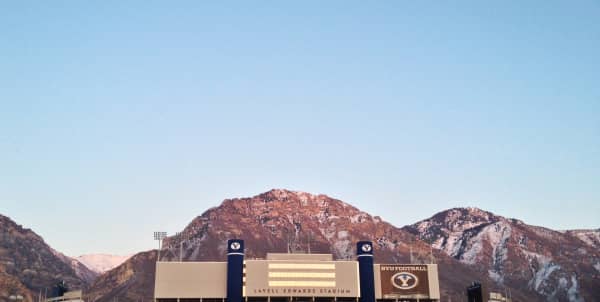
BYU vs Iowa State: the fixed details
- Date
- Friday, October 9, 2026
- Kickoff
- 8:15 p.m. MDT · ESPN
- Where
- LaVell Edwards Stadium, 1700 N Canyon Rd, Provo
- Listing
- On the events calendar, which links to this guide
The four things that are the same at every home game
These do not change from game to game, and they are where most first-time problems happen. Each has its own guide rather than being restated on every hub.
- The clear-bag policy turns people away at the gate at every single game, and it is the most common avoidable ruin of a Saturday. See our BYU football game day guide.
- Parking fills earlier than almost anyone expects, and the lots that look closest are not the ones that clear fastest afterward. See our game-day parking guide.
- BYU is a dry campus and that is not suspended for a big opponent or a night kickoff. See our BYU football game day guide.
- The stadium's own layout rewards knowing before you arrive: where to enter, where the shade is, and what the concourses are like. See our LaVell Edwards Stadium guide.
The rest of the 2026 home slate
- Saturday, September 5, 2026 BYU vs Utah Tech Played
- Saturday, September 12, 2026 BYU vs Arizona Played
- Saturday, October 17, 2026 BYU vs Notre Dame Played
- Saturday, October 31, 2026 BYU vs Arizona State Kickoff TBA
- Saturday, November 14, 2026 BYU vs Baylor Kickoff TBA
- Saturday, November 28, 2026 BYU vs Cincinnati Kickoff TBA
Every home game also has a dated entry on the events calendar, and the season as a whole is covered in our 2026 season preview. Visiting for the first time? Start with the visiting fan's guide to Provo.

Final score: BYU beat Iowa State 24-10 on Friday, October 9, 2026, at homecoming. The next home game is Arizona State on Saturday, October 31, at 1:30 p.m. on FOX; see the BYU vs. Arizona State game-week guide. The advice below still applies to any weeknight kickoff.
Almost everything written about attending a BYU home game assumes a Saturday. Saturday is when the valley organizes itself around football: people wake up without work, drift toward campus through the morning, and the whole day bends around the kickoff.
This one is on a Friday, with a late kickoff, and that single change breaks most of the usual advice.
A Friday night game is not a Saturday game moved. It is a different event, attended by people coming from somewhere else, arriving under different traffic conditions, eating on a different schedule, and leaving at an hour when much of the valley has already closed.
The Things That Are the Same Every Home Game
Four things do not change from game to game, and they are where most first-time problems happen. Rather than restate them here, they have their own guides.
The no-bag policy (only a small clutch no larger than 5" x 8" x 1"; clear stadium totes are not allowed) turns people away at the gate at every single game, and it is the most common avoidable ruin of a Saturday. The parking fills earlier than almost anyone expects, and the lots that look closest are not the ones that clear fastest afterward. BYU is a dry campus, and that is not suspended for a big opponent or a night kickoff. And the stadium's own layout — where to enter, where the shade is, what the concourses are like — rewards knowing before you arrive.
Our BYU football game day guide, game-day parking guide and LaVell Edwards Stadium guide cover all of it properly. What follows on this page is only what is different about this particular game.
The Commute Is the Real Problem
On a Saturday morning, the traffic heading toward campus is almost entirely football traffic. On a Friday evening it is football traffic layered on top of one of the week's heaviest ordinary commutes.
I-15 through Utah County on a Friday afternoon is already slow. University Parkway and the approaches to campus are already carrying people going home. Add tens of thousands of people converging on the same few streets and the result is not additive, it is worse than additive — congestion compounds once intersections start backing up.
The practical implication is that the buffer you would use for a Saturday game is too small. Whatever time you would normally leave, leave substantially earlier, and expect the last mile to take a disproportionate share of it.
It also means the approach you choose matters more than usual. The route that is fastest at ten in the morning is not necessarily the one that is fastest at six in the evening, because the bottleneck has moved.
Coming Straight From Work
A large share of the crowd at a weeknight game arrives directly from a workday rather than from home, and that changes the logistics in ways people do not anticipate.
You will not be able to go home first and change. Whatever you are wearing at five is what you are wearing at eleven, in a stadium that gets cold once the sun is down. The single most common mistake at a weeknight game in October is dressing for the afternoon you left the office in rather than the night you are going to sit through.
You also will not have had dinner. The food situation at a late kickoff is different from a midday one: you are not looking for lunch before a game, you are looking for dinner either well before or well after, and the places near campus will be at their busiest precisely when you want them. Our guide to where to eat around a BYU game covers the options and which ones survive a crowd.
And if you are coming from work, think about where you are leaving the car. Parking on campus is a different proposition when you arrive during business hours rather than on a quiet Saturday morning, because some of the space is still doing its ordinary job.
The Game Ends Late
A late kickoff means a late finish. A college football game runs longer than people remember — three hours and more is normal once television timeouts and reviews are included — and the clock does not care that it is a school night.
Work backward from that rather than forward from kickoff. If the game ends near midnight, you are leaving a parking lot with sixty thousand other people near midnight, and the exit is slower than the arrival because everyone leaves at once. Getting home is comfortably an hour-plus proposition for anyone not walking.
For families this is the decisive question. A child who is fine at a one o'clock Saturday kickoff is a very different proposition at eleven at night, four hours into a cold evening. Plenty of families go and leave at the end of the third quarter, which is a perfectly reasonable plan and beats a miserable fourth quarter.
Food afterward is also thin. Provo is not a late-night city, and the places that are open after a late game are a short list. Our guide to late-night food in Provo is the relevant page, and the short version is: decide before the game, not after it.
Friday Night Is High School Night
There is a local wrinkle that visiting fans will not anticipate. In Utah, Friday night in the fall belongs to high school football. Every community in the valley has a game, and for a lot of families that is the fixed point of the week.
That matters in two directions. If you have a student athlete or a child in a marching band, a Friday BYU game conflicts directly rather than sitting alongside. And around the valley, the usual Friday-night traffic and parking near high schools is still happening, independent of anything at BYU.
It also thins out some of the local crowd in a way a Saturday would not, and changes who is in the stands.
Tailgating in the Dark
Tailgating before a late kickoff is a different activity. It happens after sunset rather than in the sun, in October, at altitude, which is a combination that surprises people who have only done this in September.
The temperature drop after sundown here is sharp — high desert at altitude loses heat fast once the sun is off the valley floor. Bring considerably more warmth than the daytime forecast suggests, and bring it for sitting still, which is colder than standing around.
Lighting is the other thing. A tailgate that starts in daylight and runs into the dark needs a light source, and phone flashlights run batteries down before a game you will want the phone for.
Iowa State, and What a Big 12 Friday Means
Iowa State is a Big 12 opponent, which means this is a conference game rather than a non-conference tune-up, and conference games carry standings consequences that non-conference games do not.
Friday slots in college football are typically television decisions. A game moved to Friday night is a game a network wanted in a standalone window, which usually means a larger audience than the same game would draw buried among a dozen Saturday kickoffs. That tends to raise the atmosphere in the stadium.
For visiting fans, a Friday game also means a different trip shape — usually a Thursday or Friday arrival and a Saturday departure, rather than the Friday-in, Sunday-out pattern of a Saturday game. Our hotels near BYU guide covers where to stay, and the booking pressure on a Friday night differs from a Saturday.
If You Are Not Going
Most people reading this will watch rather than attend, and a Friday night game is easier to watch out than a Saturday one, because the places that show it are not competing with a full day of other games.
Our guide to where to watch sports in Provo covers the rooms. The thing to know for a Friday is that they fill from the end of the workday rather than gradually through the morning, so the window in which you can walk in and get a table is narrower and earlier.
At home, a late kickoff is the easiest game of the season to host, because nobody has to give up a Saturday for it.
What a Conference Home Game Actually Means
It is worth separating a conference game from the non-conference games earlier in a season, because they are different products.
Non-conference games are scheduled years ahead, often for money or for a marquee matchup, and a loss in one is disappointing without being structurally damaging. Conference games decide the standings. They determine who plays for a conference championship, which in turn shapes access to the postseason. A home conference game is the kind a team cannot afford to drop, and everyone in the building knows it.
That changes the atmosphere in a way that is noticeable from the stands. Non-conference crowds are looser. Conference crowds are more invested, louder at the right moments, and more anxious. For a first-time visitor, a conference home game under lights is the version of this stadium worth seeing.
It also changes ticket demand. Conference games against opponents whose fans travel in numbers are harder to get into than a September non-conference game, and that pressure arrives earlier. Our BYU football tickets guide covers how tickets work here and the rules that sit underneath resale.
The Student Section Under Lights
BYU's student section is a large part of what the stadium sounds like, and a night game is when it is at its best.
Part of that is simply that students are more available on a Friday evening than on a Saturday morning — nobody is choosing between the game and a shift or a study block in the same way. Part of it is that a night crowd behaves differently anywhere; darkness, lights and a full stadium produce more noise than the same people in daylight.
For anyone sitting near the student end, it is worth knowing what you are buying: standing for most of the game, considerable volume, and an experience that is much more fun than watching from a quiet corner. For anyone who would find that tiring, the far side of the stadium is a different afternoon entirely, and it is worth choosing deliberately rather than discovering it after you sit down.
Older Attendees and Anyone With Mobility Needs
A late kickoff raises the difficulty of a game day for anyone who finds the walking, the stairs or the cold hard, and it is worth planning for rather than hoping.
The distances at this stadium are real — from the further lots it is a substantial walk, and it is a walk back in the dark and the cold at the end. The concourse stairs are the other pinch point, and they are busier and slower at the end of a night game than at the end of an afternoon one.
If that describes anyone in your group, the things that help are: arriving early enough to walk slowly rather than being carried along by a crowd, parking with the exit in mind rather than the entrance, and deciding in advance whether leaving a few minutes before the end is the right call. Our LaVell Edwards Stadium guide covers accessible seating and entry.
What a Weeknight Does to the Rest of Provo
A Friday night home game reshapes the evening across the city, not just on campus.
Restaurants near campus get a compressed rush rather than the long, rolling Saturday one — everyone wants to eat in the same ninety minutes before kickoff, and then the same places are quiet during the game and swamped again briefly afterward. If you are eating out and not going to the game, the counterintuitive move is to eat during the game, when the rooms are emptiest.
Downtown Provo, which is a mile or so from the stadium, feels it less than the immediate campus area but still feels it. And the residential streets around campus carry game parking on a night when residents are home, which is a different dynamic from a Saturday when many are out.
Planning It Backward
The approach that works for a weeknight game is to plan from the end rather than the start.
Decide when you need to be home, and whether that is compatible with a game that finishes near midnight. Decide who in your group is going to enjoy hour four in the cold. Decide where dinner is happening before you leave, because improvising near campus at six on a Friday does not work. Then, and only then, work out when to leave.
Done that way, a Friday night game is one of the best atmospheres of the season. Done as a Saturday plan with the date changed, it is a long, cold, hungry evening that ends in a parking lot.
One More Thing About Night Games
There is a reason people who have been to both will tell you a night game is the one to pick, and it is worth saying plainly because it partly offsets everything difficult above.
A stadium under lights is a different place. The mountains go dark and stop competing for your attention, the field becomes the only bright thing in your field of view, and the crowd noise behaves differently once there is nothing else to look at. Daylight games here are scenic; night games are atmospheric. They are not the same experience and most people prefer the second one.
That is the trade being offered. A Friday night kickoff costs you a difficult commute, a late finish, a cold four hours and a limited dinner. What it buys is the best version of this stadium. Whether that is a good trade depends entirely on who is in your group, which is the honest answer rather than a recommendation either way.
If you have only one home game in you this season and you do not have small children, this is a strong candidate. If you have a five-year-old and a school run on Saturday morning, an earlier Saturday kickoff will serve you better and there is no shame in saying so.
The Short Version
BYU hosts Iowa State on a Friday night with a late kickoff, and the weeknight slot is the whole story. Traffic is worse because football traffic lands on top of the ordinary Friday commute. Most of the crowd arrives straight from work, which means no chance to change and no dinner beforehand. The game ends near midnight in a valley that closes early, so the exit and the drive home are long and the food options afterward are few. Dress for a cold October night rather than the afternoon you left in, bring light for a tailgate that runs into the dark, and expect a conflict with Utah's own Friday-night high school football. Everything else — bags, parking, the dry campus, the stadium itself — works the way it does at every home game, and those guides are linked above.
Related Guides
- BYU Football Game Day Guide
- BYU Football Game-Day Parking
- LaVell Edwards Stadium Guide
- Where to Eat Around a BYU Game
- Where to Watch Sports in Provo
- Hotels Near BYU
- BYU vs Notre Dame Game-Week Guide
Frequently Asked Questions
When does BYU play Iowa State?
Why is the game on a Friday instead of a Saturday?
How much earlier should I leave for a Friday night game?
What time will the game finish?
Is a Friday night game a good idea with young children?
What should I wear to an October night game in Provo?
Does a Friday BYU game conflict with high school football?
Where can I eat after a late finish?
Sources
The facts in this guide were checked against these sources. Hours, fees and rules change, so confirm anything time-sensitive with the source before you go. How we make Provo.com.
- BYU, Big 12 announce 2026 football schedule, BYU Athletics (byucougars.com). Checked October 12, 2026.
- LaVell Edwards Stadium, BYU Ticket Office (tickets.byu.edu). Checked October 12, 2026.
- BYU Security (security.byu.edu): Tailgating, BYU Security (security.byu.edu). Checked October 12, 2026.
- BYU Football 2026 Schedule, BYU Athletics. Checked October 20, 2026.