
Every Big 12 road trip has its own personality. Ames is a cornfield cathedral, Fort Worth is brisket and boots, Morgantown burns couches. Provo's personality is this: the most dramatic stadium backdrop in the conference, the politest 62,000-person crowd you'll ever hear at full volume, and a set of local rules about alcohol and Sundays that will either amuse or ambush you depending on whether anyone warned you first.
For the Notre Dame game on October 17, ESPN's College GameDay broadcast from Provo that morning, and BYU won 28-24 that night. Consider this guide your warning, and your itinerary. It's written for the traveling fan bases on the 2026 schedule (Arizona, Iowa State, Arizona State, Baylor, and Cincinnati, plus Notre Dame's first visit in over two decades and Utah Tech's opener), but the advice holds for any visiting supporter in any season.
Getting here: the two-airport decision
Salt Lake City International (SLC) is the obvious play — a major Delta hub with nonstops from every Big 12 market, about 50 minutes north of the stadium straight down I-15. Rental cars are plentiful, and the drive south gives you the full Wasatch Front panorama as an opening act.
Provo Airport (PVU) is the one many visiting fans don't know exists, and it's ten minutes from the stadium. Three airlines serve it — Allegiant, Breeze, and American (operated by SkyWest, connecting through American's hubs). It's a single small terminal where the walk from curb to gate takes minutes. Route-specific notes for 2026's visitors: Allegiant flies Provo–Phoenix/Mesa, which puts Arizona and Arizona State fans one cheap nonstop from the stadium, and American's hub connections cover everyone else with one stop. If PVU has a route that works for you, take it; the time you save on both ends is measured in hours.
Driving? Provo sits on I-15, an easy shot from Las Vegas (about 5½ hours) or Denver via I-80/US-40. One timing note that recurs throughout this guide: the Friday-evening drive down I-15 from Salt Lake is slow, and for the Friday-night Iowa State game on October 9 it was very slow. Our game-day parking and traffic guide covers the last mile in detail.
Where to stay
The honest hotel picture: Provo's supply is modest for a stadium this size, and the marquee weekends (Notre Dame above all in 2026) sell out months ahead at prices that would make a Dallas concierge blush.
- Downtown Provo is the best experience if you can get it: you're a 15–20 minute walk from the stadium, which converts the worst part of game day (postgame traffic) into a pleasant stroll, and you're on top of Center Street's restaurants. Our where to stay in Provo guide breaks down the specific options, and the hotels near BYU guide names the two properties you can walk to the stadium from.
- Orem and the University Parkway corridor hold most of the valley's chain-hotel inventory, ten to fifteen minutes from the stadium — with UVX bus rapid transit running the corridor directly to the stadium's doorstep.
- Salt Lake City works if nightlife matters to you — it has the bar scene Provo doesn't — at the cost of the I-15 drive each way.
Booking rule of thumb for 2026: Arizona, Baylor, and Cincinnati weekends are normal-demand. Notre Dame weekend (Oct. 17) was its own economy.
The alcohol chapter, without the eye-rolling
Let's do this factually, because half the internet's advice on this subject is either outdated or written for laughs.
The stadium and campus are completely dry. No beer sales inside, no alcohol in the tailgate lot, none anywhere on university property. This is not selectively enforced or wink-wink; it's simply how it is, and the tailgate culture — smoked meat, lawn games, multi-generational family setups — has grown up around it. Many visiting fans report it's the most welcoming pregame scene in the conference, in part because nobody's twelve beers deep by 11 a.m.
Off campus, Provo is not dry. The city has one true free-standing bar — ABG's Libation Emporium, 190 W Center Street, a proper dive with pool tables, pinball, a long beer list, and live music on Friday nights. Beyond ABG's, drinking happens at restaurants with liquor licenses — Slate — inside the Provo Marriott at 101 W 100 N, a block off Center Street — has a lounge, and several spots along the Riverwoods and University Parkway corridor serve at the bar — and at the Owl Bar up Provo Canyon at Sundance, a genuine 1890s saloon with Butch Cassidy lore. Utah's licensing rules draw a hard line between "bar" and "restaurant that serves," which affects entry ages and whether you'll be asked to order food; don't take it personally, it's the license talking.
The number that matters: Utah's DUI limit is 0.05% blood alcohol — the strictest in the United States, and lower than many visitors' home-state intuition of 0.08%. For a lot of adults that's meaningfully less than two drinks. If your game weekend includes drinking, it should also include a designated driver or a rideshare budget, full stop.
For the complete picture of Provo after dark — including the surprisingly strong alcohol-free scene built around Velour, Dry Bar Comedy, and Center Street — our Provo nightlife guide is the deep dive.
Game day, from a visitor's chair
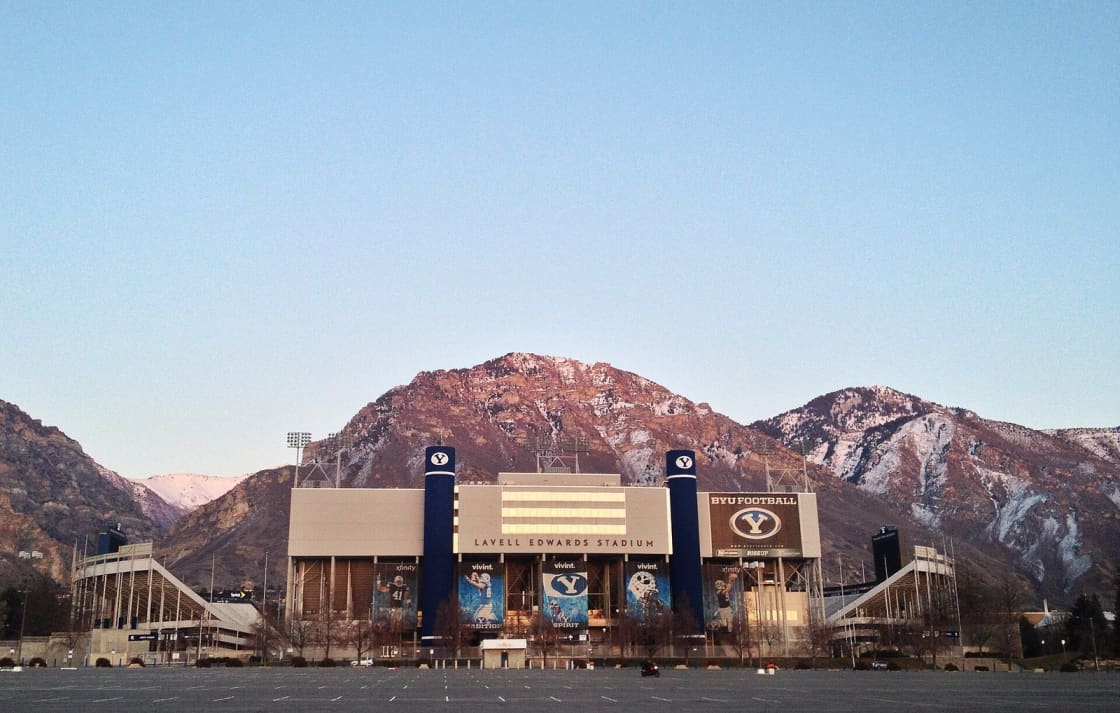
The setting first, because it's the thing you'll talk about afterward: LaVell Edwards Stadium sits directly against the Wasatch Mountains, and from the west stands the peaks rise straight out of the east end zone. For the October games, the mountainsides are mid-fall-color. There is no better-looking place to watch football in the Big 12, and that is not homerism — ask any national broadcast crew that's set up here.
The crowd is the second thing. Loud — the student section in the south end zone brings real noise — but conspicuously courteous to visitors. Wear your colors; you'll collect conversations, not confrontations. Cougar Canyon, the pregame festival west of the stadium, opens hours before kickoff and is open to everyone, visiting fans very much included.
Practicalities: the stadium enforces a strict small-clutch-only bag policy (5" × 8" × 1"), outside chairs and outside food are prohibited, and any ticket works at any gate, so if one line is long, walk to another. Where to park, when lots open, RV rules, and the transit play-by-play all live in our parking and traffic survival guide; where to eat before and after lives in our game-day dining guide.
Weather by date, 2026 edition: the Utah Tech and Arizona games (early-to-mid September) can be legitimately hot — Provo Septembers still touch the 90s — while the Arizona State game lands on Halloween with fast-cooling evenings, and Baylor (Nov. 14) and Cincinnati (Nov. 28) are layer-and-beanie territory with snow possible. At this elevation the temperature falls off a cliff when the sun drops behind the mountains, so every game after mid-September needs a warm layer regardless of the forecast high. Our Provo weather guide explains why the forecasts you'll read disagree with each other.
The Sunday problem (and it's only a problem if nobody told you)
Games are Saturdays; most visiting fans fly home Sunday. Here's what Sunday looks like in Provo: most locally owned restaurants and many businesses are closed, a reflection of the area's LDS culture. Chains stay open, some independents do, hotel restaurants do, and there's a workable list in our guide to restaurants open on Sunday in Provo — but the leisurely Sunday brunch crawl you'd do in another college town isn't on the menu here. The practical moves: eat your big meals Friday and Saturday, and if you fly out Sunday, plan on hotel breakfast or a chain rather than hunting downtown for a table that isn't there.
Worth the extra day
If your trip has any slack in it, the mountains are the reason to use it:
- Hike the Y. The switchback trail above campus climbs to the giant concrete Y with the whole valley — stadium included — spread below. It's the classic visiting-fan photo, about two hours round trip, and our Y Mountain trail guide has the details.
- Drive Provo Canyon. US-189 past Bridal Veil Falls to Sundance and on to Deer Creek Reservoir is a spectacular hour even without stopping — and for the October games, the fall color on this drive is the best free show in Utah. The Deer Creek and Jordanelle guide covers the lakes if you have longer.
- Sundance Mountain Resort runs its lift for fall scenic rides and holds the Owl Bar mentioned above — a legitimately great late-afternoon detour before a night game. (And no, the film festival isn't here anymore — its final Utah edition was early 2026 before the move to Boulder — but the resort was always a separate thing and remains very much open.)
- Center Street is the walkable downtown core: dinner, the best restaurants in town, live music at Velour, a block up University Avenue — the all-ages live-music room — and ABG's on Center Street for the nightcap.
One caution for the Cincinnati traveling party: your game falls on Thanksgiving weekend, when some local restaurants run holiday hours even on Saturday. Call ahead rather than assuming.
Come for the football. But the visitors who leave raving about Provo are almost never raving about the parking or the pregame — they're raving about a mountain range that starts where the bleachers end, a crowd that asked about their flight, and a Saturday that felt different from every other stop on the conference map. Lean into the difference; it's the whole point of a road trip.
The altitude is a planning input, not a souvenir fact
Provo sits at roughly 4,500 feet, and the stadium is higher still on the east bench. Visiting supporters from Cincinnati, Houston, Orlando or anywhere else near sea level tend to file this under trivia and then spend Saturday wondering why they feel rough.
The dryness does more than the elevation. Utah Valley air is arid, and the water you would normally lose slowly you lose quickly here — including overnight. The single most effective thing a visiting fan can do is drink more water on the Friday than feels necessary, before the game rather than during it. Arriving already behind is the common version of this mistake.
Sun exposure is stronger than the temperature suggests. A seventy-degree afternoon at this elevation burns like a warmer one at sea level, and a single-tier bowl offers less shade than a stadium with an upper deck. Sunscreen belongs in the trip, not in the maybe pile.
The overnight swing is large. A warm afternoon can hand over to a cold evening, and visitors packing for the forecast high routinely find themselves underdressed by the fourth quarter of a night game. One layer solves it.
Give the first night away. Sleep is often poorer on the first night at altitude, which matters if you flew in Friday for a Saturday game. It is an argument for landing Thursday if the trip allows, and a good argument against scheduling anything demanding for Friday morning.
None of this is dramatic — Provo is not a mountain town at 8,000 feet — but it is the difference between a fan who enjoyed the weekend and one who remembers being tired.
If you did not get a ticket
Plenty of traveling fans come for the trip rather than the seat, or find their game sold out after they have already booked flights. Provo handles that better than its reputation suggests.
Watching in town is straightforward. The valley has a real bench of places set up for game watching, and our guide to where to watch sports in Provo covers which rooms actually have the screens and the sound on. Expect a different atmosphere from a bar in a conference city with a drinking culture — it is louder than outsiders anticipate and more family-heavy than they expect.
The tailgate does not require a ticket. Cougar Canyon and the lot scene around it are open in a way that surprises visitors; you can experience most of the pregame without going through a gate, then watch the game elsewhere. For a fan who mainly wanted the road-trip experience, that is a legitimate plan rather than a consolation prize.
Resale exists but the walkable window closes early. If you intend to buy on the day, do it before you commit to a parking spot rather than after, because the two decisions interact — a ticket found late is worth much less if it comes with a twenty-minute walk you had not planned for.
A ticketless Saturday frees the best hours of the trip. The canyon drive and the Y hike described below are both better in daylight, and a fan who is not going to the game has the one thing every other visitor lacks: the whole afternoon.
What surprises visiting fans most
Ask traveling supporters what they did not expect from a trip to Provo and the same four answers come back, none of them about football.
How close the mountains are. Not visible in the distance — directly above the stadium. Visitors from flat conference cities consistently underestimate this until they walk out of a gate and look up.
How friendly the interaction is in opposing colors. The absence of hostility reads as strange to fans accustomed to hostile road environments, and it takes most of a day to stop bracing for something that does not arrive.
How early everything happens. The valley starts and finishes its day earlier than most conference cities, and a party looking for a late meal after a night game finds fewer options open than they would at home.
How quiet Sunday is. Covered above, and still the single most common complaint from fans who did not read anything before arriving.
Accessible seating for a visiting fan: the rules on groups, resale and release
Traveling to a road game creates two problems a season-ticket holder never has: you are buying late, and you are buying as a group. Both are covered by a federal rule most fans have never heard of, and it answers questions that otherwise get answered inconsistently by whoever picks up the phone.
The rule is 28 C.F.R. § 36.302(f), part of the Department of Justice's Title III regulation. It governs how accessible seating is sold rather than how it is built.
Buying for a group
§ 36.302(f)(4)(i) is the provision that matters most to a traveling party. For each wheelchair space ticket purchased by a person with a disability — or by someone buying at their request — the venue must make available for purchase three additional tickets for seats in the same row that are contiguous with the wheelchair space, provided three such seats are available at the time of purchase. The venue is not required to provide more than three contiguous seats per wheelchair space, and those seats may include other wheelchair spaces.
The subsection then handles the cases that arise.
Fewer than three contiguous seats left. Under (f)(4)(ii), where patrons may buy at least four tickets and fewer than three contiguous seats remain, the venue must offer the next highest number available and make up the difference with seats as close as possible to the accessible seats.
Ticket limits below four. Under (f)(4)(iii), if a venue caps sales below four seats per patron, it owes a disabled patron only as many seats as it would offer anyone else, including the wheelchair space ticket.
Limits above four. Under (f)(4)(iv), where patrons may buy more than four, a patron with a disability may buy up to the same number, including the wheelchair space ticket.
Larger groups. (f)(4)(v) is the one that matters for a road-trip party: where a group includes someone who needs accessible seating, the group shall be placed in a seating area with accessible seating so that, if possible, the group can sit together — and if the group must be divided, it should be divided so that wheelchair users are not isolated from their group.
Why accessible seats sometimes are not available at all
§ 36.302(f)(5) governs hold and release, and it explains a situation visiting fans meet frequently. A venue may release unsold accessible seating to people without disabilities for their own use only in three circumstances: (A) when all non-accessible tickets have sold, excluding luxury boxes, club boxes and suites; (B) when all non-accessible tickets in a designated seating area have sold and the accessible tickets are released in that same area; or (C) when all non-accessible tickets in a designated price category have sold and the release is within that same category.
(f)(5)(ii) adds that nothing requires a venue to release accessible seating at all. So for a sold-out game, "there are no accessible seats" and "the accessible seats were released" are both possible answers, and only one of them is a reason to ask a follow-up question.
There is a further protection for season tickets. Under (f)(5)(iii)(A), where series-of-events tickets sell out and a venue releases accessible seating to people without disabilities for a series, it must establish a process that prevents the automatic reassignment of that seating to those holders in future seasons — so that disabled buyers who become newly eligible have an opportunity to purchase.
Resale, transfer and the exchange right
Two subsections cover the secondary market, which is where a late-booking road fan usually ends up.
§ 36.302(f)(6) provides that people holding accessible-seating tickets must be permitted to transfer them to third parties on the same terms and to the same extent as other spectators holding the same type of ticket.
§ 36.302(f)(7)(i) requires a venue to modify its policies so that a person with a disability may use a ticket acquired on the secondary market on the same terms as anyone else. And (f)(7)(ii) is the useful one: if a person with a disability acquires a ticket to an inaccessible seat through the secondary market, the venue must make reasonable modifications to allow an exchange for an accessible seat in a comparable location, if accessible seating is vacant at the time the ticket is presented.
That is a right worth knowing about at a gate. Buying resale to a regular seat is not necessarily the end of the matter.
Practical notes for a road weekend
Book the accessible seats at the same stage as everyone else. Under § 36.302(f)(1)(ii)(B) the venue must offer them during the same sales stages, including presales — so the ordinary advice about buying early applies without modification.
Say "group" when you call. The group-seating provision at (f)(4)(v) only operates if the venue knows the party exists.
No one may ask for documentation. § 36.302(f)(8) bars requiring proof of disability; a single-event seller may ask the question, and a series seller may ask for a written attestation.
Bag policies, gate arrangements and ticketing procedures change year to year — verify current details with the venue. For the surrounding logistics see our parking and traffic guide, and for the valley-wide accessibility picture see wheelchair-accessible Utah Valley.
Related Guides
- BYU vs Baylor, 14 November 2026: the game-week guide
- The Jazz Rebuilt Themselves in Five Months: A Utah Valley Fan's Guide to 2026–27
- AJ Dybantsa vs. Darryn Peterson: How the 2026 NBA Draft Left Utah Caught in the Middle
- BYU Football 2026: The Complete Schedule, Home Games, and Season Preview
- BYU Football Game Day Guide (2026)
- Visiting Provo: Start Here
Frequently Asked Questions
Are visiting fans treated well at BYU games?
Can you drink alcohol at a BYU football game?
Where can visiting fans get a drink in Provo?
What airport do you fly into for a BYU game?
Is anything open in Provo on Sunday?
What's the weather like for a game in Provo?
How far is Provo from Salt Lake City?
What should visiting fans do in Provo besides the game?
Sources
The facts in this guide were checked against these sources. Hours, fees and rules change, so confirm anything time-sensitive with the source before you go. How we make Provo.com.
- Utah's DUI Laws, Utah Department of Public Safety, Highway Safety Office. Checked October 12, 2026.
- About the Airport | Provo Airport, UT, Provo City (Provo Airport). Checked October 12, 2026.
- BYU, Big 12 announce 2026 football schedule, BYU Athletics (byucougars.com). Checked October 12, 2026.
- LaVell Edwards Stadium, BYU Ticket Office (tickets.byu.edu). Checked October 12, 2026.
- BYU Football 2026 Schedule and Results, BYU Athletics (byucougars.com). Checked October 20, 2026.
- Allegiant route map (Phoenix/Mesa to Provo), Allegiant Air. Checked October 20, 2026.
- Sundance Film Festival is officially moving to Boulder, Colorado, in 2027, KSL.com. Checked October 12, 2026.