Upcoming dates
BYU vs Baylor: the fixed details
- Date
- Saturday, November 14, 2026
- Kickoff
- Not yet announced. Big 12 television partners set kickoff windows later in the year, so treat any start time you see quoted elsewhere as a guess until BYU publishes it.
- Where
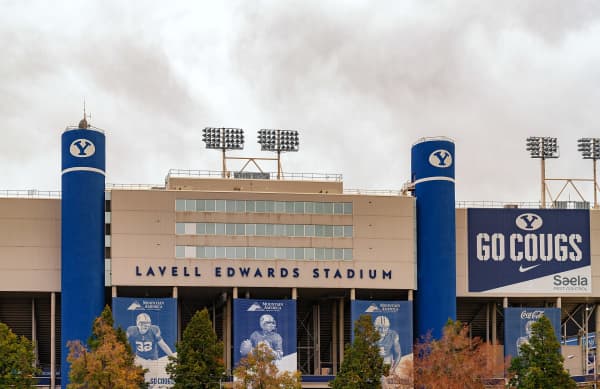
- LaVell Edwards Stadium, 1700 N Canyon Rd, Provo
- Listing
- On the events calendar, which links to this guide
The four things that are the same at every home game
These do not change from game to game, and they are where most first-time problems happen. Each has its own guide rather than being restated on every hub.
- The clear-bag policy turns people away at the gate at every single game, and it is the most common avoidable ruin of a Saturday. See our BYU football game day guide.
- Parking fills earlier than almost anyone expects, and the lots that look closest are not the ones that clear fastest afterward. See our game-day parking guide.
- BYU is a dry campus and that is not suspended for a big opponent or a night kickoff. See our BYU football game day guide.
- The stadium's own layout rewards knowing before you arrive: where to enter, where the shade is, and what the concourses are like. See our LaVell Edwards Stadium guide.
The rest of the 2026 home slate
- Saturday, September 5, 2026 BYU vs Utah Tech Played
- Saturday, September 12, 2026 BYU vs Arizona Played
- Friday, October 9, 2026 BYU vs Iowa State Played
- Saturday, October 17, 2026 BYU vs Notre Dame Played
- Saturday, October 31, 2026 BYU vs Arizona State Kickoff TBA
- Saturday, November 28, 2026 BYU vs Cincinnati Kickoff TBA
Every home game also has a dated entry on the events calendar, and the season as a whole is covered in our 2026 season preview. Visiting for the first time? Start with the visiting fan's guide to Provo.

There are seven home games on BYU's 2026 schedule and each one has a personality. The opener is a warm-up. Arizona is September heat. Iowa State is a Friday night. Notre Dame is the marquee. Arizona State lands on Halloween. Cincinnati is Thanksgiving weekend and the coldest day of the year.
Baylor, on Saturday, November 14, is the one with no gimmick — and that is precisely what makes it worth understanding. It is the last ordinary home Saturday of the season, and it arrives exactly seven days after the rivalry.
The Utah hangover is the real variable
BYU plays Utah in Salt Lake City on Saturday, November 7, 2026. The rivalry sits in the middle of the schedule rather than at the end of it, which means the Baylor weekend is the one that absorbs the aftermath.
This is not a small thing, and it is the part no schedule tells a visiting fan. A win in Salt Lake and the valley spends the following week in an extremely good mood; the tailgate lots fill early, the student section is loud from the first snap, and strangers talk to you in line. A loss and the whole city is quieter in a way you can feel — not hostile, just flat.
If you are coming from out of town and want to know what the atmosphere will be, do not look up Baylor's record. Look up what happened the Saturday before.
Mid-November is a different climate from late November
Provo sits well above 4,000 feet, and the thing that catches people is not the forecast high. It is the drop.
The stadium faces the Wasatch, and once the sun goes behind the ridge the temperature falls hard and fast. A mild afternoon can feel like real cold by the fourth quarter. People arrive in a sweatshirt because the walk from the car was pleasant, and spend the second half shivering.
The practical rule for any BYU game after mid-September is to dress for the second half. In November that means a real layer, not an optimistic one — and if the kickoff time lands in the evening, add another.
What mid-November does not usually mean is snow on the field. That is more of a late-November and December proposition, and it is one of the differences between this game and the Cincinnati finale two weeks later.
The kickoff time probably is not set yet
Four of BYU's twelve 2026 games had confirmed kickoffs and networks when BYU announced the opening window on May 27. The rest, Baylor included, are announced later on a 12-day or six-day notice, and as of mid-October Baylor was still listed as TBA.
Read that as written: a game on November 14 may not have a time until early November. This is the single most common planning mistake visitors make here. Flights get booked around an assumed 1 p.m. kickoff, the window lands at 8:15 p.m., and a day trip becomes an overnight.
If you are traveling, book refundable and confirm on BYU's schedule page once the window is announced.
The canyon is closing down for the year
If your plan was to pair the game with the Alpine Loop scenic drive, mid-November is past it in most years. UDOT typically closes the loop from November through May or June.
Provo Canyon on US-189 stays open year round, and that is the realistic alternative. Bridal Veil Falls is visible from the road and from the paved parkway, and the canyon in November has a stark quality that the summer crowds never see.
The bench trails above the city are usable with traction. The high routes are not. This is the season where the difference between those two sentences starts to matter.
It is the last home game before everything changes
Two weeks later, Cincinnati brings Thanksgiving weekend: family in town, restaurants on holiday hours, and colder conditions. Baylor gets none of that.
That makes this the last weekend of the year when a Provo game day is simply a Provo game day — normal restaurant hours, normal parking, normal traffic, no holiday overlay. For anyone who wants to see what a BYU home Saturday is like rather than what a holiday version of one is like, this is the better of the two remaining dates.
Tickets, and the bag rule that catches people
Two logistical things sit between most visitors and a smooth entry, and neither is about football.
Tickets. A mid-November conference game is not the hardest ticket on the schedule — Notre Dame and the rivalry hold that distinction — which generally makes Baylor one of the more obtainable home dates of the season. Season tickets and singles run through BYU's own ticket office, with additional inventory on secondary markets. Our guide to how the BYU football ticket system works covers the mechanics, the student-section rules, and where the real differences in price come from.
The bag policy. This is the thing that reliably catches first-time visitors, and it catches them at the gate with no good options. The stadium operates a restricted bag policy, and in cold weather it interacts badly with the one habit November encourages: bringing more stuff. Blankets, seat cushions, extra layers and hot drinks all raise the question of what you are carrying them in. Sort that out before you leave the car rather than at the turnstile, where the only remedy is a walk back across the lot in the cold.
Our guide to LaVell Edwards Stadium itself covers the building, the name, and the bag rule in detail. It is the single most useful thing to read before a first visit here, in any month.
Getting there, and the parking reality
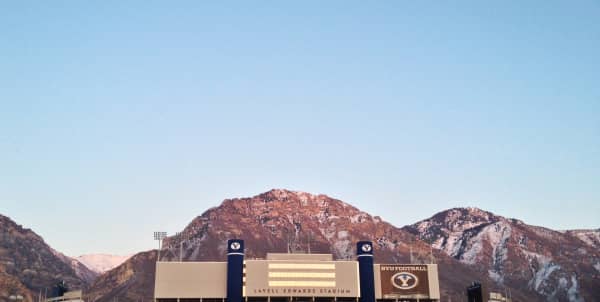
The stadium sits on the north edge of campus with the mountains directly behind it, which is the view every broadcast uses and the reason the place photographs the way it does.
Parking fills from the inside out, and the lots closest to the stadium go first. The reliable move is the same as it is in September: arrive earlier than feels necessary, or park further out and accept the walk. In November that walk is a cold one in both directions, and the return leg happens after dark.
Our visiting fan's guide to Provo covers the two-airport decision, where to stay, and the alcohol and Sunday-hours questions that surprise people arriving from other Big 12 cities.
The layering problem, solved properly
The mistake is treating this as one decision made in the parking lot. It is two decisions, and the second one is the one that matters.
A November afternoon in Provo can be pleasant — the sun at this elevation is strong even when the air is not warm, and the walk from the car often feels like overdressing. Then the sun drops behind the ridge west of the stadium and the radiant heat disappears in minutes rather than gradually. The air temperature has not necessarily moved much. What has gone is everything that was making it feel survivable.
What works is a base layer you will not notice for three hours, an insulating middle layer you can open, and a windproof outer layer you carry rather than wear for the first half. Cold stadium seating draws heat away from you for the entire game — a folding seat cushion or even a folded blanket under you does more than an extra jacket. Hands and ears go first, feet go second, and none of that is affected by how warm your coat is.
The people who look comfortable in the fourth quarter are not the ones who wore the heaviest coat. They are the ones who brought something to sit on.
Tailgating in the cold, on a dry campus
Tailgating happens here and it is worth understanding before you arrive with the wrong expectations. LaVell Edwards Stadium is a dry stadium on a dry campus — no alcohol is sold inside, none is permitted at the tailgate lots, and none anywhere on university property. That is not a game-day policy, it is the standing rule.
What this changes in November is the whole shape of the pregame. Without alcohol as the warming mechanism, tailgates here run on hot food and shorter duration. Griddles, soup, Dutch ovens and hot drinks do the work. The practical effect is that the lots fill later than they would at other Big 12 stops in cold weather, and they empty into the stadium faster once the gates open, because standing around in a parking lot loses its appeal quickly at this temperature.
Visiting fans consistently report the atmosphere as friendly rather than hostile, and the family-heavy, alcohol-free pregame is the main reason the temperature of the crowd differs from what they are used to. Our visiting fan's guide goes into that in more depth.
Bringing kids to a November game
The calculus is different from September, and the honest answer is that it depends almost entirely on the kickoff window.
An afternoon kickoff is a reasonable family outing. A late-window game is a different proposition: the second half runs well past dark in real cold, and small children have a short and non-negotiable tolerance for that. The families who manage it well tend to plan for leaving early rather than treating an early exit as a failure — the stadium sits on the north edge of campus, the walk out is straightforward, and beating the exit traffic is its own reward.
Two practical notes. Concessions lines are longest at the start of the second quarter and again at halftime, which is exactly when a cold child decides they want something hot. And there is no advantage to sitting high — the views are good throughout and the wind is worse up there.
Where to be before and after, indoors
This is the season where the plan stops being "walk around downtown" and starts being "have somewhere to sit."
Downtown Provo is the reliable answer for both ends of the day. Center Street is walkable, concentrated, and close enough to campus that it works either side of a game, and our full Provo restaurant guide covers the wider range. For a group that needs somewhere to be between arriving and kickoff, the indoor options around Provo and Orem are the November version of what a September visitor would do outdoors.
The one thing worth knowing: because the kickoff window is often set late, restaurants do not know their own game-day rush until the week of the game. A reservation is worth more here than it would be in a city where the schedule was fixed in May.
Getting here if winter has already arrived
Mid-November is the point where the drive stops being a neutral input.
Most visiting fans come down from Salt Lake City International, roughly 50 minutes south on I-15 in ordinary conditions. In weather that number becomes unreliable rather than merely longer, because I-15 through the point of the mountain is where valley-to-valley conditions change. Provo Airport is a short drive from the stadium and avoids the I-15 trip, which is worth more in November than it is in September.
If you are renting a car, the relevant local knowledge is about tires rather than about routes — our guide to winter tires and canyon driving covers what matters on Utah roads once the snow line drops. For a game weekend that stays on the valley floor this is usually academic. For anyone planning to drive a canyon before or after, it is not.
What the rest of the valley is doing that weekend
Mid-November is one of the quieter weekends in Utah Valley, and that is an argument for coming rather than against it.
Fall color is finished. Ski season has not meaningfully started. The canyon crowds that make September and early October difficult are gone, and the holiday season has not begun. Parking downtown is easy, restaurants are not slammed except around the game itself, and the trails on the bench above the city are usable with traction and almost empty.
For anyone extending the trip, our guides to winter activities around Provo and indoor running tracks cover what the valley offers once the outdoor season narrows. The high routes are closed or snowbound; the low ones are at their quietest all year.
If the window lands at night
A night kickoff changes four things at once, and it is worth planning for the possibility even before the time is announced.
The temperature difference between a 1 p.m. and an 8 p.m. start in mid-November is not incremental — it is the difference between a jacket and full winter clothing. The walk back to a distant lot happens in the dark and the cold rather than in daylight. Post-game dining options narrow considerably, because Provo is not a late-night city by the standards of most Big 12 towns. And a same-day return flight stops being realistic.
None of this is a reason to avoid a night game. The stadium under lights with the mountains black behind it is the version people photograph. It is simply a different trip, and the people who enjoy it are the ones who packed for it.
Baylor, briefly
Baylor is a Big 12 opponent out of Waco, Texas, and a conference game in mid-November is where the standings usually stop being theoretical. By the second week of November, most Big 12 teams know roughly what they are playing for, and a home conference game at this point in the calendar tends to carry more weight than the same fixture in September would.
That is as far as this guide will go on the football, because the result is not knowable in advance and a game-week guide that pretends otherwise is not useful. What is knowable is the logistics, and those are above.
If you are watching instead
Most of Utah County watches from somewhere other than the stadium, and the infrastructure for that is good. Downtown Provo has places showing the game, and the nightlife guide covers what is open after dark, which is a more useful question here than in most college towns.
One local note: because the kickoff window is set late, restaurants and bars often do not know their own game-day rush until the week of. Calling ahead is worth more here than it would be elsewhere.
The short version
Saturday, November 14, at LaVell Edwards Stadium. Time almost certainly unset until early November — confirm before booking. Dress for the second half, not the first. The Alpine Loop is closed; Provo Canyon is not. The mood in town is set by what happened in Salt Lake City seven days earlier, not by Baylor.
And it is the last home Saturday of 2026 without a holiday attached to it, which is either a reason to pick this one or a reason to pick the other, depending on what you want out of the trip.
Related Guides
- BYU Football 2026: schedule, home games and season preview
- BYU vs Cincinnati: the Thanksgiving weekend finale
- BYU vs Notre Dame, 17 October 2026: the game-week guide
- The Visiting Fan's Guide to Provo
- BYU Basketball 2026-27: the schedule and the new roster
- The Alpine Loop Scenic Drive: the complete guide
Frequently Asked Questions
When does BYU play Baylor in 2026?
Is the Baylor game the last home game of the season?
How cold is a mid-November game in Provo?
Why does the Utah game matter for the Baylor weekend?
Where should visiting Baylor fans stay in Provo?
Can you drink alcohol at a BYU football game?
Is the Alpine Loop open for a November game weekend?
What else is worth doing in Provo on a November game weekend?
Sources
The facts in this guide were checked against these sources. Hours, fees and rules change, so confirm anything time-sensitive with the source before you go. How we make Provo.com.
- Seasonal Roads, Utah Department of Transportation. Checked October 12, 2026.
- Alpine Scenic Loop Backway, USDA Forest Service. Checked October 12, 2026.
- Utah Code 41-6a-502, Utah Legislature. Checked October 12, 2026.
- BYU Football Schedule, BYU Athletics. Checked October 12, 2026.
- TV networks, kick times announced for four BYU football games, BYU Athletics. Checked October 12, 2026.
- BYU, Big 12 announce 2026 football schedule, BYU Athletics. Checked October 12, 2026.