The Family History Library is FamilySearch's flagship research center, a short walk from Temple Square in downtown Salt Lake City. Check the hours, parking and construction notices below first. FamilySearch says the library may close on short notice, and a building project is changing which floors you can use.
| Address | 35 North West Temple Street, Salt Lake City, UT 84150 |
| Phone | (801) 240-6996 |
| Monday | 9 a.m. to 6 p.m. |
| Tuesday to Thursday | 9 a.m. to 8 p.m. |
| Friday and Saturday | 9 a.m. to 6 p.m. |
| Cost | Not stated on FamilySearch's Visit page |
| From Provo | About 45 miles on I-15, or FrontRunner plus TRAX |
What the library is
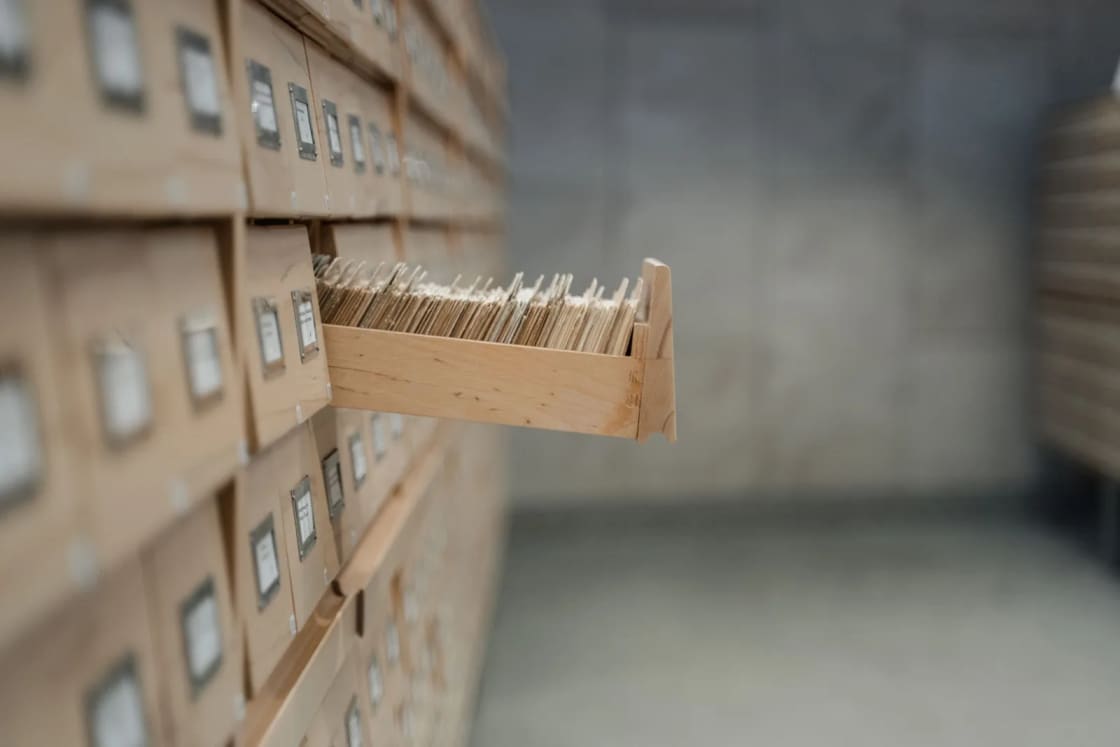
Visit Salt Lake says the library began in 1894 as a one-room repository and is now a five-floor genealogical research and collection library. FamilySearch calls its holdings "the largest collection of genealogical materials in the world." Visit Salt Lake's listing gives figures for the collection: more than 1.3 million microfilm rolls and 600,000 books, periodicals and maps, mainly covering people who lived before 1940, with records from the United States, Canada, the British Isles, Europe, Latin America, Asia, Africa and the Pacific. Those numbers come from a tourism listing, not from FamilySearch's own pages, which give no item counts, so treat them as approximate.
The library is operated by FamilySearch, and FamilySearch says everything on its website is free. That matters for planning, because most of what the library holds can be searched from your kitchen table before you ever drive north. The building is for the pieces that are not online, for hands-on help, and for equipment you do not own.
Who should go, and who should skip it
Go if you have a specific question that online searching has not answered, if you want a person to look at your tree with you, or if you have a box of tapes, slides or home movies to digitize. Go if you are visiting Temple Square anyway and want to see where the research happens.
Skip it, for now, if you have not yet created a FamilySearch account or built any tree. You will spend your visit learning the basics that free online consultations and Utah Valley's family history centers cover closer to home. Skip it if you are counting on the Main Floor experience that older articles describe, because that floor is closed during construction. And skip a Sunday trip: the hours FamilySearch lists run Monday through Saturday, and FrontRunner does not run on Sunday.
Before you go
Start at home. FamilySearch's U.S. page says you can search billions of ancestor profiles, photographs and historical documents at no cost, and that its Family Tree tool helps you add information and look for connections. The page does not say that an account is required to search, but it says signing up lets you save your progress. Create the account and add what you know about two or three generations before the visit, so the helper has something to work from.
Then decide what you want from the day:
- A research question. Write it as one sentence: who, where, and roughly when. "Find where my great-grandfather was born" is a better start than "do my genealogy."
- A catalog check. FamilySearch's collections page lists Our Catalogs, so you can look up whether the library holds a book, film or periodical before you travel. It also says visitors can suggest titles for purchase.
- Media to digitize. If you plan to use Memory Lane, read its page first (details below).
- A storage device. Memory Lane's page says to bring a thumb drive or external hard drive.
FamilySearch's help pages do not list what to bring for a research appointment, so the checklist above is our suggestion rather than an official one. If you want to confirm anything, email askfsl@familysearch.org, the contact FamilySearch gives on its construction page, or call the library.
Hours and holiday closures
FamilySearch lists Monday 9 a.m. to 6 p.m., Tuesday through Thursday 9 a.m. to 8 p.m., and Friday and Saturday 9 a.m. to 6 p.m. Special Collections on the B1 floor keeps the same hours. The Visit page links to a holiday hours and closures page, but when we tried the address we expected, it returned a not-found error, so we could not read any holiday dates. Use the link on the Visit page itself and check it before a trip around Thanksgiving, Christmas or New Year's.
The Tuesday-through-Thursday evenings are the longest days. If you are coming from Utah Valley by car after work or class, those are the nights that give you time to do anything.
Construction in 2026 and 2027
This is the most important section for anyone who last visited a few years ago. FamilySearch's construction news page says work runs from October 2025 through February 2027 and is phased, so different areas may be affected at different times. According to that page:
- Main Floor: closed except for the elevators, restrooms and break room. Services have moved to other floors.
- Discovery Experiences: a limited version is on the 2nd floor. Tree help is available on any floor.
- Noise: the Main, B1 and 2nd floors are the most affected. The B2 and 3rd floors are described as quieter and better for study and research. Work also takes place around the exterior, and FamilySearch says the Plaza Hotel next door is being demolished, which may bring louder periods outdoors during the day.
- Entrances: they remain open, though roads and sidewalks around the library may change as work progresses.
- Short-notice closures: the library may close for safety, and the page says notice may be only one to two weeks.
The Visit page carries a notice dated September 2026 repeating that improvements may affect noise levels, parking and building access. Check the construction page the morning you leave. A closure that was announced two weeks ago is the kind of thing you can miss if you planned the trip a month out.
What you can do there
FamilySearch's library page lists these services: Collections, Genealogy Help, Memory Lane, Discovery Experiences, Learning Resources, historical maps and Guest Services. Its collections page names these holdings:
- Books and Periodicals, including genealogical books and periodicals.
- Microfilm, Microfiche and CDs.
- Maps and Pedigrees, plus Historical Maps organized by region: Africa, Asia, Europe, Oceania, North America and South America.
- Special Collections, on the B1 floor, listed without a description.
- The FamilySearch Digital Library and Digital Images, which are online.
- A Medieval Collection, named in the site menu with no details.
FamilySearch does not say which of these are available only on site, and it does not give counts. If a record exists online, you can see it at home. If you need a physical book or film, search the catalog first and confirm it is on a floor that is open.
Getting help
FamilySearch says you can work with a research helper in person or online. In-person help at the library covers family history research, language translation and the Family Tree. The Genealogy Help page does not say how to book in-person help, and it does not list the languages supported. Guest Services is on the 2nd floor, so ask there.
Online, FamilySearch offers free 20-minute consultations, booked through the "Schedule help" link on its Genealogy Help page. It also points to free community groups where you can post translation and research questions. For a first-timer in Utah Valley, an online consultation is a low-cost way to learn whether the library visit is worth the drive.
Memory Lane
Memory Lane is on the 2nd floor. FamilySearch describes it as self-serve equipment for digitizing tapes, photos, slides, negatives, film, home movies and documents, with separate book-scanning stations. Staff can answer questions, but the page says they will not scan your media for you.
Some practical points from the page:
- Reservations are recommended, and walk-ins are welcome. Confirmation emails include a cancellation link.
- Book-scanning stations on the 3rd floor and B2 do not need a reservation, but a spot is not guaranteed.
- You must stay with your media for the whole transfer of video, audio or film. Those transfers run in real time, so a two-hour tape takes two hours. FamilySearch suggests bringing a laptop to work on in the meantime.
- Check in on arrival and staff will direct you to your reserved station.
The page does not state a price, a maximum session length or an item limit. Ask before you pack a suitcase of tapes.
Parking
FamilySearch says parking at the Church History Museum ended May 11, 2026. Its construction page recommends the Conference Center garage: you receive a paper ticket on entry and must scan it at Guest Services to validate it. Unvalidated tickets must be paid, and paper validation slips are no longer issued. Guest Services is on the 2nd floor, and the construction page associates it with Memory Lane. City Creek and Park Place are listed as paid alternatives, and street parking is limited, with fewer spaces during some phases.
Do not leave the garage without validating the ticket. If you are staying for the Tuesday-through-Thursday evening hours, remember where you parked and that you will want the scan done early rather than at closing time. The pages do not give garage prices, so we cannot say what an unvalidated ticket costs.
Driving or riding from Provo
By car, downtown Salt Lake City is about 45 miles up I-15 from Provo, and our I-15 commuter guide puts the free-flowing drive at a little under an hour, with rush hour adding more. The guide also covers the express lane and the construction that is changing the road through 2027 and 2028. For a library visit, avoid leaving Provo between 7 and 9 a.m. if you can. Aim for a mid-morning arrival and use the long Tuesday through Thursday hours if you want a full afternoon.
By train, our FrontRunner from Provo guide says the ride to Salt Lake Central takes a little over an hour, and our Salt Lake day-trip guide puts it at about an hour and five minutes and $6.10 each way at the regular fare. UTA's fare page lists FrontRunner at $2.50 for one station plus $0.60 for each additional station, with a maximum one-way fare of $9.70 from Provo to Ogden. Trains run Monday through Saturday, every 30 minutes at weekday peaks and hourly otherwise, according to UTA. From Salt Lake Central, you continue by TRAX or on foot toward West Temple. We did not confirm the best stop or the walking time, so use UTA's trip planner. The station-by-station guide covers boarding in Utah County.
The train solves the parking question, which is the library's biggest headache right now. It does not solve the Sunday gap, and it makes a late Tuesday evening trip harder, because you need to check the last southbound departure. Our UTA fares guide explains the pricing.
Plan the rest of the day
The library is a short walk from Temple Square, so most visitors pair it with something nearby. Our Salt Lake City day-trip guide lists the stops. In December, see Temple Square in December from Provo and Christmas in Salt Lake from Utah Valley. If you want to compare the two cities before deciding how often to make the trip, our Provo vs. Salt Lake City guide is useful.
If you are more interested in the genealogy world than the trip, our guide to RootsTech from Utah Valley covers the big annual conference, and the genealogy industry in Utah Valley covers the companies. For research tools outside FamilySearch, see family history beyond FamilySearch.
Closer to home
Utah Valley has family history centers, including a branch on the second floor of BYU's Harold B. Lee Library, according to our family history centers guide. FamilySearch's Visit page also links to a tool for finding a FamilySearch Center or affiliate near you, and suggests continuing at home, at a center, or on FamilySearch.org after a visit. For a first session, a nearby center costs less time than a day in Salt Lake City. Save the library for the questions a local center cannot answer.
What we could not confirm
FamilySearch's Visit page does not state an admission price, the library's Sunday status, what to bring, how to book in-person help, or what Memory Lane costs. Its holiday page did not load for us. Visit Salt Lake describes a children's area and main-floor Discovery Experiences, but FamilySearch's construction page says the Main Floor is closed and only a limited Discovery version is on the 2nd floor, so rely on FamilySearch for current layout. For anything that affects your trip, call (801) 240-6996 or email askfsl@familysearch.org before you go.
Frequently Asked Questions
Where is the Family History Library?
What are the Family History Library hours?
How much does the Family History Library cost?
Where do I park?
Is there free help with my research?
What can I do at the library that I can't do online?
Can the library close on short notice?
Is there a closer option in Utah Valley?
Is the library under construction in 2026?
What is Memory Lane at the library?
Sources
The facts in this guide were checked against these sources. Hours, fees and rules change, so confirm anything time-sensitive with the source before you go. How we make Provo.com.
- Utah Transit Authority: Current Fares, Utah Transit Authority. Checked November 4, 2026.
- Utah Transit Authority: FrontRunner, Utah Transit Authority. Checked November 4, 2026.
- Visit the Library, FamilySearch. Checked November 4, 2026.
- FamilySearch Library, FamilySearch. Checked November 4, 2026.
- Construction News, FamilySearch. Checked November 4, 2026.
- FamilySearch: Memory Lane, FamilySearch. Checked November 4, 2026.
- Genealogy Help, FamilySearch. Checked November 4, 2026.
- FamilySearch: Collections, FamilySearch. Checked November 4, 2026.