Rain, a snowstorm or a week of gray inversion air can cancel a hike, but it doesn't have to cancel a day out. Salt Lake City has a cluster of museums, a planetarium with free exhibits, a children's museum and a library built to wander, most within a few blocks of TRAX and an hour or less from Provo. This guide lists the indoor places we could confirm on Nov. 17, 2026, with hours, prices and what each one is best for, plus how to read the state's air quality forecast and how to get there without adding to the haze. For the bigger city itinerary, see our Salt Lake City day trip from Provo.
Facts below come from each attraction's own website, the Utah Division of Air Quality's air.utah.gov site, the Utah Department of Environmental Quality, the Utah Transit Authority and Salt Lake County, all checked Nov. 17, 2026. Where a page did not load or did not say, this guide tells you to check the official page rather than guess.
Quick facts
| Place | Hours (as posted) | Price | Source |
|---|---|---|---|
| Clark Planetarium | Sun to Thu 9:30 a.m. to 8 p.m.; Fri and Sat 9:30 a.m. to 11 p.m. | Exhibits free; shows ticketed | Salt Lake County |
| Natural History Museum of Utah | Daily 10 a.m. to 5 p.m.; Wed until 9 p.m. | Adults $24.95, kids 3 to 12 $20.95 | NHMU |
| Utah Museum of Fine Arts | Tue to Sun 10 a.m. to 5 p.m.; Wed until 8 p.m.; closed Mon | Adults $19.95; free 1st Wed and 3rd Sat | UMFA |
| Discovery Gateway | 10 a.m. to 6 p.m.; closed Tue | Kids $13.50 to $14.50, adults $16.50 to $18 | Discovery Gateway |
| Utah Museum of Contemporary Art | Tue to Sat 11 a.m. to 6 p.m.; Fri until 9 p.m. | $10 suggested donation, pay what you can | Utah MOCA |
| Salt Lake City Main Library | Mon to Thu 10 a.m. to 8 p.m.; Fri and Sat 10 a.m. to 6 p.m.; Sun 11 a.m. to 5 p.m. | Free | The City Library |
| Utah State Capitol | Mon to Thu 7 a.m. to 8 p.m.; Fri to Sun 7 a.m. to 6 p.m. | No fee listed | utahstatecapitol.utah.gov |
| Pioneer Memorial Museum | Mon to Fri 9 a.m. to 4:30 p.m. | Free | Daughters of Utah Pioneers |
| Church History Museum | Mon 10 a.m. to 6 p.m.; Tue to Thu until 8 p.m.; Fri and Sat until 6 p.m.; closed Sun | Check the official page | Church of Jesus Christ |
| Temple Square grounds | Daily 7 a.m. to 10 p.m. | Free | templesquare.org |
| Drive from Provo | About 45 miles, 53 minutes to downtown | Gas and parking | OSRM routing estimate |
| Air quality | Hourly readings and 3-day forecast | Free | air.utah.gov |
Check the air before you leave
Winter inversions are the reason many Utah Valley families end up looking for an indoor plan. The Utah Department of Environmental Quality explains that in an inversion "cold air at the surface gets trapped under a layer of warmer air," holding pollution near the ground. DEQ says inversions are most common in winter, often form after a snowstorm when high pressure moves in, and can last for days. A typical Utah winter has about five or six multi-day episodes, and DEQ says "a strong storm or low-pressure system is often needed to clear out the inversion." PM2.5, the fine particle pollution that builds during these episodes, "can reach unhealthy levels" the longer an inversion lasts.
The place to check is air.utah.gov, run by the Division of Air Quality. Its Current Conditions page shows hourly PM2.5, ozone, temperature and wind for each county, and its Forecast tab shows a three-day outlook. The site covers 14 counties, including both Utah and Salt Lake. DEQ's inversion FAQ also points to the free UtahAir app for Android and iPhone. Because Salt Lake City and Provo sit in different valleys, check both counties: it's common for one to look better than the other.
The forecast has two parts.
The Health Forecast uses the Air Quality Index. At Good (0 to 50), the division's legend says "It's a great day to be active outside." At Unhealthy for Sensitive Groups (101 to 150), sensitive people should reduce prolonged or heavy exertion and people with asthma should follow their asthma action plans. At Unhealthy (151 to 200), the guidance for fine particles is for sensitive groups to avoid prolonged or heavy exertion and move activities indoors or reschedule, while everyone else should reduce prolonged or heavy exertion. At Very Unhealthy, sensitive groups should "avoid all physical activity outdoors."
The Action Forecast governs burning. On an Unrestricted day, wood and coal stoves and fireplaces may be used within visible emission rules. On a Voluntary Action day, people are asked not to use solid fuel burning devices, to reduce or stop open burning and to consolidate trips. On a Mandatory Action day, "solid fuel burning devices must not be used," and open burning is not allowed, "including fire pits, fire rings, and campfires." A Voluntary or Mandatory day is a fair signal that the air is bad enough to plan an indoor day and to share a ride or take the train.
DEQ's FAQ adds that N95 and KN95 masks, worn correctly, can filter PM2.5. The Division of Air Quality's main line is (801) 536-4000, and its forecast line is 801-536-0072. For the Utah County side of the story, including where the local monitors are, see our Utah County inversion and air quality guide.
When we checked air.utah.gov on the morning of Nov. 17, 2026, the Salt Lake County forecast showed Good health ratings and Unrestricted Action through Wednesday. That will change once inversion season sets in, so look the morning you go.
Getting there from Provo
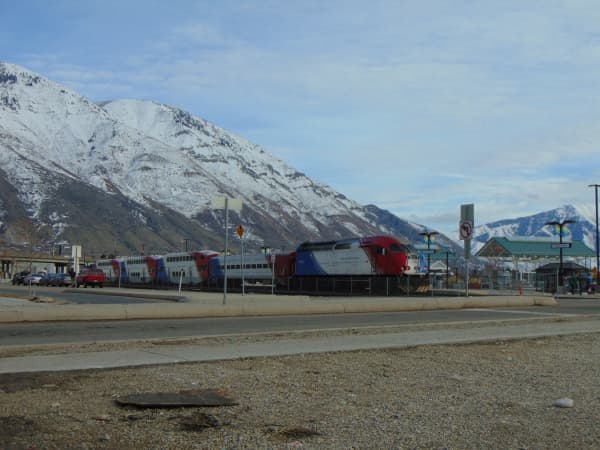
FrontRunner and TRAX. On a bad-air day, the train is the low-emission choice and it skips downtown parking. UTA says FrontRunner runs Monday through Saturday, every 30 minutes at weekday peak times and every 60 minutes off-peak and on Saturdays. There is no Sunday FrontRunner service. UTA's current fare page lists a FrontRunner base fare of $2.50 plus 60 cents for each additional station, a $5 round-trip base fare, and a FAREPAY daily cap of $10 on FrontRunner. A FrontRunner paper ticket from a vending machine includes transfers to buses, TRAX and the S-Line for two hours from purchase.
TRAX runs seven days a week, with 15-minute service at peak times. UTA describes three lines: the Blue Line from Draper to Salt Lake City, the Red Line from South Jordan to the University of Utah, and the Green Line from West Valley to the airport. The Red Line is the one that reaches the university campus, home to the Natural History Museum and the UMFA. A TRAX one-way fare is $2.50, good for two hours, and a $5 day pass covers bus, TRAX and S-Line rides but not FrontRunner. UTA's trip planner at rideuta.com is the best way to work out a transfer. Our guides to FrontRunner from Provo and TRAX for Utah County riders cover stations and timing in more detail.
Driving. An OpenStreetMap routing estimate (OSRM) puts downtown Provo to the Salt Lake City Main Library at about 45 miles and 53 minutes, to Clark Planetarium at about 45 miles and 53 minutes, to the Utah State Capitol at about 46 miles and 56 minutes, and to the Natural History Museum of Utah at about 46 miles and 56 minutes. Those are free-flowing times. Snow and the I-15 commute can add a lot. Parking notes for each stop are below.
Clark Planetarium
Clark Planetarium, run by Salt Lake County, is the easiest free indoor stop in the city. Its Plan Your Visit page says, "Admission to our exhibit space is always free." The county describes three floors of free exhibits, grouped as Exhibits Earth, Exhibits Near Earth and Exhibits Beyond. Two theaters are ticketed: the Hansen Dome, a 55-foot dome theater that shows star fields, animated films and laser shows, and the Northrop Grumman IMAX theater, with a screen 70 feet wide and 50 feet tall. Show prices are on the planetarium's Shows page, which we could not load; check there for current tickets.
Hours are long, which helps on a day when you're waiting out weather: 9:30 a.m. to 8 p.m. Sunday through Thursday and 9:30 a.m. to 11 p.m. Friday and Saturday. Every Saturday from 9:30 to 11:30 a.m. is Sensory Friendly Saturday, when lights and sound are adjusted in the exhibits and both theaters, and noise-canceling headphones, sunglasses and weighted blankets are available at the ticket counter. Under Museums for All, visitors with an EBT card can get Dome or IMAX admission for $3 each.
The planetarium is at 110 S. 400 West, at The Gateway. The county says discount parking validations are available at the ticket desk and the Planet Fun gift shop.
Best for: A free hour with kids, a cheap date night with a late show, anyone who wants to stay close to Salt Lake Central.
Discovery Gateway Children's Museum
Near the planetarium on the west side of downtown, Discovery Gateway calls itself "Utah's Premier Children's Museum," with hands-on exhibits, interactive activities, imaginative play spaces and a STEAM and art lab. Its visit page lists hours of 10 a.m. to 6 p.m., closed Tuesdays.
Admission is priced per person, with weekend rates a little higher:
- Child, ages 1 to 17: $13.50 weekdays, $14.50 weekends
- Adult, ages 18 to 64: $16.50 weekdays, $18 weekends
- Senior, 65 and older: $13.50 weekdays, $14.50 weekends
Children under 16 must be with an adult 18 or older. The museum is at 444 W. 100 South. Its parking is free for the first hour and $2 an hour for one to six hours, with a $20 charge for a lost ticket.
Who should skip it: Teens, and adults without kids. The museum doesn't publish an age range, but everything on its site is aimed at young children. Remember the Tuesday closure, which catches people who plan around weekday crowds.
Natural History Museum of Utah
The Natural History Museum of Utah sits on the University of Utah's east bench at 301 Wakara Way and is the biggest single indoor outing on this list. Its site highlights the Past Worlds gallery and the Gems and Minerals exhibit, and it announced a new special exhibition, We Carry Stories, opening Dec. 5, which it describes as "a brand-new, home-grown special exhibition that honors Indigenous basket makers in Utah." Our Natural History Museum of Utah guide walks through the galleries floor by floor.
The museum says it is open 10 a.m. to 5 p.m. seven days a week and until 9 p.m. on Wednesdays, with last admission 30 minutes before closing. It closes on Thanksgiving Day and Christmas Day and at 3 p.m. the day before each.
Ticket prices on the museum's site:
- Adult: $24.95
- Senior 65 and older: $22.95
- Young adult 13 to 24: $22.95
- Child 3 to 12: $20.95
- Child 2 and under: free
- University of Utah students, faculty and staff: free
Discounts have to be applied at the admission desk, according to the ticket page, and groups of 12 or more can ask for a group rate.
Getting there. The museum has two levels of surface parking next to the building, plus overflow parking and street parking on Colorow Road a block west; its page doesn't say whether the lots charge. By transit, the museum lists UTA bus 223 Monday to Saturday and routes 455 and 473 on weekdays, with no Sunday bus service, and says the stops at Chipeta and Wakara Way involve an uphill walk. The University of Utah campus shuttle's Sunnyside and RP Circulator routes stop in front.
Who should skip it: Anyone hoping for a cheap stop. At nearly $25 an adult, plan on a few hours there rather than a quick look. The Wednesday evening hours are the best fit for a weekday after school or work.
Utah Museum of Fine Arts
The Utah Museum of Fine Arts is also on the University of Utah campus, in the Marcia and John Price Museum Building at 410 Campus Center Drive. Its homepage listed three exhibitions as now on view: "salt 18: Amor Muñoz," "For the Future: Collecting at the UMFA 2001-2026," and "Onishi Yasuaki: Stone on Boundary." The page gave no closing dates, so check before a trip built around one of them.
Hours are 10 a.m. to 5 p.m. Tuesday through Sunday, with Wednesday hours extended to 8 p.m. The museum is closed Mondays. Its visit page lists special closures on Thursday, Nov. 26; Friday, Nov. 27; Thursday, Dec. 24; Friday, Dec. 25; Thursday, Dec. 31; and Friday, Jan. 1.
Admission:
- Adults: $19.95
- Seniors 65 and older: $16.95
- Youth 6 to 18: $16.95
- Children 5 and under: free
- University of Utah students, staff and faculty: free with ID
- Students at Utah public universities and colleges: free with student ID
Most useful for families on a budget: "Admission is free for everyone on the first Wednesday and third Saturday of the month," the UMFA says, though free access can vary for special ticketed exhibitions. The museum also takes part in Museums for All, Bank of America's Museums on Us and Blue Star Museums for military families. That student line matters in Utah Valley, since BYU is private but UVU students fall under "public universities and colleges."
The UMFA and the Natural History Museum are both on campus, so they pair well on one long day. Parking and transit directions are on the UMFA's directions page, which did not load when we checked.
Utah Museum of Contemporary Art
Utah MOCA is downtown at 20 S. West Temple, and it's the cheapest museum on this list that isn't free. "We suggest a $10 donation, but we believe art should be accessible to everyone so we have a pay-what-you-can policy," its FAQ says.
The museum is open Tuesday through Saturday from 11 a.m. to 6 p.m., with Friday hours running until 9 p.m. It is closed Sunday and Monday, and also on July 4, July 24, Thanksgiving, Christmas Eve, Christmas Day and New Year's Day, with a 3 p.m. close on New Year's Eve. Exhibitions rotate about every other month, so the current shows are on its exhibitions page.
Who should skip it: Families with toddlers who need to run. MOCA is a gallery visit, not a hands-on museum. It's a good fit for an adult outing or older kids who like art, and it's an easy walk from other downtown stops.
Salt Lake City Main Library
The Main Library at 210 E. 400 South is free, open seven days a week and big enough to fill a morning. The City Library says the building, designed by Moshe Safdie with VCBO Architecture, opened in February 2003 and covers 240,000 square feet with more than 500,000 books and other materials. A six-story curving wall wraps the public plaza, with shops at ground level and reading galleries above. The Urban Room between the library and that wall is, in the library's words, "a space for all seasons," and fireplaces spiral up four floors.
Hours are 10 a.m. to 8 p.m. Monday through Thursday, 10 a.m. to 6 p.m. Friday and Saturday, and 11 a.m. to 5 p.m. Sunday. That Sunday opening makes it one of the few free indoor options when FrontRunner isn't running.
What to look for:
- The Children's Library on the lower level, a light-filled, five-story atrium with stroller and coat space, a parents' room, and two story spaces tucked under the plaza's reflecting pool: Grandmother's Attic and the Wild Woods.
- The Teen Lounge on Level 2, along with more than 600 newspaper and magazine titles and a zine collection that dates to 1997.
- The Gallery at Library Square on Level 4, with changing art exhibits, and Special Collections on the same floor.
- The Rooftop Terrace, reached by walking the Crescent Wall or by elevator, with a 360-degree view of the valley. The library says it closes in bad weather, during programs and an hour before the library closes, so on a smoggy day the view may be exactly what you came indoors to avoid. Call the Main Library at 801-524-8200 to check whether it's open.
Parking. The underground garage is reached from westbound 500 South or eastbound 400 South between 200 and 300 East. Scan your ticket inside for validation and the first two hours are free, then $1.50 per half hour, card only. The garage has free EV charging stations on levels P1 and P2 with a four-hour limit.
Utah State Capitol
The Capitol at 350 N. State St. is open daily, and its tours page does not list a fee. The building is open 7 a.m. to 8 p.m. Monday through Thursday and 7 a.m. to 6 p.m. Friday through Sunday and holidays.
Guided tours start on the hour from 10 a.m. to 3 p.m., Monday through Friday except state holidays, and last about 40 to 45 minutes. They meet at the Visitor Center just inside the east entrance. Groups need to reserve with the tour request form. For a winter smog day, note the gaps: the tours page says there are no guided tours Nov. 25 to 27, 2026, or Dec. 7, 2026, to Jan. 1, 2027. Self-guided tours are available any time the building is open, with no group size limit. Tour scheduling is (801) 538-3074, and Visitor Services is (801) 538-1800.
Parking is covered on the Capitol's Maps and Parking page. Our Utah State Capitol tour guide covers the art, the chambers and where to park.
Pioneer Memorial Museum
Just west of the Capitol at 300 N. Main St., the Daughters of Utah Pioneers' Pioneer Memorial Museum is free. "Admission is free of charge," the DUP says. The museum is open Monday through Friday, 9 a.m. to 4:30 p.m., so it doesn't work for a Saturday trip.
The DUP describes the collection as the "world's largest collection of artifacts on one particular subject," covering the years from the first settlers in the Salt Lake Valley to the joining of the rails at Promontory Point in 1869. It fills the main, second and third floors, the basement and a carriage house. The list includes quilts, clothing, samplers, guns, furniture, a Conestoga wagon, a stagecoach, a 1902 fire engine, Brigham Young's wagon, the steam engine "Roosevelt," medical and dental tools, the original carved eagle from Eagle Gate and Victorian hair art.
One rule to know before you go: "The use of cameras, video cameras, or personal scanners is not allowed in any part of the Museum or carriage house."
The Capitol and the Pioneer Memorial Museum make an easy weekday pair: a guided Capitol tour in the morning and the museum after lunch.
Temple Square and the Church History Museum
Temple Square is in the middle of the Salt Lake Temple renovation, but much of it is open. Its visit page says Temple Square "is free and open to the public during renovation," with grounds open 7 a.m. to 10 p.m. daily. The site describes the area as five city blocks covering about 35 acres, including the Tabernacle, the Conference Center, the Church History Museum and the FamilySearch Library.
Indoor stops to look at:
- The Temple Square Visitors' Center, which the Temple Square site lists as open since July 13, 2026, with displays focused on Jesus Christ and the temple. Reservations are recommended and walk-ins are welcome. Our Temple Square Visitors' Center guide has more.
- The Church History Museum at 75 N. West Temple, open 10 a.m. to 6 p.m. Monday, 10 a.m. to 8 p.m. Tuesday through Thursday, and 10 a.m. to 6 p.m. Friday and Saturday, closed Sunday. The museum posted that its second floor, including the children's exhibit "A Firm Foundation," was closed for construction Aug. 3 to Nov. 18, 2026, and that it would close early at 5 p.m. on Nov. 18. Its page doesn't list an admission fee; check the official page if that matters.
- Music and the Spoken Word, the Tabernacle Choir's live broadcast at 9:30 a.m. Sundays in the Tabernacle. Ticket and broadcast information is on templesquare.org.
- The FamilySearch Library, covered in our Family History Library visitor guide.
Conference Center parking is open daily from 4:30 a.m. to 10:30 p.m. with a validation, and a limited number of wheelchairs are available first come, first served. The Temple Square app has an "Avoid Stairs" map setting. The Salt Lake Temple open house itself runs April 5 to Oct. 1, 2027, with timed-entry tickets required; it isn't a 2026 option. Temple Square's contact line is (801) 353-3355, weekdays 7 a.m. to 5 p.m.
Loveland Living Planet Aquarium
The aquarium is in Draper, about 28 miles and 34 minutes from downtown Provo by an OpenStreetMap routing estimate (OSRM), so it's the closest stop on this list and a natural pick when you'd rather not drive all the way into the city. A Utah State University news story from Feb. 25, 2026, reported that the aquarium had recently opened the Sam & Aline Skaggs Science Learning Center, an expansion that "doubled the aquarium's size, establishing it as the fifth-largest aquarium in the nation," with 14 classrooms and labs.
The aquarium's own website blocked our requests on Nov. 17, so we could not confirm current hours or ticket prices. Check livingplanetaquarium.org before you go. Our Loveland Living Planet Aquarium from Provo guide covers the galleries and the drive.
Indoor climbing
A climbing gym is a good way to get a workout without breathing inversion air. Momentum Climbing lists Utah gyms in Lehi, Sandy, Millcreek and at Trolley Square in Salt Lake City. Its Millcreek rate page lists an adult day pass (12 and up) at $29, a child day pass (11 and under) at $21, and a rental combo of harness, shoes and belay device for $11. Day passes include climbing areas, fitness equipment and showers. Check the individual gym page for hours and for rates at other locations. If you'd rather stay in Utah Valley, we compare the local options in our climbing gyms guide.
What about Tracy Aviary and The Leonardo?
Tracy Aviary at Liberty Park, 589 E. 1300 South, is open 9 a.m. to 5 p.m. daily, with last admission at 4 p.m., and closes on Thanksgiving and Christmas. Adults 13 and up are $16.95, children 3 to 12 are $10.95, and seniors 65 and older and students, veterans or military with ID are $12.95. The aviary describes its Liberty Park campus as birds "in curated botanical gardens," and its visit page doesn't describe indoor exhibits beyond a visitor's center, so treat it as an outdoor stop and skip it on a bad-air day. It's covered with Hogle Zoo in our Hogle Zoo and Tracy Aviary from Provo guide.
The Leonardo is the other indoor stop people often ask about, but its website returned errors every time we tried it on Nov. 17, 2026, so we could not confirm hours or prices. Check theleonardo.org before you go.
Sample rainy-day plans
Weekday by train, free. FrontRunner to Salt Lake Central, then Clark Planetarium's free exhibit floors. TRAX downtown to the Main Library for lunch and the Children's Library, then north to the Capitol for a self-guided walk and the Pioneer Memorial Museum before 4:30 p.m.
Saturday with little kids. Drive or take FrontRunner. Sensory Friendly Saturday at Clark Planetarium from 9:30 a.m., then Discovery Gateway after lunch. Remember FrontRunner runs hourly on Saturdays.
Third Saturday or first Wednesday, art and science. The UMFA is free for everyone on those days. Pair it with the Natural History Museum, also on the University of Utah campus, and on a Wednesday stay for NHMU's evening hours.
Sunday. No FrontRunner, so drive. The Main Library opens at 11 a.m., Clark Planetarium at 9:30 a.m., and Temple Square's grounds at 7 a.m. Utah MOCA, the Church History Museum and the Pioneer Memorial Museum are closed.
What to check before you go
- air.utah.gov or the UtahAir app, for both Salt Lake and Utah counties, the morning you leave.
- The attraction's hours page, especially around Thanksgiving, Christmas and New Year's, when several of these places close or shorten hours.
- Tuesday and Monday closures. Discovery Gateway closes Tuesdays. The UMFA closes Mondays. Utah MOCA closes Sundays and Mondays.
- Capitol tour dates. Guided tours pause Nov. 25 to 27, 2026, and from Dec. 7, 2026, to Jan. 1, 2027.
- The FrontRunner schedule at rideuta.com, since trains run hourly off-peak and on Saturdays and not at all on Sundays.
- Road conditions and parking. A snowstorm that clears the air can also slow I-15.
Related guides
- Salt Lake City day trip from Provo
- Utah County inversion and air quality guide
- Natural History Museum of Utah guide
- Utah State Capitol: free tours, the art and where to park
- Loveland Living Planet Aquarium from Provo
- Hogle Zoo and Tracy Aviary from Provo
- Free museum and attraction days for Utah families
- Indoor activities in Provo
- Kids' crafts for snow, red-air and heat days
- FrontRunner from Provo
- UTA fares and passes for Utah County
Frequently Asked Questions
What is the best free indoor thing to do in Salt Lake City on a smoggy day?
How do I check the air quality before driving to Salt Lake City?
What do Voluntary Action and Mandatory Action mean?
Is the Natural History Museum of Utah open late?
When is the Utah Museum of Fine Arts free?
Can I take FrontRunner to Salt Lake City on a Sunday?
Are Utah State Capitol tours running in December?
How long is the drive from Provo to downtown Salt Lake City?
Sources
The facts in this guide were checked against these sources. Hours, fees and rules change, so confirm anything time-sensitive with the source before you go. How we make Provo.com.
- Clark Planetarium: Plan Your Visit, Salt Lake County. Checked November 17, 2026.
- Clark Planetarium, Salt Lake County. Checked November 17, 2026.
- The City Library (Salt Lake City Public Library): Main Library, The City Library (Salt Lake City Public Library). Checked November 17, 2026.
- Utah State Capitol, Utah State Capitol Preservation Board. Checked November 17, 2026.
- Utah State Capitol Preservation Board: Tours, Utah State Capitol Preservation Board. Checked November 17, 2026.
- Current Conditions, Utah Division of Air Quality. Checked November 17, 2026.
- Utah Division of Air Quality: Forecast, Utah Division of Air Quality. Checked November 17, 2026.
- Forecast Legend, Utah Division of Air Quality. Checked November 17, 2026.
- Utah Department of Environmental Quality: Inversions, Utah Department of Environmental Quality. Checked November 17, 2026.
- Utah's Inversion Season Frequently Asked Questions, Utah Department of Environmental Quality. Checked November 17, 2026.
- Utah Transit Authority: FrontRunner, Utah Transit Authority. Checked November 17, 2026.
- Utah Transit Authority: TRAX, Utah Transit Authority. Checked November 17, 2026.
- Utah Transit Authority: Current Fares, Utah Transit Authority. Checked November 17, 2026.
- Hours and Admission (Visit), Natural History Museum of Utah. Checked November 17, 2026.
- Natural History Museum of Utah: Tickets, Natural History Museum of Utah. Checked November 17, 2026.
- Hours and Directions, Natural History Museum of Utah. Checked November 17, 2026.
- Utah Museum of Fine Arts: Visit, Utah Museum of Fine Arts. Checked November 17, 2026.
- New USU lab space opens inside Loveland Living Planet Aquarium, Utah State University. Checked November 17, 2026.
- Discovery Gateway Children's Museum: Visit, Discovery Gateway Children's Museum. Checked November 17, 2026.
- Utah Museum of Contemporary Art: Visit, Utah Museum of Contemporary Art. Checked November 17, 2026.
- The Pioneer Memorial Museum, International Society Daughters of Utah Pioneers. Checked November 17, 2026.
- Visit Temple Square, Temple Square. Checked November 17, 2026.
- Temple Square home, Temple Square. Checked November 17, 2026.
- Church History Museum, The Church of Jesus Christ of Latter-day Saints. Checked November 17, 2026.
- Visit Tracy Aviary at Liberty Park, Tracy Aviary. Checked November 17, 2026.
- Millcreek Rates, Momentum Climbing. Checked November 17, 2026.