
Halloween 2026 falls on a Saturday, and Provo is running three events through the same part of the city on the same day.
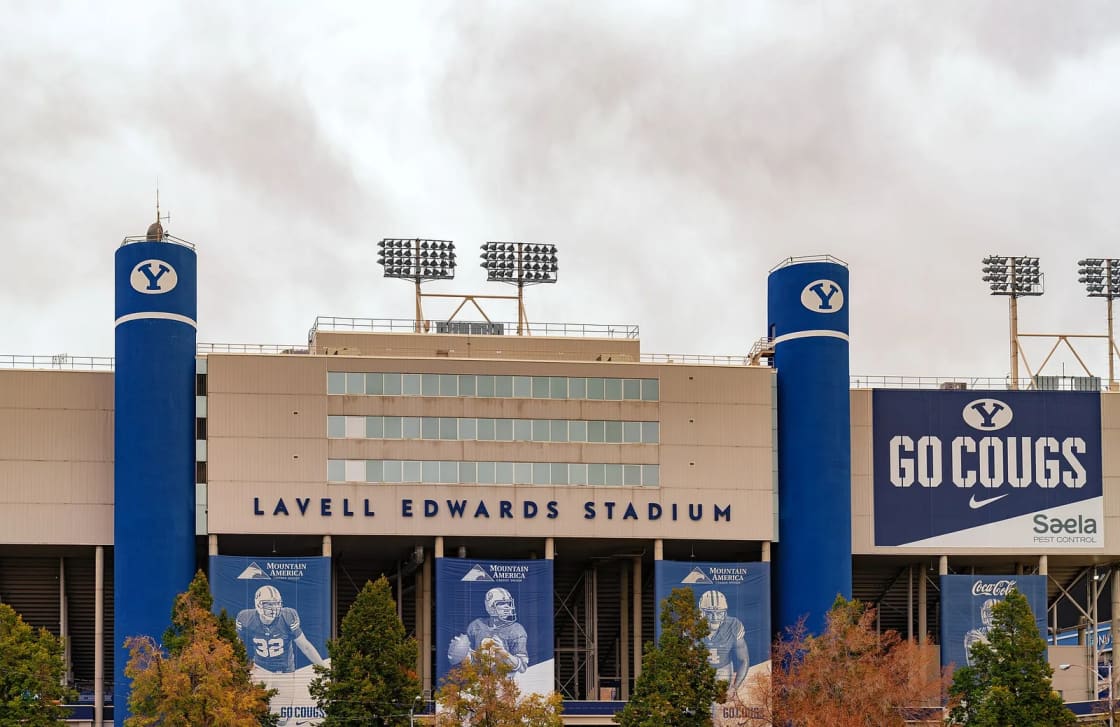
In the morning, the HAUNTED Provo half marathon comes down Provo Canyon. In the afternoon or the evening — nobody knows which yet — BYU hosts Arizona State at a stadium that seats 62,073. And at around six, several thousand children walk into the residential streets immediately north and east of that stadium.
Nobody has modeled how those three things interact. This is an attempt to.
The one number that decides the evening
Kickoff time is still TBA. That is not an oversight; it is how Big 12 scheduling works. Television selects kickoff windows for most conference games somewhere between twelve and six days out, which means the single most important planning input for Halloween night in north Provo will not exist until late October.
The scenarios diverge sharply:
- An 11am or 1pm kickoff empties the stadium by mid-afternoon. Egress finishes hours before the first doorbell. Halloween is a normal Halloween with heavier daytime traffic.
- A 4pm or 5pm kickoff is the difficult one. A three-and-a-half-hour game window puts the final whistle somewhere between 7:15 and 8:30 — directly across the busiest trick-or-treat hour, and in the dark.
- A 7pm or 8:15pm kickoff front-loads the problem. Arrival traffic, not departure traffic, coincides with trick-or-treating: 62,073 people driving into north Provo between five and seven, which is arguably worse, because arriving drivers are searching for parking rather than following a signed exit route.
That last scenario deserves emphasis, because the instinct is to worry about the crowd leaving. A driver leaving a stadium is following an officer down a marked route. A driver arriving is circling residential blocks looking at curbs, not at corners.
The geography, street by street
LaVell Edwards Stadium sits at 1700 North Canyon Road. That address is the whole story.
Canyon Road is the artery, and it has an unusual property: it runs diagonally against Provo's grid. Almost every other street in this city is a numbered north–south or east–west line with regular, signalized intersections. Canyon Road cuts across that pattern, which means it meets residential streets at oblique angles, has longer runs between controlled crossings, and produces sight lines that are not square. It feeds directly into Pleasant View, the north Provo neighborhood organized around it.
The other two north–south routes carrying the load are University Avenue on the west and 900 East on the east. Both are genuine arterials, both are the obvious way out for a driver following a phone, and both run straight through neighborhoods where children will be walking. Bulldog Boulevard and 800 North take the southbound share toward the central grid.
Here is the part that matters and is not obvious:
The streets that absorb the stadium are the streets that are already the worst for trick-or-treating.
Oak Hills climbs the bench immediately above campus, and this site's own neighborhood profile lists LaVell Edwards Stadium among the places you can walk to from it. That proximity is exactly what makes its curbs the first overflow parking on a home game. Oak Hills is also, on any ordinary Halloween, a hard place to trick-or-treat: sloping lots, long driveways, curving streets, and stretches without sidewalk.
Rock Canyon sits on the upper northeast bench around 2230 North and Temple View Drive. North Timpview runs above roughly 2600 North, east of University Avenue — its own profile calls it, plainly, a car neighborhood. Both are quiet, established, generous-lot streets. Both are uphill of the stadium. Both fill with unfamiliar cars on a Saturday in autumn.
Carterville is a different case worth naming: the river-corridor pocket where the streets wind rather than grid, with University Parkway as its spine. Winding streets and stadium overflow are a poor combination on a dark evening.
The grid neighborhoods are the good ones for walking children — Joaquin between 500 West and 900 East, the central numbered blocks, and central Orem. Small blocks, houses near the street, sidewalks, short gaps between doors. They are also, conveniently, further from the stadium.
So the established local pattern — bench families drive down to a grid neighborhood, or go to a trunk-or-treat — still works in 2026. It just has to happen earlier, because the drive down now crosses the egress flow.
Why the walk signal is not the instruction
This is the piece of the evening that almost everyone has backwards, and it is worth being precise about, because it inverts the rule the rest of Halloween safety guidance rests on.
On an ordinary evening in Utah, the pedestrian is heavily protected. A driver must yield to a pedestrian in a crosswalk, must exercise care to avoid colliding with any pedestrian, and must exercise appropriate precaution on observing a child. Those duties sit in the pedestrian provisions of Title 41, Chapter 6a, and they are covered in the Halloween safety guide.
Stadium egress is not an ordinary evening. When BYU police and Provo police hand-direct traffic out of a full stadium, a different section governs, and it sits upstream of all of that.
Utah Code § 41-6a-1001, headed Pedestrians subject to traffic-control devices — Other controls, states at subsection (1):
A pedestrian shall obey the instructions of a traffic-control device specifically applicable to the pedestrian unless otherwise directed by a peace officer.
Subsection (3) makes a violation an infraction. The section was last amended by Chapter 412 of the 2015 General Session.
Read the conditional carefully. The pedestrian's duty to obey the signal is not absolute — it is displaced when an officer directs otherwise. The officer is not adding an instruction on top of the walk signal. The officer replaces it.
§ 41-6a-209, Obedience to peace officer or other traffic controllers, closes the loop:
A person may not willfully fail or willfully refuse to comply with any lawful order or direction of a peace officer, firefighter, flagger at a highway construction or maintenance site, or uniformed adult school crossing guard.
Note the subject: a person. Not a driver, not an operator. A pedestrian standing at a curb on Canyon Road with a four-year-old dressed as a dinosaur is a person, and an officer waving stadium traffic through is issuing a lawful direction.
The practical translation is short. For roughly ninety minutes after the final whistle, on the streets where officers are posted:
- A green walk signal is not permission to cross if an officer is holding pedestrians.
- The driver-yields default that governs the rest of the year is suspended at those specific intersections, because the officer is allocating right-of-way directly.
- Children have spent their whole lives being taught that the walking figure means go. On this evening, on these corners, it does not.
That last point is the reason to explain this to a child before leaving the house rather than at the curb.
None of this is legal advice, and none of it is a reason to stay home. It is a reason to know which intersections are officer-controlled and to treat them as a different kind of crossing.
What a full stadium puts on the street
The capacity number is 62,073, and it is easy to read that as an abstraction. Converted into vehicles it stops being abstract.
Stadium crowds do not arrive one person per car. A reasonable working figure for a college football crowd is somewhere between two and three occupants per vehicle once you account for families, student groups walking in from campus housing, and the share who are dropped off. Take the middle of that range and a full house is on the order of twenty to twenty-five thousand vehicles moving into north Provo across a three-hour arrival window, and back out across a much shorter one.
The asymmetry is the whole problem. Arrival is spread over hours; departure is compressed into minutes. People arrive when it suits them — some four hours early to tailgate, some at the anthem. Everyone leaves at the same whistle. That is why the postgame is the crush and the pregame is merely busy, and it is why the fifteen minutes after a close finish behave differently from the fifteen minutes after a blowout, when a meaningful share of the crowd has already gone.
On 31 October those departing vehicles are not dispersing into an empty city. They are dispersing into residential streets that have children on them — and into a student population whose own Halloween night is starting at roughly the same hour, covered separately in the student Halloween guide.
There is one softening factor worth naming honestly, because this site's own parking guide already notes it: on a Halloween game, some families leave early regardless of score. That flattens the peak slightly. It does not remove it, and it arguably makes the picture worse in one specific way — an early trickle of departing cars overlaps the start of trick-or-treat hours rather than the end.
Why this is not simply "more traffic"
It would be easy to file this under congestion. That undersells what changes.
The drivers are unfamiliar. A visiting-team crowd, plus BYU's substantial out-of-county attendance, means a large fraction of the vehicles on these streets belong to people who have never driven them. They do not know that a great many streets in older Provo have no sidewalk. They do not know which corners are dark. They are navigating by phone, and a phone will happily route a driver down a residential street it has no business being on.
The lighting is not what people assume. Residential north Provo is not brightly lit. Bench streets in particular were built for cars, not for pedestrians after dark, and a child in a dark costume against an unlit verge is hard to see at thirty miles an hour.
Parked cars change the geometry. This is the underrated one. When both curbs of a residential street fill with stadium parking, the effective sight line between a driver and a child stepping out from between two vehicles collapses. Utah's own pedestrian statute acknowledges this shape directly: a pedestrian crossing outside a crosswalk yields to vehicles, so a child emerging from between parked cars is, technically, the one in the wrong. That is cold comfort at the moment of impact, and it is why the duty of care running the other way matters so much.
The children are not behaving normally either. Costumes restrict peripheral vision. Masks restrict it further. Excitement overrides caution in a way that a parent walking the same route in June would not have to manage. Halloween is already the evening when child pedestrian risk is at its annual peak; the stadium is an additional variable layered on top of a night that was never routine to begin with.
The three-crowd day, in sequence
Set out as a timeline, the day reads clearly:
Morning. The HAUNTED Provo half marathon runs down Provo Canyon, with the 5K and kids' half-mile behind it. Canyon-corridor traffic, road management on the approaches, and a finish-line crowd. The neighborhoods nearest this are Carterville and the canyon-mouth pockets.
Midday to afternoon. Tailgating builds. Lot 18 opens early. Campus lots fill in a rush rather than gradually. Overflow parking works outward from the stadium into Oak Hills, Pleasant View and the streets below Rock Canyon.
Kickoff, whenever it lands. Three and a half hours of relative calm on the streets, and the single best window of the day for anyone who needs to drive across north Provo.
Final whistle. Compressed egress. Officers directing at the main intersections. Canyon Road, University Avenue and 900 East carrying the bulk.
Six o'clock, or thereabouts. Children in the road.
Whether the last two of those overlap is the entire question, and it is decided by a kickoff time that does not exist yet.
The morning race, and why it belongs in this plan
The HAUNTED Provo half marathon runs down Provo Canyon on the morning of 31 October, with a 5K behind it and a kids' half-mile after that. A Friday Night 5K runs the evening before.
For most households this is simply a good Halloween morning. But it has a planning consequence worth stating: the canyon corridor and its approaches carry race traffic and road closures in the morning, then stadium traffic in the afternoon. If your Halloween plan involves being in or near Provo Canyon at any point that day — and the canyon-mouth neighborhoods put a lot of households there — the day has two separate congestion events, not one.
The upside is real too. A family that runs the kids' half-mile in the morning has already had a Halloween by lunchtime, and the evening becomes optional rather than obligatory. On a year this crowded, that is not a small thing.
What to do
Check the kickoff as soon as it is announced. Everything else is downstream of it. It will be set roughly one to two weeks out.
Go early. Trick-or-treating here runs earlier than newcomers expect, and the early end of the window is the part of the evening least likely to overlap with anything. Six o'clock is not too early; five-thirty is not unreasonable with small children.
Treat the arterials as walls. Canyon Road, University Avenue and 900 East are not routes on this evening. Pick a loop that does not require crossing any of them, even if that means a shorter circuit. A block with sidewalks on both sides and no arterial crossing beats a longer route with one bad corner.
If you are driving down from the bench, leave before the stadium does. The window between the third quarter and the final whistle is the quietest driving hour of the entire evening. Use it.
If you are going to the game and you live here, park once. Circling residential blocks for a curb space at six o'clock on Halloween is the single most avoidable hazard in this whole picture.
Assume visiting drivers do not know the streets. They do not know which corners lack a sidewalk, which streets have no lighting, or that the child-shaped figure at the edge of the headlights is where children are, because in this valley a great many streets have no sidewalk and walking on the roadway is normal and lawful.
Put something reflective on the outside of the costume. Not under the cape. Outside, where a driver's headlights will find it.
The short version
BYU hosts Arizona State on Halloween night at a 62,073-seat stadium sitting at 1700 North Canyon Road, and the kickoff time that determines everything is still unannounced. A canyon half marathon runs the same morning. The neighborhoods that absorb the stadium — Oak Hills, Pleasant View, Rock Canyon, North Timpview, Carterville — are the same bench and canyon-corridor neighborhoods that are already difficult for walking children, and the grid neighborhoods that are good for it are further away.
Go early, stay off Canyon Road, University Avenue and 900 East, and know that where an officer is directing traffic, the officer outranks the walk signal — for pedestrians as much as for drivers.
Related Guides
- Halloween in Utah Valley: the October circuit and the traffic problem
- LaVell Edwards Stadium guide: history, capacity and bag policy
- BYU football parking
- BYU football game day: the complete guide
- Haunted attractions in Utah Valley
- Provo neighborhoods, explained
Frequently Asked Questions
Is there a BYU home game on Halloween 2026?
What time does trick-or-treating happen in Provo?
Which Provo streets are worst affected by stadium traffic on a game night?
Does a police officer directing traffic override the walk signal?
Is it still safe to trick-or-treat near BYU on Halloween 2026?
Where should families in the bench neighborhoods go instead?
What else is happening in Provo that day?
Do I need a parking permit to park near the stadium on a game day?
Sources
The facts in this guide were checked against these sources. Hours, fees and rules change, so confirm anything time-sensitive with the source before you go. How we make Provo.com.
- Utah Code 41-6a-1001: Pedestrians subject to traffic-control devices -- Other controls, Utah State Legislature. Checked October 12, 2026.
- Utah Code 41-6a-209: Obedience to peace officer or other traffic controllers, Utah State Legislature. Checked October 12, 2026.
- BYU, Big 12 announce 2026 football schedule, BYU Athletics (byucougars.com). Checked October 12, 2026.
- TV networks, kick times announced for four BYU football games, BYU Athletics (byucougars.com). Checked October 12, 2026.
- LES Stadium Upgrades Ready for 2024 Season Opener, BYU Athletics (byucougars.com). Checked October 12, 2026.
- LaVell Edwards Stadium, BYU Ticket Office (tickets.byu.edu). Checked October 12, 2026.
- Runtastic HAUNTED Half and 5K Provo, RunSignup (official race registration page). Checked October 12, 2026.