More on Spanish Fork: every guide we have published there, in one place.
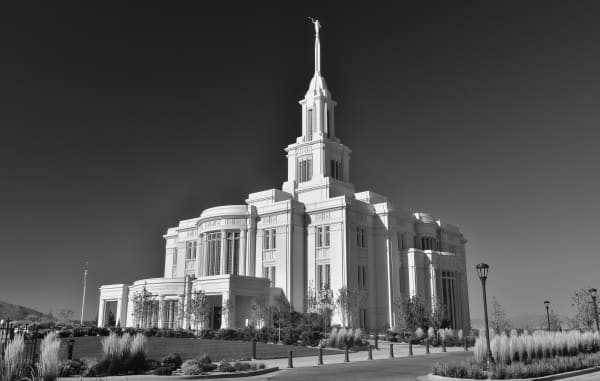
Drive south out of Spanish Fork, up onto the bench, and something appears that has no business being there: a white Rajasthani-style temple with domed towers, standing on fifteen acres of hillside with the Wasatch behind it and llamas in the field out front.
It has been there since the late 1990s. Most people in Utah County know it as the place with the colored powder, and most of them have never been on an ordinary day — which is the day it is most worth seeing.
The short version
A Hindu temple on fifteen acres south of Spanish Fork, open daily 10am to 8pm, free to visit, with short guided tours, an animal park with about thirty llamas, a vegetarian buffet, and a festival calendar running from March to October. Best known for the Festival of Colors. Quietly excellent the rest of the year.
Where it is
311 West 8500 South, Spanish Fork.
The same site also appears as 8628 South State Road, which is the source of a good deal of navigation confusion. Both refer to the same temple. If a mapping app offers you two pins, they are one place.
From Provo it is about twenty-five minutes south on I-15 and then up onto the bench. The temple is visible from a distance on the approach, which makes the last part of the drive easy.
How it got there
In 1983 Charu Das left Los Angeles and moved to Spanish Fork. The temple that eventually resulted was designed by Vaibhavi das, drawing on traditional Indian architecture.
Devotees held a groundbreaking ceremony in November 1996. Construction began in February 1998, and the temple was completed that year. It is affiliated with ISKCON — the International Society for Krishna Consciousness — and was built to serve the Hindu community in Utah County as well as to introduce the wider public to the tradition.
Why it is in Spanish Fork of all places
This is the question everyone asks and the answer is less exotic than the building. Land on the bench south of Spanish Fork was affordable, agricultural and quiet, and a community that wanted room for animals, cultivation and thousands of festival visitors could not have had any of that closer to the population center.
The visual incongruity — Rajasthani domes against Utah sagebrush — is a consequence of the economics rather than a statement.
The site itself
Fifteen acres. A temple, a six-thousand-square-foot residential facility with double rooms, two outdoor stages and a large covered pavilion.
There is a lake holding a couple of hundred thousand gallons with a waterfall, which gravity-feeds an acre under cultivation. That acre produces tomatoes, aubergines, chillies, squash, melons, corn, cabbage, broccoli, courgettes, cucumbers, spinach, radishes, potatoes and flowers used in worship.
The animals
About thirty llamas live on site, along with cows, peacocks, parrots and koi.
They are not a festival attraction wheeled out twice a year. They are permanent residents, visitors are welcome at the enclosures on ordinary days, and the temple explicitly encourages bringing baby carrots and apple pieces.
Why there are cows
In Hindu tradition cows are sacred and are not raised for slaughter. The temple's own explanation is direct: cows supply milk for the family that cares for them, and bulls supply labor.
That principle is the same one behind the food served on site, and it is the clearest single thing a visitor can learn here about how the belief translates into daily practice.
The tour
The standard temple tour runs roughly ten to fifteen minutes and covers the history, beliefs and deities of Krishna consciousness.
It is free, it is pitched at people who know nothing, and there is no proselytising edge to it. Individuals and small groups can drop in; parties of six or more should book.
The tour hours are not the opening hours
Worth separating carefully, because the temple's own materials give slightly different figures in different places — one page describes tour guides available 10am to 7pm daily, another gives tours 10am to 6pm Monday to Saturday and 10am to 4pm Sundays.
Opening is 10am to 8pm daily. Tours are a narrower window inside that. If you are driving down specifically for a tour, phone (801) 798-3559 rather than trusting any single published figure, this page included.
The llama tours
Separate from the temple tour, and better value than almost anything else in the county. Around an hour, with a small per-person charge and a minimum group spend, discounted for larger groups.
They can include llama orientation, the llama obstacle course, grooming, feeding, walking one, and rides for children under sixty pounds.
Forty thousand visitors a year
The temple reports more than 40,000 people taking tours annually — college students, families, home-schoolers, seniors, community service groups, schools, festival-goers, and, in its own phrasing, the curious and the casual passers-by.
That is a substantial visitor operation, and it explains why the tour is polished. They have done this a great many times.
Govinda's buffet
There is a vegetarian Indian buffet on site and a gift store.
Visitor accounts are consistent about it being both good and cheap. Everything follows the temple's cruelty-free principles, which means no meat or fish anywhere on the menu, festival days included.
The Festival of Colors
This is what the temple is famous for, and the scale is real: tens of thousands of people, a very large share of them students from the nearby universities.
It happens in spring, generally late March — the 2026 event ran on 28 and 29 March — and in recent years it has been spread across more than one weekend specifically to spread the crowds. Dates move annually.
What happens at Holi
Wear white. Buy colors on site — outside colors and outside food are not permitted, which is both a revenue point and a safety one, since the temple knows what is in its own powder.
The signature moment is the hourly color throw. A countdown runs from the main stage and thousands of people release handfuls of colored cornstarch simultaneously. For about ninety seconds afterwards the air is hard to breathe.
Practical advice for festival day
Sunglasses, a bandana or buff, sun protection, and clothes you have written off. Cornstarch-based color washes out of skin and hair reasonably well and out of white cotton less reliably than anyone hopes.
Go early if you have children. The crowd skews heavily to teenagers and people in their twenties, and it gets rowdier as the day goes on. The temple interior is generally closed during the festival to keep it clean.
A Game Plan for Festival Day
The festival runs across a Saturday and a Sunday in late March, and the two days are not the same. In 2026 it was held on March 28 and 29, with the Saturday running from mid-morning to late afternoon and the Sunday starting an hour later and ending an hour earlier. The organizer had not posted 2027 dates as of September 2026, so check its site before planning around a weekend.
Before you go. Buy admission online, where it has been cheaper than at the gate: in 2026 it was $8 online against $10 at the gate, with children twelve and under free. The organizer also sells combination packages of admission and colors online. It posts parking details on its site each year, and they are worth reading before you drive down, since the lots fill early. Dress in white or in clothes you have written off, and pack sunglasses and a buff or bandana; the festival sells T-shirts, sunglasses, buffs and bandanas on site if you forget.
Arriving. Aim for the opening on either day. The crowd builds through the afternoon, and an early arrival means a shorter wait at the gate, an easier time parking and room to find a spot near the main stage before the first throw.
The throws. Colors go up on the hour, counted down from the main stage. Plan the day around them: settle into a spot a few minutes before the hour, pull your bandana over your mouth and nose, close your eyes as the countdown ends, and step back once the cloud rises. The organizer asks that no one throw color directly into anyone's eyes or mouth, and it prohibits liquid colors. Between throws, the stage keeps going with mantra bands, DJs, interactive dance and yoga.
Food. Outside food is not allowed, so plan to eat on site, where vegetarian food is sold.
With children. Children twelve and under are admitted free. Go at the opening on Saturday or at the start of Sunday, keep small children back from the densest part of the crowd during a throw, and bring eye protection that fits them.
Leaving. Bring a towel or an old sheet for the car seat, a change of shirt, and wipes for faces and phones. Brush off as much color as you can before you get in the car.
Rain or shine. The organizer says every color festival goes ahead in any weather, so check the forecast and dress for a spring day in Utah County, which can swing from warm sun to cold wind in a single afternoon.
If the dates do not work. The same organizer holds Festival of Colors events elsewhere in Utah later in the spring; in 2026 it held one at Lorin Farr Park in Ogden in May and one at the Krishna Temple in Salt Lake City in early June.
The "largest in the Western Hemisphere" claim
You will see this repeated constantly, including by event listings. It may well be true — the crowd is enormous by any standard.
It is also a superlative that nobody appears to adjudicate, and we would rather attribute it than assert it. What can be said without qualification is that it is by a wide margin the largest Holi celebration in Utah and one of the largest anywhere in the United States.
The rest of the festival calendar
Holi gets the coverage; the calendar is much fuller.
Llama Fest in July. Krishna Janmashtami in August, marking Krishna's birth. The Festival of India in September. Diwali, the festival of lights, in October. The temple also runs yoga retreats two or three times a year.
The regular weekly rhythm
Yoga is taught five days a week. There are Bhagavad Gita classes at 6am and 6pm, and daily kirtans. Arati is held at 6pm each evening.
The Krishna Love Feast runs every Sunday at 5pm. For anyone who wants to understand the place as a living religious community rather than as a festival venue, the Sunday feast is the single most informative thing on the schedule.
The amphitheater
The site includes a natural amphitheater with capacity for thousands, which is what makes the festival program possible at all.
From roughly March through October the temple's outdoor programming runs steadily. Winter is quiet, and a January visit is a completely different and much more contemplative experience.
It is a photographer's location
The temple has been explicitly promoted for senior portraits, engagement photos, bridal shoots and family sessions, and it is easy to see why: ornate architecture, open sky, mountains behind, and no visual clutter.
If you are shooting there, ask at the office rather than treating it as public land. It is an active place of worship with a working farm attached.
Visiting respectfully
Nothing here is difficult. Dress as you would for any place of worship, remove shoes where you are asked to, do not photograph inside the temple without checking, and keep your voice down in the worship space.
The staff are used to visitors who know nothing about Hinduism and will not make you feel awkward about it. Asking questions is welcomed; the tour exists for exactly that.
Going with children
This is one of the better under-marketed family outings in south Utah County. Free entry, animals to feed, a spectacular building, and cheap food.
The llamas do the heavy lifting with younger children. The ten-minute tour is about the right length for a primary-school attention span, and the grounds absorb the running-around that follows.
Combining it with the rest of the day
Spanish Fork has more going on than its reputation suggests. Our guides to things to do in Spanish Fork and restaurants in Spanish Fork cover the town.
If you are already this far south, Payson and the Nebo Loop Scenic Byway are the natural continuation, and the byway is one of the best drives in the state in autumn.
Parking
Ordinary days are straightforward — there is room, and it is free.
Festival days are a completely different problem. Parking is managed, it is some distance from the grounds, and the approach roads carry far more traffic than a rural bench road was built for. Assume a walk and assume a wait on the way out.
When to go if you have never been
A weekday morning in late spring or early autumn. The light is good, the tour guides have time, the llamas are out, the buffet is open and there are no crowds.
Going first at Holi is a bit like meeting a city for the first time during its biggest street party. You will enjoy it, and you will not have seen the place.
What surprises people most
Two things, consistently. The first is how quiet it is on an ordinary day — a working farm and a temple, with birds and not much else.
The second is how thoroughly welcome visitors are made. There is no admission, no pressure and no attempt to convert anybody. A community built something unusual and decided the sensible response to curiosity was to open the door and offer lunch.
The building itself, briefly
The architecture is Rajasthani in inspiration rather than a copy of any single temple, adapted by its designer to a Utah hillside and Utah weather.
What that means in practice is white masonry, domed towers, carved detailing and a symmetry that reads as palatial from the approach road. It is the only building of its kind in the state, and photographs consistently undersell how large it is once you are standing at the base of the steps.
Winter, and why nobody talks about it
The program runs March to October. November through February the site is quiet, cold and largely empty of visitors.
It is also, for a certain kind of visit, the best time of year. A snow-covered bench, a white temple, no crowd, a short tour with someone who has all the time in the world, and hot food afterwards. Nothing about the temple closes for winter; the events simply stop.
Donations and how the place is funded
There is no admission charge for the temple or the standard tour, which means the site runs on the gift store, the buffet, festival tickets, the llama tours and donations.
Historically the Holi entry price has been modest — single-digit dollars for years, with 2026 advertised at ten dollars at the gate and children twelve and under free. A free daily attraction drawing forty thousand tour visitors a year is doing something unusual, and it is worth buying lunch or something from the shop on the way out.
What to know if you are bringing a group
School groups are a core part of the visitor mix, and the temple has actively invited Utah educators to familiarize themselves with the facility.
For any party of six or more, book. For a coach-sized group, book well ahead and ask specifically about the llama component, which has its own scheduling and its own minimum charge.
The Utah County context
Utah Valley is one of the most religiously homogeneous places in the United States, and this is the part of the story that makes the temple more interesting rather than less.
A Hindu temple with a working farm, thirty llamas and a spring festival that draws tens of thousands of predominantly Latter-day Saint university students is not an obvious fit for the valley on paper. In practice it has become one of the region's shared events — which says something about the temple's decision, from the beginning, to treat curiosity as an invitation rather than an intrusion.
The honest verdict
Go on a normal day. Take children, take carrots, take an hour, eat at the buffet, and do the tour.
Then go back in March, wear white, and understand that you are seeing the same place with forty thousand people on it. Both visits are worth making, and almost everyone in Utah County has only ever made the second.
The Federal Law That Made a Temple in a Farming Town Possible
The obvious question about this building — how does a Hare Krishna temple end up in a small Utah farming town — usually gets answered with the story of the people who built it. That story is above, and it is the true one. But there is a legal layer underneath it that explains why a project like this can survive the planning stage anywhere in the United States, and it is worth knowing because it governs every religious building in Utah Valley, not just this one.
The statute is the Religious Land Use and Institutionalized Persons Act of 2000, Public Law 106-274, codified at 42 U.S.C. § 2000cc. Congress passed it because zoning is where religious minorities most reliably lose. Not through an outright ban — those are rare and obviously unconstitutional — but through the ordinary machinery of local government: a conditional use permit denied on parking grounds, a height variance refused, a use classified into a district where it happens not to be permitted. Each decision looks technical. The pattern was not.
RLUIPA attacks that pattern from two directions.
Subsection (a) is the substantial burden rule. No government shall impose or implement a land use regulation in a manner that imposes a substantial burden on a person's religious exercise — expressly including a religious assembly or institution — unless it demonstrates that the burden is in furtherance of a compelling governmental interest and is the least restrictive means of furthering it. That is strict scrutiny, the most demanding standard in American constitutional law, applied to a parking requirement. Subsection (a)(2)(C) is the part that reaches almost every case in practice: the rule applies wherever the burden arises from a system under which the government makes individualized assessments of proposed uses. Conditional use permits and variances are individualized assessments by definition.
Subsection (b) is the equal-treatment rule, and it needs no burden at all. Paragraph (1) forbids treating a religious assembly on less than equal terms with a nonreligious assembly — the comparison is to a lodge hall, a theater, a banquet venue. Paragraph (2) forbids discrimination on the basis of religion or denomination. Paragraph (3) forbids a regulation that totally excludes religious assemblies from a jurisdiction or unreasonably limits them within one.
That last phrase is the quiet one. A city need not ban anything to violate RLUIPA. Zoning that leaves religious assemblies technically permitted but practically nowhere to go is a violation on the face of the statute.
Our guide to faith communities in Provo covers how the same Act shapes the wider valley; this section is the statutory detail behind it.
None of this means a temple can be built anywhere regardless of local rules, and it is not a license to ignore setbacks or traffic studies. What it means is that when a religious use is refused, the refusing government has to be able to articulate what it was protecting and why nothing less restrictive would have done — and it has to apply the same standard it would apply to a secular assembly of the same size doing the same thing. That is the frame worth carrying when you walk the grounds here. A building this unexpected in a place this small is not an accident of tolerant neighbors. It is a use that the law is unusually careful to protect, in a country that learned the hard way why it needed to be.
Related Guides
- Where to Stay in Spanish Fork: The Honest Answer About Lodging
- Barry's Parkview Drive Inn: The Spanish Fork Burger Stand That Made the Drive-Thru Line Worth It
Frequently Asked Questions
Can anyone visit the Krishna Temple, or is it only for worshippers?
Where is it and what are the hours?
Do I need to book a tour?
Are there really llamas?
When is the Festival of Colors?
Is there food?
What else happens there through the year?
Is it accessible?
Sources
The facts in this guide were checked against these sources. Hours, fees and rules change, so confirm anything time-sensitive with the source before you go. How we make Provo.com.
- Radha Krishna Temple in Utah, Utah Krishnas. Checked October 12, 2026.
- Festival of Colors, Festival of Colors USA. Checked October 12, 2026.