
Utah Valley families drive past the exit for years without stopping. Utah Olympic Park sits just off I-80 above Park City, about an hour from Provo, and most people assume it is a museum with a car park.
It is a working training facility that happens to sell you a very good day out. Athletes are on the jumps. The sliding track is real. And the whole site is now booked to appear again in an Olympic Winter Games, which changes how it is being maintained and talked about.
It is also more expensive and more conditional than a casual visitor expects, and the pricing model specifically punishes people who turn up without planning.
Prices, operating calendars and activity line-ups change season to season, and 2034 planning is still moving. Everything below describes how the park has been operating recently; confirm current details before you drive up.
What the place is
Roughly 400 acres on the hillside above Kimball Junction, built for the Salt Lake 2002 Olympic Winter Games and kept running afterward rather than abandoned.
It holds one of only four sliding tracks in North America — the bobsled, luge and skeleton course — plus six Nordic ski jumps, a museum covering the 2002 Games, and a large collection of adventure activities layered on top. It operates as an official training site, which is why you will frequently see athletes working while you are there.
That combination is unusual. Most Olympic venues worldwide either decay or become pure tourist attractions. This one does both jobs at once, and the Utah Olympic Legacy Foundation that runs it treats public revenue as the thing that funds athlete development.
For a visitor, the practical consequence is that you are a guest at a training facility rather than a customer at a theme park. The atmosphere is different, and better.
Getting there from Provo: two different routes
This is where a Utah Valley guide earns its keep, because the obvious route is not always the right one.
The scenic route runs US-189 up Provo Canyon, past Bridal Veil Falls and Deer Creek Reservoir, into Heber, then US-40 north and west into the Park City area. It is around 50 miles and it is a lovely drive in good weather.
The freeway route runs I-15 north to I-80 east through Parleys Canyon to Kimball Junction. It is longer in distance, around 65 miles, but it is all divided highway.
In summer, take the canyon. In winter, or when Provo Canyon has construction or weather, take the freeway — US-189 is a mountain road with a genuine winter personality, and the time you save on the map disappears the moment conditions turn.
The park sits on Olympic Parkway, close enough to the I-80 exit that the freeway route delivers you almost to the gate.
The ticket structure, decoded
The pricing model is the single most misunderstood thing about the park.
Entry to the grounds has generally been free. You can park, walk the site, visit the museum area, and watch training without paying anything. Families on a tight budget can spend a couple of hours here for the cost of the fuel.
Activities are then sold on top, in two shapes:
The Summer Gold Pass is the all-day or session pass that bundles most of the thrill attractions. It has used dynamic pricing — described by the park as plan-ahead pricing — with rates that climb as the date approaches or capacity fills. Booking early is not a nicety here; it is how the pricing works.
Single activity tickets are also sold, and availability has been limited to in-person purchase as capacity allows. This is the expensive way to do one thing, and it is worth doing the arithmetic: two single tickets approach the cost of a pass that includes six attractions.
Separately ticketed are the bobsled experiences and guided tours, which are not in the Gold Pass.
What the Gold Pass has included
Recent seasons have bundled the Alpine Slide, Extreme Tubing, Extreme Zipline, Freestyle Zipline, the Discovery Course and the Action Tower.
During the peak mid-summer window, additional attractions have come online — a drop tower, ropes courses and airbag jumps among them — which means the same pass buys noticeably more in July than in late May.
That seasonal difference matters for planning. A shoulder-season visit costs the same headline price for a shorter menu. If the ropes courses are the reason you are going, check they are running before you book.
The activities, assessed
The Alpine Slide is the family anchor. A metal track down the mountainside with rider-controlled sleds, banked curves and straightaways, and a youth passenger option for children too small to ride alone. It suits a wide age range and is the attraction most people ride repeatedly.
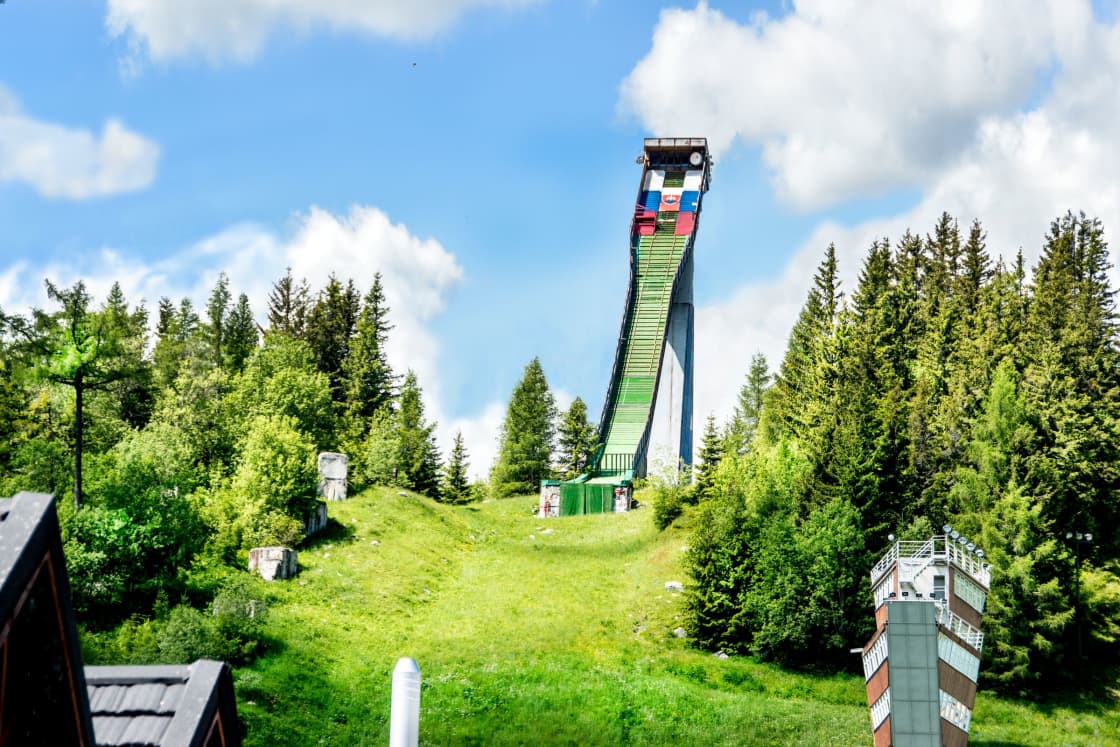
The Extreme Zipline launches from near the ski jump structures and is steep — it is marketed on the premise that you are approximating a jumper's flight path. It is not a gentle canopy tour.
The Freestyle Zipline is the shorter, calmer sibling and is where nervous first-timers should start.
Extreme Tubing runs on a synthetic surface and is exactly what it sounds like.
The Discovery Course and Action Tower are climbing and obstacle elements that reward children with energy to burn and frustrate adults expecting a ride.
The honest summary: the Gold Pass is good value for an active family with children roughly eight and up. It is poor value for a family whose youngest cannot meet height minimums, because you will pay for access to things half your group cannot use.
The bobsled, which is the real souvenir
The Summer Bobsled Experience puts you in a wheeled sled on the actual 2002 competition track with a trained pilot driving. The summer ride runs $115 to $125, with the lower price for booking online 48 hours ahead, and reaches speeds up to 70 mph. The winter version runs on ice and is priced separately.
Both sell separately from the Gold Pass, both have age and physical restrictions, and both sell out.
This is the thing people remember. It is also the thing most likely to be unavailable if you decide on the day, so book it first and build the rest of the visit around it.
The free part most visitors skip
Watching training is the best-value activity at Utah Olympic Park and it costs nothing.
In summer, freestyle aerial skiers train by launching off ramps into a pool — they perform full aerial routines and land in water rather than snow. It is spectacular, it happens on a published schedule during the season, and you can watch from the deck.
Ski jumpers train on plastic-surfaced jumps in summer as well. Standing at the base of a large hill and looking up is the single best way to understand what the sport involves; television flattens it completely.
The museum covering the 2002 Games is also included in free entry and is worth thirty to forty minutes, particularly for anyone who was too young to remember Salt Lake hosting.
The 2034 layer, and what is known
Salt Lake City was awarded the 2034 Olympic Winter Games, and Utah's bid was built explicitly on reusing venues rather than constructing new ones. Utah Olympic Park's sliding track and ski jumps are central to that argument — they are among the reasons the state could credibly promise a low-construction Games.
What that means for a visitor today is mostly atmosphere. The park is being maintained to a competition standard rather than a tourist-attraction standard, and staff talk about the coming Games as a working deadline.
What it does not mean is that anything is settled in detail. Event assignments, schedules, spectator arrangements and any venue upgrades are all subject to change across a planning horizon this long. Treat published 2034 specifics as provisional, including any you read here.
For Utah Valley specifically, the interesting question is what a second Games does to accommodation, transport and prices across the whole Wasatch Front — and that is a subject with a long runway.
Why this venue survived when most do not
The default fate of an Olympic venue is dereliction. Sarajevo's bobsled track is a ruin. Athens has a graveyard of them. Utah's did not go that way, and the reason is structural rather than sentimental.
When Salt Lake finished hosting in 2002, a portion of the Games' surplus was set aside as an endowment to keep the venues operating, and a foundation was created to run them as public facilities and athlete training sites rather than as monuments. Utah Olympic Park, Soldier Hollow near Midway and the Utah Olympic Oval in Kearns all came under that umbrella.
The consequence is the thing you notice on a summer visit: the ziplines and the alpine slide are not a theme park bolted onto a museum. They are the revenue model. Public recreation pays a share of the cost of keeping a competition-grade sliding track refrigerated and a set of ski jumps maintained, so that Utah keeps producing athletes in sports that most states cannot host at all.
It is also why Utah could bid for 2034 on an existing-venue platform while other candidate cities were promising construction. The infrastructure was never allowed to rot.
Winter, which is a completely different park
Most Utah Valley visitors come in summer, and the winter version of the site is arguably more interesting.
The sliding track ices up and the winter bobsled experience runs — the same track, now fast, at a considerably higher price. Ski jumping and Nordic combined training move onto snow. Tubing runs on a snow surface rather than a synthetic one.
The park has also run learn-to-ski-jump and freestyle programs for children, which is one of the few places in the country where a family can put a child into those sports at an entry level rather than an elite one.
Winter operations are weather-dependent and the calendar is narrower than summer's. If a winter visit is the plan, check what is running rather than assuming the summer menu has a cold-season equivalent.
The sister venues, and the argument for a two-stop day
Utah Olympic Park is one of three Olympic Legacy sites, and the other two are also reachable from Utah Valley.
Soldier Hollow, near Midway in the Heber Valley, hosted the 2002 cross-country and biathlon events and now runs Nordic skiing, tubing and a golf course. It is closer to Provo than the Olympic Park is, sitting just beyond Deer Creek.
The Utah Olympic Oval in Kearns is the indoor speed-skating venue, open for public skating sessions, and is about an hour north of Provo on the west side of the valley.
Pairing the Olympic Park with Soldier Hollow makes geographic sense on the Provo Canyon route — Soldier Hollow is essentially on the way if you drive through Heber. Trying to add the Oval to either is a Salt Lake trip rather than a Park City one.
Timing your visit
Best months: July and early August, when the largest set of attractions is running and the weather is reliable.
Best time of day: morning. The park opens mid-morning, queues build through the afternoon, and mountain thunderstorms are an afternoon phenomenon in Utah summers. An early arrival gets more rides per pass.
Worst plan: arriving at 2 p.m. on a Saturday in peak season without a booking.
The park has also run discounted community days — an August date with substantially reduced Gold Pass pricing has appeared in recent seasons. If your dates are flexible, those are worth watching for.
The restrictions that ruin unplanned visits
Nearly every thrill activity at the park carries a height, age or weight requirement, and they are not uniform across attractions.
The pattern in recent seasons has been that the Alpine Slide accepts young children as passengers riding with an adult, with solo riding gated behind a minimum age and height. The ziplines, tubing and tower activities have their own thresholds. The bobsled experiences carry the strictest limits, including physical-condition guidance, and have not been open to young children at all.
The failure mode is predictable and expensive: a family buys four Gold Passes, drives an hour, and discovers the six-year-old qualifies for two of the six included attractions.
Check the published requirements for each activity against the actual heights of the actual children before buying anything. If the youngest falls short across most of the menu, the free-entry version of the day — museum, grounds, watching training, one single-ticket alpine slide ride as a passenger — is the better purchase.
What the 2002 Games left in Utah Valley
The venues went to Park City, Kearns and Midway rather than Utah County, which is why the Games can feel like someone else's history from Provo.
The lasting local inheritance is less visible: a generation of Utah children who grew up with world-class winter facilities within an hour's drive, a set of clubs and programs that feed athletes into them, and a state transport and hospitality build-out along the Wasatch Front that Utah Valley shared in.
With 2034 awarded, the same question returns in a form that matters more locally — where overflow accommodation goes, what happens to I-15 and the canyon roads during a Games fortnight, and whether Utah County ends up hosting anything directly. None of that is settled, and anyone claiming otherwise this far out is guessing.
What to bring
Layers, because the elevation is meaningfully higher than Utah Valley and mornings are cool even in July.
Closed-toe shoes, which several activities require outright.
Sun protection, because the site is exposed and the elevation is unforgiving.
Water, and more than you think. There is food service on site but the walking between activities is real, spread across a hillside.
How it compares with the Utah Valley alternatives
If the appeal is the thrill activities alone, Utah Valley has closer and cheaper options, and Sundance's summer lift-served activities are a shorter drive from Provo.
What Utah Olympic Park has that nothing closer does is the Olympic infrastructure itself — a real sliding track, real jumps, real athletes training in front of you, and a museum about a Games that happened in living memory and will happen again.
That is the reason to make the drive. If you want an alpine slide, there are alpine slides. If you want to stand at the bottom of a K120 ski jump and reconsider what human beings are willing to do, this is the place within an hour of Provo.
A workable day from Utah Valley
Leave Provo around 8:30 a.m. Take Provo Canyon in summer for the drive itself. Arrive near opening.
Do the booked bobsled slot first if you have one, then work through the Gold Pass attractions while queues are short. Break for lunch, watch the aerials training session, and do the museum in the heat of the afternoon.
Leave by mid-afternoon and you are home in Utah Valley for dinner, having spent about eight hours on a distinctive day rather than a generic one.
Related Guides
- Park City from Provo: The Year-Round Day Trip Guide
- Soldier Hollow: The Olympic Venue You Can Actually Use
- Utah 2034: What the Winter Olympics Bring to Utah Valley — Peaks Ice Arena, the Money, and the Eight-Year Countdown
- Sundance Mountain Resort: Your Complete Guide (2026)
- Skiing Near Provo: Beyond Sundance (2026)
Frequently Asked Questions
How far is Utah Olympic Park from Provo?
How much does Utah Olympic Park cost?
What does the Summer Gold Pass include?
Can you ride a bobsled at Utah Olympic Park?
Is Utah Olympic Park free to visit?
Is it good for young children?
Will Utah Olympic Park host events in 2034?
When is the summer season?
Sources
The facts in this guide were checked against these sources. Hours, fees and rules change, so confirm anything time-sensitive with the source before you go. How we make Provo.com.
- Utah Olympic Park, Utah Olympic Legacy Foundation. Checked October 12, 2026.
- Summer Bobsled Experience, Utah Olympic Legacy Foundation. Checked October 12, 2026.
- Museums at Utah Olympic Park, Utah Olympic Legacy Foundation. Checked October 12, 2026.