
The idea behind "the 7 p.m. rule" is simple: in a Utah Valley summer, don't start an outdoor reception until the heat breaks, and the heat breaks around 7. There is no published rule behind it, so we checked it against NOAA's climate normals. The short version: at 7 p.m. in July it is still about 90 degrees. The real break comes after sunset, which in midsummer is closer to 9.
That doesn't mean summer weddings are a bad idea. It means planning the day around the actual temperature curve, giving guests shade and water, and knowing how much cooler the canyon runs.
How hot summer is, in numbers
NOAA's 1991-2020 climate normals for the Provo BYU weather station (elevation about 4,570 feet):
| Month | Normal high | Normal low | Days 90 F or hotter |
|---|---|---|---|
| June | 87.2 F | 55.0 F | 13.9 |
| July | 95.2 F | 62.3 F | 27.0 |
| August | 92.9 F | 61.0 F | 24.2 |
| September | 83.1 F | 52.0 F | n/a |
On a normal July day in Provo, it is 90 or hotter on 27 of the 31 days. August is nearly as hot. June is warm but forgiving, especially early in the month.
The 7 p.m. rule, tested
Provo's station does not have hourly normals, so we used the closest station that does: Salt Lake City International Airport. NOAA publishes hourly normals in local standard time, so the hours below have been shifted one hour to the daylight time on your invitation.
For park pavilions, seasons and permits, see our outdoor and garden venues guide.
| Time (MDT) | June 21 | July 15 | Aug 15 |
|---|---|---|---|
| 5 p.m. | 84.2 F | 91.9 F | 89.8 F |
| 6 p.m. | 83.7 F | 91.5 F | 89.1 F |
| 7 p.m. | 82.6 F | 90.1 F | 87.4 F |
| 8 p.m. | 80.5 F | 87.6 F | 83.7 F |
| 9 p.m. | 76.3 F | 82.9 F | 79.4 F |
| 10 p.m. | 72.9 F | 79.6 F | 76.9 F |
Hourly normals for Salt Lake City International Airport, 1991-2020. Salt Lake City's July curve in this series peaks near 92 F, a few degrees below Provo BYU's 95.2 F normal high, so Provo's evenings may run a little warmer than this table.
Read the July column. The hottest normal hour is 5 p.m. At 7 p.m. it has dropped less than two degrees. Between 8 and 9 p.m. it falls nearly five degrees, and it keeps falling. In June the curve is gentler; at 7 p.m. it is already in the low 80s.
What that means for planning:
- A 7 p.m. start in July is a start at about 90 F. Guests in a receiving line on a sunny lawn will feel every degree.
- A 7:30 or 8 p.m. start puts most of the event in the cooling hours, with the last hour well into the 80s or below.
- In June, a 7 p.m. start is comfortable for most guests.
- In late August, sunset comes earlier and the evening cools sooner.
Sunset, and why it matters more than the clock
The temperature drop tracks the sun. Sunset times in Provo from the U.S. Naval Observatory:
| Saturday | Sunset | End of civil twilight |
|---|---|---|
| Jun 5, 2027 | 8:53 p.m. | 9:25 p.m. |
| Jun 19, 2027 | 8:59 p.m. | 9:32 p.m. |
| Jul 17, 2027 | 8:54 p.m. | 9:26 p.m. |
| Aug 14, 2027 | 8:25 p.m. | 8:54 p.m. |
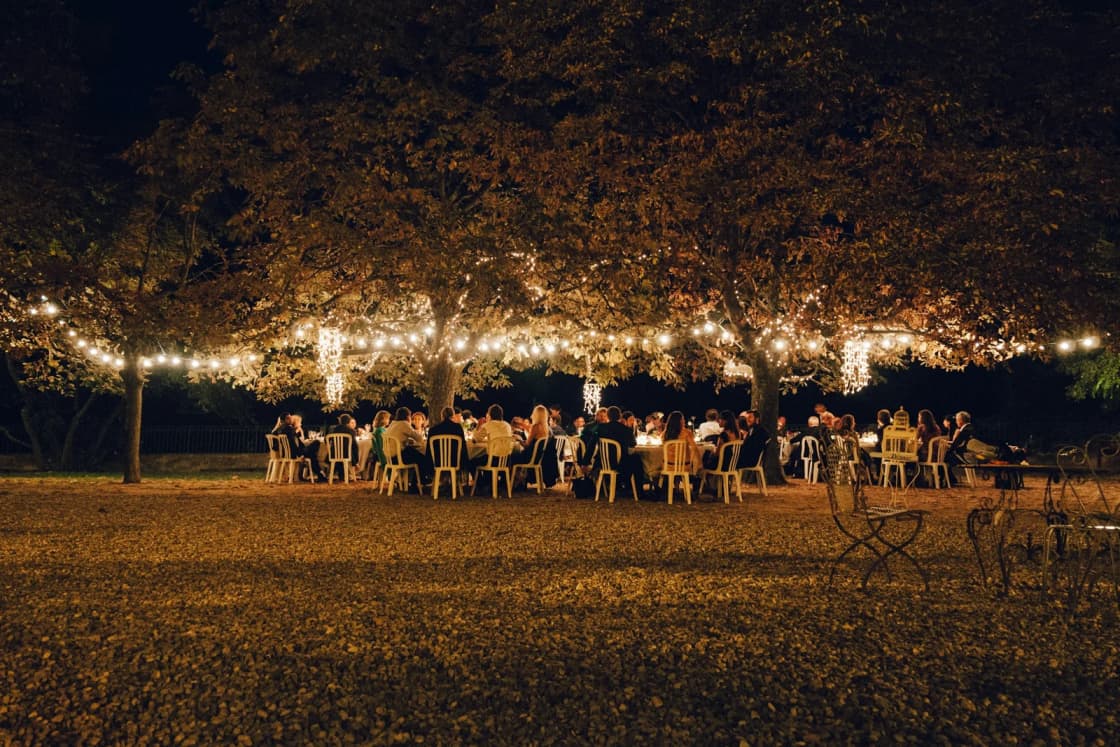
Two consequences. The receiving line in the last hour of daylight is when guests stand in low, direct western sun; orient the line so the couple and guests are not squinting into it. And string lights do nothing until after 9 in June and July; if the look depends on lights, the reception has to run late.
Shade, water and the people most at risk
Heat lands hardest on the oldest and youngest guests, and on anyone in a suit or a long dress standing in line. A few practical measures:
- Shade over the line. A tent, a covered patio or a row of trees for the receiving line matters more than shade over the cake table.
- Water before punch. Put a water station where guests arrive, not just at the refreshment table.
- Seats for grandparents. Indoor or shaded chairs near the line, so older relatives can greet the couple without standing outside for 20 minutes.
- A cool room. An air-conditioned room at the venue, or a car with the engine running, for anyone who starts to feel unwell.
- The wedding party. The couple and their parents may stand in the sun for two hours. Water and short breaks help them most.
The National Weather Service lists the signs of heat exhaustion as heavy sweating, weakness, cool and pale or clammy skin, a fast weak pulse, cramps, dizziness, nausea and fainting. Move the person somewhere cooler, loosen tight clothing, apply cool damp cloths and give small sips of water; get medical help if symptoms worsen or last more than an hour. Heat stroke (confusion, slurred speech, hot red skin, a body temperature above 103 F) is an emergency: call 911.
The canyon option
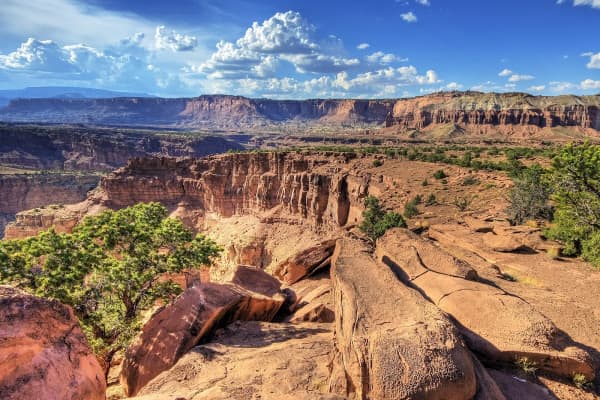
Going up Provo Canyon, to Sundance or into American Fork Canyon is the obvious escape from the heat. The data support it, with a caveat: the canyon is much cooler at night, and only somewhat cooler during the day.
July normals from NOAA:
| Station | Elevation (approx.) | Normal high | Normal low | Days 90 F or hotter |
|---|---|---|---|---|
| Provo BYU | 4,570 ft | 95.2 F | 62.3 F | 27.0 |
| Deer Creek Dam | 5,270 ft | 85.9 F | 49.2 F | 8.3 |
| Timpanogos Cave | 5,740 ft | 87.8 F | 59.6 F | 19.4 |
Deer Creek Dam, at the top of Provo Canyon, averages about 9 degrees cooler than Provo by day and 13 degrees cooler at night in July. That night-time number is the one that matters: a canyon reception that starts warm can be chilly by 10 p.m. Tell guests to bring a layer.
The canyon brings its own logistics: a longer drive for guests, limited parking, narrower roads after dark and fire restrictions. Our guides to Provo Canyon, Sundance in summer and American Fork Canyon cover the drive and the setting, and our wedding venues guide covers canyon and estate venues.
Sparklers, fire and the dry months
July is the driest month of the year in Provo, with an average of 0.51 inches of precipitation at the BYU station. That makes summer the season when fire rules matter most for a wedding.
- Sparklers. Utah Code 53-7-202 lists "wire sparkler under 12 inches in length" as an exempt explosive. Longer wedding sparklers are not covered by that exemption.
- Fireworks windows. Utah Code 53-7-225 allows consumer fireworks to be discharged in summer only from July 2 to 5 and July 22 to 25, between 11 a.m. and 11 p.m. (until midnight on July 4 and July 24).
- Closed areas. Under Utah's fire code amendments (Utah Code 15A-5-202.5), a city may prohibit any ignition source, including fireworks, lighters and matches, in mountainous or brush-covered areas, within 200 feet of waterways, trails and canyons, and in the wildland-urban interface during hazardous conditions. In unincorporated areas, the state forester can do the same.
- The venue. Venues set their own rules on sparklers, candles and open flames. Theirs apply on their property regardless of state law.
If a sparkler send-off matters to you, ask the venue and check your city's current fire restrictions before buying. For alternatives, bubbles, ribbon wands and flower petals need no permission. Our wildfire defensible space guide explains the valley's wildland edges.
Storms
Summer rain is light by volume, but storms can arrive with wind and lightning. Our comparison of reception centers and backyard weddings covers the wind risk to tents and decor. For any outdoor reception, have a written backup: a tent already reserved, or an indoor space and a decision time.
The summer temple calendar
Summer is also when several temples close for maintenance. As listed on the Church's temple pages in October 2026:
| Temple | Summer 2027 closures |
|---|---|
| Provo City Center | May 31 to Jul 5; Jul 24 |
| Saratoga Springs | Jun 7 to 21; Jul 3; Jul 24 |
| Mount Timpanogos | May 17 to 31; Jul 24 |
| Lindon | Jul 3; Jul 24; Aug 2 to 16 |
| Orem | Jul 3; Jul 24; Aug 23 to Sep 6 |
| Payson | Jul 3; Jul 24 |
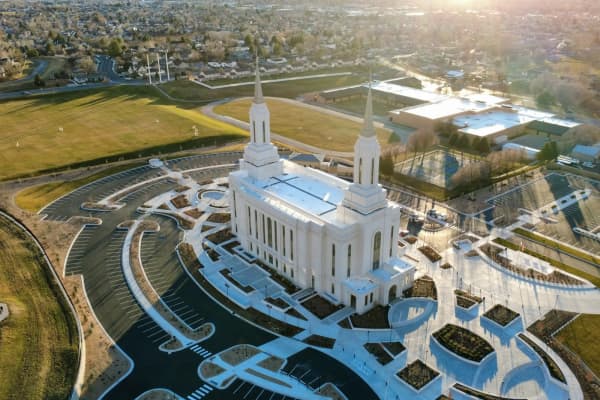
In the first half of June 2027, both the Provo City Center and Saratoga Springs temples are closed. Our wedding season guide has the full-year calendar and the statewide monthly marriage numbers; July and August were the third and fourth busiest months in 2025.
A summer wedding checklist
- Start an outdoor reception at 7:30 or 8 p.m. in July and August if you can; 7 p.m. works in June.
- Put shade over the receiving line and water at the entrance.
- Give older guests a cool place to sit.
- For a canyon venue, tell guests to bring a jacket for after dark.
- Check your temple's summer closures before setting the date.
- Confirm sparkler and open-flame rules with the venue and city.
- Have a written storm plan.
Frequently Asked Questions
How hot is Provo in July?
Is 7 p.m. late enough for an outdoor summer reception?
What time is sunset in Provo in summer?
How much cooler is it in the canyon?
Can we do a sparkler send-off at a summer wedding in Utah?
Which temples close in summer 2027?
What are the signs of heat illness at an outdoor event?
Does it rain much at summer weddings in Provo?
Sources
The facts in this guide were checked against these sources. Hours, fees and rules change, so confirm anything time-sensitive with the source before you go. How we make Provo.com.
- National Weather Service: Heat Illness, National Weather Service. Checked October 20, 2026.
- Utah Code 53-7-202 (definitions, exempt explosive), Utah Legislature. Checked October 20, 2026.
- Utah Code 53-7-225 (times for sale and discharge of fireworks), Utah Legislature. Checked October 20, 2026.
- Utah Code 15A-5-202.5 (IFC amendments, hazardous environmental conditions), Utah Legislature. Checked October 20, 2026.
- Provo City Center Temple (closures), The Church of Jesus Christ of Latter-day Saints. Checked October 20, 2026.
- Saratoga Springs Utah Temple (closures), The Church of Jesus Christ of Latter-day Saints. Checked October 20, 2026.
- Mount Timpanogos Utah Temple (closures), The Church of Jesus Christ of Latter-day Saints. Checked October 20, 2026.
- Lindon Utah Temple (closures), The Church of Jesus Christ of Latter-day Saints. Checked October 20, 2026.
- Orem Utah Temple (closures), The Church of Jesus Christ of Latter-day Saints. Checked October 20, 2026.
- Payson Utah Temple (closures), The Church of Jesus Christ of Latter-day Saints. Checked October 20, 2026.
- U.S. Climate Normals 1991-2020, monthly (Provo BYU USC00427064; Deer Creek Dam USC00422057; Timpanogos Cave USC00428733), NOAA National Centers for Environmental Information. Checked October 20, 2026.
- U.S. Climate Normals 1991-2020, hourly (Salt Lake City Intl Airport USW00024127) and documentation (LST), NOAA National Centers for Environmental Information. Checked October 20, 2026.
- Sun and Moon Data for One Day (Provo, 40.2338 N, 111.6585 W), U.S. Naval Observatory. Checked October 20, 2026.
- Utah Quick Stats Summary, 2025 Issue 4 (monthly 2025), Utah DHHS Office of Vital Records and Statistics. Checked October 20, 2026.