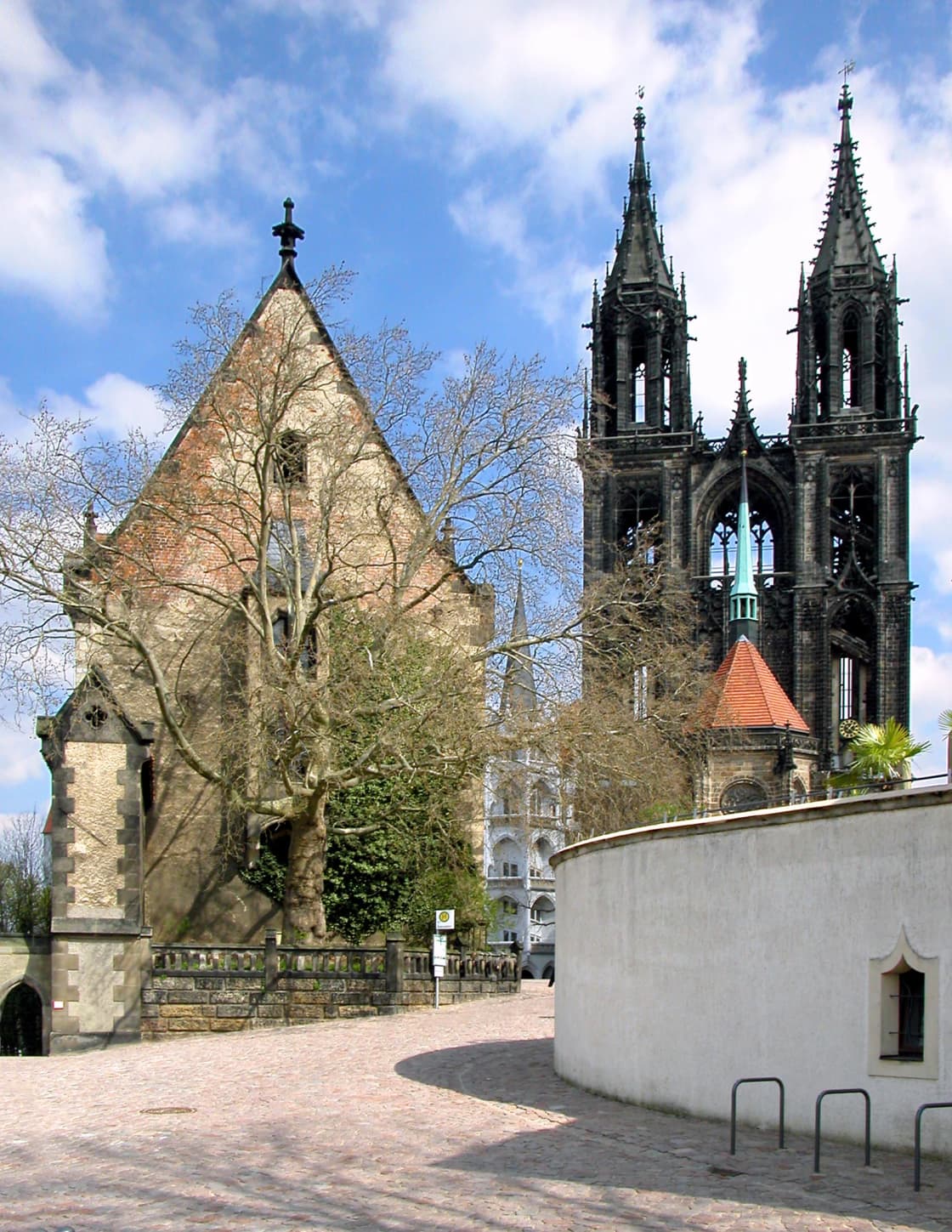

Provo has two sister cities: Meissen, a porcelain town on the River Elbe in eastern Germany, and Nanning, the capital of a Chinese autonomous region near the Vietnamese border.
One of those pairings has a specific reason behind it that runs straight through the history of Brigham Young University. The other is a much more conventional municipal relationship. Both are worth understanding, and the difference between them says something useful about what a sister city relationship is — and is not.
What a sister city is, and what it is not
The modern American sister cities movement has a specific origin. In 1956, President Dwight Eisenhower convened a White House conference to launch a formal effort supporting what was called citizen diplomacy — the proposition that ordinary people meeting ordinary people across national borders does something that governments talking to governments cannot.
Eisenhower framed the purpose in unusually large terms, describing it as helping to build a road to an enduring peace. That is a lot of weight to put on municipal partnerships, and the movement has never entirely escaped the gap between the rhetoric and the reality of a delegation visit.
Practically, a sister city relationship is:
- Voluntary. No treaty, no obligation, no enforcement.
- Municipal. Between city governments, not between states or countries.
- Unfunded by default. Whatever happens is paid for by the cities, by participants, or by volunteers.
- Entirely dependent on individual people. This is the crucial one. A sister city relationship is exactly as active as the specific humans who choose to maintain it, and it goes dormant the moment they stop.
That last point explains almost everything about how these relationships behave over time, including Provo's.
Meissen: the Karl G. Maeser connection
Provo's relationship with Meissen is listed by the U.S. Embassy in Germany among German-American sister-city pairs.
That name is the whole story.
Karl G. Maeser was born in Meissen. He was a German educator who converted to the Church of Jesus Christ of Latter-day Saints, emigrated, and in 1876 became the first principal of Brigham Young Academy — the institution that became Brigham Young University. He is, by broad agreement, the founding figure of BYU as an educational project rather than merely as a building. The Maeser Building on campus carries his name.
So the pairing is not a diplomatic arrangement of convenience. Provo is a sister city to the hometown of the man who founded its university. Of all the sister-city relationships in Utah, it is probably the one with the clearest single reason for existing.
Meissen itself is worth knowing about. It is a city of roughly thirty thousand people on the River Elbe in Saxony, over a thousand years old, and known worldwide for one thing: porcelain. Meissen porcelain was the first hard-paste porcelain produced in Europe, and it is identified by a distinctive trademark of two crossed swords — one of the oldest continuously used trademarks anywhere. If you have ever seen the crossed-swords mark on the underside of a piece of European china, that is Meissen.
The city also holds an annual wine festival, and delegations have traveled between the two cities over the years.
The Timpview exchange, which is the part that works
Here is the piece of the relationship with the most substance behind it, and it did not come from city hall.
A German teacher at Timpview High School worked with the Franziskaneum, a Gymnasium in Meissen, to build an ongoing educational exchange program.
This is the structural lesson of the whole subject. The exchange has outlasted mayors, delegations and enthusiasm cycles because it is institutionally anchored in two schools rather than in two mayors' offices. A school program has a teacher who owns it, a calendar that repeats, and a cohort of students each cycle who become the following cycle's advocates. A delegation visit has none of those things.
A small documentary note, in the interest of accuracy: the German school's name is spelled inconsistently across sources. Both Franziskaneum and Franziskanium appear, including in materials attributed to Provo City itself. We have not been able to resolve which spelling Provo intends, and we are recording the discrepancy rather than silently picking one.
Nanning: the larger city, the thinner relationship
Provo's other sister city is Nanning, the capital of the Guangxi Zhuang Autonomous Region in southern China, located near the border with Vietnam, with a population in the millions.
The asymmetry with Meissen is immediate and worth stating plainly. Meissen has around thirty thousand people. Nanning has more than three million. Provo has around a hundred and fifteen thousand. In one pairing Provo is the much larger partner; in the other it is a rounding error.
The stated purposes are conventional: a cooperative agreement to promote cultural and commercial ties, with Nanning described as a rapidly growing industrial region interested in learning about American culture and business practice. Mayors from both cities have made trips to the other.
What has been reported as absent is the thing that made Meissen durable: student exchanges between Provo and Nanning have not developed in the way the Meissen exchange did. Without a school program or an equivalent recurring institutional anchor, the relationship rests on mayoral visits, and mayoral visits stop when mayors change.
This is not a criticism of anyone involved. It is the predictable behavior of a relationship without a mechanism.
The dormancy question
A sister-city relationship can go quiet when invitations go unanswered or leaders change. The part that tends to last is the student exchange, because it runs on a school calendar rather than on a mayor's schedule. That is the theory of citizen diplomacy in practice: the outcomes that stick are usually student outcomes rather than municipal ones.
How Provo compares locally
Provo is not unusual in Utah for having sister cities, and the comparison is instructive.
Midway, in neighboring Wasatch County, has a single sister-city relationship with a Swiss city — and it is arguably the most successful in the region precisely because it is fused to the town's identity. Midway's Swiss heritage produces Swiss Days, one of the best-attended festivals in the area, and the sister-city relationship and the festival reinforce each other. The partnership is not a separate civic activity; it is part of what the town is.
Salt Lake City runs a formal program with a Sister Cities Advisory Board that meets publicly, keeps minutes, takes public comment and has staff support. That is what an institutionalized program looks like.
Provo sits between the two: a relationship with a compelling reason behind it, a school exchange that works, and no standing civic apparatus underneath either.
Why Meissen is a better match than it looks
It would be easy to read the Meissen pairing as sentimental — a nice link to a nineteenth-century educator, pleasant but insubstantial.
That underrates it, because the two cities have more in common structurally than the size difference suggests.
Both are defined by a single dominant institution. Meissen has its porcelain manufactory, running since the early eighteenth century and central to the city's identity, employment and tourism. Provo has BYU. In both cases the institution is older than most of the surrounding development, employs a large share of the workforce, brings in visitors, and shapes how outsiders perceive the town.
Both are small cities with international name recognition out of proportion to their size. More people worldwide have heard of Meissen porcelain than have heard of Meissen. More people have heard of BYU than of Provo.
Both sit in a river valley below hills, with a larger regional center nearby — Dresden for Meissen, Salt Lake City for Provo.
And both are, in different ways, religious-heritage towns. Meissen's cathedral and castle complex sits above the town; Meissen was an episcopal seat for centuries. Provo's relationship to faith and community life needs no elaboration.
Whoever chose Meissen chose better than the Maeser connection alone required.
The honest assessment
The Meissen relationship is real, specific and worth preserving. It rests on a genuine historical link, it has produced a functioning student exchange, and the two cities are more alike than the map suggests.
The Nanning relationship is thinner, and the reason is structural rather than anyone's failure: nothing recurring was ever built underneath it.
Provo's participation depends on individuals, and that is the vulnerability. The exchange survives because teachers own it. The municipal side has visibly waxed and waned with whoever occupies the mayor's office, to the point where a newspaper column was needed to prompt a visit.
The transferable lesson is not about Provo. It is that a partnership without a mechanism is a letter of intent. Midway fused its Swiss relationship to a festival and it thrived. Provo fused its German relationship to a high school German program and that part thrived. The parts attached to nothing in particular have behaved exactly as you would expect.
For anyone in Provo curious about this, the school exchange remains the concrete route in, and the mayor's office is the only other door. There is no commission to join, because there is no commission.
The crossed swords, and why Meissen guarded a secret
If you are going to have a sister city famous for one thing, it is worth understanding the thing.
For centuries, Europe could not make porcelain. Chinese porcelain arrived through trade, commanded extraordinary prices, and could not be reproduced — European potters could not work out the material. The problem was not decoration or skill. It was chemistry.
Meissen solved it in the early eighteenth century, and the resulting manufactory produced the first hard-paste porcelain made in Europe. The formula was treated as a state secret of the kind that would now involve lawyers and non-disclosure agreements, and the effort to keep it inside Saxony was substantial and not entirely successful.
The two crossed swords mark, taken from the arms of Saxony, was adopted to identify genuine Meissen work — and it is one of the oldest trademarks in continuous use anywhere in the world. If you have handled European china and turned it over, you have probably seen it.
The relevance to Provo is not merely decorative. Meissen is a small city whose global identity rests entirely on one institution that has operated on the same ground for three hundred years. Take the manufactory out of Meissen and you have a pleasant town on a river below a cathedral, largely unknown outside Saxony.
Provo's relationship to BYU has the same shape, on a shorter timescale. The university is older than most of the surrounding city, it employs a large share of the workforce, it produces the visitor traffic, and it is the reason anyone outside Utah has heard the name. Remove it and Provo is a mid-sized city on a lake below a mountain.
Two towns, each carrying a single institution that made it legible to the world. Whoever paired them chose better than the Karl Maeser link alone required.
Nanning, and the scale problem
Nanning deserves more than a passing mention, because the relationship's difficulties are structural rather than anyone's fault.
Nanning is the capital of the Guangxi Zhuang Autonomous Region — one of China's autonomous regions, named for the Zhuang, the country's largest ethnic minority. It sits in the far south, close to the Vietnamese border, and functions as a significant hub for trade between China and Southeast Asia. Its population runs into the millions.
Set that against Provo's roughly one hundred and fifteen thousand people and the asymmetry is not a detail — it is the defining fact of the pairing. In the Meissen relationship, Provo is the larger and wealthier partner and can plausibly host, fund and lead. In the Nanning relationship, Provo is a small American city partnered with a provincial capital that has partnerships across multiple continents and vastly greater administrative capacity.
The reported outcome fits: mayoral visits in both directions, and no student exchange comparable to the Timpview program. A school-to-school exchange requires a teacher on each side with the language, the time and the institutional backing to own it for years. That existed for German at Timpview. Building the equivalent for Mandarin across a much greater distance, cost and administrative gap is a substantially harder problem.
None of this makes the relationship pointless. Provo has a meaningful population with China connections through business, through the university's international student body, and through returned missionaries with Mandarin. What it lacks is the recurring mechanism — and as the Meissen case demonstrates, the mechanism is the entire game.
If you want to go
Meissen is worth visiting on any German itinerary, and it is easier to reach than its size suggests.
It sits on the Elbe about half an hour from Dresden, which is the natural base — Dresden has the airport, the rail connections and the hotel supply, and the run out to Meissen is short. The riverside setting, the castle and cathedral complex on the hill above the old town, and the porcelain manufactory are the three things people come for, and all three fit comfortably into a day.
For anyone from Provo, there is a fourth reason to go, and it is the one nobody else on the tour will care about: this is where Karl G. Maeser came from. Standing in the town that produced the man who founded Brigham Young Academy is a strange and specific pleasure if you have any connection to BYU, and it costs nothing beyond the train fare from Dresden.
Nanning is a different proposition — a large, fast-moving southern Chinese city that is not on the standard tourist circuit and is generally visited for business or as a gateway toward Vietnam.
Related Guides
- Provo History: From Fort Utah to the Modern City
- The BYU Guide to Provo
- Midway Swiss Days: The Complete Guide
- The Freedom Festival in Provo: How the Whole Thing Works
- Faith Communities in Provo: A Guide for Newcomers
- Festival Latinoamericano in Provo
- Volunteering and Service in Utah Valley
Frequently Asked Questions
What are Provo's sister cities?
Why is Provo a sister city with Meissen?
Is there a student exchange with Meissen?
What is a sister city, actually?
Are Provo's sister city relationships still active?
Does Provo have a paid staff member for sister cities?
Do other Utah Valley cities have sister cities?
Can a resident get involved?
Sources
The facts in this guide were checked against these sources. Hours, fees and rules change, so confirm anything time-sensitive with the source before you go. How we make Provo.com.
- U.S. Embassy & Consulates in Germany: Sister Cities, U.S. Embassy & Consulates in Germany. Checked October 12, 2026.
- Brigham Young Academy, Provo City Library. Checked October 12, 2026.