Upcoming dates

The Balloon Fest is the event people in Provo are most likely to describe as magical without embarrassment, and it is the one they are most likely to get wrong on the calendar. It happens on three consecutive mornings during Freedom Festival week, not on the Fourth of July alone. It happens at Fox Field, a location almost no online listing bothers to name. And it is over by 8:00 a.m., which means the difference between a great morning and a wasted alarm is about twenty minutes of planning.
The short answer
About 25 hot air balloons inflate and launch from Fox Field, 1100 N Freedom Boulevard, between 6:00 and 8:00 a.m., on three mornings during the Freedom Festival. In 2026 those were Thursday July 2, Friday July 3 and Saturday July 4. Admission is free, parking is free, and there is no ticket of any kind. A separate Balloon Glow — tethered balloons lit from within after dark — runs on the Friday evening at the same field, starting around 8:30 p.m.
Arrive at 6:00. Not 6:30.
Where Fox Field actually is
This is the part that trips people up, and it is worth being specific because the official listings usually are not.
Fox Field is the large open grass field on North Freedom Boulevard at roughly 1100 North, immediately east of the hospital campus. It does not look like a destination park. There is no monument sign, no playground, no obvious entrance arch. It reads as a big empty field, because that is exactly what a balloon launch site needs to be.
The practical navigation advice locals give: aim for the hospital, then look east. People routinely park on the east side of the hospital grounds and walk across. If you type the address into a phone you will get there, but if you are following a friend's "it's by the hospital" description, that is genuinely the whole instruction.
Three mornings, not one — and this matters
The Freedom Festival's own event page and most aggregator listings mention the balloons without pinning down how many days they fly. A surprising number of otherwise reliable local guides describe Balloon Fest as a Fourth of July sunrise event.
It is not. It is three mornings, and treating it as one is how people miss it entirely.
The practical consequence is about weather. Hot air balloons are grounded by wind, and wind on any single July morning in Utah Valley is a coin flip that a pilot, not you, gets to call. If you plan around the Fourth alone and the Fourth is breezy, your year is done. If you go on the first morning, a scrub still leaves two more shots. Locals who have been going for years almost universally go early in the run and treat any additional morning as a bonus.
What 6:00 a.m. actually looks like
The sequence is more interesting than the phrase "balloon launch" suggests, and it is why the arrival time matters so much.
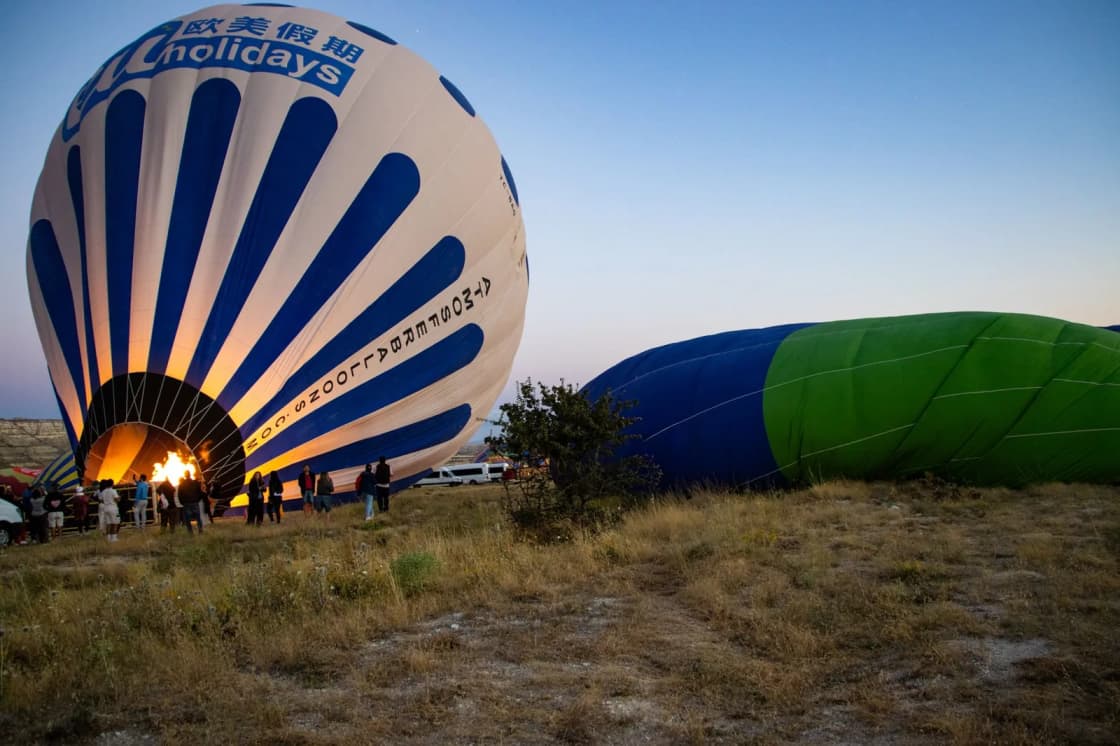
Crews arrive in the dark and lay the envelopes out flat on the grass — enormous nylon shapes stretched across the field like collapsed parachutes. Gas-powered fans push cold air in first, and the balloons slowly take shape lying on their sides, still horizontal. Only then do the burners fire, heating the air inside until each balloon stands itself upright, one after another across the field.
That standing-up moment is the thing. It takes maybe twenty minutes across the whole field, and during it you can walk between balloons that are two-thirds inflated, close enough to feel the burner heat and hear the roar. Nobody is roping you off at a distance.
Then they lift, more or less together, over the valley with the Wasatch behind them. The whole arc runs about ninety minutes from empty field to empty field.
Show up at 7:00 and you have skipped the interesting part to watch the ending.
The Hare and the Hound
The launch is not purely decorative. Pilots compete, and the format is worth understanding because it explains why the balloons do not simply drift off in a line.
A "hare" balloon launches first and flies out ahead, eventually setting a target on the ground somewhere downwind. The "hound" balloons launch after it and try to navigate to that target, dropping a marked bean bag as close to the center as they can manage. Additional points are available for scoring in designated target areas.
The catch, and the reason this is genuinely difficult: a balloon has no steering. A pilot controls altitude and nothing else. Winds run in different directions at different heights, so the entire sport is reading those layers and moving up and down to catch the one going where you want. Pilots come from around the country for this.
You will not see the target from the field. What you see is the shape of the competition — the hare going first, everyone else following, and a lot of balloons making unexpectedly precise-looking turns.
Balloon cards, and the thing families do
Pilots hand out balloon cards — trading-card-style cards for their individual balloons. There are questions on the back, and answering them enters you into a prize drawing.
This is a small thing that changes how kids experience the morning. Instead of watching, they have a reason to walk up to crews and talk to pilots, and pilots are generally happy to be interrupted during inflation because their hands are busy but their mouths are not. Collecting a full set is a genuine activity, not a token one.
The Balloon Glow
The Glow is a separate event on the Friday evening, same field, and it is a different experience from the morning launch.
The balloons inflate but stay tethered. Once it is dark, crews fire the burners in sequence and the envelopes light up from the inside like paper lanterns four stories tall. Nothing flies. People walk the field, and the whole thing is much more of a stroll than the morning's controlled rush.
Published times vary — start around 8:30 p.m. is consistent across sources, but end times appear as both 10:00 and 10:30 p.m. depending on where you look. Plan for the start, not the finish.
Practically: the Glow is the better option if the 6:00 a.m. alarm is a non-starter for your household, and it is the easier one with tired kids. It is also the more forgiving of the two on wind, since nothing has to fly.
Weather is the whole story
Every year people are disappointed, and every year the reason is the same.
Balloons launch in near-calm conditions. A pilot's read of a light breeze at ground level does not tell them what is happening at 500 feet, so crews send up a small test balloon and watch it. If it moves wrong, nobody flies. That call sometimes comes after a field of balloons is already partly inflated, which is anticlimactic if you drove in for it and completely fine if you understood the odds going in.
Two honest notes. First, a scrubbed morning is not a wasted trip in the way it sounds — crews still lay out and often partially inflate, and the field is still worth walking. Second, the Freedom Festival posts weather calls the morning of, so a phone check at 5:45 a.m. costs nothing.
Parking, and getting out
Parking is free and the fields and streets around the site absorb a lot of cars, but the crowd is large — reported in the tens of thousands across the run — and it all arrives inside the same twenty-minute window.
The pattern that works: arrive before 6:00 and park close, or arrive at 6:10 and park three blocks away and walk. There is no version where you arrive at 6:25 and park close.
Getting out is easier than getting in, because departures spread across the full 7:00–8:00 window as families give up at different points. If you are heading to anything else on the Freedom Festival schedule afterward, you have plenty of margin — the rest of the day's events do not start for hours.
What to bring
- A jacket. This is the advice people ignore and regret. Provo sits around 4,500 feet, and a July morning before sunrise runs far cooler than the afternoon that follows it. Every year the field is full of people in shorts and t-shirts with their arms crossed.
- A blanket or camp chairs. It is a grass field with no seating.
- Breakfast. There is no reliable food operation at 6:00 a.m. Families bring it.
- A phone with room on it. See below.
- Nothing else. There is no bag check, no gate, no security line. It is a field.
The balloons themselves, and the people flying them
Worth knowing what you are actually looking at, because the numbers are not intuitive.
A standard sport balloon envelope holds somewhere in the range of 77,000 to 105,000 cubic feet of air and stands roughly seven stories when upright. The basket carries a pilot and typically two to four passengers. The burners put out a genuinely startling amount of heat — you feel it from several feet away, and that is why crews watch where spectators drift during inflation.
Every balloon on that field represents a crew, not just a pilot. Someone drives the chase vehicle, someone holds the crown line during inflation, someone tracks where the thing is going to come down and gets permission from whoever owns that field. Most of these people are volunteers or family. When you talk to a pilot during inflation you are usually talking to someone who paid their own way to be there.
The shapes are part of the draw. Alongside the conventional teardrops, special-shape balloons turn up in most years — the sort of thing that reads as a cartoon character or an object rather than a balloon. There is no published guarantee of which shapes appear in a given year, so treat any specific one you have seen in a photo as a possibility rather than a promise.
If a 6:00 a.m. alarm is not happening
Two honest alternatives, because the morning is genuinely hard with some households.
The Balloon Glow on the Friday evening, covered above, is the same balloons at the same field at an hour that human beings keep. You trade the flight for the light. For families with kids under about six, most parents will tell you the Glow is the better trade.
The other option is a different festival entirely. Springville's Art City Days runs its own balloon launch in June, from Art City Elementary at 121 North 900 East, with balloons typically lifting from about 6:30 a.m. It is a smaller field and a smaller crowd, which some people prefer — you get more room and more access to crews, with fewer balloons to look at. Springville has been launching balloons as part of Art City Days since the mid-1990s. Our guide to things to do in Springville covers the rest of that week.
Both of these are free. Neither requires a ticket.
Photography, briefly
This is one of the most photographed things that happens in Utah Valley, for a reason that has nothing to do with skill: the light at 6:00 a.m. in early July is low and warm, the subjects are enormous and brightly colored, and the Wasatch sits behind everything.
The shot most people miss is the inside of an envelope during inflation — standing at the mouth of a half-inflated balloon looking up into it. Ask a crew member first; they will usually say yes and tell you where to stand so you are not in the way.
The shot everyone gets is the mass ascent. It is good and you should take it, but it is the same photo everyone takes.
Where it fits in Freedom Festival week
Balloon Fest is one piece of America's Freedom Festival at Provo, a nonprofit that runs a large slate of events across the valley each summer. The Fourth of July week schedule stacks: the balloons in the morning, the Colonial Heritage Festival running all day in Orem, and Stadium of Fire closing the whole thing out at LaVell Edwards Stadium.
If you are building a single day around it, the balloons and Colonial Days pair naturally — one ends at 8:00 a.m., the other opens at 9:00 a.m. about fifteen minutes away. Our full Freedom Festival guide covers the rest of the week.
Planning a Fourth of July week around it
The balloons are the earliest thing on a very full week, and that is an advantage rather than a constraint if you sequence it.
A morning at Fox Field ends at 8:00 a.m. with the whole day intact. The Colonial Heritage Festival opens at 9:00 a.m. at SCERA Park in Orem, about fifteen minutes south, and runs until 6:00 p.m. — so balloons then colonial village is a genuinely comfortable pairing rather than a rush, with breakfast in between.
The harder sequencing question is the Fourth itself. Stadium of Fire fills the evening, the Grand Parade fills a chunk of the morning, and stacking a 5:45 a.m. departure onto a day that ends with fireworks after 10:00 p.m. is a long day for anyone under about ten. Families who do all three usually pick a different morning for the balloons — which is precisely what the three-day run is for.
One more scheduling note that catches visitors: Freedom Festival week is the single busiest stretch of the year for lodging in Utah Valley. If you are coming in from out of town for it, rooms and rates are a spring problem, not a June one. Our guides to cheap hotels in Provo and unique places to stay both cover how the calendar moves prices.
Is it worth the alarm?
For a first-timer, yes, and it is not close. The scale of the objects is the whole argument — photographs do not convey what standing next to an inflating balloon is like, and it is free, and it is ninety minutes long.
For a returning local, the honest answer is that it is a two-or-three-year event rather than an annual ritual for most families, because the alarm is real and the experience does not change much year to year. The people who go every year tend to be the ones with a camera, or with kids in the balloon-card phase.
The one group for whom it is always worth it: anyone with out-of-town visitors during the Fourth. It is the single most impressive free thing you can show someone in Utah Valley before breakfast, and it makes you look like you planned something.
Related Guides
- The Timpanogos Storytelling Festival: What It Is and How to Do It Right
- Midway Swiss Days: The Complete Guide
- The Rooftop Concert Series: Provo's Free Friday Night, Explained
- The Utah Valley Parade of Homes: How It Works, How Tickets Work & How to Actually Tour It
- Golden Onion Days: Inside Utah's Oldest Labor Day Celebration
Frequently Asked Questions
Where is the Provo Balloon Fest held?
What time does Balloon Fest start?
How many mornings does the Balloon Fest run?
Is the Balloon Fest free?
What is the Balloon Glow and when is it?
Can you ride the balloons at Balloon Fest?
What happens if it is too windy?
Is Balloon Fest good for young kids?